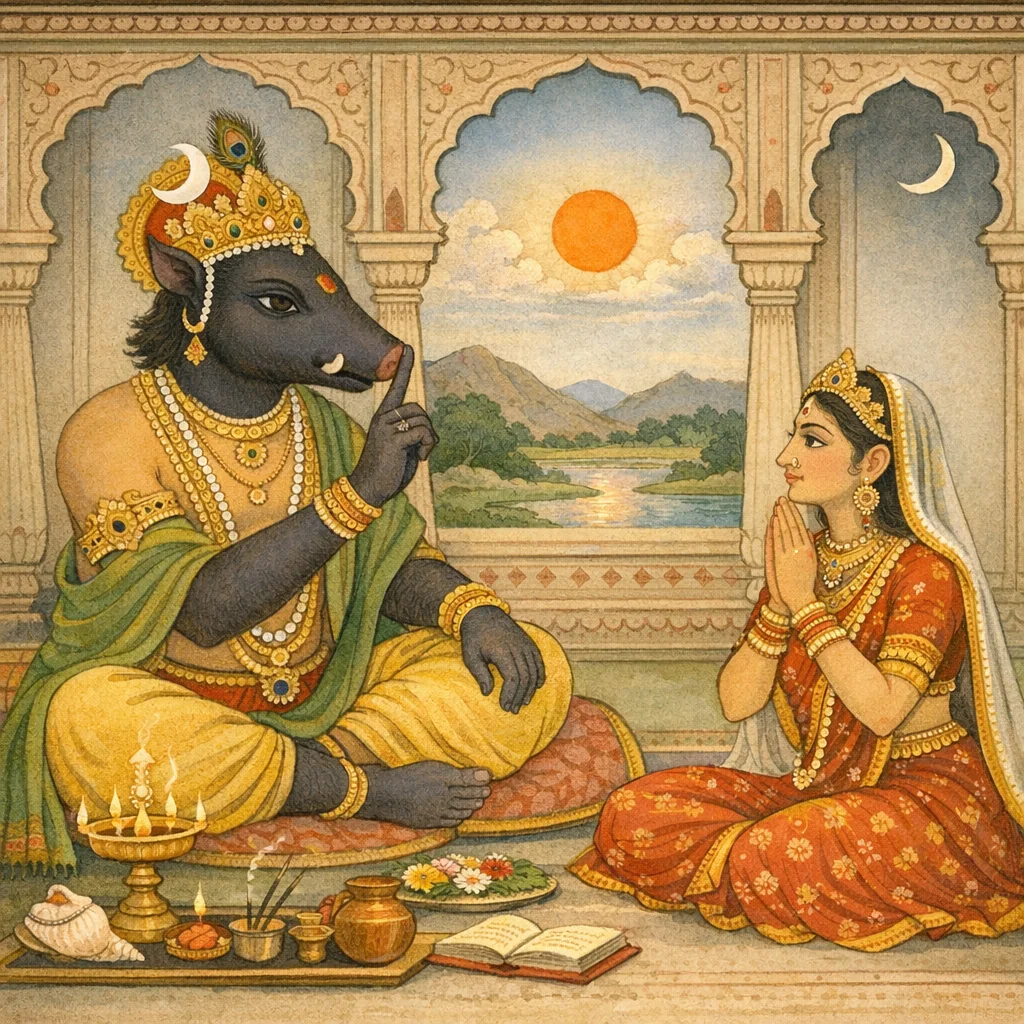
Adhyaya 115: The Arising of Diverse Dharmas: Devotional Observances and Varṇa-Based Duties
Vividhadharmotpattiḥ
Ethical-Discourse (Bhakti-oriented Dharma and Social Conduct)
In reply to Pṛthivī’s question about deeds that bring heavenly welfare and steady human conduct, Varāha (as Nārāyaṇa) teaches a bhakti-centered ethic, downplaying wealth, mass charity, and many sacrifices when done without focused devotion. He declares that single-minded knowledge and worship of Viṣṇu is the decisive measure. The chapter prescribes a dvādaśī fast and a simple rite—water-offering, mantra, gazing at the sun, flowers, fragrance, and incense—with stated merit. Varāha then sets forth proper conduct for the four varṇas—brāhmaṇa, kṣatriya, vaiśya, and śūdra—stressing humility, self-control, non-malicious speech, and steadiness in duty. The teaching culminates in ascetic-style disciplines and restraints as a path toward yoga-like attainment, presented as upholding moral order upon Earth (Pṛthivī).
Primary Speakers
Key Concepts
Shlokas in Adhyaya 115
Verse 1
अथ विविधधर्मोत्पत्तिः ॥ ततो महीवचः श्रुत्वा देवो नारायणोऽब्रवीत् ॥ कथयिष्यामि ते देवि कर्म स्वर्गसुखावहम्
Now begins the arising of diverse dharmas (practices). Then, having heard the words of Mahī (Earth), the god Nārāyaṇa said: “I shall tell you, O Goddess, the practice that brings the happiness associated with heaven.”
Verse 2
यत्त्वया पृच्छ्यते देवि तच्छृणुष्व वसुन्धरे ॥ स्थितिं सत्तां तु मर्त्यानां भक्त्या ये च व्यवस्थिताः
What you ask, O Goddess—listen, O Vasundharā. I shall explain the condition and mode of being of mortals, and also those who are established in devotion.
Verse 3
नाहं दानसहस्रेण नाहं यज्ञशतैरपि ॥ तुष्यामि न तु वित्तेन ये नराः स्वल्पचेतसः
I am not satisfied by a thousand gifts, nor even by a hundred sacrifices; nor by wealth, as pursued by people of limited understanding.
Verse 4
एकचित्तं समाधाय यो मां जानाति माधवि ॥ नित्यं तुष्यामि तस्याहं पुरुषं बहुदोषकम्
Whoever, having composed the mind into single-pointedness, knows me—O Mādhavī—I am continually satisfied with that person, even if he bears many faults.
Verse 5
यच्च पृच्छसि मां भद्रे कर्म स्वर्गसुखावहम् ॥ तच्छृणुष्व वरारोहॆ गदतो मे शुचिस्मिते
And what you ask me, O gentle one—about the practice that brings the happiness associated with heaven—listen, O fair-hipped one, as I speak, O pure-smiling one.
Verse 6
ये नमस्यति मां नित्यं पुरुषा बहुचेतसः ॥ अर्द्धरात्रेऽन्धकारे च मध्याह्ने वापराह्णके
Those persons who regularly bow to me—though their thoughts are many and scattered—do so at midnight, in darkness, at midday, or in the afternoon.
Verse 7
यस्य चित्तं न नश्येत मम भक्तिव्यवस्थितम् ॥ द्वादश्यामुपवासं तु यः कुर्यान्मम तत्परः ॥
He whose mind does not waver, firmly established in devotion to Me—if such a person, intent on Me, undertakes the fast on Dvādaśī,
Verse 8
ते मामेव प्रपश्यन्ति मयि भक्तिपरायणाः ॥ लब्धचेतो गुणज्ञश्च नरो भक्तिव्यवस्थितः ॥
Those who are devoted to Me with single-minded bhakti behold Me alone; the person established in devotion is one whose mind is settled and who rightly discerns qualities.
Verse 9
इच्छया अपि भवेद्भद्रे स्वर्गे वसति सुन्दरि ॥ स्वल्पकेन न गम्यन्ते दुष्प्राप्योऽहं वरानने ॥
Even by mere wish, O fortunate one—O beautiful one—one may come to dwell in heaven; but I am not reached by trivial means, for I am difficult to attain, O fair-faced one.
Verse 10
द्वादश्यामुपवासं तु ये च कुर्वन्ति ते नराः ॥ तेषामेव प्रपश्यन्ति मम भक्तिपरायणाः ॥
Those persons who indeed observe the fast on Dvādaśī—My devotees devoted to bhakti—behold (Me) for them alone.
Verse 11
कृत्वा चैवोपवासं प्रगृह्य चैव जलाञ्जलिम् ॥ नमो नारायणेत्युक्त्वा आदित्यं चावलोकयेत् ॥
And having performed the fast, and having taken up an añjali (a handful in joined palms) of water, having uttered ‘Namo Nārāyaṇa’—‘Homage to Nārāyaṇa’—one should gaze upon the Sun.
Verse 12
यावन्तो बिन्दवः किञ्चित्पतन्त्येवाञ्जलेर्जलात् ॥ तावद्वर्षसहस्राणि स्वर्गलोके महीयते ॥
As many drops as fall, even a small amount, from the water in one’s cupped hands—so many thousands of years one is honored in the heavenly world.
Verse 13
अथ चैव तु द्वादश्यां पुरुषा धर्मवादकाः ॥ विधिना च प्रयत्नेन ये मां कुर्वन्ति मानुषाः ॥
And further, on Dvādaśī, those persons—speakers of dharma—who, as human beings, worship me with proper procedure and with effort,
Verse 14
पाण्डुरैश्चैव पुष्पैश्च मृष्टैर्धूपैस्तु धूपयेत् ॥ यो मे धारयते भूमौ तस्यापि शृणु या गतिः ॥
One should offer fragrant incense and pale (white) flowers; and as for the one who installs or supports (my image or emblem) upon the ground—hear also what destination befalls him.
Verse 15
दत्त्वा शिरसि पुष्पाणि इमं मन्त्रमुदीरयेत् ॥ हृदि कृत्वा तु मन्त्रांश्च शुक्लाम्बरधरो धरे ॥
Having placed flowers upon the head, one should recite this mantra; and having set the mantras within the heart, wearing white garments, one should perform the rite.
Verse 16
सुमान्यः सुमना गृह्य प्रीयतां भगवान्हरिः ॥
Taking fair blossoms with a serene mind: “May the Blessed Hari be pleased.”
Verse 17
नमोऽस्तु विष्णवे व्यक्ताव्यक्तगन्धिगन्धान्सुगन्धान्वा गृह्ण गृह्ण नमो भगवते विष्णवे ॥ अनेन मन्त्रेण गन्धं दद्यात् ॥ श्रुत्वा प्रत्यागतमाधारसवनं पतये भवं प्रविष्टं मे धूप धूपनं गृह्णातु मे भगवाञ्च्युतः ॥ अनेन मन्त्रेण धूपं दद्यात् ॥
Homage to Viṣṇu—accept, accept the fragrances, whether manifest or unmanifest, whether sweet-scented or otherwise; homage to the Blessed Lord Viṣṇu. With this mantra one should offer perfume. Having heard and returned to the supporting base of the rite, may the Lord Acyuta accept my incense and the act of fumigation that has entered into this offering for the sake of the Lord; with this mantra one should offer incense.
Verse 18
श्रुत्वा चैवं च शास्त्राणि यो मामेव तु कारयेत् ॥ मम लोकं च गच्छेत जायेतैव चतुर्भुजः ॥
Thus, having heard the teachings of the śāstras, whoever causes these ordinances to be carried out with reference to me alone goes to my world and is indeed born as four-armed.
Verse 19
श्यामाकं स्वस्तिकं चैव गोधूमं मुद्गकं तथा ॥ शालयस्तु यवाश्चैव तथा नीवारकाङ्गुकाः ॥
Śyāmāka millet, svastika-grain, wheat, and mudga (green gram); likewise rice varieties, barley, and also nīvāra wild rice and aṅguka grains.
Verse 20
एतानि यस्तु भुञ्जीत मम कर्मपरायणः ॥ शङ्खं चक्रं लाङ्गलं च मुसलं स च पश्यति ॥
But whoever eats these grains, devoted to the practices enjoined by me, beholds the conch, the discus, the plough, and the pestle.
Verse 21
ब्राह्मणस्य तु वक्ष्यामि शृणु कर्म वसुन्धरे ॥ यानि कर्माणि कुर्वीत मम भक्तिपरायणः ॥
Now I shall state the duties of a brāhmaṇa; listen, O Vasundharā: the acts that one devoted to devotion toward me should perform.
Verse 22
षट्कर्मनिरतो भूत्वा अहङ्कारविवर्जितः ॥ लाभालाभं परित्यज्य भिक्षाहारो जितेन्द्रियः ॥
Engaged in the six duties, free from egoism; abandoning concern for gain and loss, living on alms, with the senses restrained.
Verse 23
मम कर्मसमायुक्तः पैशुन्येन विवर्जितः ॥ शास्त्रानुसारिमध्यस्थो नवृद्धशिशुचेतनः ॥
Joined to the practices taught by me, free from slander; following the śāstras and remaining impartial—showing consideration for the young and the aged.
Verse 24
एतद्वै ब्रह्मणः कर्म एकचित्तो जितेन्द्रियः ॥ इष्टापूर्तं च कुरुते स मामेति वसुन्धरे ॥
This indeed is the brāhmaṇa’s duty: single-minded, with senses restrained, he performs iṣṭa and pūrta (sacrificial and public meritorious works); he comes to me, O Vasundharā.
Verse 25
क्षत्रियाणां प्रवक्ष्यामि मम कर्मसु तिष्ठताम् ॥ यानि कर्माणि कुर्वीत क्षत्रियो मध्यसंस्थितः ॥
I shall declare the duties of kṣatriyas who remain established in the practices I teach—what acts a kṣatriya, standing in balance, should perform.
Verse 26
दानशूरश्च कर्मज्ञो यज्ञेषु कुशलः शुचिः ॥ मम कर्मसु मेधावी अहङ्कारविवर्जितः ॥
Heroic in giving, knowledgeable in duties, skilled in sacrifices, and pure; intelligent in the practices taught by me, and free from egoism.
Verse 27
अल्पभाषी गुणज्ञश्च नित्यं भागवतप्रियः ॥ गुरुविद्योऽनसूयश्च निन्द्यकर्मविवर्जितः ॥
He speaks little, knows virtue, and is ever fond of the devotees of the Bhagavat; trained in reverence for the teacher and for learning, free from envy, he avoids blameworthy deeds.
Verse 28
भजते मम यो नित्यं मम लोकाय गच्छति ॥ वैश्यानां तु प्रवक्ष्यामि मम कर्मसु तिष्ठताम् ॥
Whoever worships Me constantly goes to My world. Now I shall set forth the duties of the Vaiśyas—those who remain established in the works enjoined for Me.
Verse 29
यानि कर्माणि कुरुते मम भक्तिपथे स्थितः ॥ एतैर्गुणैः स्वधर्मेण लाभालाभविवर्जितः ॥
Whatever works he performs while established on the path of devotion to Me—endowed with these qualities and with his own dharma—he remains free from fixation on gain and non-gain.
Verse 30
ऋतुकालाभिगामी च शान्तात्मा मोहवर्जितः ॥ शुचिर्दक्षो निराहारो मम कर्मरतः सदा ॥
He approaches conjugal relations only in the proper season; he is calm in mind and free from delusion; he is pure and capable, moderate in eating, and always devoted to the works enjoined for Me.
Verse 31
गुरुसम्पूजको नित्यं युक्तो भक्तानुवत्सलः ॥ वैश्योऽप्येवं सुसंयुक्तो यस्तु कर्माणि कारयेत् ॥
Always honoring the teacher, disciplined, and affectionate toward devotees, such a Vaiśya too—thus well-composed—should cause the prescribed works to be carried out.
Verse 32
तस्याहं न प्रणश्यामि स च मे न प्रणश्यति ॥ अथ शूद्रस्य वक्ष्यामि कर्माणि शृणु माधवि ॥
I do not forsake him, and he does not forsake me. Now I shall describe the duties of the Śūdra; listen, O Mādhavī.
Verse 33
कर्माणि यानि कृत्वा ह शूद्रो मह्यं व्यवस्थितः ॥ दम्पती मम भक्तौ यो मम कर्म परायणौ ॥
By performing whatever duties, the Śūdra becomes firmly established in relation to me. A married couple devoted to me and devoted to my prescribed works—
Verse 34
उभौ भागवतौ भक्तौ मद्भक्तौ कर्मनिष्ठितौ ॥ देशकालौ च वानीतौ रजसा तमसोज्झितौ ॥
Both are bhāgavatas—my devotees—steadfast in their duties; and in their observance of place and time they are rightly guided, having cast off rajas and tamas.
Verse 35
निरहङ्कारशुद्धात्मा आतिथेयो विनीतवान् ॥ श्रद्धधानोऽतिपूतात्मा लोभमोहविवर्जितः ॥
With egoism removed and the self purified, hospitable and well-mannered; possessing faith, exceedingly pure in disposition, and free from greed and delusion.
Verse 36
नमस्कारप्रियो नित्यं मम चिन्ताव्यवस्थितः ॥ शूद्रः कर्माणि मे देवि य एवं सममाचरेत् ॥
Always fond of respectful salutations, firmly established in contemplation of me—O Devī—the Śūdra who performs my duties in this manner, with even conduct—
Verse 37
एवं कर्मगुणाश्चैव येन भक्त्या व्यवस्थितः ॥ सर्ववर्णाश्च मां देवि अपरं क्षत्रिये शृणु ॥
Thus, through the qualities manifested in action, one becomes firmly established in devotion. And all social classes, O Goddess, may follow this; now hear further, O Kṣatriya.
Verse 38
येन तत्प्राप्यते योगं तच्छृणुष्व वसुन्धरे ॥ त्यक्त्वा लाभमलाभं च मोहं कामं च वर्जयेत् ॥
Hear, O Vasundharā, the means by which that yoga is attained: one should abandon gain and non-gain, and should avoid delusion and desire.
Verse 39
न शीतं च न चोष्णे च लब्धालब्धं विचिन्तयेत् ॥ न तिक्तेनास्ति कटुना मधुराम्लैर्न लावणैः ॥
One should not brood over cold or heat, nor over what is obtained or not obtained. One should not be driven by preferences regarding the bitter, the pungent, the sweet, the sour, or the salty.
Verse 40
न कषायैः स्पृहा यस्य प्राप्नुयात्सिद्धिमुत्तमाम् ॥ भार्या पुत्राः पिता माता उपभोगार्थसंयुतम् ॥
He for whom there is no craving even for astringent things would attain the highest accomplishment. Yet wife, sons, father, and mother are bound up with the aims of enjoyment and thus become sources of attachment.
Verse 41
य एतान् हि परित्यज्य मम कर्मरतः सदा ॥ धृतिज्ञः कुशलश्चैव श्रद्धधानो धृतव्रतः ॥
For one who, having truly abandoned these, is always devoted to action for me: he is discerning of steadfastness, skilled, faithful, and firm in vows.
Verse 42
तत्परो नित्यमुद्युक्तः अन्यकार्यजुगुप्सकः ॥ बाले वयसि कल्पश्च अल्पभोगी कुलान्वितः ॥
Intent on that goal, ever diligent and averse to other pursuits, he is disciplined from youth, moderate in enjoyment, and grounded in a respectable lineage and community.
Verse 43
कारुण्यः सर्वसत्त्वानां प्रत्युत्थायी महाक्षमः ॥ काले मौनक्रियां कुर्याद्यावत्तत्कर्म कारयेत् ॥
Compassionate toward all beings, ready to rise in service, and greatly forbearing, at the proper time he should undertake the discipline of silence for as long as that observance is to be carried out.
Verse 44
त्रिकालं च दिशो भागं सदा कर्मपथि स्थितः ॥ उपपन्नानभुञ्जानः कर्माण्यभोजनानि च ॥
Observing the three times of day and the divisions of direction, always abiding on the path of disciplined action, he does not consume what is improper and undertakes practices that include abstention from eating.
Verse 45
अनुष्ठानपरश्चैव मम पार्श्वे मनश्चरः ॥ काले मूत्रपुरीषाणि विसृज्य स्नानवत्सलः ॥
Devoted to observances, with the mind kept near me (oriented toward the teacher or the Deity), at the proper time he should void urine and feces, being devoted to bathing and purity.
Verse 46
पयसा यावकेनापि कदाचिद्वायुभक्षणः ॥ कदाचित्षष्ठकालेन क्वचिद्दृष्टमहाफलः ॥
At times he lives on milk, or even on barley gruel; at times he subsists on air (extreme fasting); at times he eats only at the sixth interval—thus, in some cases, great fruits are said to be observed.
Verse 47
कदाचित्तु चतुर्थेन कदाचित्फलमेव च ॥ कदाचिद्दशमे भुञ्जेत्पक्षे मासे वसुन्धरे
At times one should eat on the fourth day; at times only fruit. At times one should eat on the tenth day—within a fortnight or a month, O Vasundharā (Earth).
Verse 48
य एतत्सप्त जन्मानि मम कर्माणि कुर्वते ॥ योगिनस्तान्प्रपश्यन्ति पूर्वोक्तान्कर्मसु स्थितान्
Whoever performs these acts of mine for seven births—yogins behold those persons, established in the actions previously described.
Verse 49
यानि कर्माणि कुर्वन्तु मां प्रपश्यन्ति माधवि ॥ तानि ते कथयिष्यामि येन भक्त्या व्यवस्थिताः
I shall tell you those actions by doing which they behold me, O Mādhavī; through them they become firmly established in devotion.
Verse 50
एतत्ते कथितं देवि श्रेष्ठं चैव मम प्रियम् ॥ तव चैवं प्रियार्थाय मन्त्रपूजां सुखावहम्
This has been explained to you, O Devī—excellent and dear to me; and likewise, for your sake and pleasure, I describe mantra-worship, which brings well-being.
Verse 51
अभ्युत्थानादिकुशलः पैशुन्येन विवर्जितः ॥ एतैर्गुणैः समायुक्तो यो मां व्रजति क्षत्रियः
Skilled in acts such as rising to greet and serve, and free from slander—endowed with these qualities, the kṣatriya who approaches me is commended.
Verse 52
त्यक्त्वा ऋषिसहस्राणि शूद्रमेव भजाम्यहम् ॥ चातुर्वर्ण्यस्य कर्माणि यत्त्वया परिपृच्छितम्
Setting aside thousands of ṛṣis, I favor even a single śūdra; now I shall speak of the duties of the four varṇas, as you have asked.
Verse 53
पुष्पे गन्धे च धूपे च मत्कर्मणि सदा रतः ॥ कदाचित्कन्दमूलानि फलानि च कदाचन
Always devoted to my rite with flowers, fragrance, and incense; at times taking bulbs and roots, and at times fruits as well.
Frequently Asked Questions
The chapter prioritizes single-minded bhakti and inner orientation over external scale—stating that wealth, large donations, or numerous sacrifices are not decisive when performed without focused devotion. It presents humility, sense-restraint, avoidance of malicious speech, and steadiness in one’s duty as the practical ethical core across social roles.
The principal marker is dvādaśī (the 12th lunar day), prescribed for upavāsa (fasting). Additional daily time-markers appear for worship (e.g., at midnight—arddharātra, in darkness—andhakāra, at midday—madhyāhna, and in the afternoon—aparāhṇa). The ritual also includes Āditya/Sūrya-darśana (looking toward the sun).
Although it does not describe ecosystems or landscapes directly, the dialogue framework with Pṛthivī (Earth) positions dharma as a stabilizing force for ‘sthiti’ (social and moral stability) among mortals. By prescribing disciplined conduct, reduced greed, and regulated consumption, the text implicitly links ethical self-governance to maintaining terrestrial order and minimizing disruptive human behavior upon Earth.
No specific royal dynasties, sages by name, or administrative lineages are cited in this chapter. The narrative references social categories (brāhmaṇa, kṣatriya, vaiśya, śūdra), generalized ṛṣi-s (e.g., ‘ṛṣi-sahasrāṇi’), and deities/titles such as Nārāyaṇa, Viṣṇu, Hari, and Acyuta.