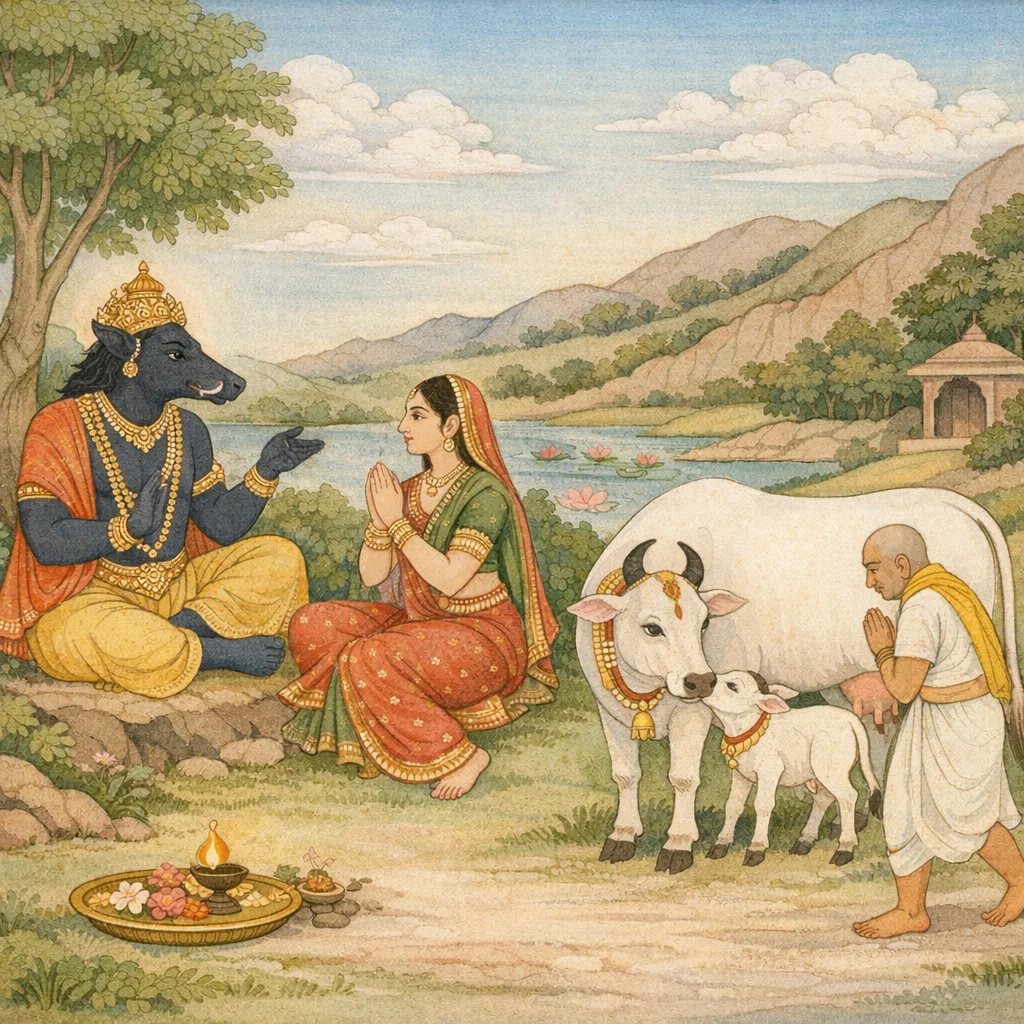
Adhyaya 111: The Eulogy of Donating a Tawny (Kapilā) Cow
Kapilādhenudāna-māhātmya
Ritual-Manual (Dāna-vidhi and Phalaśruti) with Ethical-Discourse on bovine care
Set within the Varāha–Pṛthivī teaching frame, this adhyāya (via a narrator’s introduction) instructs on kapilādhenudāna, the meritorious gift of a tawny kapilā cow. The cow is to be donated with her calf and adorned with ornaments and gems, stressing proper ritual procedure (vidhāna). It then lists daily devotional acts toward the cow—reverencing water that has fallen from her head, circumambulation (pradakṣiṇā), and bathing with cow’s urine—each said to remove accumulated pāpa over vast spans of time. Donating one kapilā cow is declared equal to gifting a thousand cows, and merit is extended to practical stewardship: grooming, protecting, and feeding hungry cattle. A typology of cows by color-forms is given, concluding that gifting such a cow to a brāhmaṇa grants worldly enjoyment and liberation (mokṣa), aligning dāna with sustained care for earthly well-being.
Primary Speakers
Key Concepts
Shlokas in Adhyaya 111
Verse 1
अथ कपिलाधेनुदानमाहात्म्यम् ॥ होतॊवाच ॥ अथातः सम्प्रवक्ष्यामि कपिलां धेनुमुत्तमाम् ॥ यत्प्रदानान्नरो याति विष्णुलोकमनुत्तमम् ॥
Now (begins) the eulogy of the gift of the tawny cow. The Hotā said: “Now I shall expound the excellent tawny cow; by giving her, a man attains the unsurpassed realm of Viṣṇu.”
Verse 2
पूर्वोक्तेन विधानॆन दद्याद्धेनुं सवत्सकाम् ॥ सर्वालङ्कारसंयुक्तां सर्वरत्नसमन्विताम् ॥
According to the procedure stated earlier, one should give a cow together with her calf, adorned with every ornament and furnished with all kinds of gems.
Verse 3
कपिलायाः शिरो ग्रीवा सर्वतीर्थानि भामिनि ॥ पितामहनीयॊगाच्च निवसन्ति हि निश्चयः ॥
O radiant one, in the head and neck of the tawny cow all tīrthas (sacred fords) dwell—indeed, certainly—by the ordinance of the Grandfather, Brahmā.
Verse 4
प्रातरुत्थाय यो मर्त्यः कपिलागलमस्तकात् ॥ च्युतं तु भक्त्या पानीयं शिरसा वन्दते शुचिः ॥
A person who rises in the morning, pure in observance, and with devotion bows the head in reverence to the drinkable water that has dripped from the tawny cow’s neck and head, gains merit.
Verse 5
स तेन पुण्यतोयेन तत्क्षणाद्दग्धकिल्बिषः ॥ त्रिंशद्वर्षकृतं पापं दहत्यग्निरिवेन्धनम् ॥
By that sacred, meritorious water, at that very moment his faults are burnt away; it consumes sin accumulated over thirty years, as fire consumes fuel.
Verse 6
कल्यमुत्थाय यो मर्त्यः कुर्यात्तासां प्रदक्षिणम् ॥ प्रदक्षिणी कृता तेन पृथिवी स्याद्वसुन्धरे ॥
Whoever rises at dawn and performs a rightward circumambulation of those (cows)—by him, O Vasundharā, bearer of wealth, the very Earth is as though circumambulated.
Verse 7
प्रदक्षिणेन चैकेन श्रद्धायुक्तेन तत्क्षणात् ॥ दशजन्मकृतं पापं तस्य नश्यत्यसंशयम् ॥
And by a single circumambulation, performed with faith, at that very moment his sin accumulated over ten births perishes—without doubt.
Verse 8
कपिलायास्तु मूत्रेण स्नायाच्चैव शुचिव्रतः । स गङ्गादिषु तीर्थेषु स्नातो भवति मानवः ॥
One who observes the vow of purity should also bathe with the urine of the tawny (kapilā) cow; that person becomes as one who has bathed in sacred pilgrimage-fords such as the Gaṅgā.
Verse 9
तेन स्नानेन चैकेन भावयुक्तेन वै नरः ॥ यावज्जीवकृतात्पापान्मुच्यते नात्र संशयः ॥
And by that single bath, performed with proper inner disposition, a person is freed from wrongs committed throughout life; there is no doubt about this.
Verse 10
गवामस्थि ततोऽप्येतन्मृतगन्धेन दूषयेत् ॥ यावज्जिघ्रति तं गन्धं तावत्पुण्यैस्तु पूर्यते ॥
Even the bone of cattle would (otherwise) be defiled by the odor of the dead; but as long as one smells that odor, for so long one becomes filled with merit (puṇya).
Verse 11
गवां कण्डूयनं श्रेष्ठं तथा च परिपालनम् ॥ तुल्यं गोशतदानस्य भयरोगादिपालने ॥
The highest service to cattle is to relieve their itching and to guard and sustain them; protecting them from fear, disease, and the like is said to be equal to the gift of a hundred cows.
Verse 12
तृणादिकानि यो दद्यात्क्षुधितेन गवाऽह्निकम् ॥ गोमेधस्य फलं दिव्यं लभते मानवोत्तमः ॥
Whoever gives grass and the like as a daily provision to a hungry cow attains the divine fruit associated with the gomedha, O best of men.
Verse 13
विमानैर्विविधैर्दिव्यैः कन्याभिरभितोऽर्पितैः ॥ सेव्यमानः सुगन्धैर्वै दीप्यमान इवाग्नयः ॥
He is honored with various divine vimānas, with maidens presented on every side; attended by fragrances, he shines like fires ablaze.
Verse 14
सुवर्णकपिला पूर्वं द्वितीया गौरपिङ्गला ॥ तृतीया चैव रक्ताक्षी चतुर्थी गुडपिङ्गला ॥
First is the golden kapilā; second is the yellow-brown piṅgalā; third is the red-eyed one; fourth is the piṅgalā with a sweet, molasses-like hue.
Verse 15
पञ्चमी बहुवर्णा स्यात्षष्ठी च श्वेतपिङ्गला ॥ सप्तमी श्वेतपिङ्गाक्षी त्वष्टमी कृष्णपिङ्गला ॥
The fifth should be multi-colored; the sixth is white-piṅgalā; the seventh is white-piṅgalā-eyed; the eighth is black-piṅgalā.
Verse 16
नवमी पाटला ज्ञेया दशमी पुच्छपिङ्गला ॥ एकादशी खुरश्वेता त्वेतासां सर्वलक्षणाः ॥
The ninth is to be known as rose-colored (pāṭalā); the tenth as tawny-tailed; the eleventh as white-hoofed—these are the complete identifying marks.
Verse 17
सर्वलक्षणसंयुक्ता सर्वालङ्कृतसुन्दरी ॥ ब्राह्मणाय प्रदातव्या भुक्तिमुक्तिप्रदायिनी ॥
Endowed with all marks and beautifully adorned, she is to be given to a brāhmaṇa; she is said to grant both worldly enjoyment and liberation (mokṣa) as the fruit of such giving.
Verse 18
भुक्तिमुक्तिप्रदा तेषां विष्णुमार्गप्रदायिनी ॥
For them, it bestows both enjoyment and liberation, and is described as granting the path associated with Viṣṇu.
Verse 19
गोसहस्रं च यो दद्यादेकां वा कपिलां नरः ॥ सममेतत्पुरा प्राह ब्रह्मा लोकपितामहः ॥
Whether a man gives a thousand cows, or even a single kapilā (tawny) cow—this was declared to be equivalent long ago by Brahmā, the grandsire of the worlds.
Frequently Asked Questions
The text instructs that merit is generated not only through formal dāna (donation) but also through sustained go-sevā: protecting, grooming, and feeding cattle. This frames moral action as both ritual correctness (vidhāna) and practical care, presenting an ethics of responsibility toward living beings that indirectly supports terrestrial well-being (Pṛthivī-centered stewardship).
No tithi, nakṣatra, māsa, or seasonal timing is specified. The practices are presented as daily or situational actions (e.g., prātaḥ—morning rising; kalyam utthāya—rising at an auspicious time; feeding when cattle are hungry), indicating a routine discipline rather than calendar-fixed observance.
While not explicitly ecological in modern terms, the chapter valorizes protection and maintenance of cattle (paripālana, kaṇḍūyana, feeding), which implies a model of terrestrial balance: sustaining domesticated animals as part of agrarian life and resource cycles. In a Varāha–Pṛthivī interpretive frame, these prescriptions function as practical stewardship supporting the stability and productivity of the Earth.
The chapter references Brahmā as lokapitāmaha and invokes Pitāmaha-niyoga (assignment by the Grandfather figure) regarding sacred presences associated with the kapilā cow. No royal dynasties or administrative lineages are named in the provided passage.