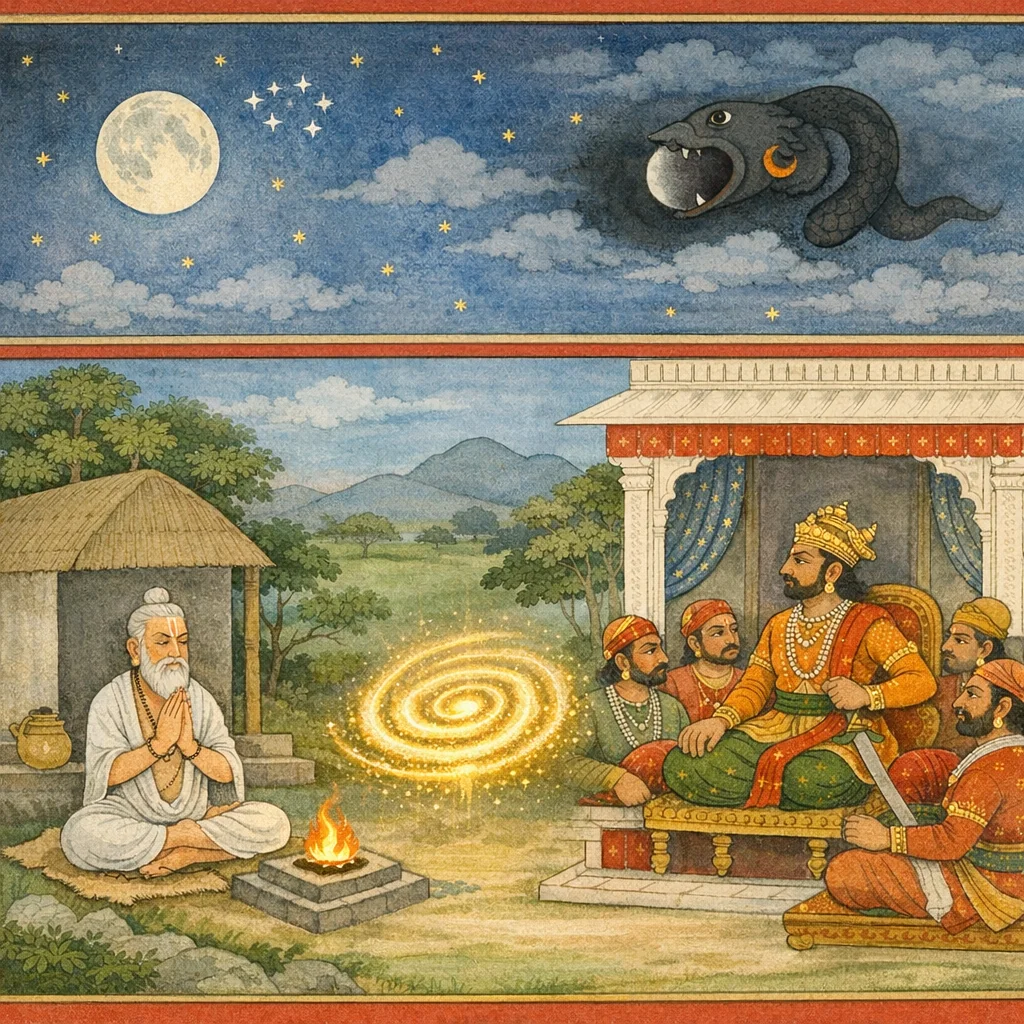
Adhyaya 11: Hospitality at Gauramukha’s Hermitage and the Power of the Wish-Fulfilling Jewel
Gauramukhāśrame Durjayasya Ātithyaṃ, Cintāmaṇiprabhāvaś ca
Narrative-Ethics (Hospitality, Royal Conduct, and Divine Intervention) / Sacred Geography (Naimiṣāraṇya)
Varāha tells Pṛthivī how King Durjaya comes to the hermitage of the sage Gauramukha and is received with due, formal hospitality. Anxious about feeding the king and his forces, the rishi meditates on Nārāyaṇa and offers a hymn praising Viṣṇu as immanent in water, earth, fire, wind, and space, thus linking divine order with earthly abundance. Viṣṇu appears, grants a boon, and bestows a radiant cintāmaṇi, a wish-fulfilling jewel that provides plentiful provisions and luxurious service for the entire royal retinue. When night has passed, Durjaya covets the jewel and tries to seize it through emissaries and then by force; warrior-leaders emerge from the gem and fight his troops. Gauramukha again appeals to Viṣṇu, who destroys the hostile army with the Sudarśana and proclaims the forest to be known as Naimiṣāraṇya, establishing an enduring sacred landscape.
Primary Speakers
Key Concepts
Shlokas in Adhyaya 11
Verse 1
श्रीवराह उवाच । ततस्तमीदृशं दृष्ट्वा तदा गौरमुखाश्रमम् । दुर्ज्जयश्चिन्तयामास रम्यमाश्रममण्डलम् ॥ ११.१ ॥
Śrī Varāha said: Then, having seen such a hermitage—Gauramukha’s āśrama—Durjjaya reflected upon the delightful precincts of that hermitage.
Verse 2
प्रविशाम्यत्र पश्यामि ऋषीन् परमधार्मिकान् । चिन्तयित्वा तदा राजा प्रविवेश तमाश्रमम् ॥ ११.२ ॥
“Here I shall enter and behold the seers of highest righteousness.” Having reflected thus, the king then entered that hermitage.
Verse 3
तस्य प्रविष्टस्य ततो राज्ञः परमहर्षितः । चकार पूजां धर्मात्मा तदा गौरमुखो मुनिः ॥ ११.३ ॥
Then, when the king had entered, the sage Gauramukha—righteous in conduct and exceedingly delighted—performed an act of honor, the ritual welcome, for him.
Verse 4
स्वागतातिक्रियाः कृत्वा कथान्ते तं महामुनिः । स्वशक्त्या अहं नृपश्रेष्ठ सानुगस्य च भोजनम् ॥ ११.४ ॥
Having performed the customary acts of welcome and related courtesies, at the close of the discourse the great sage said: “O best of kings, according to my capacity I shall provide a meal for you, together with your attendants.”
Verse 5
करिष्यामि प्रमुच्यन्तां साधु वाह इति द्विजः । एवमुक्त्वा स्थितस्तूष्णीं स मुनिः संशितव्रतः ॥ ११.५ ॥
The twice-born (brāhmaṇa) said, “I shall do it; let them be released—well done.” Having spoken thus, that sage, firm in his vowed discipline, stood in silence.
Verse 6
राजाऽपि तस्थौ तद्भक्त्या स्वसहायैः समन्वितः । अक्षौहिण्यो बलस्यास्य पञ्चमात्रास्तदा स्थिताः । अयं च तापसः किं मे दास्यते भोजनं त्विह ॥ ११.६ ॥
The king too remained there, devoted to him and accompanied by his own attendants. At that time, five akṣauhiṇīs of his army stood stationed. And he reflected, “This ascetic—what food will he give me here?”
Verse 7
निमन्त्र्य दुर्जयं विप्रस्तदा गौरमुखो नृपम् । चिन्तयामास किं चास्य मया देयं तु भोजनम् ॥ ११.७ ॥
Having invited King Durjaya, the brāhmaṇa Gauramukha then reflected: “What food should be given to him by me?”
Verse 8
एवं चिन्तयतस्तस्य महर्षेर्भावितात्मनः । स्थितो मनसि देवेशो हरिर्नारायणः प्रभुः ॥ ११.८ ॥
As that great seer—of cultivated inner awareness—thus reflected, the Lord of the gods, Hari, Nārāyaṇa, the sovereign, became established within his mind.
Verse 9
ततः संस्मृत्य मनसा देवं नारायणं तदा । तोषयामास गङ्गायां प्रविश्य मुनिसत्तमः ॥ ११.९ ॥
Then, recollecting in his mind the god Nārāyaṇa, the foremost of sages entered the Gaṅgā and performed acts of propitiation at that time.
Verse 10
धरण्युवाच । कथं गौरमुखो विष्णुं तोषयामास भूधर । एतन्मे कौतुकं श्रोतुं सम्यगिच्छा प्रवर्तते ॥ ११.१० ॥
Dharanī (Earth) said: “O Bhūdhara, how did Gauramukha please Viṣṇu? A keen desire has arisen in me to hear this rightly and in full.”
Verse 11
नमोऽस्तु विष्णवे नित्यं नमस्ते पीतवाससे । नमस्ते चाद्यरूपाय नमस्ते जलरूपिणे ॥ ११.११ ॥
Homage ever to Viṣṇu; homage to You who are clad in yellow garments. Homage to You whose form is primordial; homage to You whose form is water.
Verse 12
नमस्ते सर्वसंस्थाय नमस्ते जलशायिने । नमस्ते क्षितिरूपाय नमस्ते तेजसात्मने ॥ ११.१२ ॥
Salutations to You, the support of all established orders; salutations to You who lie upon the waters. Salutations to You who take the form of the Earth; salutations to You whose essence is radiance (tejas).
Verse 13
नमस्ते वायुरूपाय नमस्ते व्योमरूपिणे । त्वं देवः सर्वभूतानां प्रभुस्त्वमसि हृरिच्छयः ॥ ११.१३ ॥
Salutations to You whose form is wind; salutations to You whose form is the sky. You are the divine presence of all beings; You are the Lord, abiding as the heart’s inner impulse.
Verse 14
त्वमोङ्कारो वषट्कारः सर्वत्रैव च संस्थितः । त्वमादिः सर्वदेवानां तव चादिर्न विद्यते ॥ ११.१४ ॥
You are the syllable Oṃ and the vaṣaṭ-exclamation; You are established everywhere. You are the beginning of all the gods, and for You no beginning is found.
Verse 15
त्वं भूस्त्वं च भुवो देव त्वं जनस्त्वं महः स्मृतः । त्वं तपस्त्वं च सत्यं च त्वयि देव चराचरम् ॥ ११.१५ ॥
O Deva, you are Bhū and you are Bhuvaḥ; you are Janaḥ and are remembered as Mahaḥ. You are Tapas and also Satya; in you, O Deva, abide all beings, moving and unmoving.
Verse 16
त्वत्तो भूतमिदं विश्वं त्वदुद्भूताऋगादयः । त्वत्तः शास्त्राणि जातानि त्वत्तो यज्ञाः प्रतिष्ठिताः ॥ ११.१६ ॥
From you this entire universe has come into being; from you the Ṛg and the other Vedas have arisen. From you the authoritative śāstras are born, and upon you the yajñas, the sacrificial rites, are established.
Verse 17
त्वत्तो वृक्षाः वीरुधश्च त्वत्तः सर्वा वनौषधिः । पशवः पक्षिणः सर्पास्त्वत्त एव जनार्दन ॥ ११.१७ ॥
From you arise trees and creeping plants; from you arise all forest herbs. Animals, birds, and serpents likewise arise from you alone, O Janārdana.
Verse 18
ममापि देवदेवेश राजाऽदुर्जयसंज्ञितः । आगतोऽभ्यागतस्तस्य आतिथ्यं कर्तुमुत्सहे ॥ ११.१८ ॥
O Devadeveśa, a king named Durjaya has also come to me as a guest; I am willing to extend to him ātithya, the proper hospitality.
Verse 19
तस्य मे निर्धनस्याद्य देवदेव जगत्पते । भक्तिनम्रस्य देवेश कुरुष्वान्नाद्यसंचयम् ॥ ११.१९ ॥
O Devadeva, Lord of the world (Jagatpati)—today, for me who am destitute and bowed in devotion, O Lord, please arrange a provision of food and necessities.
Verse 20
यं यं स्पृशामि हस्तेन यं यं पश्यामि चक्षुषा । वृक्षं वा तृणकन्दं वा तत्तदन्नं चतुर्विधम् ॥ ११.२० ॥
Whatever I touch with my hand, whatever I behold with my eyes—be it a tree or a bulb/tuber amid the grasses—each of those becomes food, in fourfold form.
Verse 21
तथा त्वन्यतमं वापि यद्ध्यातं मनसा मया । तत्सर्वं सिद्ध्यतां मह्यं नमस्ते परमेश्वर ॥ ११.२१ ॥
Likewise, whatever else—of any kind—I have contemplated within my mind, may all of it be fulfilled for me. Reverence to You, O Supreme Lord.
Verse 22
इति स्तुत्या तु देवेशस्तुतोष जगतां पतिः । मुनेस्तस्य स्वकं रूपं दर्शयामास केशवः ॥ ११.२२ ॥
Thus, by that hymn of praise, the Lord of the gods—the sovereign of the worlds—was pleased; and Keśava revealed to that sage His own true form.
Verse 23
उवाच सुप्रसन्नात्मा ब्रूहि विप्र वरं परम् । एवं श्रुत्वाऽक्षिणी यावदुन्मीलयति वै मुनिः ॥ ११.२३ ॥
With a deeply serene mind, He spoke: “O best of brāhmaṇas, declare the supreme boon.” Having heard thus, the sage then began to open his eyes.
Verse 24
तदा शङ्खगदापाणिः पीतवासा जनार्दनः । गरुडस्थोऽपि तेजस्वी द्वादशादित्यसप्रभः ॥ ११.२४ ॥
Then Janārdana—bearing the conch and mace in His hands, clad in yellow garments—radiant even while seated upon Garuḍa, shone with a splendor comparable to that of the twelve Ādityas.
Verse 25
दिवि सूर्यसहस्रस्य भवेद्युगपदुत्थिता । यदि भाः सदृशी सा स्याद्भासस्तस्य महात्मनः ॥ ११.२५ ॥
If, in the sky, the radiance of a thousand suns were to arise all at once, that might be comparable to the splendor of that great-souled one.
Verse 26
तत्रैकस्थं जगत्कृत्स्नं प्रविभक्तमनेकधा । ददर्श स मुनिर्देवि विस्मयोत्फुल्ललोचनः ॥ ११.२६ ॥
There, in a single locus, he beheld the entire universe—yet differentiated in many ways. That sage, O Goddess, saw it with eyes widened in astonishment.
Verse 27
जगाम शिरसा देवं कृताञ्जलिरथाब्रवीत् । यदि मे वरदो देवो भूयाद् भक्तस्य केशव ॥ ११.२७ ॥
Having approached the god with his head bowed, and with hands joined in reverence, he then spoke: “If the god Keśava would grant me a boon—as one devoted (to him) …”
Verse 28
इदानीमेष नृपतिर्यथा सबलवाहनः । ममाश्रमे कृताहारः श्वः प्रयाता स्वकं गृहम् ॥ ११.२८ ॥
Now this king, together with his forces and vehicles, having taken his meal in my hermitage, will depart tomorrow for his own home.
Verse 29
इत्युक्तस्तस्य देवेशो वरदः सम्बभूव ह । चित्तसिद्धिं ददौ तस्मै मणिं च सुमहाप्रभम् ॥ ११.२९ ॥
Thus addressed, the Lord of the gods indeed became a bestower of boons to him; he granted him mastery of mental attainment (citta-siddhi) and also a jewel of exceedingly great radiance.
Verse 30
तं दत्त्वाऽन्तर्दधे देवः स च गौरमुखो मुनिः । जगाम चाश्रमं पुण्यं नाना ऋषिनिषेवितम् ॥ ११.३० ॥
Having bestowed that, the deity vanished from sight; and the sage Gauramukha went to a holy hermitage, frequented by many ṛṣis.
Verse 31
तत्र गत्वा स विप्रेन्द्रश्चिन्तयामास वै मुनिः । हिमवच्छिखराकारं महाभ्रमिव चोन्नतम् । शशाङ्करश्मिसङ्काशं गृहं वै शतभूमिकम् ॥ ११.३१ ॥
Having gone there, that sage—foremost among the brāhmaṇas—reflected upon a mansion: towering like a great cloud, shaped like a peak of the Himālaya, radiant as moonbeams, and indeed rising to a hundred storeys.
Verse 32
तादृशानां सहस्राणि लक्षकोट्यश्च सर्वशः । गृहानि निर्ममे विप्रो विष्णोर्लब्धवरस्तदा ॥ ११.३२ ॥
Then the brāhmaṇa—having obtained a boon from Viṣṇu—caused such houses to be built everywhere: in thousands, in hundreds of thousands, and in koṭis (crores) of every kind.
Verse 33
प्राकाराणि ततोऽपान्ते तल्लग्नोद्यानकानि च । कोकिलाकुलघुष्टानि नानाद्विजवराणि च । चम्पकाशोकपुन्नागनागकेशरवन्ति च ॥ ११.३३ ॥
Then, along the outskirts, there were ramparts and gardens attached to them, resounding with the calls of flocks of kokila birds and filled with many excellent kinds of birds; and they abounded in groves of campaka, aśoka, punnāga, and nāgakeśara trees.
Verse 34
नानाजात्यस्तथा वृक्षाः गृहोद्यानॆषु सर्वशः । हस्तिनां हस्तिशालाश्च तुरगाणां च मन्दुराः ॥ ११.३४ ॥
And in the household gardens there were trees of many kinds everywhere; and there were elephant-stables for elephants, and stables (manduras) for horses.
Verse 35
चकार सञ्चयान् विप्रो नानाभक्ष्याणि सर्वशः । भक्ष्यं भोज्यं तथा लेह्यं चोष्यं बहुविधं तथा । चकारान्नाद्यनिचयं हेमपात्र्यश्च सर्वतः ॥ ११.३५ ॥
The brāhmaṇa made stores of many kinds of foods everywhere—foods to be eaten, foods to be chewed as meals, foods to be licked, and foods to be sucked, of many varieties. He also arranged heaps of prepared provisions in all places, together with golden vessels.
Verse 36
एवं कृत्वा स विप्रस्तु राजानं भूरितेजसम् । उवाच सर्वसैन्यानि प्रविशन्तु गृहानिति ॥ ११.३६ ॥
Having done so, that brāhmaṇa addressed the king of great splendor: “Let all the troops enter their quarters.”
Verse 37
एवमुक्तस्ततो राजा तद्गृहं पर्वतोपमम् । प्रविवेशान्तरेष्वन्ये भृत्या विविशुराशु वै ॥ ११.३७ ॥
Thus addressed, the king then entered that mansion, comparable to a mountain; and the other attendants quickly went in through the inner quarters.
Verse 38
ततस्तेषु प्रविष्टेषु तदा गौरमुखो मुनिः । प्रगृह्य तं मणिं दिव्यं राजानं छेदमब्रवीत् ॥ ११.३८ ॥
Then, when they had entered, the sage Gauramukha—having taken up that divine jewel—spoke to King Cheda.
Verse 39
मज्जनाभ्यवहारार्थं पथि श्रमकृते तथा । विलासिनीस्तथा दासान् प्रेषयिष्यामि ते नृप ॥ ११.३९ ॥
“For the purpose of bathing and taking food, and likewise to relieve fatigue on the road, O king, I shall send to you courtesans (vilāsinī) as well as servants.”
Verse 40
एवमुक्त्वा स विप्रेन्द्रस्तं मणिं वैष्णवं शुभम् । एकान्ते स्थापयामास राज्ञस्तस्य प्रपश्चतः ॥ ११.४० ॥
Having spoken thus, the foremost of brāhmaṇas placed the auspicious Vaiṣṇava jewel in a secluded spot, while that king looked on.
Verse 41
तस्मिन् स्थापितमात्रे तु मणौ शुद्धसमप्रभे । निश्चेरुर्योषितस्तत्र दिव्यरूपाः सहस्रशः ॥ ११.४१ ॥
But as soon as that jewel—radiant with pure, even brilliance—was set in place, thousands upon thousands of women of celestial appearance emerged there.
Verse 42
सुकुमाराङ्गरागाद्याः सुकुमारवराङ्गनाः । सुकपोलाः सुचार्व्यङ्ग्यः सुकेशान्ताः सुलोचनाः । काश्चित्सौवर्णपात्रीश्च गृहीत्वा संप्रatasthire ॥ ११.४२ ॥
Delicate and finely adorned women—soft-limbed and eminent—having beautiful cheeks, charming bodies, well-arranged tresses, and lovely eyes, set out; and some, taking golden vessels, departed.
Verse 43
एवं योषिद्गणास्तत्र नराः कर्मकरास्तथा । निर्जग्मुस्तस्य नृपतेः सर्वे भृत्या नृपस्य ह । केवलं भोजनं पूर्वं परिधानं च सर्वशः ॥ ११.४३ ॥
Thus, the groups of women there, and likewise the men who were laborers, all departed from that king—indeed, all the king’s attendants—taking only their food provisions and their clothing.
Verse 44
ताः स्त्रियः सर्वभृत्यानां राजमार्गेण मज्जनं । ददुस्ते च नराश्वानां हस्तिनां च त्वरान्विताः ॥ ११.४४ ॥
Those women arranged the bathing for all the attendants by way of the royal road; and, acting with haste, they also made provisions for the men, the horses, and the elephants.
Verse 45
नानाविधानि तूर्याणि तत्रावाद्यन्त सर्वशः । मज्जने नृपतेस्तत्र ननृतुश्चान्ययोषितः । अपराश्च जगुस्तत्र शक्रस्येव प्रमज्जतः ॥ ११.४५ ॥
There, on every side, many kinds of musical instruments were played. During the king’s ritual immersion, some women danced and others sang, as though Indra himself were bathing.
Verse 46
एवं दिव्योपचारेण स्नात्वा राजा महामनाः । चिन्तयामास राजेन्द्रो विस्मयाविष्टचेतनः । किमिदं मुनिसामर्थ्यं तपसो वाऽथ वा मणेः ॥ ११.४६ ॥
Thus, after bathing amid divine attendance, the great-minded king—his mind seized by astonishment—reflected: “What is this power of the sages? Is it the fruit of austerity, or else of a gem (maṇi)?”
Verse 47
यथा च नृपतेः पूजा कृता तेन महर्षिणा । तद्वद्भृत्यजनस्यापि चकार मुनिसत्तमः ॥ ११.४८ ॥
And just as that great seer rendered due honors to the king, so too did the foremost sage extend proper hospitality to the king’s attendants and retinue.
Verse 48
यावत् स राजा बुभुजे सभृत्यबलवाहनः । तावदस्तगिरिं भानुर्जगामारुणसप्रभः ॥ ११.४९ ॥
As long as that king enjoyed (his rule and pleasures) together with his attendants, forces, and mounts/vehicles, for just so long did the Sun—radiant with a ruddy glow—go to the western mountain, the mountain of setting.
Verse 49
ततस्तु रात्रिः समपद्यताधुना शरच्छशाङ्कोज्ज्वलऋक्षमण्डिता । करोति रागं स च रोहिणीधवः सुसङ्गतं सौम्यगुणेषु तापि च ॥ ११.५० ॥
Then night arrived, adorned with constellations made radiant by the autumn moon. And the lord of Rohiṇī—the Moon—kindled longing, well attuned to gentle qualities, and yet also producing heat.
Verse 50
भृगूद्वहः कृष्णतरांशुभानुना सहोद्यातो दैत्यगुरुः सुराधिपः । अथान्तरात्पक्षगतो न राजते स्वभावयोगेन मतिस्तु देहिनाम् ॥ ११.५१ ॥
When the foremost of the Bhṛgus, the preceptor of the Daityas, rose together with the sun whose rays had grown darker, the lord of the gods did not shine once he had moved into the inner side (that is, become obscured). Thus, for embodied beings, the mind follows its own inherent disposition by the force of innate nature.
Verse 51
सुरक्ततां भूमिसुतश्च मुञ्चते राहुः सिती चन्द्रमसोऽंशुभिः सितैः । मुक्तः स्वभावो जगतः सुरासुरैरनुस्वभावो बलवान् सुकृन्नृपः ॥ ११.५२ ॥
Even Bhūmisuta releases his deep redness; and Rāhu becomes pale by the pale rays of the Moon. The world’s inherent nature becomes unbound—among both devas and asuras—while a powerful king, performing meritorious deeds, acts in accordance with that inherent order.
Verse 52
सितेश्वराख्यापितरश्मिमण्डले सूर्यत्वसिद्धान्तकषेव निर्मले । करोति केतुर्न परे महत्तमस्तदा कुशीलॆषु गतिश्च निर्मला ॥ ११.५३ ॥
In the pure orb of rays identified as “Siteśvara,” polished as it were by the established doctrine of the Sun’s nature, Ketu does not produce an excessive darkness elsewhere; and then, even among those of poor conduct, the course of things becomes clarified.
Verse 53
बुधोच्चबुद्धिर्जगतो विभावयन् रराज राज्ञो तनयः स्वकर्मभिः । भृरीतेच्छकः कक्षविवाहितश्चिरं भवेदियं साधुषु सम्मितिर्ध्रुवम् ॥ ११.५४ ॥
Endowed with an exalted, discerning intellect, the king’s son shone forth while illuminating the world through his own deeds. Long established as one who sought proper support and one joined in marriage within the Kakṣa lineage, this measure of esteem among the virtuous is indeed steady.
Verse 54
करोति केतुः कपिलं वियच्छिरं राज्ञः सुराणां पथि संस्थितं भृशम् । न दुर्जनः सज्जनसंसदि क्वचित् करोति शुद्धं निजकर्मकौशलम् ॥ ११.५५ ॥
Ketu produces a tawny, widely spreading sign and stands powerfully in the path of the king and the gods. Yet a wicked person, even in the assembly of the virtuous, does not anywhere render pure the skill of his own actions.
Verse 55
शशाङ्करश्मिप्रविभासिता अपि प्रकाशमीयुर्निरताः पदे पदे । कुलम्भवाः सम्भवधर्मपत्तयो महांशुयोगान्महतां समुन्नतिम् ॥ ११.५६ ॥
Even when illuminated by the moon’s rays, they still shine forth—steadfast at every step. Born of a noble lineage and aligned with the dharma proper to their station, they attain the exaltation of the great through association with great radiance, that is, with the eminent.
Verse 56
त्रिदोषसक्तान्निकृतोऽस्य सर्वशः सुतेन राज्ञो वरुणस्य सूर्यजः । विराजते कौशिकसन्निवेशिता न वेदकर्म क्वचिदन्यथा भवेत् ॥ ११.५७ ॥
Though wholly set aside by this one who clings to the three doṣas (vāta–pitta–kapha), the Sun-born—son of King Varuṇa—shines forth, established by Kauśika. Nowhere should the performance of Vedic rites become otherwise, that is, deviate from proper form.
Verse 57
द्वन्द्वः समेतान् मम यः शिशुः पुरा हरिर्य आराधितवान् नृपासनम् । लक्ष्म्यापि बुद्ध्या सुचिरं प्रकाशते ध्रुवेण विष्णुस्मरणेन दुर्लभम् ॥ ११.५८ ॥
That child of mine, Hari, who formerly encountered the pairs of opposites (dvandva), nevertheless revered the royal seat. Even amid prosperity (Lakṣmī) and discernment he shines for a long time—yet such steadfast remembrance of Viṣṇu, like Dhruva’s, is difficult to attain.
Verse 58
इतीदृशी रात्रिरभूदृषेः शुभे वराश्रमे दुर्जयभूपतेः शुभा । सभृत्यसामन्तवराश्वदन्तिनः सुभक्तवस्त्राभरणादिपूजया ॥ ११.५९ ॥
Thus passed the night—auspicious—for the sage in that excellent hermitage; and auspicious as well for King Durjaya, attended by his servants and feudatory allies, with fine horses and elephants, through offerings of good food, garments, ornaments, and other honors.
Verse 59
इतीदृशायां वररत्नचित्रिताः सुपट्टसंवीतवरास्तृतास्तदा । गृहेषु पर्यङ्कवराः समाश्रिताः सुरूपयोषित्कृतभङ्गभासुराः ॥ ११.६० ॥
In such a setting, then, excellent couches in the houses—adorned with choice jewels and covered with fine cloth and superior spreads—were occupied; they shone with the graceful postures fashioned by beautiful women.
Verse 60
स तत्र राजा विससर्ज भूभृतः स्वयं सभृत्यानपि सर्वतो गृहान् । गतेषु सुष्वाप वरस्त्रिया वृतः सुरेशवत्स्वर्गगतः प्रतापवान् ॥ ११.६१ ॥
There, the king—protector of the earth—personally dismissed the households on every side, together with their attendants, sending them back to their homes. When they had departed, the valorous one slept, surrounded by an excellent woman; as though gone to heaven, he became like the lord of the gods.
Verse 61
एवं सुमनसस्तस्य सभृत्यस्य महात्मनः । ऋषेस्तस्य प्रभावेण हृष्टास्तु सुषुपुस्तदा ॥ ११.६२ ॥
Thus the attendants of that great-souled, noble-hearted one became cheerful; and, delighted by the potency of that ṛṣi, they then fell asleep.
Verse 62
ततो रात्र्यां व्यतीतायां स राजा ताः स्त्रियः पुनः । अन्तर्द्धानं गतास्तत्र दृष्ट्वा तानि गृहाणि च ॥ ११.६३ ॥
Then, when the night had passed, the king looked again and saw that those women there had vanished from sight, and he also saw those houses.
Verse 63
अदृश्यानि महार्हाणि वरासनजलानि च । राजा स विस्मयाविष्टश्चिन्तयामास दुःखितः ॥ ११.६४ ॥
He beheld precious things not visible to ordinary sight, and also excellent seats and waters. That king, overwhelmed with astonishment, began to reflect, distressed.
Verse 64
कथमेवं मणिर्मह्यं भवतीति पुनः पुनः । चिन्तयन्नधिगम्याथ स राजा दुर्जयस्तदा ॥ ११.६५ ॥
Again and again he pondered, “How is it that this jewel comes to me?” Then, after coming to an understanding, King Durjaya at that time acted accordingly.
Verse 65
चिन्तामणिमिमं चास्य हरामीति विचिन्त्य सः । प्रयाणं नोदयामास स राजाश्रमबाह्यतः । आश्रमस्य बहिर्गत्वा नातिदूरे सवाहनः ॥ ११.६६ ॥
Thinking, “I shall take this Cintāmaṇi jewel from him,” the king set out from outside the hermitage; having gone out beyond the āśrama, he was not far away, together with his mount or vehicle.
Verse 66
ततो विरोचनाख्यं वै प्रेषयामास मन्त्रिणम् । ऋषेर्गौरमुखस्यापि मणेर्याचनकर्मणि ॥ ११.६७ ॥
Then he dispatched a minister named Virocana to carry out the task of requesting (a boon or an object) from the sage Gauramukha as well—specifically in connection with obtaining the jewel.
Verse 67
ऋषिं तं च समागत्य मणिं याचितुमुद्यतः । रत्नानां भाजनं राजा मणिं तस्मै प्रदीयताम् ॥ ११.६८ ॥
Approaching that ṛṣi and preparing to request the jewel, it was said: “Let the king—who is a repository of precious treasures—give that jewel to him.”
Verse 68
अमात्येनैवमुक्तस्तु क्रुद्धो गौरमुखोऽब्रवीत् । प्रतिगृह्णाति विप्रस्तु राजा चैव ददाति च । त्वं च राजा पुनर्भूत्वा याचसे दीनवत् कथम् ॥ ११.६९ ॥
Thus addressed by the minister, Gauramukha, angered, said: “A brāhmaṇa accepts gifts, and a king indeed gives. Yet you, having become a king again, how can you beg like a destitute person?”
Verse 69
एवं ब्रूहि दुराचारं राजानं दुर्जयं स्वयम् । गच्छ द्रुतं दुराचार मा त्वां लोकोऽत्यगादिति ॥ ११.७० ॥
“Speak to that ill-conducted king—himself hard to overcome—in this manner. Go quickly, O wicked one, lest the people abandon you,” thus he said.
Verse 70
एवमुक्त्वा मुनिः प्रागात् कुशेध्माहरणाय वै । चिन्तयन् मनसा तं च मणिं शत्रुविनाशनम् ॥ ११.७१ ॥
Having spoken thus, the sage went forth to gather kuśa-grass and kindling, while mentally contemplating that jewel—the destroyer of enemies.
Verse 71
एवमुक्तस्तदा दूतो जगाम च नृपान्तिकम् । कथयामास तत्सर्वं यदुक्तं ब्राह्मणेन च ॥ ११.७२ ॥
Thus addressed, the messenger then went to the king’s presence and reported in full everything that had been spoken by the brāhmaṇa.
Verse 72
ततः क्रोधपरीतात्मा श्रुत्वा ब्राह्मणभाषितम् । दुर्जयः प्राह नीलाख्यं सामन्तं गच्छ माचिरम् । ब्राह्मणस्य मणिं गृह्य तूर्णमेहि यदृच्छया ॥ ११.७३ ॥
Then, his mind overcome by anger, having heard what the brāhmaṇa had said, Durjaya spoke to a vassal named Nīla: “Go—do not delay. Take the brāhmaṇa’s jewel, and return quickly, by whatever means present themselves.”
Verse 73
एवमुक्तस्तदा नीलो बहुसेनापरिच्छदः । जगाम स च विप्रस्य वन्याश्रममण्डलम् ॥ ११.७४ ॥
Thus addressed, Nīla—attended by many troops and retinue—then departed; and he went to the forest āśrama-enclosure of the brahmin.
Verse 74
तत्राग्निहोत्रशालायां दृष्ट्वा तं मणिमाहितम् । उत्तीर्य स्यन्दनान्नीलः सोऽवरोहत भूतले ॥ ११.७५ ॥
There, in the agnihotra-hall, having seen that jewel set in place, Nīla descended from the chariot and alighted upon the ground.
Verse 75
अवतीर्णे ततस्तस्मिन् नीले परमदारुणे । क्रूरबुद्ध्या मनेस्तस्मान्निर्जग्मुः शस्त्रपाणयः ॥ ११.७६ ॥
Then, after he had descended there—into that dark-blue, exceedingly dreadful place—armed men, driven by cruel intent, went forth from the mind-born one (Maṇi).
Verse 76
सरथाः सध्वजाः साश्वाः सबाणाः सासिचर्मिणः । सधनुष्काः सतूणीराः योधाः परमदुर्जयाः ॥ निश्चेरुस्तं मणिं भित्वा असंख्येया महाबलाः ॥ ११.७७ ॥
Warriors—mounted on chariots with banners and horses, furnished with arrows, swords, and shields, bearing bows and quivers—invincible in battle, countless and of great strength, burst forth after breaking open that jewel (maṇi).
Verse 77
तत्र सज्जा महाशूरा दश पञ्च च संख्यया । नामभिस्तान् महाभागे कथयामि श्रृणुष्व तान् ॥ ११.७८ ॥
There, ready and great heroes—fifteen in number—were present. O fortunate one, I shall tell you their names; listen to them.
Verse 78
सुप्रभो दीप्ततेजाश्च सुरश्मिः शुभदर्शनः । सुकान्तिः सुन्दरः सुन्दः प्रद्युम्नः सुमनाः शुभः ॥ ११.७९ ॥
“Supremely radiant; of blazing splendor; of divine rays; of auspicious appearance; of lovely brilliance; beautiful; delightful; Pradyumna; of good mind; auspicious.”
Verse 79
सुशीलः सुखदः शम्भुः सुदान्तः सोम एव च । एते पञ्चदश प्रोक्ता नायका मणितोत्थिताः ॥ ११.८० ॥
“Suśīla, Sukhadā, Śambhu, Sudānta, and Soma as well.” These fifteen leaders are declared to have arisen from jewels (maṇi).
Verse 80
ततो विरोचनं दृष्ट्वा बहुसैन्यपरिष्कृतम् । योधयामासुरव्यग्रा विविधायुधपाणयः ॥ ११.८१ ॥
Then, seeing Virocana arrayed with a great host of troops, they—eager for battle, with hands bearing various weapons—engaged in combat.
Verse 81
धनूंषि तेषां कनकप्रभाणि शरान् सुजाम्बूनदपुङ्खनद्धान् । पतन्ति खङ्गानि विभीषणानि भुशुण्डिशूलाः परमप्रधानाः ॥ ११.८२ ॥
Their bows, gleaming like gold, and their arrows—fitted with fine Jāmbūnada-gold feathers—were falling; terrifying swords too were falling, along with bhuśuṇḍī-clubs and spears of the highest order.
Verse 82
रथो रथं संपरिवार्य तस्थौ गजो गजस्यापि हयो हरस्य । पदातिरत्युग्रपराक्रमश्च पदातिमेव प्रससार चाग्र्यम् ॥ ११.८३ ॥
A chariot, having surrounded a chariot, stood firm; an elephant confronted an elephant, and a horse met a horse. And the foot-soldier, of exceedingly fierce valor, advanced—indeed against the foremost foot-soldier.
Verse 83
द्वन्द्वान्यनेकानि तथैव युद्धे द्रवन्ति शूराः परिभर्त्सयन्तः । विभीषणं निर्गतचापमार्गं बभूव बाहुप्रभवं सुघोरम् ॥ ११.८४ ॥
In the battle, many single combats likewise surged on, as the heroes advanced while hurling taunts. Then, for Vibhīṣaṇa—who had come out into the line of fire of the bow—there arose a most dreadful missile, born of an arm’s force.
Verse 84
तथा प्रवृत्ते तुमुलेऽथ युद्धे हतः स राज्ञः सचिवो विसंज्ञः । सहानुगः सर्वबलैरुपेतो जगाम वैवस्वतमन्दिराय ॥ ११.८५ ॥
When the fierce battle had thus commenced, that minister of the king was struck down and became unconscious. Accompanied by his followers and attended by all his forces, he went to the abode of Vaivasvata (Yama)—that is, he met death.
Verse 85
तस्मिन् हते दुर्जयराजमन्त्रिणि उपाययौ स्वेन बलेन राजा । स दुर्जयः साश्वरथोऽतितीव्रः प्रतापवांस्तैर्मणिजैर्यuyodha ॥ ११.८६ ॥
When Durjaya’s royal minister had been slain, the king advanced with his own forces. That Durjaya, mounted upon a horse-drawn chariot, exceedingly swift and mighty in valor, fought against those warriors.
Verse 86
ततस्तस्मिंस्तदा राज्ञो महत्कदनमाबभौ । ततो हेतुप्रहेत्रीभ्यां श्रुत्वा जामातरं रणे ॥ ११.८७ ॥
Then, at that time, a great slaughter arose there for the king. Thereupon, having heard from the instigators and agents about the son-in-law in the battle, he responded accordingly.
Verse 87
युध्यमानं महाबाहुं ततस्त्वाययतुश्चमूः । तस्मिन् बले तु दैत्या ये तान् शृणुष्व धरिरितान् ॥ ११.८८ ॥
While that mighty-armed one was engaged in battle, the army then advanced. Now, as for the Daitiyas who were in that force—hear them as Hari has declared.
Verse 88
प्रघसो विघसश्चैव सङ्घसोऽशनिसप्रभः । विद्युत्प्रभः सुघोषश्च उन्मत्ताक्षो भयङ्करः ॥ ११.८९ ॥
“They are called Praghasa, Vighasa, and also Saṅghasa; Aśanisaprabha (‘radiant like a thunderbolt’); Vidyutprabha (‘radiant like lightning’); Sughoṣa (‘of auspicious or resounding voice’); Unmattākṣa (‘with frenzied eyes’); and Bhayaṅkara (‘fear-inducing’).”
Verse 89
अग्निदन्तोऽग्नितेजाश्च बाहुशक्रः प्रतर्दनः । विराधो भीमकर्मा च विप्रचित्तिस्तथैव च ॥ ११.९० ॥
Agnidanta and Agnitejas; Bāhuśakra and Pratardana; Virādha and Bhīmakarman; and likewise Vipracitti as well.
Verse 90
एते पञ्चदश श्रेष्ठा असुराः परमायुधाः । अक्षौहिणीपरिवार एकैकोऽत्र पृथक्पृथक् ॥ ११.९१ ॥
These fifteen eminent asuras, armed with supreme weapons—each one here, individually, was attended by an akṣauhiṇī as his retinue.
Verse 91
महामायास्तु समरे दुर्ज्जयस्य महात्मनः । युयुधुर्मणिजैः सार्द्धं महासैन्यपरिच्छदाः ॥ ११.९२ ॥
Then the Mahāmāyās, in the battle, fought together with the Maṇijas, fully equipped with a great military array, on behalf of the great-souled Durjjaya, the hard-to-conquer.
Verse 92
सुप्रभः प्रघसं त्वाजौ ताडयामास पञ्चभिः । शरैराशीविषाकारैः प्रतप्तैः पतगैरिव ॥ ११.९३ ॥
In the battle, Suprabha struck Praghasa with five arrows—heated and shaped like venomous serpents—like blazing birds in flight.
Verse 93
तप्ततेजास्त्रिभिर्बाणैर्विघसं संप्रविध्यत । संघसं दशभिर्बाणैः सुरश्मिः प्रत्यविध्यत ॥ ११.९४ ॥
Taptatejas struck Vighasa with three arrows; and Suraśmi, in return, struck Saṃghasa with ten arrows.
Verse 94
अशनिप्रभं रणेऽविध्यत् पञ्चभिः शुभदर्शनः । विद्युत्प्रभं सुकान्तिस्तु सुघोषं सुन्दरस्तथा ॥ ११.९५ ॥
In the battle, the handsome Śubhadarśana struck Aśaniprabhā with five arrows. Sukānti, for his part, struck Vidyutprabhā; and Sundara likewise struck Sughoṣa.
Verse 95
उन्मत्ताक्षं तथाविध्यत् सुन्दः पञ्चभिराशुगैः । चकर्त च धनुस्तस्य शितेन नतपर्वणा ॥ ११.९६ ॥
Then Sunda struck Unmattākṣa with five swift arrows, and with a sharp shaft, curved at the joint, he also severed his bow.
Verse 96
सुमना अग्निदंष्ट्रं तु सुषुभश्चाग्नितेजसम् । सुशीलो वायुषक्रं तु सुमुखश्च प्रतर्दनम् ॥ ११.९७ ॥
“Sumanā is Agnidaṁṣṭra; Suṣubha is Agnitejasa. Suśīla is Vāyuśakra; and Sumukha is Pratardana.”
Verse 97
विराधेन तथा शम्भुः सुकीर्तिर्भीमकर्म्मणा । विप्रचित्तिस्तथा सोमं एतद्युद्धं महानभूत् ॥
Likewise, Śambhu fought with Virādha; Sukīrti engaged Bhīmakarman; and Vipracitti engaged Soma—thus this battle became immense.
Verse 98
परस्परं सुयुद्धेन योद्धयित्वाऽस्त्रलाघवात् । यथासंख्येन ते दैत्याḥ पुनर्मणिभवैर्हताः ॥ ११.९९ ॥
Having fought one another in a well-matched battle, and through skill in the swift deployment of weapons, those Dāityas were again struck down, in due order, by the Maṇibhavas.
Verse 99
यावत् संग्रामघोरो वै महांस्तेषां व्यवर्धत । तावत् समित्कुशादीनि कृत्वा गौरमुखो मुनिः ॥ ११.१०० ॥
As long as that dreadful battle, great among them, continued to intensify, for just that long the sage Gauramukha prepared fuel-sticks, kuśa grass, and related ritual materials.
Verse 100
आगतॊ महदाश्चर्यं संग्रामं भीमदर्शनम् । बहुसैन्यपरिवारं स्थितं तं चापि दुर्ज्जयम् ॥ ११.१०१ ॥
A great marvel appeared: a battle of terrifying aspect, surrounded by many armies—standing there, and indeed difficult to conquer.
Verse 101
एवं कृत्वा मणिकृतं रौद्रं गाढं च संयुगम् । चिन्तयामास देवेशं हरिं गौरमुखो मुनिः ॥ ११.१०३ ॥
Having thus brought about a fierce and tightly joined conflict involving the jewel, the sage Gauramukha reflected upon Hari—the Lord of the gods.
Verse 102
स देवः पुरतस्तस्य पीतवासाः खगासनः । किमत्र ते मया कार्यमिति वाणीमुदीरयत् ॥ ११.१०४ ॥
That deity—clad in yellow garments and seated upon Garuḍa—stood before him and uttered these words: “What is it here that is to be done for you by me?”
Verse 103
स ऋषिः प्राञ्जलिर्भूत्वा उवाच पुरुषोत्तमम् । जहीमं दुर्ज्जयं पापं ससैन्यं परिवारिणम् ॥ ११.१०५ ॥
That sage, having folded his hands in reverence, addressed Puruṣottama: “Destroy this sinful one—hard to conquer—together with his army and his surrounding retinue.”
Verse 104
एवमुक्तस्तदा तेन चक्रं ज्वलनसन्निभम् । मुमोच दुर्जयबले कालचक्रं सुदर्शनम् ॥ ११.१०६ ॥
Thus addressed by him at that time, he released the Sudarśana—an invincible wheel likened to blazing fire—the wheel of Time, against the foe of hard-to-conquer strength.
Verse 105
तेन चक्रेण तत्सैन्यमासुरं दुर्जयं क्षणात् । निमेषान्तरमात्रेण भस्मवद् बहुधा कृतम् ॥ ११.१०७ ॥
With that discus, in an instant, he reduced the Asura army—hard to overcome—into many pieces, like ash, within the span of a single blink.
Verse 106
एवं कृत्वा ततो देवो मुनिं गौरमुखं तदा । उवाच निमिषेणेदं निहतं दानवं बलम् ॥ ११.१०८ ॥
Having done so, the god then addressed the sage Gauramukha: “In but an instant, this Dānava force has been slain.”
Verse 107
अरण्येऽस्मिंस्ततस्त्वेवं नैमिषारण्यसंज्ञितम् । भविष्यति यथार्थं वै ब्राह्मणानां विशेषतः ॥ ११.१०९ ॥
Thereafter, this forest will indeed become known as Naimiṣāraṇya, truly in accord with the meaning of its name, especially in relation to the Brāhmaṇas.
Verse 108
अहं च यज्ञपुरुष एतस्मिन् वनगोचरे । नाम्ना याज्या सदा चेमे दश पञ्च च नायकाः । कृते युगे भविष्यन्ति राजानो मणिजा मुने ॥ ११.११० ॥
“And I am the Yajña-Puruṣa in this forest region. By name, I am Yājyā; and these fifteen leaders are always here. In the Kṛta Yuga, O sage, they will become kings, born from Maṇijā.”
Verse 109
एवमुक्त्वा ततो देवो गतोऽन्तर्धानमीश्वरः । द्विजोऽपि स्वाश्रमे तस्थौ मुदा परमया युतः ॥ ११.१११ ॥
Having spoken thus, the Lord, the God, departed into invisibility. The twice-born man, too, remained in his own hermitage, filled with the highest joy.
Verse 110
पाठभेदः सुमना अग्निदंष्ट्रं तु सुवेदश्चाग्नितेजसम् ॥
Variant reading: (the names/epithets) Sumanā; Agnidaṃṣṭra; Suveda; and (one described as) possessing the brilliance of fire.
Verse 111
सुनलो वायुषक्रौ तु सुवेदस्तु प्रतर्दनम् ॥
Sunala; Vāyuśakra; Suveda; and Pratardana—these are listed as names/epithets.
Verse 112
११.१००
This entry appears to be only a verse-number marker “11.100”, without the accompanying text in the provided input.
Verse 113
एवं स्नात्वा शुभे वस्त्रे परिधायोत्तमे तथा । विविधान्नं तु विधिना बुभुजे स नृपोत्तमः ॥
Thus, having bathed and donned the finest auspicious garments, that excellent king partook of various foods in accordance with the proper rite.
Frequently Asked Questions
The narrative contrasts ātithya-dharma (the obligation to host and sustain guests without coercion) with royal covetousness and extraction. Gauramukha’s reliance on stuti and disciplined intent (bhāva) produces abundance framed as orderly provision, while Durjaya’s attempt to appropriate the jewel converts abundance into conflict and leads to punitive restoration of order.
The chapter marks time through a full day of feasting ending at sunset and an extended night description using lunar/astral imagery (śaśāṅka/candra, Rohiṇī, Rāhu, Budha, Ketu, and other celestial references). No explicit tithi, māsa, or seasonal rite-prescription is stated, but the narrative uses night-sky markers to frame the passage from hospitality to attempted theft.
Through the hymn, Viṣṇu is described as present in water (jala), earth (kṣiti), fire (tejas), wind (vāyu), and space (vyoman), implying that material plenitude is grounded in a cosmic-terrestrial continuum rather than mere human control. The hermitage’s gardens, groves, and provisioning imagery model abundance as cultivated and distributed; the violence triggered by greed functions as a caution against destabilizing that balance through coercive appropriation.
The central figures are King Durjaya and the sage Gauramukha; Viṣṇu/Nārāyaṇa appears and later declares the site Naimiṣāraṇya. Named groups include fifteen leaders emerging from the jewel (e.g., Suprabha, Suraśmi, Sukānti, Sundara, Sunda, Pradyumna, Sumanas, Suśīla, Śambhu, Sudanta, Soma, etc.) and fifteen opposing asura leaders (e.g., Praghasa, Vighasa, Saṅghasa, Aśaniprabha, Vidyutprabha, Unmattākṣa, Vipracitti, etc.), presented as martial-catalogues rather than genealogical dynasties.