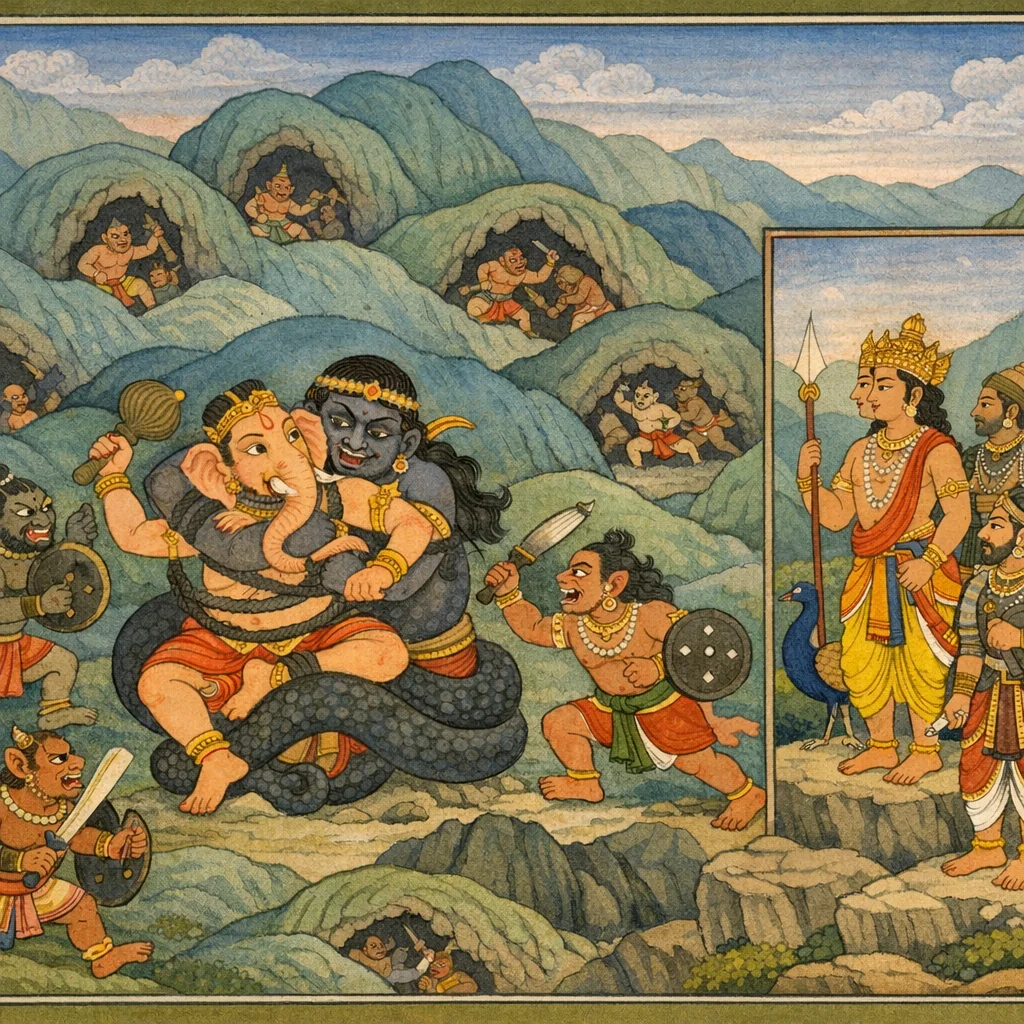
Adhyaya 42: The Battle at Mandara: Vinayaka, Nandin, and Skanda Rout the Daitya Hosts
मन्दरयुद्ध-वर्णनम् (Mandara-yuddha-varṇanam)
Vinayaka, Nandin, and Skanda Rout the Daityas
Within the Pulastya–Nārada narrative frame, this Adhyāya shifts into a distinctly Śaiva martial episode centered on Mandara-parvata, the caverned stronghold of the Pramathas. Andhaka arrives with Daitya forces, provoking a cosmic din that draws Vināyaka (Vighnarāja) into the conflict. Śiva (Hara), after instructing Ambikā and her attendant goddesses to remain vigilant, mounts Vṛṣabha and proceeds to battle amid auspicious and ominous portents—an iconographic and omenological register typical of Purāṇic war-books. The fighting foregrounds Gaṇeśvara lineages (Vināyaka and multiple gaṇas) and culminates in successive reversals: Tuhuṇḍa’s assault, Rāhu’s binding of Vināyaka, and the counterstrikes by Mahodara and other gaṇas. Asura champions (e.g., Bali, Duryodhana, Hastī, Śambara) engage Nandin and Skanda’s circle (Viśākha, Naigameya, Śākha), ending with Daitya troops seeking refuge with Śukra. Though overt Vaiṣṇava material is minimal here, the chapter contributes to the Purāṇa’s syncretic theology by presenting Śiva’s gaṇic order as a cosmic stabilizing force within the broader Hari–Hara compatible Purāṇic universe.
Divine Beings
Sacred Geography
Mortal & Asura Figures
Key Content Points
- Andhaka reaches Mandara with Daitya allies; Pramathas raise a battle-clamor, and Vināyaka (Vighnarāja) is drawn into the fray.
- Śiva’s departure sequence: counsel to Ambikā and her attendants, mounting Vṛṣabha, and the appearance of battle-omens (nimittas) interpreted as signs of victory.
- Major combat cycle: Tuhuṇḍa and Rāhu challenge the gaṇas; Vināyaka is struck and bound; gaṇeśvaras retaliate, leading to routs and renewed Daitya offensives.
- Escalation with named Asura champions (Bali, Duryodhana, Hastī, Śambara) versus Nandin and Skanda’s commanders (Viśākha, Naigameya, Śākha); Daitya forces ultimately flee and take refuge with Śukra.
Shlokas in Adhyaya 42
Verse 1
आच्छादितो गिरिवरः प्रमथैर्घनाभै राभाति शुक्लतनुरीश्वरपादजुष्टः नीलाजिनातततनुः शरदभ्रवर्णो यद्वद् विभाति बलवान् वृषभो हरस्य // वम्प्_41.59 इति श्रीवामनपुराणे एकचत्वारिशो ऽध्यायः पुलस्त्य उवाच एतस्मिन्नन्तरे प्राप्तः समं दैत्यैस्तथान्धकः मन्दरं पर्वतश्रेष्ठं प्रमथाश्रितकन्दरम्
Śukra said: ‘Salutations to you, the giver of boons; salutations to Hara, the abode of virtues. Salutations again and again to Śaṅkara, to Maheśa, to Tryambaka.’
Verse 5
प्रणिपत्य तथा भक्त्या वाक्यमाह महेश्वरम् किं तिष्ठसि जगन्नाथ समुत्तिष्ठ रणोत्सुकः
Having bowed down with devotion, he spoke these words to Maheśvara: “Why do you stand still, O Lord of the world? Rise up—eager for battle!”
Verse 15
दक्षिणाङ्गं नखान्तं वै समकम्पत शूलिनः शकुनिश् चापि हारीतो मौनी याति पराङ्गमुखः
The right limb of the trident-bearer trembled, down to the tips of the nails; and a bird too—the greenish one (hārīta)—went silently, turning its face away.
Verse 16
निमित्तानीदृशान् दृष्ट्वा भूतभव्यभवो विभुः शैलादिं प्राह वचनं सस्मितं शशिशेखरः
Having seen such omens, the all-pervading Lord—source of past and future—Śiva, the Moon-crested (Śaśiśekhara), spoke to Śailādi with a gentle smile.
Verse 17
हर उवाच नन्दिन् जजो ऽद्य मे भावी न कथञ्चित् पराजयः निमित्तानीह दृस्यन्ते संभूतानि गणेश्वर
Hara said: “O Nandin, today victory shall be mine; in no way shall there be defeat for me. Here, O lord of the gaṇas, the omens are seen to have arisen, as confirmation.”
Verse 18
तच्छंभुवचनं श्रुत्वा शैलादिः प्राह संकरम् कः संदेहो महादेव यत् त्वं जयसि शात्रवान्
Hearing that speech of Śambhu, Śailādi said to Śaṅkara: “What doubt is there, O Mahādeva, that you will conquer the enemies?”
Verse 19
तच्छंभुवचनं श्रुत्वा शैलादिः प्राह शङ्करम् समादिदेश युद्धाय महापशुपतैः सह
Having heard that utterance of Śambhu, Śailādi addressed Śaṅkara and issued the command to engage in battle, together with the great Pāśupatas.
Verse 20
ते ऽभ्येत्य दानवबलं मर्दयन्ति स्म वेगिताः नानाशस्त्रधरा वीरा वृक्षानशनयो यथा
They, rushing forward, began to crush the army of the Dānavas—swift-moving heroes bearing many kinds of weapons—like a force that consumes trees.
Verse 21
ते वध्यमाना बलिभिः प्रमथैर्दैत्यदानवाः प्रवृत्ताः प्रमथान् हन्तुं कूटमुद्गरपाणयः
Being slain by the powerful Pramathas, those Daityas and Dānavas set about to kill the Pramathas, with clubs and mallets in their hands.
Verse 22
ततो ऽम्बरतले देवाः सेन्द्रविष्णुपितामहाः ससूर्याग्निपुरोगास्तु समायाता दिदृक्षवः
Then, in the expanse of the sky, the gods—together with Indra, Viṣṇu, and Pitāmaha (Brahmā), and with Sūrya and Agni at their head—assembled, desiring to witness what was about to occur.
Verse 23
ततो ऽम्बरतले घोषः सस्वनः समजायत गीतवाद्यादिसंमिश्रो दुन्दुभीनां कलिप्रिय
Then, in the sky, a clamorous sound arose—resounding, mingled with songs, musical instruments, and the like—a tumult dear to the beating of kettledrums (dundubhis).
Verse 24
ततः पश्यत्सु देवेषु महापाशुपतादयः गणास्तद्दानवं सैन्यं जिघांसन्ति स्म कोपिताः
Then, while the gods looked on, the gaṇas—beginning with the great Pāśupatas—angered, sought to slay that army of Dānavas.
Verse 25
चतुरङ्गबलं दृष्ट्वा हन्यमानं गणेश्वरैः क्रोधान्वितस्तुहुण्डस्तु वेगोनाबिससार ह
Seeing the fourfold army being cut down by the lords of the gaṇas, Huṇḍa—filled with wrath—rushed forward at great speed.
Verse 26
आदाय परिघं घोरं पट्टोद्ब्द्धमयस्मयम् राजतं राजते ऽत्यर्थमिन्द्रध्वजमिवोच्छ्रितम्
Taking up a dreadful iron club (parigha), bound fast with straps, he shone brilliantly, raised aloft like Indra’s banner.
Verse 27
तं भ्रामयानो बलवान् निजघान रणे गणान् रुद्राद्याः स्कन्दपर्यन्तास्ते ऽभज्यन्त भयातुराः
Whirling it about, the mighty one struck the gaṇas in battle; and those forces, from Rudra onward up to Skanda, were shattered and scattered, distressed with fear.
Verse 28
तत्प्रभग्नं बलं दृष्ट्वा गणनाथो विनायकः समाद्रवत वेगेन तुहुण्डं दनुरुङ्गवम्
Seeing that force shattered, Gaṇanātha Vināyaka rushed forward with speed against Tuhuṇḍa, the foremost among the Dānava warriors.
Verse 29
आपतन्तं गणपतिं दृष्ट्वा दैत्यो दुरात्मवान् परिघं पातयामास गुम्भपृष्ठे महाबलः
Seeing Gaṇapati charging toward him, the wicked-souled Daitya, mighty in strength, struck down a parigha (iron club/bar) upon the back of his elephant-like head.
Verse 30
विनायकस्य तत्कुम्भे परिघं वज्रभूषणम् शतधा त्वगमद् ब्रह्मन् मेरोः कूट इवाशनिः
But upon that ‘kumbha’ of Vināyaka, the parigha—hard as a thunderbolt—shattered into a hundred pieces, O Brāhmaṇa, like a lightning-bolt striking the peak of Mount Meru.
Verse 31
परिघं विफलं दृष्ट्वा समायान्तं च पार्षदम् बबन्ध बाहुपाशेन राहू रक्षन् हि मातुलम्
Seeing that the parigha had proved ineffective, and that the attendant (pārṣada) was advancing, Rāhu—indeed protecting his maternal uncle—bound him with the noose of his arms.
Verse 32
स बद्धो बाहुपासेन बलादाकृष्य दानवम् समाजघान शिरशि कुठारेण महोदरः
Though bound by the arm-noose, Mahodara, forcefully drawing the dānava toward him, struck him on the head with an axe.
Verse 33
काष्ठवत् स द्विधा भूतो निपपात धरातले तथापि नात्यजद् राहुर्बलवान् दानवेश्वरः स मोक्षार्थे ऽकरोद् यत्नं न शशाक च नारद
Split in two, he fell upon the ground like a piece of wood. Yet Rāhu, the mighty lord of the dānavas, did not give up; striving for release (mokṣa), he made effort—but he could not succeed, O Nārada.
Verse 34
विनायकं संयतमीक्ष्य राहुणा कुण्डोदरो नाम गणेश्वरो ऽथ प्रगृह्य तूर्ण मुशलं महात्मा राहुं दुरात्मानमसौ जघान
Seeing that Vināyaka was engaged in combat with Rāhu, a Gaṇa-lord named Kuṇḍodara—great-souled—quickly seized a club and struck the wicked Rāhu.
Verse 35
ततो गणेशः कलशध्वजस्तु प्रासेन राहुं हृदये बिभेद घटोदरो वै गदया जघान खड्गेन रक्षो ऽधिपतिः सुकेशी
Then Gaṇeśa—(the one) bearing the banner marked with a water-pot—pierced Rāhu in the heart with a spear. Ghaṭodara struck (him) with a mace, and the rākṣasa-chief Sukeśī (struck) with a sword.
Verse 36
स तैश्चतुर्भिः परिताड्यमानो गणाधिपं राहुरथोत्ससर्ज संत्यक्तमात्रो ऽथ परश्वधेन तुहुण्मूर्द्धानमथो बिभेद
Struck all around by those four, Rāhu then hurled (a weapon/assault) at the Gaṇa-chief. And then, with an axe, Tu(h)uṇmūrddhā split (him/it).
Verse 37
हते तुहुण्डे विमुखे च राहौ गणेश्वराः क्रोधविषं मुमुक्षवः पञ्चैककालानलसन्निकाशा विशान्ति सेनां दनुपुङ्गवानाम्
When Tuhaṇḍa, Vimukha, and Rāhu had been slain, the Gaṇeśvaras—eager to discharge the poison of their wrath—entered the army of the foremost Dānavas, blazing like the fires of dissolution at the end of the fivefold time-cycle.
Verse 38
तां बध्यमानां स्वचमूं समीक्ष्यचबलिर्बली मारुततुल्यवेगः गदां समाविध्य जघान मूर्ध्नि विनायकं कुम्भतटे करे च
Seeing his own army being bound/overpowered, mighty Bali—swift as the wind—whirled his mace and struck Vināyaka on the head, on the temple of the elephant (his cheek/forehead), and on the hand as well.
Verse 39
कुण्डोदरं भग्नकटिं चकार महोदरं शीर्णशिरःकपालम् कुम्भध्वजं चूर्णितसंधिबन्धं घटोदरं चोरुविभिन्नसंधिम्
He made Kuṇḍodara’s waist shattered; Mahodara’s skull and head-bone broken; Kumbhadhvaja’s joint-fastening crushed; and Ghaṭodara’s thigh-joints split apart.
Verse 40
गणाधिपांस्तान् विमुखान् स कृत्वा बलन्वितो वीरतरो ऽसुरेन्द्रः समभ्यधावत् त्वरितो निहन्तुं गणेश्वरान् स्कन्दविशाखमुख्यान्
Having turned those leaders of the gaṇas away (driven them back), the mighty and most valiant lord of the asuras rushed forward in haste to slay the gaṇa-lords—those headed by Skanda and Viśākha.
Verse 41
तमापतन्तं भगवान् समीक्ष्य महेश्वरः श्रेष्ठतमं गणानाम् शैलादिमामन्त्र्य वचो बभाषे गच्छस्व दैत्यान् जहि वीर युद्ध
Seeing him charging in, the Blessed Lord Maheśvara, addressing Śailādi—the foremost among the gaṇas—spoke these words: “Go, hero; in battle, strike down the daityas.”
Verse 42
इत्येवमुक्तो वृषभध्वजेन वज्रं समादाय शिलादसूनुः बलिं सम्भ्येत्य जघान मूर्ध्नि संमोहितः सो ऽवनिमाससाद
Thus instructed by the Bull-bannered Lord (Śiva), the son of Śilāda took up a thunderbolt-like weapon; approaching Bali, he struck him upon the head. Bewildered, Bali fell down upon the ground.
Verse 43
संमोहितं भ्रातृसुतं विदित्वा बली कुजम्भो मुसलं प्रगृह्य संभ्रामयंस्तूर्णतरं स वेगात् ससर्ज नन्दिं प्रति जातकोपः
Realizing that his brother’s son had been bewildered, the powerful Kujambha seized a mace. Whirling it with even greater speed, and inflamed with anger, he hurled it with force against Nandī.
Verse 44
तमापतन्तं मुसलं प्रगृह्य करेण तूर्ण भगवान् स नन्दी जघान तेनैव कुजम्भमाहवे स प्राणहीनो निपपात भूमौ
Swiftly seizing with his hand that incoming mace, the revered Nandī struck Kujambha in battle with that very weapon; and Kujambha, bereft of life, fell upon the ground.
Verse 45
हत्वा कुजम्भं मुसलेन नन्दी वज्रेण वीरः शतशो जघान ते वध्यमाना गणनायकेन दुर्योधनं वै शरणं प्रपन्नाः
After killing Kujambha with the mace, the heroic Nandī struck down hundreds with a thunderbolt-like weapon. Being slain by the leader of the gaṇas, they indeed sought refuge with Duryodhana.
Verse 47
दुर्योधनः प्रेक्ष्य गणाधिपेन वज्रपहारैर्निहतान् दितीशान् प्रासं समाविध्य तडित्प्रकाशं नन्दिं प्रचिक्षेप हतो ऽसि वै ब्रुवन् // वम्प्_42.46 तमापतन्तं कुलिशेन नन्दी बिभेद गुह्यं पिशुनो यथा नरः तत्प्रासमालक्ष्य तदा निकृत्तं संवर्त्त्य मुष्टिं गणमाससाद
Duryodhana, seeing the Diti-born Daityas struck down by the thunderbolt-blows of the Lord of the Gaṇas, hurled a spear, bright as lightning, at Nandin, crying, “You are slain!” As it came rushing on, Nandin shattered it with his thunderbolt, as a man breaks a treacherous foe. Seeing that spear cut down, he clenched his fist and advanced upon the host of Gaṇas.
Verse 48
ततो ऽस्य नन्दी कुलिसेन तृर्ण शिरो ऽच्छिनत् तालफलप्रकाशम् हतो ऽथ भूमौ निपपात वेगाद् दैत्याश्च भीता विगता दिशो दश
Then Nandin, with his thunderbolt, cut off his head, shining like a palmyra fruit. Slain, he fell swiftly to the ground; and the Daityas, terrified, fled in all ten directions.
Verse 49
ततो हतं स्वं तनयं निरीक्ष्य हस्ती तदा नन्दिनमाजगाम प्रगृह्य बाणासनमुग्रवेगं बिभेद बाणैर्यमदण्डकल्पैः
Then Hastin, seeing his own son slain, came against Nandin. Taking up his bow with fierce speed, he pierced him with arrows like the staff of Yama.
Verse 50
गणान् सन्दीन् वृषभध्वजांस्तान् धाराभिरेवाम्बुरास्तु शैलान् ते छाद्यमानासुरबामजालैर्विनायकाद्या बलिनो ऽपि समन्तान्
Kumāra checked Pṛṣatkāntha with his spear. Then
Verse 53
अमरारिबलं दृष्ट्वा भग्नं क्रुद्धा गणेश्वराः पुरतो नन्दिनं कृत्वा जिघांसन्ति स्म दानवान्
Seeing the army of the gods’ enemies routed, the furious lords of Śiva’s gaṇas, placing Nandin in the vanguard, set about to slay the Dānavas.
Verse 54
ते वध्यमानाः प्रमथैर्दैत्याश्चापि पराङ्मुखाःष भूयो निवृत्ता बलिनः कार्त्तस्वरपुरोगमाः
Though being slain by the Pramathas, the Daityas too turned away; yet again those powerful ones—led by Kārttasvara—returned to the fight.
Verse 55
तान् निवृत्तान् समीक्ष्यैव क्रोधदीप्तेक्षणः श्वशसन् नन्दिषेणो व्याघ्रमुखो निवृत्तश्चापि वेगवान्
Seeing them return, Nandiṣeṇa—his gaze blazing with wrath, snorting—Vyāghramukha, swift and impetuous, also turned back to meet them.
Verse 56
तस्मिन् निवृत्ते गणपे पट्टिशाग्रकरे तदा कार्त्तस्वरो निववृते गदामादाय नारद
O Nārada, when that Gaṇapa, leader of the gaṇas, holding the sharp-edged battle-axe (paṭṭiśa), turned back, Kārttasvara too turned back, taking up his mace.
Verse 58
तमापतन्तं ज्वलनप्रकाशं गमः समीक्ष्यैव महासुरेन्द्रम् तं पट्टिशं भ्राम्य जघान मूर्ध्नि कार्तस्वरं विस्वरमुन्नदन्तम् // वम्प्_42.57 तस्मिन् हते समाविध्य तुरङ्गकन्धरः बबन्ध वीरः सह पट्टिशेन गणेश्वरं चाप्यथ नन्दिषेणम्
Seeing that great lord of the asuras rushing in, blazing like fire, the gaṇa-warrior whirled his battle-axe (paṭṭiśa) and struck Kārttasvara on the head as he roared loudly. When he was slain, the hero Turaṅgakandhara advanced and captured Gaṇeśvara and also Nandiṣeṇa by force in the engagement with the paṭṭiśa.
Verse 59
नन्दिषेणं तथा बद्धं समीक्ष्य बलिनां वरः विशाखः कपितो ऽभ्येत्य शक्तिपाणिरवस्थितः
Seeing Nandiṣeṇa thus bound, Viśākha—foremost among the mighty—came forward; and the tawny one (kapitaḥ), spear in hand, stood his ground, ready for battle.
Verse 60
तं दृष्ट्वा बलिनां श्रेष्ठः पाशपाणिरयःशिराः संयोधयामास बली विशाखं कुक्कुटध्वजम्
Seeing him, Ayaḥśiras—best among Bali’s asura host, a noose (pāśa) in his hand—joined battle with Viśākha, whose banner bore the emblem of a cock.
Verse 61
विशाखं संनिरुद्धं वै दृष्ट्वायशिरसा रणे शाखश्च नैगमेयश्च तूर्णमाद्रवतां रिपुम्
Seeing Viśākha held in check in battle by Ayaḥśiras, Śākha and Naigameya swiftly rushed toward the enemy.
Verse 62
एकतो नैगमेयेन भिन्नः शक्त्या त्वयःसिराः शाखश्च नैगमेयश्च तूर्णमाद्रवतां रिपुम्
On one side, Ayaḥśiras was pierced by Naigameya with a spear (śakti). Then Śākha and Naigameya swiftly rushed upon the enemy.
Verse 63
स त्रिभिः शङ्करसुतैः पीड्यमानो जहौ पणम् ते प्राप्ताः शम्बरं तूर्णं प्रेक्ष्यमाणा गणेश्वराः
Hard pressed by three sons of Śaṅkara, he abandoned his stratagem. Those lords of the Gaṇas swiftly reached Śambara, keeping him under close watch.
Verse 64
पाशं शक्त्या समाहत्य चतुर्भिः शङ्करात्मजैः जगाम विलयं तूर्णमाकासादिव भूतलम्
Struck by a spear-weapon wielded by the four sons of Śaṅkara, the noose (pāśa) swiftly dissolved—like the earth seeming to vanish into the sky.
Verse 65
पाशे निराशतां याते शम्बरः कातरेक्षणः दिशो ऽथ भेजे देवर्षे कुमारः सैन्यमर्दयत्
When the noose (pāśa) had come to naught, Śambara—his gaze anxious—fled toward the quarters, O divine seer; and Kumāra crushed the army.
Verse 66
तैर्वध्यमाना पृतना महर्षे सादानवी रुद्रसुतैर्गणैश्च विषण्णारूपा भयविह्वलाङ्गी जगाम सुक्रं शरणं भयार्ता
O great sage, that army of the Dānavas, being slaughtered by them—by the gaṇas, the sons/attendants of Rudra—became dejected in appearance, its limbs shaken with fear; afflicted by terror, it went to Śukra for refuge.
Frequently Asked Questions
Although the narrative is predominantly Śaiva (Śiva, Vināyaka, Nandin, Skanda and the gaṇas), it is embedded in a Purāṇic universe where major deities (including Viṣṇu) appear as cosmic witnesses and participants in dharma’s maintenance. The chapter models functional unity: different divine orders uphold cosmic stability against asura-dharma, consistent with the Vāmana Purāṇa’s broader Hari–Hara compatibility.
The chapter’s topography is primarily martial rather than pilgrimage-oriented. It sacralizes Mandara-parvata by emphasizing its pramatha-inhabited caverns (kandaras) as a divine stronghold and by staging the Devas’ aerial witnessing (ambaratala). No explicit Sarasvatī-basin tirtha catalog, bathing merit (snāna-phala), or ritual prescription is foregrounded in this passage.
Bali appears as a frontline asura champion who directly strikes Vināyaka and turns the tide momentarily, prompting Śiva to deploy Nandin decisively. The sequence culminates in repeated daitya retreats and, finally, the asura host seeking refuge with Śukra—an asura-dharma motif that frames their survival strategy through counsel and protection rather than victory.