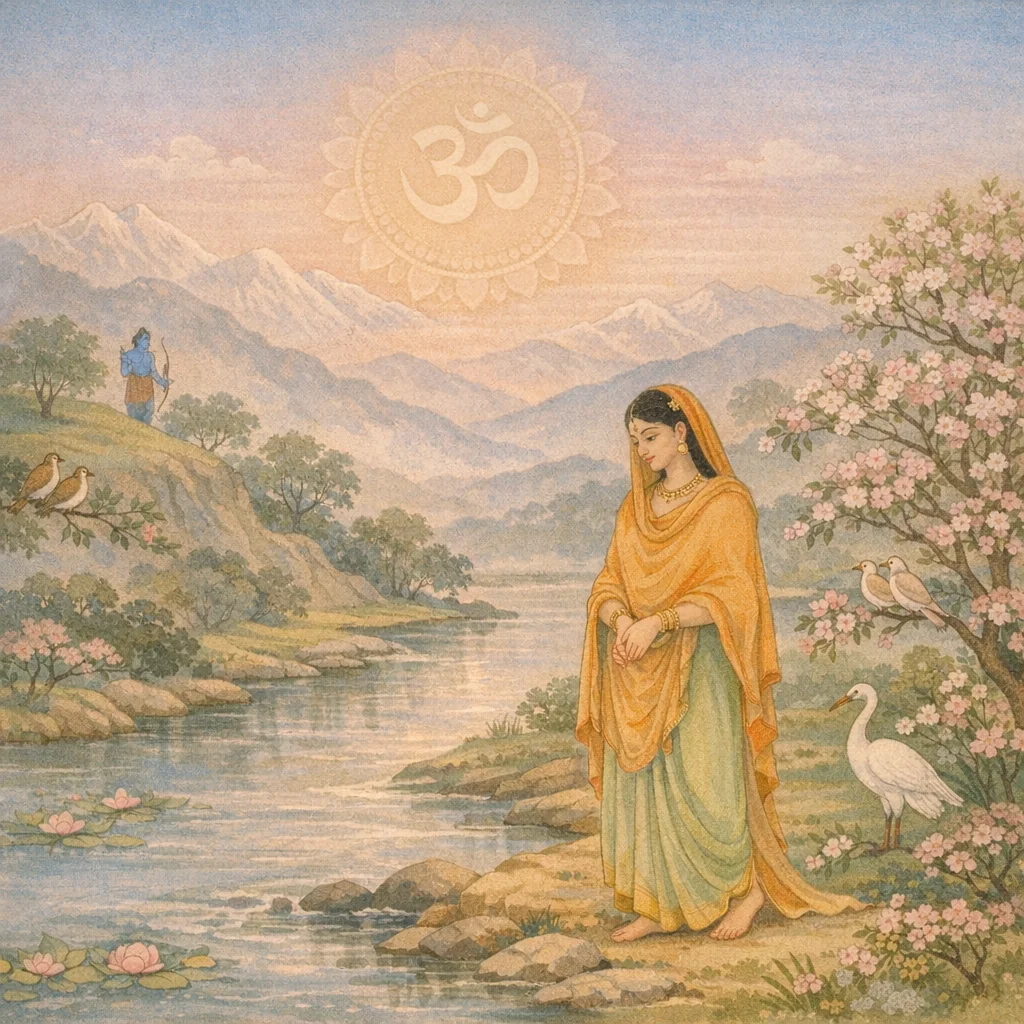
Sita
The Sītā Upaniṣad, later associated with the Atharvaveda and commonly grouped among Śākta minor Upaniṣads, reconfigures Sītā from the Rāmāyaṇa as more than an exemplary consort of Rāma: she is Parāśakti, the supreme divine power, and is identified with Brahman itself. In a style that blends hymn and metaphysical assertion, the text translates epic devotion into Upaniṣadic inquiry, treating the Goddess as the key to understanding Ātman, Brahman, and liberation. In its historical-intellectual setting, the Upaniṣad reflects a broader movement to interpret Purāṇic and epic deities through Vedāntic categories. Its distinctive “Śākta–Vaiṣṇava” profile lies in this synthesis: Sītā is inseparable from Rāma, yet she is simultaneously the cosmic power of creation, preservation, and dissolution. The epic relationship becomes a theological grammar for articulating the unity of consciousness and power. Philosophically, Sītā is presented as the all-pervading witness-consciousness and the inner self of all beings, while also remaining transcendent beyond limiting attributes. Knowledge of Sītā as Brahman dispels fear, sorrow, and bondage; bhakti (praise, remembrance) is not opposed to jñāna but matures into it, culminating in mokṣa as stable, non-dual recognition. Thus, the Sītā Upaniṣad both legitimizes Sītā worship with Upaniṣadic authority and offers a contemplative path in which devotion to the Goddess becomes direct realization of the ultimate reality.
Start ReadingKey Teachings
- Sītā as Devī: identification of Sītā with the supreme Goddess (Īśvarī/Śakti) and with Brahman
- Śākta–Vaiṣṇava synthesis: Sītā’s inseparability from Rāma
yet her status as the cosmic power underlying all forms
- Ātman–Brahman recognition: the inner self is not other than the Goddess; liberation arises from direct knowledge (jñāna)
- Śakti as cosmological principle: creation
maintenance
and dissolution occur through the Goddess’s power
- Bhakti as contemplative discipline: devotion
praise
and remembrance mature into non-dual realization
- Immanence and transcendence: the Goddess pervades the world while remaining beyond limiting attributes
- Mokṣa as freedom from fear and sorrow: knowledge of Sītā-Brahman removes bondage and grants abiding peace
Verses of the Sita
37 verses with Sanskrit text, transliteration, and translation.
Verse 1
देवा ह वै प्रजापतिम् अब्रुवन्—का सीता, किं रूपम् इति । स होवाच प्रजापतिः—सा सीतेति । मूलप्रकृतिरूपत्वात् सा सीता प्रकृतिः स्मृता । प्रणवप्रकृतिरूपत्वात् सा सीता प्रकृतिर् उच्यते । सीता इति त्रिवर्णात्...
The gods said to Prajāpati: “Who is Sītā, and what is her form?” Prajāpati replied: “She is Sītā.” Because she is of the nature of the root-Prakṛti (Mūla-Prakṛti), Sītā is remembered as Prakṛti; and because she is of the nature of the Prakṛti of the praṇava (Oṃ), she is called Prakṛti. “Sītā” is of three phonemes and is directly Māyā. Viṣṇu is the seed of the manifested world; Māyā is said to be the vowel ī. The phoneme sa is declared to be truth, immortality, attainment, and Soma; the phoneme ta is remembered as tāra-prosperity and as the cosmic expanse (vairāja). In the form of ī, adorned with divine ornaments—garlands, pearls, and the like—Mahāmāyā, unmanifest in essence, becomes manifest. The first is Śabda-Brahman, pleased at the time of Vedic recitation, bringing forth manifestation, and sattvic; the second arises on earth at the tip of the plough; the third, in the form of ī, is of unmanifest nature—thus they speak of “Sītā.”
Māyā/Prakṛti as the manifesting power (Śakti) associated with Praṇava and cosmic creationVerse 2
देवा ह वै प्रजापतिम् अब्रुवन्—का सीता, किं रूपम् इति । स होवाच प्रजापतिः—सा सीतेति । मूलप्रकृतिरूपत्वात् सा सीता प्रकृतिः स्मृता । प्रणवप्रकृतिरूपत्वात् सा सीता प्रकृतिर् उच्यते । सीता इति त्रिवर्णात्...
The gods said to Prajāpati: “Who is Sītā, and what is her form?” Prajāpati replied: “She is Sītā.” Since she is of the form of the root-Prakṛti (Mūla-Prakṛti), Sītā is remembered as Prakṛti; and since she is of the form of the Prakṛti of the praṇava (Oṃ), she is called Prakṛti. “Sītā” consists of three phonemes and is directly Māyā. Viṣṇu is the seed of the phenomenal world; Māyā is said to be the vowel ī. The phoneme sa is declared to be truth, immortality, attainment, and Soma; the phoneme ta is remembered as tāra-prosperity and as the cosmic expanse (vairāja). In the form of ī, adorned with divine ornaments—garlands, pearls, and the like—Mahāmāyā, unmanifest in form, becomes manifest. The first is Śabda-Brahman, pleased during Vedic study, productive of manifestation, and sattvic; the second arises on earth at the tip of the plough; the third, in the form of ī, is unmanifest in nature—thus they speak of “Sītā.”
Śakti as Māyā/Prakṛti; phonemic theology (śabda-tattva) linked to PraṇavaVerse 3
देवा ह वै प्रजापतिम् अब्रुवन्—का सीता, किं रूपम् इति । स होवाच प्रजापतिः—सा सीतेति । मूलप्रकृतिरूपत्वात् सा सीता प्रकृतिः स्मृता । प्रणवप्रकृतिरूपत्वात् सा सीता प्रकृतिर् उच्यते । सीता इति त्रिवर्णात्...
The gods asked Prajāpati: “Who is Sītā, and what is her form?” Prajāpati answered: “She is Sītā.” Because she is of the nature of the root-Prakṛti (Mūla-Prakṛti), Sītā is remembered as Prakṛti; and because she is of the nature of the Prakṛti of the praṇava (Oṃ), she is called Prakṛti. “Sītā” is of three phonemes and is directly Māyā. Viṣṇu is the seed of the phenomenal world; Māyā is said to be the vowel ī. The phoneme sa is declared to be truth, immortality, attainment, and Soma; the phoneme ta is remembered as tāra-prosperity and as the cosmic expanse (vairāja). In the form of ī, adorned with divine ornaments—garlands, pearls, and the like—Mahāmāyā, unmanifest in form, becomes manifest. The first is Śabda-Brahman, pleased during Vedic recitation, productive of manifestation, and sattvic; the second arises on earth at the tip of the plough; the third, in the form of ī, is unmanifest in nature—thus they speak of “Sītā.”
Māyā-Śakti (Prakṛti) and Śabda-Brahman; manifestation from avyakta to vyaktaVerse 4
देवा ह वै प्रजापतिमब्रुवन्—का सीता किं रूपमिति । स होवाच प्रजापतिः—सा सीतेति । मूलप्रकृतिरूपत्वात् सा सीता प्रकृतिः स्मृता । प्रणवप्रकृतिरूपत्वात् सा सीता प्रकृतिरुच्यते । सीता इति त्रिवर्णात्मा साक्ष...
The gods indeed said to Prajāpati: “Who is Sītā, and what is her form?” Prajāpati replied: “She is Sītā.” Because she bears the nature of the root-Prakṛti (mūla-prakṛti), Sītā is remembered as Prakṛti; and because she bears the nature of the Prakṛti of the praṇava (Oṃ), Sītā is also spoken of as Prakṛti. “Sītā” is of threefold sound, constituted of three phonemes, and is directly made of Māyā. Viṣṇu is the seed of the manifested world; Māyā is called the phoneme “ī”. The phoneme “sa” is declared to be truth, immortality, attainment, and also Soma. The phoneme “ta” is remembered as the prosperity of “tāra” and as the cosmic (vairāja) expanse or stratum. Taking the form of “ī”, the Great Māyā—unmanifest in form—becomes manifest, adorned with divine ornaments, garlands, pearls, and other adornments, composed of the nectar-like portions of Soma. The first aspect is of Śabda-Brahman, delighted at the time of Vedic recitation, bringing forth manifestation, sāttvic. The second arises upon the earth at the tip of the ploughshare. The third, having the form of “ī”, is of unmanifest nature—thus they proclaim her as “Sītā”.
Māyā–Prakṛti (Śakti) as the manifesting power associated with Praṇava and cosmic creationVerse 5
देवा ह वै प्रजापतिमब्रुवन्—का सीता किं रूपमिति । स होवाच प्रजापतिः—सा सीतेति । मूलप्रकृतिरूपत्वात् सा सीता प्रकृतिः स्मृता । प्रणवप्रकृतिरूपत्वात् सा सीता प्रकृतिरुच्यते । सीता इति त्रिवर्णात्मा साक्ष...
The gods indeed said to Prajāpati: “Who is Sītā, and what is her form?” Prajāpati replied: “She is Sītā.” Because she bears the nature of the root-Prakṛti (mūla-prakṛti), Sītā is remembered as Prakṛti; and because she bears the nature of the Prakṛti of the praṇava (Oṃ), Sītā is also spoken of as Prakṛti. “Sītā” is of threefold sound, constituted of three phonemes, and is directly made of Māyā. Viṣṇu is the seed of the manifested world; Māyā is called the phoneme “ī”. The phoneme “sa” is declared to be truth, immortality, attainment, and also Soma. The phoneme “ta” is remembered as the prosperity of “tāra” and as the cosmic (vairāja) expanse or stratum. Taking the form of “ī”, the Great Māyā—unmanifest in form—becomes manifest, adorned with divine ornaments, garlands, pearls, and other adornments, composed of the nectar-like portions of Soma. The first aspect is of Śabda-Brahman, delighted at the time of Vedic recitation, bringing forth manifestation, sāttvic. The second arises upon the earth at the tip of the ploughshare. The third, having the form of “ī”, is of unmanifest nature—thus they proclaim her as “Sītā”.
Māyā–Prakṛti (Śakti) and mantra-ontology (sound as cosmogenic principle)Verse 6
देवा ह वै प्रजापतिमब्रुवन्—का सीता किं रूपमिति । स होवाच प्रजापतिः—सा सीतेति । मूलप्रकृतिरूपत्वात् सा सीता प्रकृतिः स्मृता । प्रणवप्रकृतिरूपत्वात् सा सीता प्रकृतिरुच्यते । सीता इति त्रिवर्णात्मा साक्ष...
The gods indeed said to Prajāpati: “Who is Sītā, and what is her form?” Prajāpati replied: “She is Sītā.” Because she bears the nature of the root-Prakṛti (mūla-prakṛti), Sītā is remembered as Prakṛti; and because she bears the nature of the Prakṛti of the praṇava (Oṃ), Sītā is also spoken of as Prakṛti. “Sītā” is of threefold sound, constituted of three phonemes, and is directly made of Māyā. Viṣṇu is the seed of the manifested world; Māyā is called the phoneme “ī”. The phoneme “sa” is declared to be truth, immortality, attainment, and also Soma. The phoneme “ta” is remembered as the prosperity of “tāra” and as the cosmic (vairāja) expanse or stratum. Taking the form of “ī”, the Great Māyā—unmanifest in form—becomes manifest, adorned with divine ornaments, garlands, pearls, and other adornments, composed of the nectar-like portions of Soma. The first aspect is of Śabda-Brahman, delighted at the time of Vedic recitation, bringing forth manifestation, sāttvic. The second arises upon the earth at the tip of the ploughshare. The third, having the form of “ī”, is of unmanifest nature—thus they proclaim her as “Sītā”.
Śakti as Māyā (unmanifest-to-manifest), linked to praṇava and cosmogenesisVerse 7
श्रीरामसान्निध्यवशाज्जगदानन्दकारिणी । उत्पत्तिस्थितिसंहारकारिणी सर्वदेहिनाम् । सीता भगवती ज्ञेया मूलप्रकृतिसंज्ञिता । प्रणवत्वात्प्रकृतिरिति वदन्ति ब्रह्मवादिन इति । अथातो ब्रह्मजिज्ञासेति च ॥७॥
By the power of Śrī Rāma’s nearness, she brings forth the bliss of the world. She is the doer of creation, preservation, and dissolution for all embodied beings. Sītā is to be known as the Blessed Goddess, called the root Prakṛti. Because she is of the nature of the praṇava (Oṃ), the knowers of Brahman declare, “She is Prakṛti.” And also: “Now, therefore, the inquiry into Brahman.”
Māyā/Prakṛti (Śakti) as the cosmic power associated with Brahman; Brahma-jijñāsāVerse 8
श्रीरामसान्निध्यवशाज्जगदानन्दकारिणी । उत्पत्तिस्थितिसंहारकारिणी सर्वदेहिनाम् । सीता भगवती ज्ञेया मूलप्रकृतिसंज्ञिता । प्रणवत्वात्प्रकृतिरिति वदन्ति ब्रह्मवादिन इति । अथातो ब्रह्मजिज्ञासेति च ॥८॥
By the power of Śrī Rāma’s nearness, she brings forth the bliss of the world. She is the doer of creation, preservation, and dissolution for all embodied beings. Sītā is to be known as the Blessed Goddess, called the root Prakṛti. Because she is of the nature of the praṇava (Oṃ), the knowers of Brahman declare, “She is Prakṛti.” And also: “Now, therefore, the inquiry into Brahman.”
Śakti (Prakṛti/Māyā) and Brahman-inquiryVerse 9
श्रीरामसान्निध्यवशाज्जगदानन्दकारिणी । उत्पत्तिस्थितिसंहारकारिणी सर्वदेहिनाम् । सीता भगवती ज्ञेया मूलप्रकृतिसंज्ञिता । प्रणवत्वात्प्रकृतिरिति वदन्ति ब्रह्मवादिन इति । अथातो ब्रह्मजिज्ञासेति च ॥९॥
By the power of Śrī Rāma’s nearness, she brings forth the bliss of the world. She is the doer of creation, preservation, and dissolution for all embodied beings. Sītā is to be known as the Blessed Goddess, called the root Prakṛti. Because she is of the nature of the praṇava (Oṃ), the knowers of Brahman declare, “She is Prakṛti.” And also: “Now, therefore, the inquiry into Brahman.”
Brahman–Śakti inseparability; Māyā/Prakṛti as dependent power; initiation of Brahma-jijñāsāVerse 10
सा सर्ववेदमयी सर्वदेवमयी सर्वलोकमयी सर्वकीर्तिमयी सर्वधर्ममयी सर्वाधारकार्यकारणमयी महालक्ष्मीर्देवेशस्य भिन्नाभिन्नरूपा चेतनाचेतनात्मिका ब्रह्मस्थावरात्मा तद्गुणकर्मविभागभेदाच्छरीरूपा देवर्षिमनुष्यगन्...
She is constituted of all the Vedas, of all the gods, of all the worlds, of all renown, and of all dharmas; she is the Support, and she is both effect and cause. As Mahālakṣmī, she is of the Lord of gods in forms both distinct and non-distinct; her nature is the sentient and the insentient; she is Brahman and the immovable world as the Self. Through the differentiation of qualities and actions she becomes embodied as gods, seers, humans, and gandharvas; as the bodies of asuras, rākṣasas, bhūtas, pretas, piśācas, and other beings. She is also known as the forms of the elements, the senses, the mind, and the vital breath (prāṇa).
Brahman–Śakti as the immanent and transcendent ground (non-duality with apparent plurality)Verse 11
सा देवी त्रिविधा भवति शक्त्यासना—इच्छाशक्तिः क्रियाशक्तिः साक्षाच्छक्तिरिति। इच्छाशक्तिस्त्रिविधा भवति—श्रीभूमिनीलात्मिका भद्ररूपिणी प्रभावरूपिणी सोमसूर्याग्निरूपा भवति। सोमात्मिका ओषधीनां प्रभवति कल्...
That Goddess becomes threefold, having power as her seat: the power of will, the power of action, and the power that is immediate (direct). The power of will becomes threefold: having the nature of Śrī, Bhūmi, and Nīlā; having the form of auspiciousness; having the form of splendour; she becomes the forms of Soma, Sūrya, and Agni. As Soma in nature she brings forth the plants—becoming the flowers and fruits of the wish-fulfilling tree, the creepers and shrubs; becoming medicines and remedies; becoming nectar (amṛta); granting to the gods the fruit of great Soma-rites; producing satisfaction—by nectar for the gods, by food for cattle, and by grass for each living being according to its kind.
Śakti-traya (icchā–kriyā–sākṣāt) and cosmic nourishment as the Divine’s immanent powerVerse 12
सा देवी त्रिविधा भवति शक्त्यासना—इच्छाशक्तिः क्रियाशक्तिः साक्षाच्छक्तिरिति। इच्छाशक्तिस्त्रिविधा भवति—श्रीभूमिनीलात्मिका भद्ररूपिणी प्रभावरूपिणी सोमसूर्याग्निरूपा भवति। सोमात्मिका ओषधीनां प्रभवति कल्...
Same passage as the preceding: the Goddess is threefold as will-power, action-power, and direct power; will-power is threefold as Śrī–Bhūmi–Nīlā and as Soma–Sun–Fire, and as Soma she generates plants and medicines, becoming nectar and nourishment for gods, cattle, and all beings.
Śakti as the operative principle of manifestation and sustenanceVerse 13
सा देवी त्रिविधा भवति—शक्त्यासना, इच्छाशक्तिः, क्रियाशक्तिः, साक्षाच्छक्तिरिति। इच्छाशक्तिस्त्रिविधा भवति—श्रीभूमिनीलात्मिका, भद्ररूपिणी, प्रभावरूपिणी; सोमसूर्याग्निरूपा भवति। सोमात्मिका ओषधीनां प्रभव...
That Goddess is threefold: as the power that is the seat and support of all, as the power of will, as the power of action, and as the power that is directly present. The power of will is threefold: of the nature of Śrī, Bhūmi, and Nīlā; of auspicious form; of the form of splendor. She becomes the forms of Soma, Sūrya, and Agni. As Soma in essence she brings forth the plants—of the nature of the wish-fulfilling tree’s flowers, fruits, creepers, and shrubs; of the nature of medicines and remedies; of the form of nectar. She grants the gods the fruit of the great Soma-rite and brings satisfaction by nectar—nourishing the gods with food, cattle with grass, and each class of living beings accordingly.
Śakti (Māyā/Prakṛti as Brahman’s power; cosmic nourishment and manifestation)Verse 14
सूर्यादिसकलभुवनप्रकाशिनी दिवा च रात्रिः कालकलानिमेषमारभ्य घटिकाष्टयामदिवसवाररात्रिभेदेन पक्षमासर्त्वयनसंवत्सरभेदेन मनुष्याणां शतायुःकल्पनया प्रकाशमाना चिरक्षिप्रव्यपदेशेन निमेषमारभ्य परार्धपर्यन्तं का...
She who illumines all the worlds, beginning with the sun, appears as day and night; beginning from the time-unit called nimeṣa and its subdivisions, through the distinctions of ghaṭikā, yāma, day, weekday, and night; through the distinctions of fortnight, month, season, solstice, and year; and through the human convention of a hundred-year lifespan—manifesting as “long” and “short” time, from a nimeṣa up to a parārdha. She is the wheel of time, the wheel of the world, and so forth, revolving like a wheel. All these are particular divisions of that very time, having the nature of illumination and having the nature of time.
Kāla (time) as a manifestation of Śakti/Brahman; cosmic order (ṛta)Verse 15
अग्निरूपा अन्नपानादिप्राणिनां क्षुत्तृष्णात्मिका देवानां मुखरूपा वनौषधीनां शीतोष्णरूपा काष्ठेष्वन्तर्बहिश्च नित्यानित्यरूपा भवति॥१५॥
As the form of Agni, for living beings dependent on food, drink, and the like, she is of the nature of hunger and thirst; for the gods, she is of the form of the mouth; for forest plants and herbs, she is of the form of cold and heat; and in pieces of wood, within and without, she becomes the forms of the eternal and the non-eternal.
Agni/Tejas as Śakti; prāṇa and yajña as cosmic exchange; māyā’s mutable forms grounded in an underlying powerVerse 16
श्रीदेवी त्रिविधं रूपं कृत्वा भगवत्सङ्कल्पानुगुण्येन लोकरक्षणार्थं रूपं धारयति। श्रीरिति लक्ष्मीरिति लक्ष्यमाणा भवतीति विज्ञायते॥१६॥
The Goddess Śrī, having assumed a threefold form in accord with the Lord’s intention, bears that form for the protection of the worlds. She is understood as “Śrī,” as “Lakṣmī,” and as the one who is aimed at and marked out (lakṣyamāṇā).
Māyā/Śakti as Brahman’s power (īśvara-saṅkalpa) manifesting for loka-saṃgraha; auspiciousness (śrī) as a soteriological principleVerse 17
भूदेवी ससागराम्भःसप्तद्वीपा वसुन्धरा भूरादिचतुर्दशभुवनानामाधाराधेया प्रणवात्मिका भवति॥१७॥
The Goddess Bhū—Earth, bearing the seven continents together with the ocean-waters—is Vasundharā. She is both the support and the supported of the fourteen worlds beginning with Bhū, and she becomes of the nature of the Praṇava (Oṃ).
Brahman as cosmic support (ādhāra) and immanence; Praṇava (Oṃ) as the essence of all worlds; Devī as the embodied cosmosVerse 18
नीला च मुखविद्युन्मालिनी सर्वौषधीनां सर्वप्राणिनां पोषणार्थं सर्वरूपा भवति॥१८॥
And she is Nīlā, garlanded with lightning at her face; for the nourishment of all herbs and all living beings, she becomes of every form.
Jagat-kāraṇa and jagat-poṣaṇa (cosmic causality and sustenance); Devī as all-forms (sarvarūpā) indicating non-dual immanenceVerse 19
समस्तभुवनस्याधोभागे जलाकारात्मिका मण्डूकमयीति भुवनाधारेति विज्ञायते॥१९॥
In the lower region of the entire universe, She—whose essence is of the form of water—is understood as “made of a frog” and as “the support of the worlds.”
Śakti as cosmic support (Ādhāra), Māyā/Prakṛti symbolismVerse 20
क्रियाशक्तिस्वरूपं हरेर्मुखान्नादः । तन्नादाद्बिन्दुः । बिन्दोरोङ्कारः । ओङ्कारात्परतो राम वैखानसपर्वतः । तत्पर्वते कर्मज्ञानमयीभिर्बहुशाखा भवन्ति॥२०॥
From the mouth of Hari arises nāda, whose very nature is the power (śakti) of action. From that nāda arises bindu; from bindu, Oṅkāra. Beyond Oṅkāra, O Rāma, is the Vaikhānasa mountain; upon that mountain there come to be many branches made of action and knowledge.
Nāda–Bindu–Oṃ genesis; Śabda as creative principle; Karma–Jñāna synthesisVerse 21
तत्र त्रयीमयं शास्त्रमाद्यं सर्वार्थदर्शनम् । ऋग्यजुःसामरूपत्वात्त्रयीति परिकीर्तिता । कार्यसिद्धेन चतुर्धा परिकीर्तिता । ऋचो यजूंषि सामानि अथर्वाङ्गिरसस्तथा । चातुर्होत्रप्रधानत्वाल्लिङ्गादित्रितयं त...
There, the primordial scripture—made of the “threefold (trayī)”—is the revealer of all aims. Because it has the form of Ṛg, Yajus, and Sāman, it is proclaimed as “trayī.” By the fulfillment of its function it is also proclaimed as fourfold: the Ṛks, the Yajūṃṣis, the Sāmans, and likewise the Atharvāṅgirasa. Because the cāturhotra is primary, the triad beginning with the liṅga is called “trayī.” The Atharvāṅgirasa form is, in its nature, Sāman, Ṛg, and Yajus.
Śruti as pramāṇa; unity of Veda (trayī/caturdhā) and integrative revelationVerse 22
तत्र त्रयीमयं शास्त्रमाद्यं सर्वार्थदर्शनम् । ऋग्यजुःसामरूपत्वात् त्रयीति परिकीर्तिता । कार्यसिद्धेन चतुर्धा परिकीर्तिता । ऋचो यजूंषि सामानि अथर्वाङ्गिरसस्तथा । चातुर्होत्रप्रधानत्वाल्लिङ्गादित्रितयं ...
There, the primordial scripture made of the “threefold” (trayī) is that which discloses all aims and meanings. Because it bears the form of Ṛg, Yajus, and Sāman, it is called “trayī.” Yet, for the fulfillment of ritual purposes, it is also spoken of as fourfold: the Ṛc-verses, the Yajus-formulas, the Sāman-chants, and likewise the Atharvaṅgiras. Since the four priestly functions are primary, the threefold is inferred through the triad of marks and the like; and the Atharvaṅgiras form is of the nature of Sāman, Ṛg, and Yajus.
Śruti-prāmāṇya and Veda-trayī/caturveda classification (authority and structure of revelation)Verse 23
तत्र त्रयीमयं शास्त्रमाद्यं सर्वार्थदर्शनम् । ऋग्यजुःसामरूपत्वात् त्रयीति परिकीर्तिता । कार्यसिद्धेन चतुर्धा परिकीर्तिता । ऋचो यजूंषि सामानि अथर्वाङ्गिरसस्तथा । चातुर्होत्रप्रधानत्वाल्लिङ्गादित्रितयं ...
There, the primordial scripture made of the “threefold” (trayī) is that which discloses all aims and meanings. Because it bears the form of Ṛg, Yajus, and Sāman, it is called “trayī.” Yet, for the fulfillment of ritual purposes, it is also spoken of as fourfold: the Ṛc-verses, the Yajus-formulas, the Sāman-chants, and likewise the Atharvaṅgiras. Since the four priestly functions are primary, the threefold is inferred through the triad of marks and the like; and the Atharvaṅgiras form is of the nature of Sāman, Ṛg, and Yajus.
Śruti taxonomy; unity of Vedic revelation across apparent divisionsVerse 24
तथा दिशन्त्याभिचारसामान्येन पृथक्पृथक् । एकविंशतिशाखायामृग्वेदः परिकीर्तितः । शतं च नवशाखासु यजुषामेव जन्मनाम् । साम्नः सहस्रशाखाः स्युः पञ्चशाखा अथर्वणः । वैखानसमतस्तस्मिन्नादौ प्रत्यक्षदर्शनम् । स्म...
Likewise, they are distinguished separately according to the general class of rites such as abhicāra (coercive or banishing practices). The Ṛgveda is said to have twenty-one branches; the Yajus, one hundred and nine; the Sāman, a thousand; and the Atharvan, five. In that tradition, the Vaikhānasa view is, at the beginning, direct seeing; the sages ever remember it—the Vaikhānasa view is supreme. Kalpa, Vyākaraṇa, Śikṣā, Nirukta, Jyotiṣa, and Chandas—these are the six limbs (vedāṅgas); and as subsidiary limbs (upāṅgas) are also counted: the Veda’s “course” (ayana), Mīmāṃsā, and the expansive Nyāya. There are also works serving the aims of knowers of dharma, and further the “Veda of the Veda” (auxiliary treatises); compendia, all branches, and the concordance of customary conduct. The Dharmaśāstra is the teaching inwardly composed by the great seers. The subsidiary limb called Itihāsa and Purāṇa is also proclaimed. O sage, Vāstu-veda, Dhanur-veda, Gāndharva, and Āyur-veda—these five are proclaimed as the upavedas. Punishment and jurisprudence (daṇḍa), polity (nīti), livelihood—commerce and agriculture (vārttā), learning (vidyā), and the supreme conquest of wind/breath (vāyu-jaya)—this is proclaimed as a twenty-onefold, self-luminous body of knowledge.
Śāstra-saṅgraha (encyclopedic mapping of śruti, vedāṅgas, upāṅgas, upavedas) and dharma as a supporting framework for spiritual lifeVerse 25
तथा दिशन्त्याभिचारसामान्येन पृथक्पृथक् । एकविंशतिशाखायामृग्वेदः परिकीर्तितः । शतं च नवशाखासु यजुषामेव जन्मनाम् । साम्नः सहस्रशाखाः स्युः पञ्चशाखा अथर्वणः । वैखानसमतस्तस्मिन्नादौ प्रत्यक्षदर्शनम् । स्म...
Thus they are taught separately, in a general way, according to their distinct applications. The Ṛgveda is declared to have twenty-one branches; the Yajus, one hundred and nine; the Sāman, a thousand; and the Atharvan, five. In that tradition, the Vaikhānasa doctrine is, at the beginning, a “direct seeing” (pratyakṣa-darśana); and the sages ever remember the Vaikhānasa doctrine as supreme. Kalpa, Vyākaraṇa, Śikṣā, Nirukta, Jyotiṣa, and Chandas—these are the six limbs (Vedāṅgas); and among the auxiliary disciplines are the elaborations of Mīmāṃsā and Nyāya. There is also the “Veda of the Veda,” supplementary treatises serving the aims sought by knowers of dharma; compendia, all branches, and the concordance of customary conduct. The Dharmaśāstra of the great seers is held within the inner faculty. The auxiliary (upāṅga) called Itihāsa and Purāṇa is likewise proclaimed. O sage, Vāstu-veda, Dhanur-veda, Gāndharva, and Āyurveda—these five are proclaimed as the Upavedas. And daṇḍa (authority/discipline), nīti (polity), vārttā (livelihood), vidyā (learning), and the supreme conquest of wind (vāyu-jaya): this twenty-onefold classification is declared to be self-luminous.
Śāstra-pramāṇa (the authority and structure of Vedic revelation and its auxiliaries)Verse 26
तथा दिशन्त्याभिचारसामान्येन पृथक्पृथक् । एकविंशतिशाखायामृग्वेदः परिकीर्तितः । शतं च नवशाखासु यजुषामेव जन्मनाम् । साम्नः सहस्रशाखाः स्युः पञ्चशाखा अथर्वणः । वैखानसमतस्तस्मिन्नादौ प्रत्यक्षदर्शनम् । स्म...
Thus they are taught separately, in a general way, according to their distinct applications. The Ṛgveda is declared to have twenty-one branches; the Yajus, one hundred and nine; the Sāman, a thousand; and the Atharvan, five. In that tradition, the Vaikhānasa doctrine is, at the beginning, a “direct seeing” (pratyakṣa-darśana); and the sages ever remember the Vaikhānasa doctrine as supreme. Kalpa, Vyākaraṇa, Śikṣā, Nirukta, Jyotiṣa, and Chandas—these are the six limbs (Vedāṅgas); and among the auxiliary disciplines are the elaborations of Mīmāṃsā and Nyāya. There is also the “Veda of the Veda,” supplementary treatises serving the aims sought by knowers of dharma; compendia, all branches, and the concordance of customary conduct. The Dharmaśāstra of the great seers is held within the inner faculty. The auxiliary (upāṅga) called Itihāsa and Purāṇa is likewise proclaimed. O sage, Vāstu-veda, Dhanur-veda, Gāndharva, and Āyurveda—these five are proclaimed as the Upavedas. And daṇḍa (authority/discipline), nīti (polity), vārttā (livelihood), vidyā (learning), and the supreme conquest of wind (vāyu-jaya): this twenty-onefold classification is declared to be self-luminous.
Śāstra-pramāṇa and saṃgraha (systematization of Vedic and auxiliary knowledge)Verse 27
तथा दिशन्त्याभिचारसामान्येन पृथक्पृथक् । एकविंशतिशाखायामृग्वेदः परिकीर्तितः । शतं च नवशाखासु यजुषामेव जन्मनाम् । साम्नः सहस्रशाखाः स्युः पञ्चशाखा अथर्वणः । वैखानसमतस्तस्मिन्नादौ प्रत्यक्षदर्शनम् । स्म...
Thus they are taught separately, in a general way, according to their distinct applications. The Ṛgveda is declared to have twenty-one branches; the Yajus, one hundred and nine; the Sāman, a thousand; and the Atharvan, five. In that tradition, the Vaikhānasa doctrine is, at the beginning, a “direct seeing” (pratyakṣa-darśana); and the sages ever remember the Vaikhānasa doctrine as supreme. Kalpa, Vyākaraṇa, Śikṣā, Nirukta, Jyotiṣa, and Chandas—these are the six limbs (Vedāṅgas); and among the auxiliary disciplines are the elaborations of Mīmāṃsā and Nyāya. There is also the “Veda of the Veda,” supplementary treatises serving the aims sought by knowers of dharma; compendia, all branches, and the concordance of customary conduct. The Dharmaśāstra of the great seers is held within the inner faculty. The auxiliary (upāṅga) called Itihāsa and Purāṇa is likewise proclaimed. O sage, Vāstu-veda, Dhanur-veda, Gāndharva, and Āyurveda—these five are proclaimed as the Upavedas. And daṇḍa (authority/discipline), nīti (polity), vārttā (livelihood), vidyā (learning), and the supreme conquest of wind (vāyu-jaya): this twenty-onefold classification is declared to be self-luminous.
Veda-saṃgraha (comprehensive mapping of revealed and auxiliary knowledge)Verse 28
तथा दिशन्त्याभिचारसामान्येन पृथक्पृथक् । एकविंशतिशाखायामृग्वेदः परिकीर्तितः । शतं च नवशाखासु यजुषामेव जन्मनाम् । साम्नः सहस्रशाखाः स्युः पञ्चशाखा अथर्वणः । वैखानसमतस्तस्मिन्नादौ प्रत्यक्षदर्शनम् । स्म...
Thus they are taught separately, according to the common classification of rites of coercion and hostile magic. The Ṛgveda is declared to have twenty-one branches; the Yajus, in its recensions, one hundred and nine branches; the Sāman is said to have a thousand branches; the Atharvan has five branches. In that tradition, at the beginning, the Vaikhānasa doctrine is held to be direct perception; and the sages ever remember the Vaikhānasa doctrine as supreme. Kalpa, Vyākaraṇa, Śikṣā, Nirukta, Jyotiṣa, and Chandas—these are the six limbs (vedāṅgas). And the auxiliary disciplines are also: the expansion of Mīmāṁsā and Nyāya; texts serving the aims of those who know dharma; and further, the “Veda of the Veda,” that is, ancillary expositions; compendia, all branches, and concordance with established custom and conduct. The Dharmaśāstra of the great seers is fashioned from the inner faculty. Itihāsa and Purāṇa are also proclaimed as an upāṅga. Vāstu-veda, Dhanur-veda, Gāndharva(-veda), and Āyur-veda—these five are proclaimed as the upavedas. Then daṇḍa (discipline), nīti (polity), vārttā (livelihood and economy), vidyā (learning), and the supreme vāyujaya (mastery of the breath-wind)—this is proclaimed as a twenty-onefold, self-luminous classification.
Śruti–smṛti framework; śāstra-pramāṇa; dharma as preparatory discipline toward mokṣaVerse 29
तथा दिशन्त्याभिचारसामान्येन पृथक्पृथक् । एकविंशतिशाखायामृग्वेदः परिकीर्तितः । शतं च नवशाखासु यजुषामेव जन्मनाम् । साम्नः सहस्रशाखाः स्युः पञ्चशाखा अथर्वणः । वैखानसमतस्तस्मिन्नादौ प्रत्यक्षदर्शनम् । स्म...
This is the same passage: it sets forth, separately and by a common scheme, the rites of coercion and hostile magic; the branches of the four Vedas (Ṛg with twenty-one, Yajus with one hundred and nine, Sāman with a thousand, Atharvan with five); the Vaikhānasa doctrine as direct perception and as supreme; the six vedāṅgas (Kalpa, Vyākaraṇa, Śikṣā, Nirukta, Jyotiṣa, Chandas); the auxiliary disciplines including Mīmāṁsā and Nyāya, dharma-serving texts and ancillary expositions; Dharmaśāstra; Itihāsa–Purāṇa as upāṅga; the upavedas; and it concludes with a twenty-onefold, self-luminous classification that includes vāyujaya, mastery of the breath.
Śruti–smṛti framework; śāstra-pramāṇa; dharma as preparatory discipline toward mokṣaVerse 30
तथा दिशन्त्याभिचारसामान्येन पृथक्पृथक् । एकविंशतिशाखायामृग्वेदः परिकीर्तितः । शतं च नवशाखासु यजुषामेव जन्मनाम् । साम्नः सहस्रशाखाः स्युः पञ्चशाखा अथर्वणः । वैखानसमतस्तस्मिन्नादौ प्रत्यक्षदर्शनम् । स्म...
This is again the same passage: it lists, in a traditional catalogue, the branches of the four Vedas (Ṛg: twenty-one; Yajus: one hundred and nine; Sāman: a thousand; Atharvan: five), affirms the Vaikhānasa doctrine as direct perception and as supreme, names the six vedāṅgas (Kalpa, Vyākaraṇa, Śikṣā, Nirukta, Jyotiṣa, Chandas), includes auxiliary disciplines such as Mīmāṁsā and Nyāya along with ancillary expositions, compendia, and conformity to established custom, proclaims Dharmaśāstra and Itihāsa–Purāṇa as upāṅga, enumerates the upavedas, and concludes with a twenty-onefold, self-luminous schema that includes vāyujaya, mastery of the breath.
Śruti–smṛti framework; śāstra-pramāṇa; dharma as preparatory discipline toward mokṣaVerse 31
तथा दिशन्त्याभिचारसामान्येन पृथक्पृथक् । एकविंशतिशाखायामृग्वेदः परिकीर्तितः । शतं च नवशाखासु यजुषामेव जन्मनाम् । साम्नः सहस्रशाखाः स्युः पञ्चशाखा अथर्वणः । वैखानसमतः तस्मिन्नादौ प्रत्यक्षदर्शनम् । स्म...
Thus they are taught separately, in accordance with the common principle of rites of incantatory force (ābhicāra). The Ṛgveda is declared to have twenty-one branches; the Yajus, one hundred and nine branches; the Sāman, a thousand branches; and the Atharvan, five branches. In that tradition, the Vaikhānasa doctrine is said, at the beginning, to be direct vision; and the sages ever remember it as the supreme Vaikhānasa teaching. Kalpa, Vyākaraṇa, Śikṣā, Nirukta, Jyotiṣa, and Chandas—these are the six limbs (vedāṅgas); and the subsidiary disciplines are also counted as Mīmāṃsā and the extensive Nyāya. Further, for the purpose served by those who know dharma, there is the “Veda of the Veda” (ancillary expositions), and likewise compendia, all branches, and concordance with established custom and conduct. The Dharmaśāstra of the great seers is held within the inner organ as a guiding norm. Itihāsa and Purāṇa are also proclaimed as a subsidiary limb. O sage, Vāstu-veda, Dhanur-veda, Gāndharva, and Āyur-veda—these five are proclaimed as the upavedas. Daṇḍa (discipline), Nīti (polity), Vārttā (livelihood/economics), Vidyā (knowledge), and the supreme conquest of vital air (vāyu-jaya)—this is proclaimed as a twenty-onefold classification, self-luminous.
Śruti-smṛti-śāstra-saṅgraha (the integrated body of Vedic revelation, auxiliaries, and dharma); pramāṇa (scriptural authority) and sādhana (discipline)Verse 32
वैखानसऋषेः पूर्वं विष्णोर्वाणी समुद्भवेत् । त्रयीरूपेण सङ्कल्प्य वैखानसऋषेः पुरा । उदितो यादृशः पूर्वं तादृशं शृणु मेऽखिलम् । शश्वद्ब्रह्ममयं रूपं क्रियाशक्तिरुदाहृता । साक्षाच्छक्तिर्भगवतः स्मरणमात्र...
Before the Vaikhānasa seer, Vāṇī—the speech of Viṣṇu—arises. Conceived in the form of the Trayī, the threefold Veda, in former times—before the Vaikhānasa seer—hear from me in full what manner it first arose. Its form, ever constituted of Brahman, is declared to be the power of action (kriyā-śakti). It is sung as the Lord’s direct power (sākṣāt-śakti): having the nature of manifestation and appearance, in the form of mere remembrance; in the form of restraint and grace; accompanying the Lord; never departing; continuously co-abiding; bearing the aspect of arisen and unarisen; and, by its competence for all powers—creation, maintenance, dissolution, concealment, and grace—within the blinking and opening of the eye, it is called the direct power.
Śakti (kriyā-śakti) as Brahman’s operative power; īśvara-śakti and manifestation (āvirbhāva)Verse 33
वैखानसऋषेः पूर्वं विष्णोर्वाणी समुद्भवेत् । त्रयीरूपेण सङ्कल्प्य वैखानसऋषेः पुरा । उदितो यादृशः पूर्वं तादृशं शृणु मेऽखिलम् । शश्वद्ब्रह्ममयं रूपं क्रियाशक्तिरुदाहृता । साक्षाच्छक्तिर्भगवतः स्मरणमात्र...
Before the Vaikhānasa seer, Vāṇī—the speech of Viṣṇu—arises. Conceived in the form of the Trayī, the threefold Veda, in former times—before the Vaikhānasa seer—hear from me in full what manner it first arose. Its form, ever constituted of Brahman, is declared to be the power of action (kriyā-śakti). It is sung as the Lord’s direct power (sākṣāt-śakti): having the nature of manifestation and appearance, in the form of mere remembrance; in the form of restraint and grace; accompanying the Lord; never departing; continuously co-abiding; bearing the aspect of arisen and unarisen; and, by its competence for all powers—creation, maintenance, dissolution, concealment, and grace—within the blinking and opening of the eye, it is called the direct power.
Śakti (kriyā-śakti) as Brahman’s operative power; īśvara-śakti and manifestationVerse 34
वैखानसऋषेः पूर्वं विष्णोर्वाणी समुद्भवेत् । त्रयीरूपेण सङ्कल्प्य वैखानसऋषेः पुरा । उदितो यादृशः पूर्वं तादृशं शृणु मेऽखिलम् । शश्वद्ब्रह्ममयं रूपं क्रियाशक्तिरुदाहृता । साक्षाच्छक्तिर्भगवतः स्मरणमात्र...
Formerly, for the sage Vaikhānasa, the speech (vāṇī) of Viṣṇu arose first. Conceived in the form of the three Vedas, as it arose for the sage Vaikhānasa in ancient times, hear from me in full what it was like. Its form is ever Brahman; it is proclaimed as the power of action (kriyā-śakti). It is the Lord’s direct power—manifesting and making itself manifest as mere remembrance; of the nature of restraint and grace; accompanying the Lord, never departing, ever co-abiding; appearing and not appearing; and, by its capacity for all powers such as creation, maintenance, dissolution, concealment, and grace through the Lord’s blinking and opening of the eyes, it is sung as the direct power.
Śakti (kriyā-śakti) as Brahman’s operative power; divine grace (anugraha) and concealment (tirodhāna)Verse 35
इच्छाशक्तिस्त्रिविधा प्रलयावस्थायां विश्रमणार्थं भगवतो दक्षिणवक्षःस्थले श्रीवत्साकृतिर्भूत्वा विश्राम्यतीति सा योगशक्तिः ॥३५॥
The power of will (icchā-śakti) is threefold. In the state of dissolution, for the sake of repose, it rests on the right side of the Lord’s chest, having become the form of the Śrīvatsa mark; therefore it is called the yoga-power (yoga-śakti).
Icchā-śakti (divine will) and pralaya (cosmic dissolution)Verse 36
भोगशक्तिर्भोगरूपा कल्पवृक्षकामधेनुचिन्तामणिशङ्खपद्मनिध्यादिनवनिधिसमाश्रिता । भगवदुपासकानां कामनया अकामनया वा भक्तियुक्ता नरं नित्यनैमित्तिककर्मभिरग्निहोत्रादिभिर्वा यमनियमासनप्राणायामप्रत्याहारध्यानधा...
The power of enjoyment (bhoga-śakti), taking the form of enjoyment, is supported by the wish-fulfilling tree, the wish-granting cow, the wish-fulfilling jewel, the conch, the lotus, treasures and the like—the nine treasures. For the Lord’s worshippers, whether with desire or without desire, endowed with devotion, everything is done for the sake of pleasing the Lord: by daily and occasional rites such as the agnihotra; or by yama and niyama, posture, breath-control, withdrawal of the senses, meditation, concentration, and samādhi; or also by adornment together with gateways, ramparts, aerial mansions (vimānas) and the like; by worship with the implements for image-worship of the Lord’s form; by rites such as bathing and festival observances; by ancestral worship and the like; or by food and drink and the like.
Bhoga (enjoyment) as a śakti under divine lordship; karma-yoga/bhakti as consecration of actionVerse 37
अथातो वीरशक्तिश्चतुर्भुजाऽभयवरदपद्मधरा किरीटाभरणयुता सर्वदेवैः परिवृता कल्पतरुमूले चतुर्भिर्गजै रत्नघटैरमृतजलैरभिषिच्यमाना सर्वदैवतैर्ब्रह्मादिभिर्वन्द्यमाना अणिमाद्यष्टैश्वर्ययुता संमुखे कामधेनुना स्...
Now, indeed, the heroic Power (Vīraśakti) appears: four-armed, showing the gestures of fearlessness and boon-bestowal and holding a lotus; adorned with crown and ornaments, surrounded by all the gods. At the root of the wish-fulfilling tree she stands, being anointed by four elephants with jewel-pots filled with nectar-water; praised by all deities beginning with Brahmā; endowed with the eight sovereign powers beginning with aṇimā; lauded before her by the wish-granting cow Kāmadhenu; praised by the Vedas, the śāstras, and the like; attended by apsarases such as Jayā; illumined by the lamps of the Sun and the Moon; sung by Tumburu, Nārada, and others; shaded by the parasol of Rākā and Sinīvālī; fanned by the yak-tail fans of Hlādinī and Māyā, and by the fans of Svāhā and Svadhā; worshipped by Bhṛgu, Puṇya, and others. This Goddess, seated on a divine throne, established on the lotus-seat, accomplisher of all causes and effects—Lakṣmī, the deity’s imagining of distinct becoming—adorns the vision. Steady, with serene eyes, worshipped by all the gods, she is known as Vīralakṣmī. Thus (ends) the Upaniṣad.
Māyā/Śakti as the power of manifestation (pṛthag-bhavana-kalpanā) and Lakṣmī as cosmic sovereignty