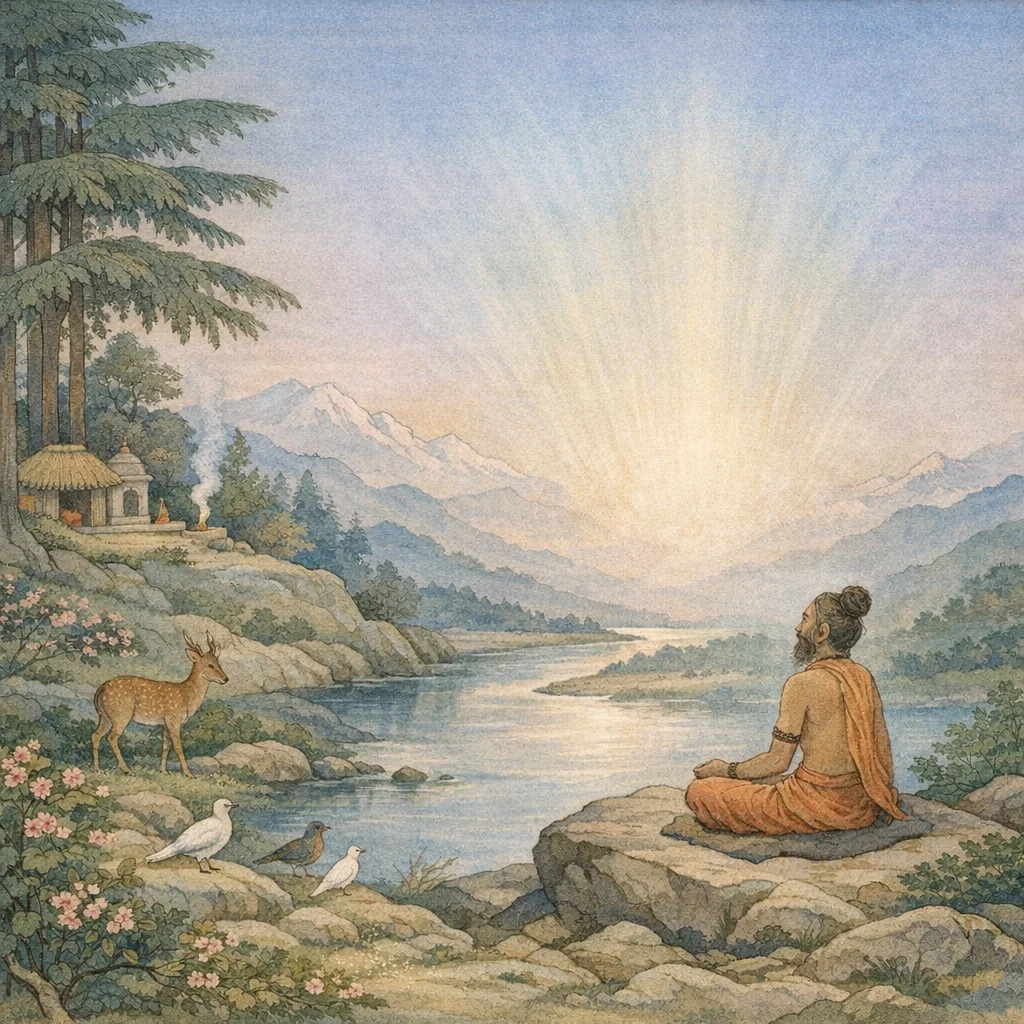
Parabrahma
The Parabrahma Upanishad, associated with the Atharvaveda and usually placed among the later, concise Upaniṣads, offers a distilled teaching on Parabrahman—the supreme reality beyond all limiting adjuncts (upādhis), names, and forms. In a brief sequence of verses, it reiterates a classical Upaniṣadic soteriology: bondage is rooted in ignorance (avidyā), while liberation (mokṣa) is immediate in the direct knowledge (jñāna) of the Self (Ātman) as non-different from Brahman. Its method is characteristically apophatic. By negating every objectifiable description (“neti neti”), the text indicates that the highest Brahman cannot be grasped as an object of thought, but is the self-luminous consciousness that makes all knowing possible. This aligns the Upaniṣad closely with Advaita Vedānta’s emphasis on nirguṇa Brahman and the primacy of self-knowledge over external attainments. In practical terms, the Parabrahma Upanishad links metaphysical insight to an inner discipline: discrimination (viveka) between the eternal and the transient, dispassion (vairāgya), meditative steadiness, and the relinquishing of egoic identification with body and mind. Historically, it can be read as a pedagogical compendium suited to renunciant and contemplative settings, where “sannyāsa” signifies above all an inward freedom from attachment.
Key Teachings
- Parabrahman as the supreme
attributeless reality (nirguṇa)
beyond name and form
- Ātman–Brahman identity: liberation through direct knowledge (jñāna)
not through external attainment
- Neti-neti (apophatic method): Brahman indicated by negating all objectifiable categories
- Avidyā as the root of bondage; vidyā (self-knowledge) as immediate freedom
- Viveka (discrimination) between the eternal (nitya) and non-eternal (anitya)
- Vairāgya (dispassion) and sannyāsa as inner renunciation of egoic identification
- Consciousness as self-luminous (svayaṃ-prakāśa)
the ground of all cognition
- Mokṣa as recognition of ever-present freedom rather than a produced state
Verses of the Parabrahma
Explore the verses of this Upanishad.
No verses available for this Upanishad yet.