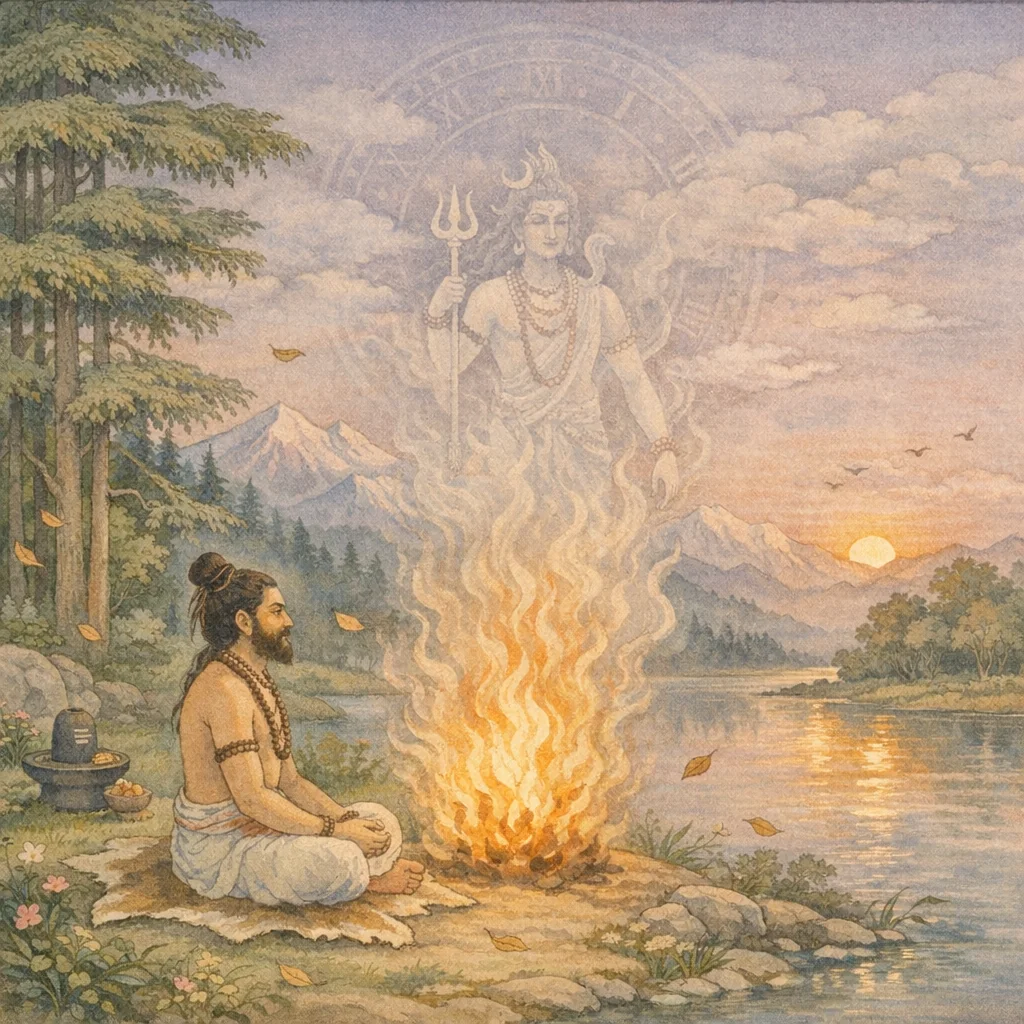
Kalagnirudra
The Kalagnirudra Upanishad, an Atharvavedic Śaiva Upaniṣad, presents “Kalāgni-Rudra” (Rudra as the fire that consumes time) as a metaphysical symbol for the Absolute. In Upaniṣadic terms, Rudra is identified with Brahman/Ātman: the witness-consciousness beyond temporality, change, and death. The “fire” motif functions soteriologically—knowledge burns ignorance and dissolves the time-bound ego that sustains saṃsāra. The text also exemplifies the Śaiva Upaniṣadic integration of emblem and insight. Sacred ash (bhasma) and the tripuṇḍra are interpreted as contemplative aids rather than mere external marks: they inculcate impermanence, renunciation, and the transcendence of triads (the three guṇas or the three states of waking, dream, and deep sleep), with the bindu pointing to turīya, pure awareness. Liberation is grounded in jñāna (direct realization), while devotion and mantra serve as supportive disciplines that culminate in inward abidance as the Self.
Start ReadingKey Teachings
- Rudra (Kalāgni-Rudra) is identified with Brahman/Ātman: the one Reality beyond time (kāla) and change.
- The “fire” of Rudra symbolizes the dissolution of ignorance and the transcendence of saṃsāra.
- Sacred ash (bhasma) and tripuṇḍra function as contemplative supports: reminders of impermanence and ego-dissolution.
- Liberation (mokṣa) is attained primarily through knowledge (jñāna) and inner realization
with devotion and observance as auxiliaries.
- The threefold mark is read as transcending triads (guṇas; waking–dream–deep sleep)
culminating in turīya (pure awareness).
- True worship of Rudra is inward: abiding as the witness-consciousness in which duality ceases.
- Renunciation and ethical restraint stabilize the mind for non-dual insight.
Verses of the Kalagnirudra
10 verses with Sanskrit text, transliteration, and translation.
Verse 1
ॐ अथ कालाग्निरुद्रोपनिषदः। संवर्तकोऽग्निरृषिरनुष्टुप्छन्दः। श्रीकालाग्निरुद्रो देवता। श्रीकालाग्निरुद्रप्रीत्यर्थे भस्मत्रिपुण्ड्रधारणे विनियोगः ॥१॥
Om. Now begins the Kālāgnirudra Upaniṣad. The seer is Saṁvartaka Agni; the meter is Anuṣṭubh; the deity is the venerable Kālāgnirudra. Its application is the wearing of the three ash-marks (tripuṇḍra) for the satisfaction and propitiation of Kālāgnirudra.
Upāsanā (Rudra-bhakti) as a support for Mokṣa; purification through bhasma; Śaiva sādhanāVerse 2
अथ कालाग्निरुद्रं भगवन्तं सनत्कुमारः पप्रच्छ—अधीहि भगवंस्त्रिपुण्ड्रविधिं सतत्त्वं। किं द्रव्यं? कियत्स्थानं? कतिप्रमाणं? का रेखा? के मन्त्राः? का शक्तिः? किं दैवतं? कः कर्ता? किं फलम्? इति च ॥२॥
Then Sanatkumāra questioned the Blessed Kālāgnirudra: “Teach, O Lord, the rite of the tripuṇḍra together with its essential principle. What is the substance? What is the place of application? What is the measure? What is the form of the lines? Which mantras? What power? What deity? Who is the performer? What is the fruit?”
Sādhana-vidhi (means) oriented to Mokṣa; ritual symbolism as tattva-jñāna supportVerse 3
तं होवाच भगवान्कालाग्निरुद्रः—यद्द्रव्यं तदाग्नेयं भस्म। सद्योजातादिपञ्चब्रह्ममन्त्रैः परिगृह्य—अग्निरिति भस्म, वायुरिति भस्म, जलमिति भस्म, स्थलमिति भस्म, व्योमेति भस्म—इत्यनेनाभिमन्त्र्य। मानस्तोक इत...
The Blessed Kālāgnirudra said to him: “The substance is of a fiery nature—ash. Taking it up with the Pañcabrahma mantras beginning with Sadyojāta, and consecrating it with the formulas, ‘Agni is ash; Vāyu is ash; water is ash; earth is ash; space is ash,’—thus sanctifying it. Lifting the ash with the mantra ‘mā nas toka…,’ and mixing it with water with ‘mā no mahāntam…,’ one should draw three horizontal lines with ‘triyāyuṣam…’ upon the head, forehead, chest, and shoulders, with the invocations triyāyuṣa, tryambaka, and triśakti. This observance is Śāmbhava; it is proclaimed by the expositors of the Veda among all the gods. Therefore the seeker of liberation should practice it for non-return, for freedom from rebirth. Then Sanatkumāra asked: ‘What is the measure for wearing the tripuṇḍra?’ (He replied:) ‘The three lines are made—on the forehead up to the eyes, up to the crown of the head, and with the middle between the eyebrows as the central reference.’
Mokṣa (non-return) supported by śuddhi and upāsanā; pañcabrahma as Brahman/Rudra theology; body as kṣetra for sādhanāVerse 4
तं होवाच भगवान्कालाग्निरुद्रः— यद्द्रव्यं तदाग्नेयं भस्म। सद्योजातादिपञ्चब्रह्ममन्त्रैः परिगृह्य ‘अग्निरिति भस्म, वायुरिति भस्म, जलमिति भस्म, स्थलमिति भस्म, व्योमेति भस्म’ इत्यनेनाभिमन्त्र्य ‘मानस्तोक...
The Blessed Kālāgnirudra said to him: “That substance is of the nature of fire—namely, ash. Having taken it up with the five Brahman-mantras beginning with ‘Sadyojāta’, and having consecrated it with: ‘Ash is fire; ash is wind; ash is water; ash is earth; ash is space’, and having lifted it with ‘mānas toka’, and having mixed it with water with ‘mā no mahāntam’, one should, with ‘triyāyuṣam’, draw three horizontal lines upon the head, forehead, chest, and shoulders—using the mantras ‘triyāyuṣa’, ‘tryambaka’, and ‘triśakti’. This observance is Śaiva (Śāmbhava) and is proclaimed by the Vedic expositors among all the deities. Therefore the seeker of liberation should practice it for the sake of non-return (from rebirth). Then Sanatkumāra asked: ‘What is the standard for wearing the tripuṇḍra?’ (He replied:) ‘The line is threefold—(drawn) from the forehead up to the eyes, up to the crown of the head, and from the middle of the eyebrows.’”
Moksha (non-return) through Śaiva-vrata; purification and consecration of the body as a support for Brahma-vidyāVerse 5
तं होवाच भगवान्कालाग्निरुद्रः— यद्द्रव्यं तदाग्नेयं भस्म। सद्योजातादिपञ्चब्रह्ममन्त्रैः परिगृह्य ‘अग्निरिति भस्म, वायुरिति भस्म, जलमिति भस्म, स्थलमिति भस्म, व्योमेति भस्म’ इत्यनेनाभिमन्त्र्य ‘मानस्तोक...
Kālāgnirudra said: “The substance is fiery—ash. Taking it with the five Brahman mantras beginning with ‘Sadyojāta’, consecrating it with ‘Ash is fire; ash is wind; ash is water; ash is earth; ash is space’, lifting it with ‘mānas toka’, mixing it with water with ‘mā no mahāntam’, and with ‘triyāyuṣam’ drawing three horizontal lines on the head, forehead, chest, and shoulders—using ‘triyāyuṣa’, ‘tryambaka’, and ‘triśakti’—one should perform this Śaiva observance. It is declared by Vedic expositors among all the deities. Therefore the seeker of liberation should practice it for non-return. Then Sanatkumāra asked: ‘What is the standard for wearing the tripuṇḍra?’ (Answer:) ‘The line is threefold—up to the eyes from the forehead, up to the crown, and from the middle of the eyebrows.’”
Sādhana for Moksha; purification (śuddhi) and consecration (saṃskāra) supporting Brahma-vidyāVerse 6
यास्य प्रथमा रेखा सा गार्हपत्यश्चाकारो रजोभूर्लोकः स्वात्मा क्रियाशक्तिरृग्वेदः प्रातःसवनं महेश्वरो देवतेति॥६॥
As for its first line: it is the Gārhapatya fire (the householder’s sacred fire); it is the syllable ‘a’; it is rajas; it is the Bhūḥ world; it is one’s own Self (svātman); it is the power of action (kriyā-śakti); it is the Ṛgveda; it is the morning pressing (prātaḥ-savana); and the deity is Maheśvara—so it is declared.
Upāsanā/adhyāropa mapping (symbolic correspondences) supporting purification and eventual MokshaVerse 7
यास्य द्वितीया रेखा सा दक्षिणाग्निरुकारः सत्त्वमन्तरिक्षमन्तरात्मा चेच्छाशक्तिर्यजुर्वेदो माध्यन्दिनं सवनं सदाशिवो देवतेति॥७॥
Its second line is the Dakṣiṇa fire; it is the syllable U; it is sattva; it is the mid-space (antarikṣa); it is the inner Self; and it is the power of will (icchā-śakti). It is the Yajurveda; it is the midday pressing (mādhyandina-savana); and its deity is Sadāśiva—thus it is declared.
Atman–Brahman contemplation through ritual-symbolic correspondences (upāsanā)Verse 8
यास्य तृतीया रेखा साहवनीयो मकारस्तमो द्यौर्लोकः परमात्मा ज्ञानशक्तिः सामवेदस्तृतीयसवनं महादेवो देवतेति॥८॥
Its third line is the Āhavanīya fire; it is the syllable M; it is tamas; it is the heaven-world (dyu-loka); it is the supreme Self; and it is the power of knowledge (jñāna-śakti). It is the Sāmaveda; it is the third pressing (tṛtīya-savana); and its deity is Mahādeva—thus it is declared.
Paramātman (supreme Self) and śakti as knowledge (jñāna) in contemplative symbolismVerse 9
एवं त्रिपुण्ड्रविधिं भस्मना करोति यो विद्वान् ब्रह्मचारी गृही वानप्रस्थो यतिर्वा स महापातकोपपातकेभ्यः पूतो भवति स सर्वेषु तीर्थेषु स्नातो भवति स सर्वान् वेदानधीतो भवति स सर्वान् देवान् ज्ञातो भवति स स...
Thus, whoever, being a knower, performs the observance of the tripuṇḍra with ash—whether a celibate student, a householder, a forest-dweller, or a renunciant—becomes purified from great sins and minor sins. He becomes as one who has bathed at all tīrthas; as one who has studied all the Vedas; as one who has known all the gods. He becomes one who constantly repeats all Rudra-mantras. He enjoys all experiences; and, having cast off the body, he attains sāyujya—union with Śiva. He does not return again; he does not return again—thus spoke the Blessed Kālāgnirudra.
Mokṣa (liberation) through śiva-upāsanā; purification (pāpa-kṣaya) and non-return (apunarāvṛtti)Verse 10
यस्त्वेतद्वाधीते सोऽप्येवमेव भवतीत्योँ सत्यमित्युपनिषत् ॥१०॥
But whoever studies this (recites and learns it), he too becomes exactly thus; thus (it ends). Oṁ—“Truth”: thus is the Upaniṣad.
Mokṣa (transformative efficacy of Upaniṣadic vidyā/adhyayana leading to identity with the taught state)