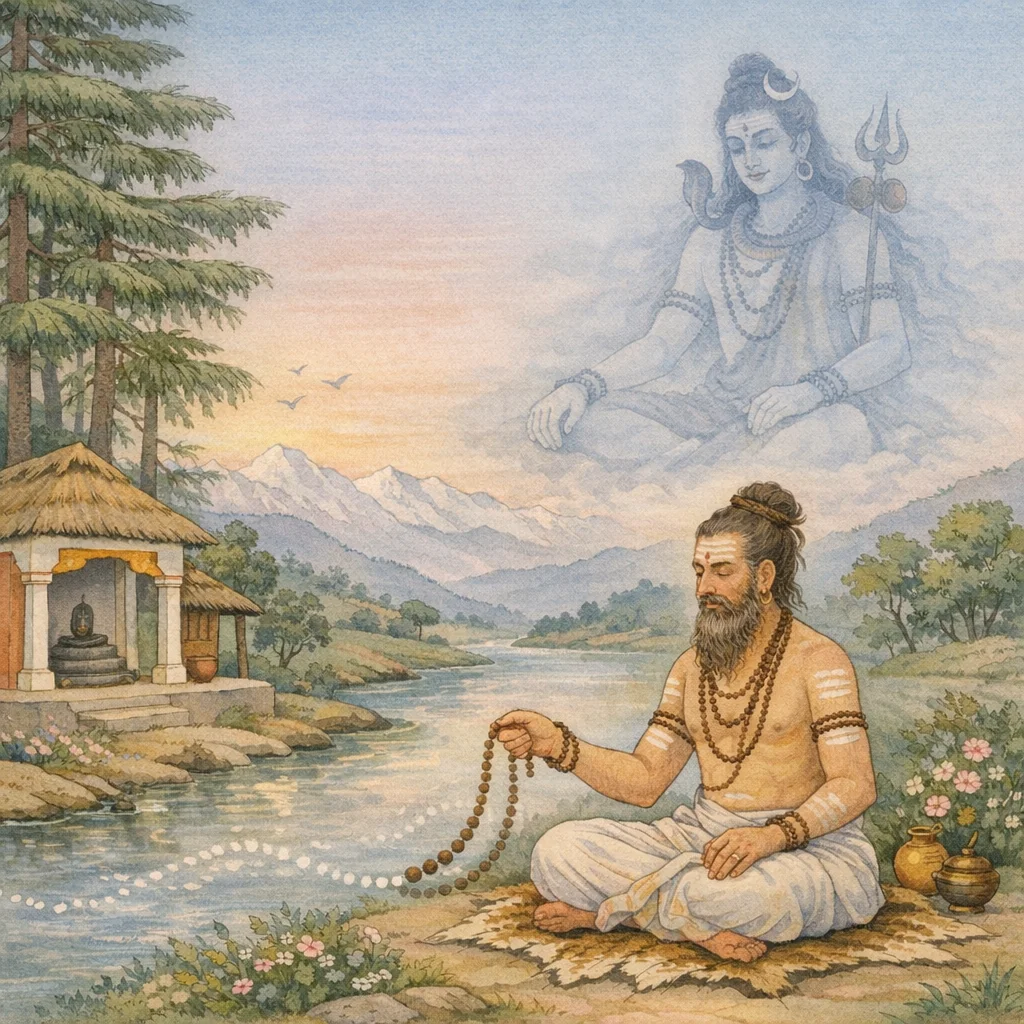
Akshamalika
The Akshamalika Upanishad is a concise, practice-oriented Śaiva Upaniṣad associated with the Atharvaveda. It treats the akṣamālā (rosary, especially rudrākṣa) as a sacred support for japa, detailing proper use and unfolding its symbolic meaning. Japa is presented not as mere counting, but as a disciplined training of attention that purifies speech and stabilizes inward remembrance of Śiva. Historically, the text belongs to the milieu of later Upaniṣads in which Upaniṣadic liberation-theory is integrated with bhakti and mantra-yoga. The Atharvan emphasis on mantra is reconfigured here into a Śiva-centered contemplative discipline. Philosophically, the mālā is interpreted as a microcosm: its circular form suggests the cycle of saṃsāra; the continuity of the thread signifies the unbroken stream of consciousness; and the meru bead marks a transcendent principle beyond enumeration. Thus an external object becomes a guide toward inner purification, concentration, and Śiva-realization.
Start ReadingKey Teachings
• Akṣamālikā (rosary) as a sacred support (ālambana) for japa and meditation in Śaiva sādhanā
• Japa as disciplined attention: repetition transforms mind and speech
not merely counts syllables
• Symbolism of beads
thread
and meru bead as a microcosm of tattvas and the ascent to transcendence
• Integration of devotion (bhakti) and yogic concentration (dhāraṇā/dhyāna) toward Śiva-realization
• Correct method and ethics of practice: steadiness
purity of intention
restraint
and humility
• Movement from external ritual to internalization: the mālā guides inward recollection (smaraṇa)
• Liberation-oriented mantra practice: japa as a means to purification and stabilizing non-dual insight centered on Śiva
Verses of the Akshamalika
16 verses with Sanskrit text, transliteration, and translation.
Verse 1
हरिः ॐ । अथ प्रजापतिर्गुहं पप्रच्छ— भो ब्रह्मन्, अक्ष-माला-भेद-विधिं ब्रूहि इति । सा किंलक्षणा, कति भेदाः अस्याः, कति सूत्राणि, कथं घटनाप्रकारः, के वर्णाः, का प्रतिष्ठा, कस्याः अधिदेवता, किं फलं च इति...
Hariḥ, Oṃ. Then Prajāpati questioned Guha: “O Brahman, declare the rule concerning the varieties and the procedure of the akṣa-mālā (rosary). What are its defining marks? How many kinds does it have? How many threads does it contain? By what method is it assembled? What are its colors? What is its consecration and installation (pratiṣṭhā)? Who is its presiding deity? And what is its fruit?”
Upāsanā (saguṇa-brahma worship) as an aid toward purification (citta-śuddhi) and liberation-oriented practiceVerse 2
तं गुहः प्रत्युवाच— प्रवाल-मौक्तिक-स्फटिक-शङ्ख-रजत-अष्टापद-चन्दन-पुत्रजीविका-अब्जे रुद्राक्षा इति । आदिक्षान्तमूर्तिः सावधानभावा । सौवर्णं राजतं ताम्रं तन्मुखे मुखं तत्पुच्छे पुच्छं तदन्तरावर्तनक्रमेण...
Guha replied: “The beads may be of coral, pearl, crystal, conch, silver, aṣṭāpada (a certain seed/wood), sandalwood, putrajīvikā seed, lotus-seed, and rudrākṣa. The mālā is to be formed from ‘a’ at the beginning to ‘kṣa’ at the end, with an attentive inner disposition. It should be joined with fittings of gold, silver, or copper—placing the ‘mouth’ at its mouth and the ‘tail’ at its tail—arranged according to the inward-turning sequence.”
Ritual supports (upakaraṇa) for mantra-upāsanā; purity of means (sādhana-śuddhi)Verse 3
यदस्याऽन्तरं सूत्रं तद्ब्रह्म । यद्दक्षपार्श्वे तच्छैवम् । यद्वामे तद्वैष्णवम् । यन्मुखं सा सरस्वती । यत्पुच्छं सा गायत्री । यत्सुषिरं सा विद्या । या ग्रन्थिः सा प्रकृतिः । ये स्वरास्ते धवलाः । ये स्प...
Its inner thread is Brahman. That on the right side is Śaiva; that on the left is Vaiṣṇava. Its ‘mouth’ is Sarasvatī; its ‘tail’ is Gāyatrī. Its aperture is Vidyā. Its knot is Prakṛti. The vowels are white; the sparśa (contact) consonants are yellow; the remaining letters are red.
Brahman and Prakṛti; nāda/śabda as vidyā; integration of sectarian deities within a Brahman-centered upāsanāVerse 4
अथ तां पञ्चभिर्गन्धैरमृतैः पञ्चभिर्गव्यैस्तनुभिः शोधयित्वा, पञ्चभिर्गव्यैर्गन्धोदकेन संस्राप्य, तस्मात् सोङ्कारेण पत्रकूर्चेन स्नपयित्वा, अष्टभिर्गन्धैरालिप्य, सुमनःस्थले निवेश्य, अक्षतपुष्पैराराध्य, ...
Then, having purified it with five nectarean fragrances and with the five products of the cow (pañcagavya) in subtle applications, and having sprinkled it with scented water together with pañcagavya, one should bathe it with a leaf-brush while uttering ‘sa-oṃkāra’. Anoint it with eight fragrances, place it in a pleasing spot, worship it with unbroken rice (akṣata) and flowers, and contemplate it clearly with the letters from ‘a’ to ‘kṣa’.
Śabda (akṣara) as sacred power; saṃskāra (consecration) of instruments for upāsanāVerse 5
ओमङ्कार मृत्युञ्जय सर्वव्यापक प्रथमेऽक्षे प्रतितिष्ठ । ओमाङ्काराकर्षणात्मकसर्वगत द्वितीयेऽक्षे प्रतितिष्ठ । ओमिङ्कारपुष्टिदाक्षोभकर तृतीयेऽक्षे प्रतितिष्ठ । ओमीङ्कार वाक्प्रसादकर निर्मल चतुर्थेऽक्षे प...
“Oṃ-aṅkāra, conqueror of death, all-pervading—be established in the first bead. Oṃ-āṅkāra, of the nature of attraction, all-going—be established in the second bead. Oṃ-iṅkāra, giver of nourishment, causing agitation—be established in the third bead. Oṃ-īṅkāra, bestower of clarity of speech, pure—be established in the fourth bead. Oṃ-uṅkāra, giver of all strength, most excellent—be established in the fifth bead. Oṃ-ūṅkāra, effecting expulsion, irresistible—be established in the sixth bead. Oṃ-ṛṅkāra, causing disturbance, unsteady—be established in the seventh bead. Oṃ-ṝṅkāra, causing fascination, brilliant—be established in the eighth bead. Oṃ-lṛṅkāra, causing enmity, deluding—be established in the ninth bead. Oṃ-lṝṅkāra, deluding—be established in the tenth bead. Oṃ-eṅkāra, making all subject, of pure sattva—be established in the eleventh bead. Oṃ-aiṅkāra, purely sāttvic, making persons subject—be established in the twelfth bead. Oṃ-oṅkāra, consisting of all speech, eternally pure—be established in the thirteenth bead. Oṃ-auṅkāra, consisting of all speech, making subject—be established in the fourteenth bead. Oṃ-aṅkāra, making even elephants and the like subject, enchanting—be established in the fifteenth bead. Oṃ-ḥkāra, destroyer of death, fierce—be established in the sixteenth bead.” Thereafter, for each consonant from ka to kṣa, with ‘oṃ’ prefixed, a specific power is assigned and the command is given: “be established in the respective bead,” concluding: “Oṃ-kṣaṅkāra, revealer of the higher and lower reality, of the form of supreme light—be established in the crest-jewel (śikhāmaṇi/meru).”
Śabda-brahman / mātṛkā-śakti as a support for upāsanā; movement from phonemic totality toward para-jyotis (supreme light)Verse 6
अथोवाच ये देवाः पृथिवीपदास्तेभ्यो नमो भगवन्तोऽनुमदन्तु शोभायै । पितरोऽनुमदन्तु शोभायै ज्ञानमयीम् अक्षमालिकाम् ॥६॥
Then he said: “To those gods whose station is the earth—to them be reverence. May the venerable ones grant assent for auspiciousness; may the Fathers grant assent for auspiciousness—to this rosary (akṣamālikā) made of knowledge.”
Upāsanā (sacralization of a ritual support) oriented to Jñāna and MokṣaVerse 7
अथोवाच ये देवा अन्तरिक्षसदस्तेभ्यो ॐ नमो भगवन्तोऽनुमदन्तु शोभायै । पितरोऽनुमदन्तु शोभायै ज्ञानमयीम् अक्षमालिकाम् ॥७॥
Then he said: “To those gods who dwell in the midspace—to them be reverence, Oṃ. May the venerable ones grant assent for auspiciousness; may the Fathers grant assent for auspiciousness—to this rosary made of knowledge.”
Upāsanā and Adhikāra (removal of obstacles for sādhana)Verse 8
अथोवाच ये देवा दिविषदस्तेभ्यो नमो भगवन्तोऽनुमदन्तु शोभायै । पितरोऽनुमदन्तु शोभायै ज्ञानमयीम् अक्षमालिकाम् ॥८॥
Then he said: “To those gods who dwell in heaven—to them be reverence. May the venerable ones grant assent for auspiciousness; may the Fathers grant assent for auspiciousness—to this rosary made of knowledge.”
Īśvara-anugraha (grace) supporting Jñāna-sādhanaVerse 9
अथोवाच ये मन्त्राः या विद्यास्तेभ्यो नमः । ताभ्यश्चोन्नमः । तच्छक्तिरस्याः प्रतिष्ठापयति ॥९॥
Then he said: “To the mantras, to the sacred knowledges (vidyās)—reverence to them; and to them also, higher reverence. Their power establishes and consecrates this rosary.”
Śakti of Mantra / Vidyā (mantra-śakti as efficacious power)Verse 10
अथोवाच ये ब्रह्मविष्णुरुद्रास्तेभ्यः सगुणेभ्यः ॐ नमः । तद्वीर्यमस्याः प्रतिष्ठापयति ॥१०॥
Then he said: “To Brahmā, Viṣṇu, and Rudra—to them, possessed of attributes (saguṇa), Oṃ, reverence. Their vigor (vīrya) establishes and consecrates this rosary.”
Saguṇa Brahman / Īśvara-upāsanā as support for sādhanaVerse 11
अथोवाच ये साङ्ख्यादितत्त्वभेदास्तेभ्यो नमो वर्तध्वं विरोधेऽनुवर्तध्वम्॥११॥
Then he said: “Salutation to those who teach distinctions among the principles (tattvas), such as the Sāṅkhyas. Abide in your own path; when opposition arises, conform without contention.”
Samanvaya (reconciliation of doctrines) and non-contention in pursuit of Brahma-vidyāVerse 12
अथोवाच ये शैवा वैष्णवाः शाक्ताः शतसहस्रशस्तेभ्यो नमो नमो भगवन्तोऽनुमदन्त्वनुगृह्णन्तु॥१२॥
Then he said: “To the Śaivas, the Vaiṣṇavas, and the Śāktas—by hundreds and thousands—salutation, salutation. May those venerable ones approve; may they bestow their favor.”},{
Īṣṭa-devatā-samanvaya (sectarian harmony) in aid of sādhana; grace (anugraha)Verse 13
अथोवाच याश्च मृत्योः प्राणवत्यस्ताभ्यो नमो नमस्तेनैतं मृडयत मृडयत॥१३॥
Then he said: “And to those powers of Death endowed with life-breath—salutation, salutation. By that, soothe him; soothe him.”},{
Mṛtyu-jaya (transcending death) through prāṇa-upāsanā and mantra; fearlessness (abhaya)Verse 14
पुनरेतस्यां सर्वात्मकत्वं भावयित्वा भावेन पूर्वमालिकामुत्पाद्यारभ्य तन्मयीं महोपहारैरुपहृत्य आदिक्षान्तैरक्षरैरक्षमालामष्टोत्तरशतं स्पृशेत्॥१४॥
Again, having contemplated in this (rosary/mantra-matrix) its nature as the Self of all, and first having brought forth and begun the preliminary garland with intention, having offered it—made of that same Reality—with great offerings, one should touch the rosary one hundred and eight times with the syllables from “a” to “kṣa” (the alphabet).
Sarvātmakatva (the all-self nature of Brahman/Ātman) expressed through mantra-mātṛkā and japa-sādhanaVerse 15
अथ पुनरुत्थाप्य प्रदक्षिणीकृत्यॊ नमस्ते भगवति मन्त्रमातृकेऽक्षमाले सर्ववशङ्कर्यै नमस्ते भगवति मन्त्रमातृकेऽक्षमालिके शेषस्तम्भिन्यै नमस्ते भगवति मन्त्रमातृकेऽक्षमाले उच्चाटन्यै नमस्ते भगवति मन्त्रमातृ...
Then again, having raised it up and circumambulated it (pradakṣiṇā), one says: “Salutation to You, O Blessed One, O mantra-matrix (mātṛkā), O rosary, accomplisher of all subjugations. Salutation to You, O Blessed One… O rosary, restrainer of the remainder (residual forces). Salutation to You, O Blessed One… O rosary, performer of expulsion. Salutation to You, O Blessed One… O rosary—form of the Conqueror of Death, power beyond death for the universe; illuminator of all worlds; supreme protector of all worlds; reviver of all worlds; producer of all worlds; initiator of day; initiator of night; You go to another river, another land, another island, another world; You ever shine; You dwell in every heart. Salutation to You as Parā; salutation as Paśyantī; salutation as Madhyamā; salutation as Vaikharī; Self of all principles, Self of all knowledges, Self of all powers, Self of all deities; worshipped by the sage Vasiṣṭha, relied upon by the sage Viśvāmitra—salutation, salutation.”
Śabda-brahman / mantra-mātṛkā as sarvātman; integration of upāsanā with Vedāntic all-inclusivenessVerse 16
प्रातरधीयानो रात्रिकृतं पापं नाशयति। सायमधीयानो दिवसकृतं पापं नाशयति। तत्सायंप्रातः प्रयुञ्जानः पापोऽपापो भवति। एवमक्षमालिकया जप्तो मन्त्रः सद्यः सिद्धिकरो भवतीत्याह भगवान् गुहः प्रजापतिमित्युपनिषत्॥१...
One who recites it in the morning destroys the sin committed at night. One who recites it in the evening destroys the sin committed during the day. Therefore, employing it in the evening and in the morning, a sinner becomes sinless. Thus, the mantra, when repeated with an akṣamālikā (rosary), becomes an immediate bestower of siddhi, of accomplishment—so said the Blessed Guha to Prajāpati: thus (ends) the Upaniṣad.
Pāpa–puṇya-śuddhi (purification), Japa as sādhana, Siddhi (attainment) as fruit of disciplined practiceRead Upanishads in the Vedapath app
Scan the QR code to open this directly in the app, with audio, word-by-word meanings, and more.