Adhyaya 98
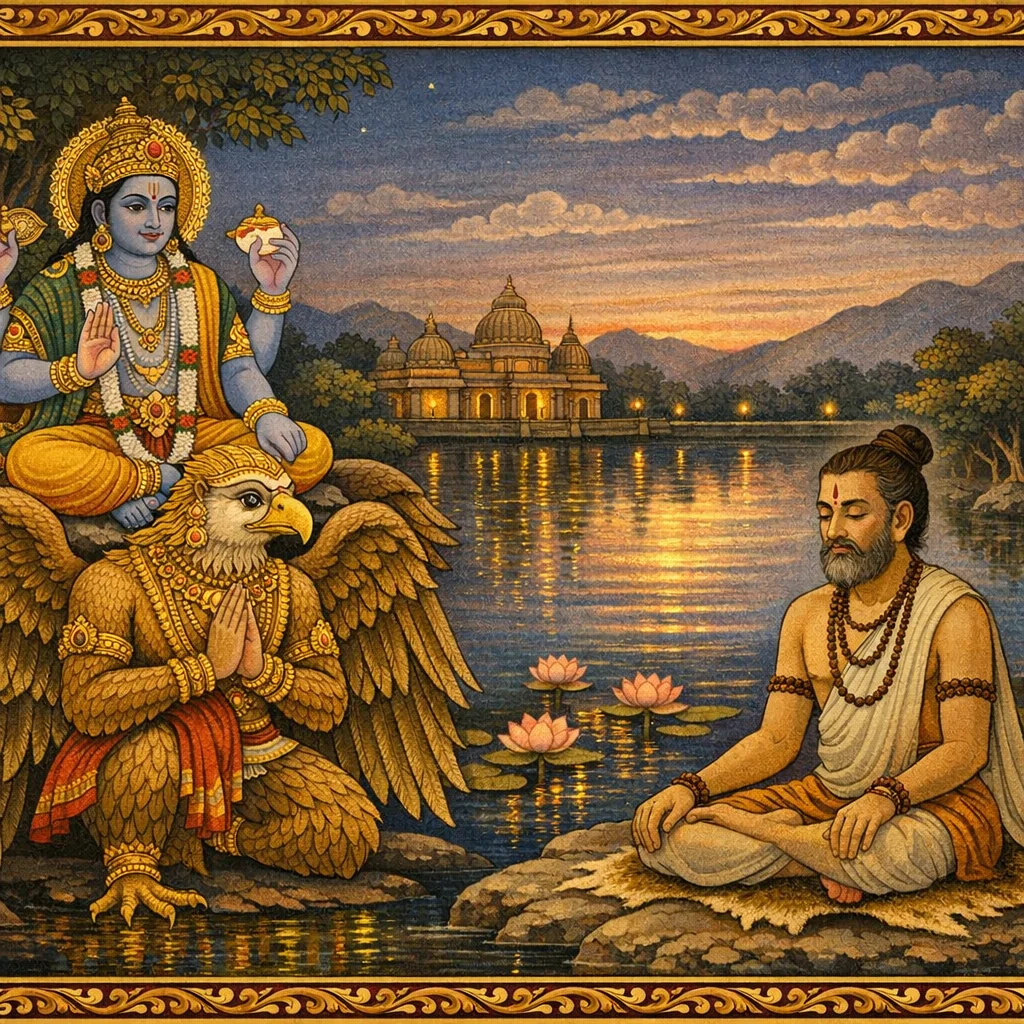
Sūta recounts how King Daśaratha, dismissed by his ministers, arrives at Hāṭakeśvara-kṣetra and undertakes a devout circuit: he worships the Goddess installed by his father, bathes in auspicious waters, visits the chief shrines, bathes at many tīrthas, and gives gifts. He commissions a temple of Viṣṇu (the Cakrī), installs a Vaiṣṇava image, and builds a clear-water stepwell/holy well (vāpi) praised by sādhus. At that water-site he performs intense tapas for a hundred years. Then Janārdana (Viṣṇu) appears, mounted on Garuḍa and surrounded by hosts of devas, and offers a boon. Daśaratha asks for sons to expand his lineage; Viṣṇu promises to be born in his house in a fourfold form and instructs him to return and rule righteously. The well is named “Rājavāpī,” and an observance is proclaimed: bathing and worship on the fifth lunar day (pañcamī), followed by śrāddha for a year, is said to grant sons to the sonless. The narrative closes by linking this grace to the birth of Daśaratha’s four sons—Rāma, Bharata, Lakṣmaṇa, and Śatrughna—along with a daughter given to King Lomapāda, and the ensuing royal succession. It also recalls temple-memories associated with Rāma, with references to Rāmeśvara, Lakṣmaṇeśvara, and Sītā’s installation.
Shlokas
Verse 1
सूत उवाच । ततो दशरथो राजा मंत्रिभिस्तैर्विसर्जितः । हाटकेश्वरजं क्षेत्रं संप्राप्तो हर्षसंयुतः
Sūta said: Then King Daśaratha, having been respectfully sent off by those ministers, reached the sacred region of Hāṭakeśvara, filled with joy.
Verse 2
तत्रागत्य ततो देवीं पित्रा संस्थापिता पुरा । पूजयित्वाऽथ सद्भक्त्या स्नात्वा कुण्डे शुभोदके
Having arrived there, he worshipped with true devotion the Goddess who had formerly been installed by his father, and then bathed in the pond (kuṇḍa) filled with auspicious waters.
Verse 3
ततोऽन्यानि च मुख्यानि दृष्ट्वा चायतनानि सः । स्नात्वा तीर्थेष्वनेकेषु दत्त्वा दानान्यनेकशः
Then, after beholding other principal shrines as well, he bathed at many sacred tīrthas and, again and again, bestowed many gifts in charity.
Verse 4
प्रासादं कारयामास देवदेवस्य चक्रिणः । तत्र संस्थापयामास प्रतिमां वैष्णवीं शुभाम्
He had a temple built for the God of gods, the discus-bearing Lord, and there he installed an auspicious Vaiṣṇava image.
Verse 5
तस्याग्रे कारयामास वापीं स्वच्छोदकान्विताम् । सोपानपंक्तिभिर्युक्तां साधुभिः संप्रशंसिताम्
In front of Him, he had a step-well made, filled with clear water—furnished with rows of steps, and highly praised by the virtuous.
Verse 6
उदकेन ततस्तस्या देवाराधनतत्परः । प्रकारैर्बहुभिस्तीव्रं चकार सुमहत्तपः
Then, using that water and intent on the worship of the gods, he performed a great austerity—extremely intense—in many ways.
Verse 7
ततो वर्षशतेऽतीते तस्य तुष्टो जनार्दनः । विलोक्य च तपस्तीव्रं विहितं तेन भूभुजा
Then, when a hundred years had passed, Janārdana became pleased with him, having beheld the intense austerity undertaken by that king.
Verse 8
प्रोवाच दर्शनं गत्वा पक्षिराजं समाश्रितः । मेघगम्भीरयावाचा बहुदेवगणैर्वृतः
Having granted his vision, the Lord spoke—resting upon the king of birds—his voice deep like thunderclouds, surrounded by many hosts of gods.
Verse 9
श्रीविष्णुरुवाच । परितुष्टोऽस्मि ते वत्स वरं वरय सुव्रत । अपि ते दुर्लभं काममहं दास्यामि कृत्स्नशः
Śrī Viṣṇu said: “I am fully pleased with you, dear one. Choose a boon, O firm-vowed one. Even a desire difficult to obtain—I shall grant to you completely.”
Verse 10
राजोवाच । पुत्रार्थोऽयं समारंभो मया देव कृतोऽखिलः । तपसो देहि मे पुत्रांस्तस्माद्वंशविवृद्धिदान्
The king said: “O Lord, this entire undertaking by me was for the sake of sons. As the fruit of my austerity, grant me sons—givers of the increase of my lineage.”
Verse 11
अन्यत्सर्वं सुराधीश ध्रुवमस्ति गृहे स्थितम् । प्रसादात्तव यत्किंचिद्वैभवं विद्यते मम
“All else, O Lord of the gods, is surely already established in my house. Whatever prosperity I possess exists only by your favor.”
Verse 12
विष्णुरुवाच । अहं तव गृहे राजन्स्वयमेव न संशयः । अवतारं करिष्यामि कृत्वा रूपचतुष्टयम्
Viṣṇu said: “O king, I myself shall indeed be born in your house—without doubt. Taking four forms, I will make my descent (incarnation).”
Verse 13
देवकार्याय तस्मात्त्वं गृहं गत्वा महीपते । कुरु राज्यं यथान्यायं पितृपैतामहं महत्
Therefore, O lord of the earth, return to your home for the sake of divine work, and rule your great ancestral kingdom in accordance with justice and dharma.
Verse 14
तथेयं या त्वया वापी निर्मिता विमलोदका । राजवापीति विख्याता लोके सेयं भविष्यति
And this step-well that you have built, whose water is pure and spotless, shall become renowned in the world as “Rāja-vāpī”—the King’s Well.
Verse 15
अस्यां स्नात्वा नरो भक्त्या य एनां पूजयिष्यति । श्रद्धया परया युक्तः संप्राप्ते पंचमीदिने
Whoever bathes here and, with devotion, worships this sacred tīrtha/this Devī on the day of Pañcamī—endowed with supreme faith—obtains the promised merit of this holy observance.
Verse 16
ततः करिष्यति श्राद्धं यावत्संवत्सरं नृप । अपुत्रः प्राप्स्यते पुत्रान्वंशवृद्धिकरान्स हि
Then, O king, he should perform śrāddha for a full year; indeed, even one who is without a son will obtain sons—bringers of the increase of lineage.
Verse 17
एवमुक्त्वा स भगवांस्ततश्चादर्शनं गतः । प्रहृष्टवदनो भूत्वा सोऽपि राजा ययौ गृहम्
Having spoken thus, that Blessed One then vanished from sight. And the king too, his face bright with joy, returned to his home.
Verse 18
ततः स्तोकेन कालेन तस्य पुत्रचतुष्टयम् । संजातं लोके विख्यातं कलत्रत्रितयस्य च
Then, after a short time, four sons were born to him, renowned throughout the world—born as well from his three queens.
Verse 19
कौशल्यानाम विख्याता तस्य भार्या सुशोभना । ज्येष्ठा तस्यां सुतो जज्ञे रामाख्यः प्रथमः सुतः
His eldest and radiant queen, famed by the name Kauśalyā—through her a son was born: the first son, named Rāma.
Verse 20
तथान्या कैकयी नाम तस्य भार्या कनिष्ठिका । भरतो नाम विख्यातस्तस्याः पुत्रोऽभवत्त्वसौ
Likewise, another queen of his, the youngest, named Kaikeyī—her son was that famed Bharata.
Verse 21
सुमित्राख्या तथा चान्या पत्नी या मध्यमा स्थिता । शत्रुघ्नलक्ष्मणौ पुत्रौ तस्यां जातौ महाबलौ
And another queen, called Sumitrā, who stood as the middle one—through her were born two sons, Lakṣmaṇa and Śatrughna, mighty in strength.
Verse 22
तथान्या कन्यका चैका बभूव वरवर्णिनी । ददौ यां पुत्रहीनस्य लोमपादस्य भूपतेः
Likewise, there was also a single daughter, of excellent complexion; her he gave to King Lomapāda, who was without a son.
Verse 23
आनृण्यं भूपतिः प्राप्य एवं दशरथस्तदा । पितॄणां प्रययौ स्वर्गं कृतकृत्यस्तथा द्विजाः
Thus, having attained freedom from debt to the Ancestors, King Daśaratha then went to heaven to join the Pitṛs—the Fathers—his duties fulfilled, O brāhmaṇas.
Verse 24
अथ राजाऽभवद्रामः सार्वभौमस्ततः परम् । रावणो येन दुर्धर्षो निहतो देवकंटकः
Thereafter Rāma became king, a universal sovereign. By him was slain the formidable Rāvaṇa—the tormentor and thorn of the gods.
Verse 25
येन रामेश्वरश्चात्र निर्मितो लक्ष्मणेश्वरः । सीतादेवी तथा मूर्ता येन चात्र प्रतिष्ठिता
He by whom Rāmeśvara was established here also founded Lakṣmaṇeśvara; and by him, in this very place, the image-form (mūrti) of Devī Sītā was likewise consecrated.
Verse 98
इति श्रीस्कांदे महापुराण एकाशीतिसाहस्र्यां संहितायां षष्ठे नागरखंडे हाटकेश्वरक्षेत्रमाहात्म्ये राजस्वामिराजवापीमाहात्म्यवर्णनंनामाष्टनवतितमोऽध्यायः
Thus ends the ninety-eighth chapter, called “The Description of the Greatness of Rājasvāmi and Rājavāpī,” in the Hāṭakeśvara-kṣetra Māhātmya, within the sixth division—the Nāgara Khaṇḍa—of the Śrī Skanda Mahāpurāṇa, in the eighty-one-thousand-verse compilation.