Adhyaya 97
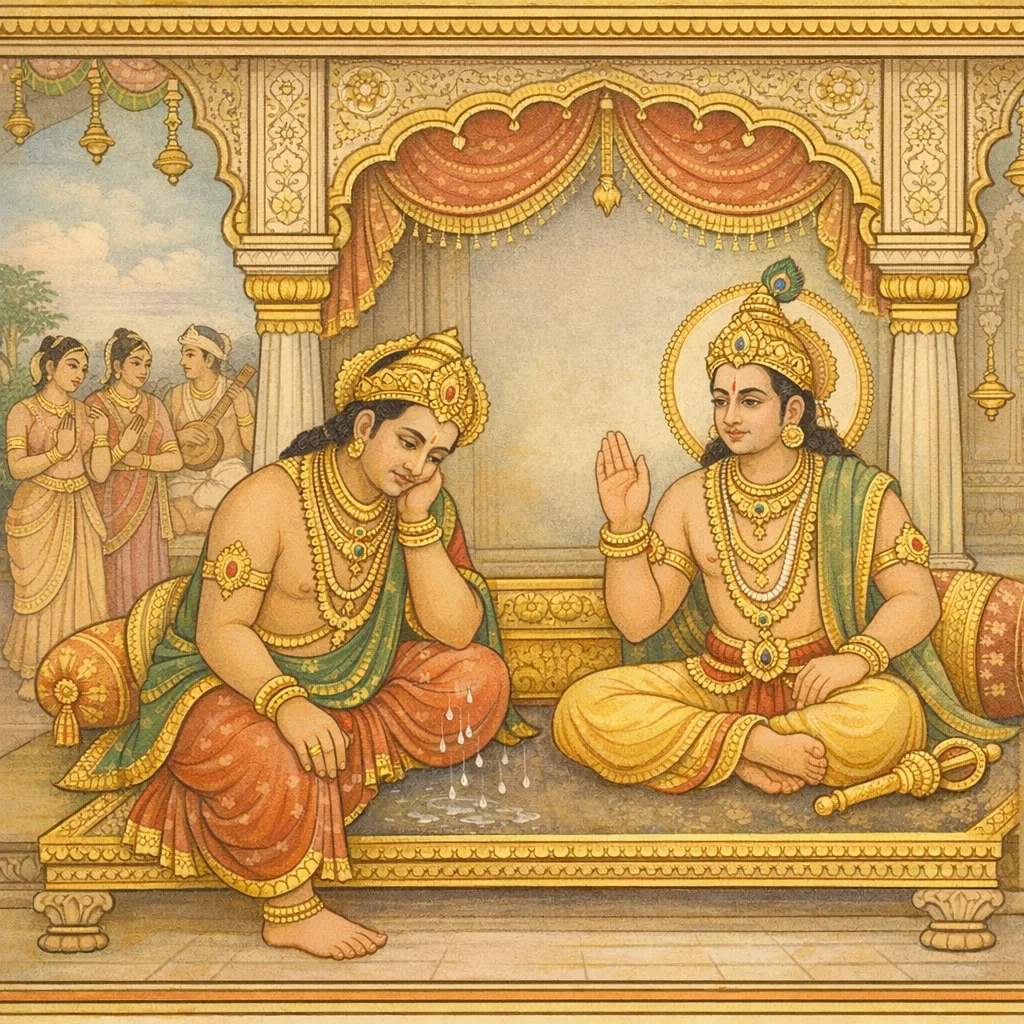
Sūta relates that after an extraordinary deed by King Daśaratha, Indra (Śakra) approaches, praises his unmatched achievement, and offers a boon. Daśaratha asks neither wealth nor conquest, but enduring friendship with Indra—an abiding alliance across all duties of dharma. Indra grants it and requests the king’s regular presence in the divine assembly; Daśaratha attends daily after evening rites, delighting in celestial music and dance and in the uplifting accounts spoken by the devarṣis. Whenever the king departs, his seat is ritually sprinkled with water (abhyukṣaṇa). Later Nārada discloses the reason, and Daśaratha, anxious, questions Indra, fearing the sprinkling signals some hidden sin. He lists possible royal failings—harm to brāhmaṇas, injustice, social disorder, corruption, neglect of those seeking refuge, and lapses in sacrifice and ritual. Indra replies that no present fault exists in the king’s body, realm, lineage, household, or servants; the impending demerit is only the condition of being without a son, taught as a debt to the ancestors (pitṛ-ṛṇa) that obstructs higher destinies. The sprinkling is therefore a preventative, ancestor-related rite. Indra urges him to strive for progeny to fulfill the forefathers and avert decline. Daśaratha returns to Ayodhyā, entrusts rule to his ministers, and undertakes austerities to obtain a son, with counsel to go to Kārttikeyapura where his father once performed tapas and attained success.
Shlokas
Verse 1
। सूत उवाच । ततः प्रभृति नो मन्दो रोहिणीशकटं द्विजाः । भिनत्ति वचनात्तस्य राज्ञो दशरथस्य च
Sūta said: From that time onward, O brāhmaṇas, Manda (Śanaiścara) no longer breaks the ‘Rohiṇī-cart’, because of the words of King Daśaratha.
Verse 2
तद्वृत्तांतं समाकर्ण्य तस्य शक्रः प्रहर्षितः । भूपालं तं समभ्येत्य ततश्चोवाच सादरम्
Hearing the full account of what had occurred, Śakra (Indra) was filled with joy. Approaching that king, he then spoke to him with respectful warmth.
Verse 3
अत्यद्भुततरं कर्म त्वयैतत्पृथिवीपते । संसाधितं यदन्येन मनसापि न चिन्त्यते
O lord of the earth, you have accomplished a deed most wondrous—one that no other person could even conceive within the mind.
Verse 4
अत एव हि संतुष्टिः सञ्जाताद्य तवोपरि । वरं मत्तो गृहाणाद्य तदभीष्टं हृदि स्थितम्
For this very reason, I am fully pleased with you today. Accept a boon from me now—whatever cherished wish rests within your heart.
Verse 5
राजोवाच । त्वया सह सुरश्रेष्ठ मैत्री संप्रार्थयाम्यहम् । शाश्वती सर्वकृत्येषु परमां लोकसंस्थिताम्
The king said: O best among the gods, I pray for friendship with you—everlasting, supreme, and firmly established in all duties and in all worlds.
Verse 6
इन्द्र उवाच । एवं भवतु राजेंद्र त्वया सह सदा मम । संपत्स्यते सदा मैत्री वसोरिव च शाश्वती
Indra said: So be it, O king of kings. With you, my friendship shall ever endure—steadfast and everlasting, like that of Vasu.
Verse 7
त्वया सदैव मे पार्श्वे सभायां देवसंनिधौ । आगन्तव्यं विशेषेण येन मैत्री प्रवर्धते
Come regularly to my side—into the assembly, in the presence of the gods—so that our friendship may grow all the more.
Verse 8
एवमुक्त्वा सहस्राक्षो जगाम त्रिदिवालयम् । राजापि चागतो हर्म्ये स्वकीये हर्षसंयुतः
Having spoken thus, the thousand-eyed one (Indra) departed for his heavenly abode in Tridiva. The king too returned to his own palace, filled with joy.
Verse 9
रक्षयित्वा जगत्सर्वं शनैश्चर कृताद्भयात् । अप्राप्यां प्राप्य संकीर्तिं स्तूयमानस्तु बन्दिभिः
Having protected the whole world from the fear caused by Śanaiścara (Saturn), he attained a renown previously unattainable, being praised by bards and heralds.
Verse 10
ततः प्रभृति नित्यं स सन्ध्याकाल उपस्थिते । सायाह्नं संविधायाथ याति शक्रस्य मंदिरे
From that time onward, whenever twilight arrived, he would each day perform the evening Sandhyā observances and then go to Śakra’s (Indra’s) abode.
Verse 11
तत्र स्थित्वा चिरं श्रुत्वा गंधर्वाणां मनोहरम् । गीतं दृष्ट्वा च नृत्यं च तानादिविहितं शुभम्
Staying there for a long time, he listened to the enchanting songs of the Gandharvas, and he beheld their dance as well—auspicious performances set to melodies and rhythms.
Verse 12
विचित्रार्थाः कथाः श्रुत्वा देवर्षीणां मुखाच्च्युताः । स्वयं च कीर्तयित्वाथ प्रयाति निजमंदिरम्
After hearing wondrous, meaning-laden accounts spoken from the mouths of the divine seers, and then recounting them himself, he departs for his own celestial abode.
Verse 13
विमानवरमारुह्य हंसबर्हिणनादितम् । मनोहरपताकाभिः समंताच्च विभूषितम्
Mounting an excellent celestial chariot, resonant with the calls of swans and peacocks, and adorned on every side with charming banners, he proceeds in splendour.
Verse 14
यदायदा स निर्याति शक्रस्थानान्निजालयम् । तदातदाऽसने तस्य क्रियतेऽभ्युक्षणं सदा
Whenever he sets out from Indra’s realm toward his own dwelling, at that very time his seat is always ritually sprinkled with consecrating water.
Verse 15
शक्रादेशात्तदा वेत्ति न स भूपः कथंचन । अन्यस्मिन्दिवसे तस्य नारदो मुनिसत्तमः । कथयामास तत्सर्वमभ्युक्षणसमुद्भवम्
By Indra’s command, that king came to know nothing of it at all. Yet on another day Nārada, the foremost of sages, told him everything about how that rite of sacred sprinkling had arisen.
Verse 16
वृत्तांतं तस्य राजर्षेस्तस्यैव गृहमागतः । तीर्थयात्रा प्रसंगेन विद्वेषपरिवृद्धये
Coming to the very house of that royal sage, Nārada raised the matter in the course of speaking of pilgrimage to the tīrthas, and thus the hostility was made to grow.
Verse 17
तच्छ्रुत्वा नारदेनोक्तं श्रद्धेयमपि भूपतिः । न चक्रे हृदयेऽधर्ममात्मानं परिचिंतयन्
Hearing what Nārada said—though it was indeed believable—the king did not allow adharma into his heart, but carefully reflected upon himself.
Verse 18
तथापि कौतुकाविष्टो गत्वा शक्रनिवेशनम् । अन्यस्मिन्दिवसे स्थित्वा चिरं तत्र समुत्थितः
Yet, seized by curiosity, he went to Indra’s residence; and on another day, after remaining there for a long time, he rose (and began to move about).
Verse 19
अलक्ष्यं वीक्षयामास स्वासनं दूरमास्थितः । किंचित्सद्मांतरं प्राप्य कौतूहलसमन्वितः
From a distance he observed his own seat, remaining unseen; and, filled with curiosity, he reached another chamber within the palace.
Verse 20
ततः शक्रसमादेशादुत्थाय सुरकिंकरः । प्रोक्षयामास तोयेन पार्थिवस्य तदासनम्
Then, at Indra’s command, a celestial attendant rose and sprinkled that king’s seat with pure water.
Verse 21
तद्दृष्ट्वा कोपसंपन्नः स राजाऽभ्येत्य वासवम् । प्रोवाच किमिदं शक्र प्रोक्ष्यते यन्ममासनम्
Seeing this, the king—filled with anger—approached Vāsava (Indra) and said: “What is this, O Śakra, that my seat is being sprinkled?”
Verse 22
किं मया निहता विप्राः किं वा विप्रसमुद्भवम् । शासनं लोपितं किंचित्किं वा विप्रा विनिंदिताः
“Have I slain any brāhmaṇas? Or harmed anything that arises from the brāhmaṇas? Have I in any way set aside the rule of righteous governance according to dharma? Or have the brāhmaṇas been dishonoured by me?”
Verse 23
किं वा नष्टोऽस्मि संग्रामे दृष्ट्वा शत्रून्समागतान् । दैन्यं वा जल्पितं तेषां भयत्रस्तेन चेतसा
“Or have I failed in battle, seeing the enemies assembled? Or, with a mind shaken by fear, have I spoken words of despair before them?”
Verse 24
मम राज्येऽथवा शक्र दुर्बलो बलवत्तरैः । पीड़्यते वाथ चौराद्यैर्मुष्यते वंचकैस्तथा
“Or, O Śakra, is the weak in my kingdom being oppressed by the strong? Or are people being robbed by thieves and likewise cheated by deceivers?”
Verse 25
किं वा राज्ये मदीये च जायते योनिविप्लवः । संकरो वाथ वर्णानां परित्यक्तविधिक्रमः
Or has there arisen in my kingdom a turmoil in lineage and birth? Or have the varṇas fallen into confusion, with the proper disciplines and sacred rites cast aside?
Verse 26
किं वा दुर्जनवाक्येन दूषितो दोषवर्जितः । दंड्यते मम राज्ये च केनचित्त्रिदशेश्वर
Or, O Lord of the Gods, is some blameless person stained by the words of the wicked and then punished by someone within my realm?
Verse 27
किं वा चौरोऽथ पापो वा गृहीतो दोषवान्स्वयम् । मुच्यते द्रव्यलोभेन तथान्यो वा जुगुप्सितः
Or has a thief—or some other sinner—though truly guilty and seized, been released out of greed for wealth? Or has some other despicable person been let go?
Verse 28
किंस्विन्मया परित्यक्तः कोऽप्यत्र शरणागतः । भयत्रस्तः सुभीतेन प्राणानां त्रिदशाधिप
Have I ever abandoned anyone here who came seeking refuge—one driven by fear, trembling, and clinging to life, O Lord of the Gods?
Verse 29
कस्य वा पृष्ठमांसानि भक्षितानि मया क्वचित् । कच्चिच्च त्रिदशाधीष ब्राह्मणस्य विशेषतः
Whose flesh from the back have I ever eaten? Surely not, O Lord of the Gods—least of all the flesh of a brāhmaṇa!
Verse 30
किं वा दानं मया दत्त्वा ब्राह्मणाय महात्मने पश्चात्तापः । कृतः पश्चाद्दत्तं चोपेक्षितं च वा
Or, having given a gift to a great-souled brāhmaṇa, did I afterwards feel regret? Or, after giving, did I later neglect that gift and the honour due to it?
Verse 31
किं वा राज्ये मदीये च दीनानां प्रपतंति च । अश्रुपाता दिवारात्रं दुःखितानां समंततः
Or in my kingdom do the wretched fall into ruin, while tears continually flow—day and night—from the suffering, on every side?
Verse 32
दैवं वा पैतृकं वापि किं वा कर्म गृहे मम । लोपं गच्छति देवेन्द्र क्रियते वा विधिच्युतम्
O Devendra, is some divine rite or ancestral rite—or any duty in my house—being lost, or performed contrary to proper rule?
Verse 33
यत्त्वया क्रियते नित्यं तोयैरभ्युक्षणं मम । आसनस्य द्रुतं ब्रूया यत्पापं विहितं मया
Tell me quickly what sin has been committed by me, because you continually sprinkle my seat with water.
Verse 34
इन्द्र उवाच । न विद्यते महाराज शरीरे तव पातकम् । न राष्ट्रे च कुले गेहे भृत्यवर्गे विशेषतः
Indra said: O great king, there is no sin in your person—nor in your kingdom, nor in your lineage, household, or especially among your attendants.
Verse 35
परं शृणु प्रवक्ष्यामि यत्ते पापं भविष्यति । तेन संप्रोक्ष्यते चैव आसनं सर्वदैव तु
Listen well: I shall declare the fault that will arise for you; for that very reason, your seat is ever sprinkled with purifying water.
Verse 36
अपुत्रस्य गतिर्नास्ति न च स्वर्गं प्रपद्यते । पैतृकेण नरो ग्रस्तो य ऋणेन सदा नृप
O king, for one without a son there is no onward course, nor does he attain heaven; a man is ever seized by the ancestral debt (pitṛ-ṛṇa).
Verse 37
द्वेष्यतां याति देवानां पितॄणां च विशेषतः । यदा पश्यति पुत्रस्य वदनं पुरुषो नृप
O king, when a man beholds the face of his son, he becomes dear to the gods—and especially to the ancestors.
Verse 38
आनृण्यं समवाप्नोति पितॄणां स तदा ध्रुवम् । स त्वं नैव गतो राजन्नानृण्यं यन्मयोदितम्
Then indeed he surely attains freedom from debt to the ancestors. But you, O king, have not attained that freedom-from-debt of which I speak.
Verse 39
पितॄणां तेन ते नित्यमासनेऽभ्युक्षणं कृतम् । तस्माद्यतस्व पुत्रार्थं यदीच्छसि परां गतिम्
Therefore, for the sake of the ancestors, the sprinkling upon your seat is done daily. Hence strive for a son, if you desire the highest destination.
Verse 40
आत्मानं नरकात्त्रातुं पुंसंज्ञाच्च तथा नृप । एवमुक्तः स शक्रेण राजा दशरथस्तदा
O king, to save oneself from hell and also to secure the state of manhood—thus addressed by Śakra (Indra), King Daśaratha then received those words.
Verse 41
दुःखेन महता युक्तो लज्जयाऽधोमुखः स्थितः । आमंत्र्याथ सहस्राक्षं गत्वाऽयोध्यां निजां पुरीम् । अमात्यानां निजं राज्यमर्पयामास सत्वरः
Overwhelmed by great sorrow and standing with his face lowered in shame, he took leave of the Thousand-eyed (Indra). Returning to his own city Ayodhyā, he swiftly entrusted the kingdom to his ministers.
Verse 42
ततः प्रोवाच तान्सर्वांस्तपः कार्यं मयाऽधुना । यावत्पुत्रस्य संप्राप्तिस्तावदेव न संशयः
Then he addressed them all: “Now I must undertake tapas—holy austerity—and I shall continue until a son is obtained; of this there is no doubt.”
Verse 43
एतद्राज्यं प्रयत्नेन रक्षणीयं यथाविधि । युष्माभिर्मम वाक्येन यावदागमनं मम
“This kingdom must be protected with diligence and in due order by you, according to my command, until my return.”
Verse 44
मंत्रिण ऊचुः । युक्तमेतन्महाराज पुत्रार्थं यत्समुद्यमः । क्रियते पुत्रहीनस्य किं राज्येन धनेन वा
The ministers said: “This is fitting, O great king, that effort be undertaken for the sake of a son. For one without a son, what use are kingdom or wealth?”
Verse 45
वयं रक्षां करिष्यामस्तव राज्ये समंततः । निर्वृतिं त्वं समास्थाय कुरु पुत्रकृते तपः
“We shall safeguard your kingdom on every side. You, established in peace of mind, perform austerity (tapas) for the sake of a son.”
Verse 46
कार्तिकेयपुरं गत्वा यत्र पित्रा पुरा तव । तपस्तप्तं यथा लब्धा सिद्धिश्च मनसेप्सिता
“Go to Kārtikeyapura, where formerly your father performed austerity; by that tapas he attained the wished-for success (siddhi) dear to his heart.”
Verse 97
इति श्रीस्कांदे महापुराण एकाशीतिसाहस्र्यां संहितायां षष्ठे नागरखण्डे श्रीहाटकेश्वरक्षेत्र माहात्म्ये दशरथकृततपःसमुद्योगवर्णनंनाम सप्तनवतितमोऽध्यायः
Thus ends the ninety-seventh chapter, entitled “The Description of King Daśaratha’s Undertaking of Austerity,” in the Śrī Skanda Mahāpurāṇa, in the Ekāśītisāhasrī Saṃhitā, within the sixth division, the Nāgara Khaṇḍa, in the Māhātmya of the sacred Śrī Hāṭakeśvara Kṣetra.