Adhyaya 95
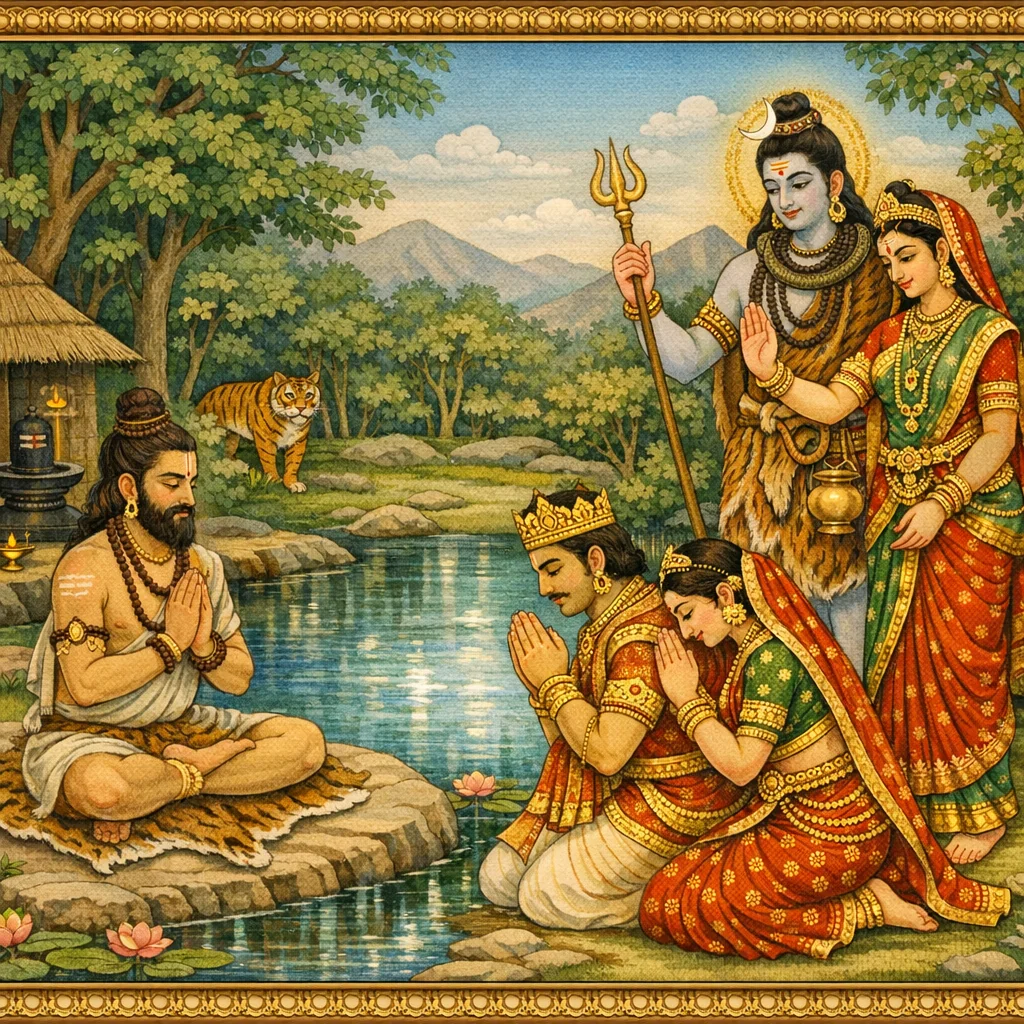
Chapter 95, as narrated by Sūta, gives an ethically framed tīrtha account of the origin and power of Ajāpāleśvarī worship. King Ajāpāla, distressed by the social harm of oppressive taxation yet aware that revenue is needed to protect his people, vows to create a “thornless” realm through tapas rather than fiscal exaction. Seeking a swiftly fruit-bearing sacred place that readily pleases Mahādeva and the gods, he consults Vasiṣṭha, who directs him to Hāṭakeśvara-kṣetra, where Caṇḍikā (the Devī) is quickly satisfied. Ajāpāla undertakes disciplined worship—brahmacarya, purity, regulated diet, and thrice-daily bathing—and the Goddess grants knowledge-filled weapons and mantras that restrain crime, curb grave moral offenses (such as violations involving others’ spouses), and control diseases. As sin and illness decline, Yama’s jurisdiction becomes virtually idle and the gods deliberate; Śiva then appears in tiger form, draws out the king’s defensive response, reveals himself, praises Ajāpāla’s unprecedented dharmic governance, and commands him and his queen to depart to Pātāla to Hāṭakeśvara, returning the granted instruments at the appointed time into the sacred waters of Devī-kuṇḍa. The chapter closes by affirming ongoing presence: Ajāpāla is said to remain there, free from aging and death, worshipping Hāṭakeśvara, and the Goddess’s installation stands as a lasting sacred anchor. A calendrical instruction is also given: worship on Śukla Caturdaśī and bathing in the kuṇḍa are linked with strong protection and health benefits, including a reduction of illnesses.
Shlokas
Verse 1
सूत उवाच । अथान्यापि च तत्रास्ति देशकामप्रदा नृणाम् । अजापालेन भूपेन स्थापिता पापनाशनी
Sūta said: There too is another sacred power that grants people the desired blessings of that land; it was established by King Ajāpāla, and it destroys sins.
Verse 2
तां च शुक्लचतुर्दश्यामजापालेश्वरीं नरः । यो वै पूजयते भक्त्या धूपपुष्पानुलेपनैः । स प्राप्नोतीप्सितान्कामान्दुर्लभा सर्वमानवैः
And whoever, on the fourteenth day of the bright fortnight, worships Ajāpāleśvarī with devotion—offering incense, flowers, and unguents—attains the desired boons, so hard for human beings to obtain.
Verse 3
तस्या देव्याः प्रसादेन सत्यमेतन्मयोदितम् । अजापालो महीपालः पुराऽसीत्संमतः सताम्
By the grace of that Goddess, what I have spoken is true. In former times King Ajāpāla was a ruler approved and honored by the virtuous.
Verse 4
हितकृत्सर्वलोकस्य यथा माता यथा पिता । तेन राज्यं समासाद्य पितृपैतामहं शुभम्
He worked for the welfare of all people, like a mother and like a father. Thus, having attained the auspicious kingdom inherited from his father and forefathers,
Verse 5
चिंतितं मनसा पश्चात्स्वयमेव महात्मना । मया तत्कर्म कर्तव्यं यदन्यैरिह भूमिपैः । न कृतं न करिष्यंति ये भविष्यन्त्यतः परम्
Afterward, the great-souled king reflected within himself: “That deed must be done by me—one which other kings here have not done, and which those who come after will not do.”
Verse 6
एष एव परो धर्मो भूपतीनामुदाहृतः । यत्प्रजापालनं शश्वत्तासां च सुखसंस्थितिः
This indeed is declared to be the highest dharma of kings: the constant protection of subjects and securing their well-being and happiness.
Verse 7
यथायथा करं भूपास्ता मां गृह्णंति लोलुपाः । तथातथा मनःक्षोभो हृदये संप्रजायते
Whenever those greedy kings seize taxes from me, in that very measure a restless agitation is born within my heart.
Verse 8
न करेण विना भूपा हस्त्यश्वादिबलं च यत् । शक्नुवंति परित्रातुं पादातं च विशेषतः
Without revenue (tax), kings cannot maintain and protect the forces of elephants, horses, and the rest—especially the foot-soldiers.
Verse 9
विना तेन स गम्यः स्यान्नीचानामपि सत्वरम् । एतस्मात्कारणाद्भूपाः करं गृह्णंति लोकतः
Without that (military strength sustained by revenue), the realm would quickly become accessible even to the low and base. For this reason kings collect taxes from the people.
Verse 10
तस्मान्मया विनाप्याशु नागैश्चैव नरैस्तथा । तपः शक्त्या प्रकर्तव्यं राज्यं निहतकण्टकम्
Therefore, even without me, let the Nāgas and the men swiftly, by the power of austerity (tapas), establish a kingdom without thorns—rid of oppressors and troubles.
Verse 11
करानगृह्णता तेन लोकान्रंजयता सदा । अन्येषां भूमिपालानां विशेषेण महात्मनाम्
By him—who took no taxes and who always delighted the people—this became a model for other rulers, pre-eminently for the noble-souled kings.
Verse 12
एवं चित्ते समाधाय वसिष्ठं मुनिपुंगवम् । पुरोधसं समाहूय ततः प्रोवाच सादरम्
Having thus resolved in his mind, he summoned Vasiṣṭha, the bull among sages—his royal priest (purohita)—and then spoke to him with reverence.
Verse 13
अत्र भूमितले विप्र सर्वेषां तीर्थमुत्तमम् । अल्पकालेन सन्तुष्टिं यत्र याति महेश्वरः । वासुदेवोऽथवा ब्रह्मा ह्येतच्छीघ्रं वदस्व मे
O Brāhmaṇa, on this earth, which is the supreme tīrtha among all—where, in a short time, Maheśvara, or Vāsudeva, or Brahmā becomes pleased? Tell me this quickly.
Verse 14
येनाहं सर्वलोकस्य हितार्थं तप आददे । न स्वार्थं ब्राह्मणश्रेष्ठ सत्येनात्मानमालभे
O best of Brāhmaṇas, I undertake austerity for the welfare of the entire world—not for my own gain; in truth, I dedicate myself to this purpose.
Verse 15
वसिष्ठ उवाच । तिस्रः कोट्योर्धकोटी च तीर्थानामिह भूतले । संति पार्थिवशार्दूल प्रभावसहितानि च
Vasiṣṭha said: O tiger among kings, upon this earth there are three crores and a half-crore of tīrthas, each endowed with its own sacred power and efficacy.
Verse 16
अष्टषष्टिस्तथा राजन्क्षेत्राणामस्ति भूतले । येषां सांनिध्यमभ्येति सर्वदैव महेश्वरः
And, O King, there are sixty-eight sacred kṣetras upon the earth—places whose holy presence Maheśvara approaches and abides in at all times.
Verse 17
तथा सर्वे सुरास्तुष्टा ब्रह्मविष्णु शिवादयः । परं सिद्धिप्रदं शीघ्रं मानुषाणां महीपते
Thus all the gods—Brahmā, Viṣṇu, Śiva, and the rest—become pleased. O king, this (observance and holy place) swiftly bestows the highest spiritual accomplishment upon human beings.
Verse 18
हाटकेश्वरदेवस्य क्षेत्रं पातकनाशनम् । देवानामपि सर्वेषां तुष्टिं गच्छति चंडिका
The sacred domain of Lord Hāṭakeśvara destroys sins. There, Caṇḍikā too attains (and grants) the satisfaction of all the gods.
Verse 19
शीघ्रमाराधिता सम्यक्छ्रद्धायुक्तैर्नरैर्भुवि । तस्मात्तत्क्षेत्रमासाद्य तां देवीं श्रद्धयान्वितः । आराधय महाभाग द्रुतं सिद्धिमवाप्स्यसि
On earth, she is quickly and properly propitiated by men endowed with faith. Therefore, having reached that sacred field, worship that Goddess with devotion, O noble one—you will swiftly obtain attainment.
Verse 20
एवमुक्तः स तेनाथ गत्वा तत्क्षेत्रमुत्तमम् । प्रतिष्ठाप्य च देवीं तां पूजयामास भक्तितः
Thus instructed by him, he then went to that excellent sacred field; and having installed the Goddess, he worshipped her with devotion.
Verse 21
ब्रह्मचर्यपरो भूत्वा शुचिर्व्रतपरायणः । नियतो नियताहारस्त्रिकालं स्नानमाचरन्
Becoming devoted to celibate discipline, pure, and intent on his vow, self-restrained and regulated in diet, he performed bathing three times a day.
Verse 22
एवमाराध्यतस्तत्र गन्धपुष्पानुलेपनैः । पूजापरस्य सा देवी तस्य तुष्टिं ततो गता
Thus, as he worshipped her there with perfumes, flowers, and unguents, the Goddess—seeing him wholly devoted to worship—became pleased with him.
Verse 23
देव्युवाच । परितुष्टास्मि ते वत्स व्रतेनानेन नित्यथः । बलिपूजाविधानेन विहितेनामुना स्वयम्
The Goddess said: “Dear child, I am fully pleased with you because of this vow, continually observed, and because of this rite of offering and worship performed as enjoined.”
Verse 24
तद्ब्रूहि येन ते सर्वं प्रकरोमि हृदि स्थितम् । सद्य एव महीपाल त्रिदशैरपि दुर्लभम्
“Therefore speak: by what means shall I accomplish for you everything that is set in your heart—this very day, O king—even what is difficult to obtain even for the gods?”
Verse 25
राजोवाच । लोकानां हितकामेन मयैतद्व्रतमाहृतम् । येन तेषां भवेत्सौख्यं मत्प्रसादादनुत्तमम्
The king said: “Seeking the welfare of the people, I have undertaken this vow, so that by my grace they may attain unsurpassed happiness.”
Verse 26
तस्माद्देहि महाभागे ज्ञानयुक्तानि भूरिशः । ममास्त्राणि विचित्राणि स्वैरगाणि समन्ततः
“Therefore, O greatly fortunate Goddess, grant me in abundance wondrous weapons endowed with right knowledge—arms that move at will in every direction.”
Verse 27
यानि जानंति भूपृष्ठे मम पार्श्वे स्थितान्यपि । अपराधं सदा लोके परदारादि यत्कृतम्
Even those who stand at my very side upon the earth know the offences continually committed in the world—such as transgressions involving another’s spouse and the like.
Verse 28
अनुरूपं ततस्तस्य पातकस्य विनिग्रहम् । प्रकुर्वंति मिथो येन न तेषां संकरो भवेत्
Therefore they should impose restraint and correction proportionate to that sin, so that—through mutual discipline—no confusion or intermixture of social norms arises among them.
Verse 29
मंत्रग्रामं तथा देवि मम देहि पृथग्विधम् । निग्रहं व्याधिसत्त्वानां येन शीघ्रं करोम्यहम्
And so, O Devī, grant me a collection of mantras of various kinds, by which I may swiftly restrain the beings that manifest as diseases.
Verse 30
येन स्युर्मनुजाः सर्वे मम राज्ये सुखान्विताः । नीरोगाः पुष्टिसंपन्ना भयशोकविवर्जिताः
By this means, may all people in my kingdom dwell in happiness—free from illness, endowed with strength and nourishment, and devoid of fear and grief.
Verse 31
नाहं देवि करिष्यामि हस्त्यश्वरथसंग्रहम् । यतस्तेषां भवेत्पुष्टिर्वित्तैर्वित्तं करैर्भवेत् । गृहीतैः सर्वलोकानां तस्मात्तन्न ममेप्सितम्
O Devī, I will not amass elephants, horses, and chariots—for their upkeep and increase would require wealth, and that wealth would come from taxes taken from all the people. Therefore, that is not what I desire.
Verse 32
श्रीदेव्युवाच । अत्यद्भुततरं कर्म त्वयैतत्पृथिवीपते । प्रारब्धं यन्न केनापि कृतं न च करिष्यति
Śrī Devī said: O lord of the earth, this deed you have undertaken is most wondrous—something that no one else has done, nor will anyone do.
Verse 33
तथाप्येवं करिष्यामि तव दास्यामि कृत्स्नशः । ज्ञानयुक्तानि शस्त्राणि मंत्रग्रामं च तादृशम्
Even so, I shall do this: I will grant you in full weapons empowered by sacred knowledge, and a corresponding collection of mantras.
Verse 34
गृह्यन्ते येन ते सर्वे व्याधयोऽपि सुदारुणाः । परं सदैव ते रक्ष्या मन्मन्त्रैरपि संयुताः
By these, even the most dreadful diseases can be seized and held in check. Yet you must always remain protected—fortified also by my mantras.
Verse 35
यदि दृष्टिपथात्तुभ्यं क्वचिद्यास्यंति दूरतः । मानवान्पीडयिष्यंति चिरात्प्राप्याधिकं ततः
If they should ever slip beyond the range of your sight and go far away, then after a long time they will afflict people, gaining thereby even greater strength.
Verse 36
यदा त्वं पृथिवीपाल स्वर्गं यास्यसि भूतलात् । तदात्र सलिले स्थाप्या मदग्रे यद्व्यवस्थितम्
O protector of the earth, when you depart from this world and go from the earthly realm to heaven, then what has been arranged here before me should be placed in water at this very spot.
Verse 37
सर्वे मंत्रास्तथाऽस्त्राणि ममवाक्यादसंशयम् । येन स्यात्पूर्ववत्सर्वो व्यवहारो नृपोद्भवः
“All those mantras, and those divine weapons as well, will without doubt arise through my command, so that every royal function and the whole order of governance may proceed again exactly as before.”
Verse 38
सूत उवाच । बाढमित्येव तेनोक्ते तत्क्षणाद्द्विजसत्तमाः । प्रादुर्भूतानि दिव्यानि तस्यास्त्राणि बहूनि च
Sūta said: “When he had spoken only, ‘So be it,’ O best of the twice-born, at that very instant many of his divine weapons manifested.”
Verse 39
ज्ञानसंपत्प्रयुक्तानि यादृशानि महात्मना । तेन संयाचितान्येव व्याधिमंत्रास्तथैव च
“And just as that great-souled one, endowed with the wealth of knowledge, employed them, so too, at his request, the disease-controlling mantras were granted.”
Verse 40
व्याधयो यैश्च गृह्यंते मुच्यंते स्वेच्छया सदा । सुखेन परिपाल्यंते दृष्टिगोचरसंस्थिताः
By those mantras, diseases may be seized and released at will, always; and they are easily kept under control, remaining within the range of one’s sight.
Verse 41
ततस्तं सकलं प्राप्य प्रसादं चंडिकोद्भवम् । तच्च हस्त्यादिकं सर्वं ब्राह्मणेभ्यो ददौ नृप
Then, having obtained all that grace born of Caṇḍikā, the king gave all those elephants and other possessions to the Brahmins.
Verse 42
एकां मुक्त्वा निजां भार्यामेकं दशरथं सुतम् । तांश्चापि सकलान्व्याधीन्मंत्रैः संयम्य यत्नतः
Saving only his own wife and his son Daśaratha, he carefully restrained all the other diseases by means of mantras.
Verse 43
अजारूपान्स्वयं पश्चाद्यष्टिमादाय रक्षति । एवं तस्य नरेन्द्रस्य वर्तमानस्य भूतले
Afterwards, taking up a staff, he himself guarded them, appearing in the form of a goat. Thus it was for that king as he lived upon the earth.
Verse 44
गुप्तोऽपि नापराधः स्यात्कस्यचित्प्रकटः कुतः । प्रमादाद्यदि भूलोके कश्चित्पापं समाचरेत्
Even if hidden, an offense does not cease to be an offense—how could it remain undisclosed? If through negligence someone in this world commits sin,
Verse 45
तद्रूपो निग्रहस्तस्य तत्क्षणादेव जायते । वधं वा यदि वा बंधं क्लेशं चाऽरातिसंभवम्
For him, a punishment of that very kind arises at once—whether it be death, or imprisonment, or suffering born of enemies.
Verse 46
अदृष्टान्यपि शस्त्राणि तानि कुर्वंति तत्क्षणात् । अन्येषां च महीपानां राज्ये गुप्तान्यनेकशः । कुर्वन्ति मनुजास्तेषां चक्रे वैवस्वतो ग्रहम्
Even unseen weapons accomplish their work that very instant. And in the realms of other kings as well, hidden forces in many ways bring men under restraint—into the grasp of Vaivasvata (Yama) and the wheel of retribution.
Verse 47
न तत्र भयसंत्रस्तस्ततः पापसमाचरेत् । प्रत्यक्षं वा विशेषेण ज्ञात्वा शस्त्रभयं च तत्
There, no one—shaken by fear—turned to sinful conduct; for they directly and distinctly knew that even the dread of weapons and violence was absent.
Verse 48
ततस्ते पापनिर्मुक्ता लोकाः संशुद्धगात्रकाः । रोगेषु निगृहीतेषु प्राप्ताः सुखमनुत्तमम्
Then those beings, freed from sin and purified in body, attained unsurpassed happiness, as diseases and afflictions were wholly restrained.
Verse 49
एवं स्थितेषु लोकेषु गतपापामयेषु च । प्रयाताः शून्यतां सर्वे नरका ये यमालये
When the worlds stood thus—free from sin and disease—then all the hells within Yama’s domain fell into emptiness.
Verse 50
न कश्चिन्नरकं याति न च मृत्युपथं नरः । यथा कृतयुगं तादृक्त्रेतायामपि संस्थितम्
No one went to hell, nor did any person tread the path of death; even in the Tretā age it stood as though it were the Kṛta age.
Verse 51
व्यवहारे ततो नष्टे यमलोकसमुद्भवे । स्वर्गेण तुल्यतां प्राप्ते प्राणिभिर्मृत्युवर्जितैः
When that Yama-born order of judgment and punishment vanished, the world became equal to heaven, for its beings were free from death.
Verse 52
ततो वैवस्वतो गत्वा ब्रह्मणः सदनं प्रति । प्रोवाच दुःखसंपन्नः प्रणिपत्य पितामहम्
Then Vaivasvata (Yama) went to the abode of Brahmā; overwhelmed with sorrow, he bowed to the Grandfather and spoke.
Verse 54
अजापालेन भूपेन तत्सर्वं विफलीकृतम् । तपःशक्त्या सुरश्रेष्ठ देवीमाराध्य चंडिकाम्
O best of gods, all that has been rendered ineffective by King Ajāpāla, who—by the power of austerities—worshipped and propitiated the Goddess Caṇḍikā.
Verse 55
नाधयो व्याधयस्तत्र न पापानि महीतले । कस्यचिद्देव जायंते यथा कृतयुगे तथा
There upon the earth, O god, neither mental afflictions nor bodily diseases arose, nor did any sin appear for anyone; it was just as in the Kṛta age.
Verse 56
तस्मात्कुरु सुरश्रेष्ठ पुनरेव यथा पुरा । मदीयभवने कृत्स्नो व्यवहारः प्रजायते
Therefore, O best among the gods, restore it once more as it was before, so that in my abode the whole order of judgment and administration may arise again.
Verse 58
अथाब्रवीत्प्रहस्योच्चैस्त्रिनेत्रश्चतुराननम् । अत्यद्भुततमां श्रुत्वा तां वार्तां यमसंभवाम्
Then the Three-eyed Lord, laughing aloud, spoke to the Four-faced Brahmā, having heard that exceedingly wondrous report that had come from Yama.
Verse 59
महेश्वर उवाच । धर्ममार्गप्रवृत्तस्य सदाचारस्य भूपतेः । कथं निवारणं तत्र क्रियते कश्च निग्रहः
Maheśvara said: “O king, for one established on the path of dharma and grounded in good conduct, how could any obstruction be imposed there, and by whom could he be restrained?”
Verse 60
तस्मात्तेन महीपेन यस्मान्मार्गः प्रदर्शितः । अपूर्वो धर्मसंभूतः कृतः सम्यङ्महात्मना
“Therefore, because that king has shown the way, that great-souled one has rightly established a wondrous path—born of dharma itself.”
Verse 61
तन्मयापि यथा चास्य प्रसादः सुरसत्तम । अपूर्वः करणीयश्च यथा धर्मो न दुष्यति
“O best among the gods, I too must act in such a way that his divine favor is extraordinary—and that dharma is not tainted.”
Verse 62
एवमुक्त्वा चतुर्वक्त्रं यमं प्राह ततः शिवः । वदायुषोऽस्य यच्छेषमजापालस्य भूपतेः । येन तत्समये प्राप्ते तं नयामि निजालयम्
Having spoken thus, Śiva then addressed Yama, the four-faced: “Tell me how much of the lifespan remains for this king Ajāpāla, so that when that time arrives I may lead him to my own abode.”
Verse 63
यम उवाच । पञ्चवर्षसहस्राणि तस्यातीतानि चायुषः । तिष्ठंति पञ्चपञ्चाशत्प्रतीक्ष्येऽहं ततः कथम्
Yama said: “Five thousand years of his lifespan have already passed; fifty-five still remain. How, then, am I to wait any longer?”
Verse 64
यावत्कालं सुरश्रेष्ठ शून्ये जाते स्व आश्रये । तस्मात्कुरु द्रुतं कंचिदुपायं तद्विनाशने
“O best among the gods, so long as my own abode remains empty; therefore devise quickly some means to bring about that end.”
Verse 65
एवमुक्ते यमेनाथ तं विसृज्य गृहं प्रति । व्याघ्ररूपं समास्थाय स्वयं तत्संनिधौ ययौ
When Yama had spoken thus, Śiva dismissed him. Then, assuming the form of a tiger, he himself went to that king’s vicinity.
Verse 66
यत्र संस्थो महीपः स प्रजापालनतत्परः । मेघगम्भीरनिर्घोषं गर्जमानो मुहुर्मुहुः
Where the king stood, intent on protecting his subjects, the (tiger) roared again and again with a deep sound like thunderclouds.
Verse 67
अजास्तास्तं च संवीक्ष्य व्याघ्रं रौद्रवपुर्द्धरम् । अजापालं समुद्दिश्य संत्रस्ताः शरणं गताः
Seeing that tiger of terrifying form, the goats, stricken with panic, turned toward Ajāpāla and took refuge in him.
Verse 68
तस्य यत्नपरस्यापि रक्षमाणस्य भूपतेः । अजास्ता व्याघ्ररूपेण शंकरेण प्रभक्षिताः
Even though the king strove hard to protect them, those goats were devoured by Śaṅkara, who had assumed the form of a tiger.
Verse 69
अजानां कदनं दृष्ट्वा ततः स पृथिवीपतिः । स्वहस्ताद्यष्टिमुत्सृज्य जग्राह निशितायुधम्
Seeing the slaughter of the innocent, the king cast away the staff from his hand and seized a keen, sharpened weapon.
Verse 70
यत्तस्य तुष्टया दत्तं चंडं चंडार्चिषा समम् । तच्छस्त्रं च तथान्यानि देवीदत्तानि शंकरः । शनैःशनैः प्रजग्राह स्ववक्त्रेण महेश्वरः
Then Maheśvara Śaṅkara, with his own mouth, gradually took up that terrible weapon—fierce as blazing flame—along with the other arms bestowed by the Goddess in her satisfaction.
Verse 71
अस्त्राभावात्ततस्तूर्णं ध्रियमाणेऽपि कांतया । द्वंद्वयुद्धेन तं व्याघ्रं योधयामास भूपतिः
Then, lacking missiles, though his beloved still restrained him, the king swiftly fought that tiger in single combat.
Verse 72
ततस्तस्यांगसंस्पर्शान्मुक्त्वा व्याघ्रतनुं च ताम् । दधार भस्मसंदिग्धां तनुं चन्द्रविभूषिताम्
Then, by the touch of his body, he cast off that tiger-form and assumed a body smeared with sacred ash and adorned with the moon.
Verse 73
रुंडमालावरां दिव्यां सखट्वांगां सपन्नगाम् । तां दृष्ट्वा स महीपालः सभार्यः प्रणतस्ततः
Beholding that divine one—wearing an excellent garland of severed heads, bearing a khaṭvāṅga staff, and accompanied by serpents—the king at once bowed down, together with his wife.
Verse 74
प्रोवाचाथ स्तुतिं कृत्वा विनयावनतः स्थितः । आनंदाश्रुपरिक्लिन्नो हर्षगद्गदया गिरा
Then, having offered a hymn of praise, he stood with head bowed in humility—his eyes wet with tears of joy, his voice trembling with rapture as he spoke.
Verse 75
राजोवाच । अज्ञानाद्यन्मया देव प्रहारास्तव निर्मिताः । तिरस्कारस्तथा दत्तस्तत्सर्वं क्षम्यतां विभो
The King said: O Lord, out of ignorance I struck at you and even showed contempt. Let all of that be forgiven, O Almighty One.
Verse 76
श्रीभगवानुवाच । क्षांत एष मया पुत्र तव सर्वः पराभवः । परितुष्टेन ते कर्म दृष्ट्वा चैवातिमानुषम्
The Blessed Lord said: O son, all this defeat of yours is forgiven by me, for I am pleased—having seen your deeds, which are truly beyond the ordinary human measure.
Verse 77
यथा कृतं त्वया राज्यं प्रजाः संरक्षिता नृप । तथान्यो भूपतिः कश्चिन्न कर्ता न करिष्यति
As you have ruled and protected your subjects, O king—no other ruler has done so, nor will any do so in the future.
Verse 78
तस्माद्गच्छ मया सार्धं पाताले पार्थिवोत्तम । अनेनैव शरीरेण धर्मपत्न्यानया सह
Therefore come with me to Pātāla, O best of kings—together with your righteous wife, and with this very same body.
Verse 79
नातः परं त्वया स्थेयं मर्त्यलोके कथंचन । विरुद्धं सर्वदेवानां यतः कर्म त्वदुद्भवम्
Beyond this point you must not remain in the mortal world in any way; for the act that has arisen from you stands opposed to all the gods.
Verse 80
राजोवाच । एवं देव करिष्यामि गत्वाऽयोध्यां महापुरीम् । पुत्रं राज्ये प्रतिष्ठाप्य मंत्रिणां संनिवेद्य च
The king said: “So be it, O Lord—I shall do thus. I will go to the great city of Ayodhyā, install my son upon the throne, and duly inform the ministers.”
Verse 81
तथाहं देव देव्या च प्रोक्तः संतुष्टया पुरा । मन्त्रग्रामो यया दत्तः शस्त्राणि विविधानि च
“So too, O Lord, in former times, when the Goddess was pleased, she addressed me thus; she granted me a whole collection of mantras, and also many kinds of weapons.”
Verse 82
यदा त्वं त्यजसि प्राज्ञ मर्त्यलोकं सुदुस्त्यजम् । तदात्र मामके कुण्डे प्रक्षेप्तव्यानि कृत्स्नशः
O wise one, when you abandon this mortal world—so hard to relinquish—then here, in my own sacred pool, all those things must be cast in, wholly and without remainder.
Verse 83
तानि चार्पय मे भूयो येनानृण्यं व्रजाम्यहम् । तस्या देव्याः सुराधीश त्वत्प्रसादेन सांप्रतम्
And return those things to me once more, so that I may be free of debt. O Lord of the gods, at this very time, by your grace, my obligation to that Goddess is now cleared.
Verse 84
एवमुक्तस्ततस्तेन भगवांस्त्रिपुरांतकः । आज्ञाप्य तानि सर्वाणि ददौ तत्र द्रुतं गतः
Thus addressed by him, the Blessed Lord Tripurāntaka gave command that all those items be returned, and then he swiftly went there.
Verse 85
अब्रवीच्च सुतस्तत्र स्वयं राजा भविष्यति । वीर्यौदार्यसमोपेतो वंशस्योद्धरणक्षमः
And there he declared: “Your son himself shall become king—endowed with valor and generosity, able to uphold and restore the lineage.”
Verse 86
त्वं चागच्छ मया सार्धमद्यैव मम मंदिरे । प्रविश्यात्र जले पुण्ये देवीकुण्डसमुद्भवे
“And you as well—come with me today itself to my abode; and enter here into this holy water that has arisen from Devīkuṇḍa.”
Verse 87
अद्य माघचतुर्दश्यां शुक्लायामपरोऽपि यः । देवीमिमां च संपूज्य जलेऽस्मिन्भक्तिसंयुतः
Today, on the bright (śukla) fourteenth day of Māgha, whoever—be it even another person—worships this Goddess and, endowed with devotion, (enters) this water…
Verse 88
करिष्यति प्रवेशेन प्राणत्यागं नृपोत्तम । स च यास्यति यत्रास्ते पाताले हाटकेश्वरः
By entering (these waters) he will relinquish his life, O best of kings; and he will go to the place where Hāṭakeśvara abides—in Pātāla.
Verse 89
स्नानं वा पार्थिवश्रेष्ठ यः करिष्यति मानवः । अष्टोत्तरशतं तस्य व्याधीनां न भविष्यति
O best of kings, any person who performs bathing (here, at this sacred tīrtha) will be free from one hundred and eight kinds of diseases.
Verse 90
एवमुक्त्वा तमादाय नृपं भार्यासमन्वितम् । अजाभिस्ताभिरस्त्रैश्च तैश्चापि परमेश्वरः । प्रविवेश जले तस्मिन्देवीकुण्डसमुद्भवे
Having spoken thus, the Supreme Lord took the king together with his wife, along with those goats and the weapons, and entered the water that had arisen from Devīkuṇḍa.
Verse 91
ततश्च मंदिरं नीतः स्वकीयं द्विजसत्तमाः । तेनैव नरदेहेन स कलत्रसमन्वितः
Then, O best of the twice-born, he was led to his own palace—still in that very human body, and accompanied by his wife.
Verse 92
अद्यापि तिष्ठते तत्र जरामरणवर्जितः । पूजयानश्च तं देवं पाताले हाटकेश्वरम्
Even today he abides there, free from old age and death, worshipping the Lord Hāṭakeśvara in Pātāla, the netherworld.
Verse 93
एवं तत्र समुद्भूता सा देवी परमेश्वरी । स्थापिता तेन भूपेन श्रद्धापूतेन चेतसा
Thus the Supreme Goddess, Parameśvarī, manifested there; and that king, his heart purified by faith, established her sacred presence in that place.
Verse 95
इति श्रीस्कान्दे महापुराण एकाशीतिसाहस्र्यां संहितायां षष्ठे नागरखण्डे श्रीहाटकेश्वरक्षेत्रमाहात्म्येऽजापालेश्वरीमाहात्म्यवर्णनंनाम पञ्चनवतितमोऽध्यायः
Thus ends the ninety-fifth chapter, entitled “The Description of the Greatness of Ajāpāleśvarī,” in the Śrī Skanda Mahāpurāṇa, in the Ekāśītisāhasrī Saṃhitā, within the sixth book, the Nāgara Khaṇḍa, in the Māhātmya of the sacred region of Śrī Hāṭakeśvara.
Verse 97
तस्य तद्वचनं श्रुत्वा ब्रह्मा लोकपितामहः । समीप उपविष्टस्य शिवस्याऽस्यं व्यलोकयत्
Hearing those words, Brahmā—the grandsire of the worlds—gazed upon the face of Śiva, who was seated nearby.