Adhyaya 93
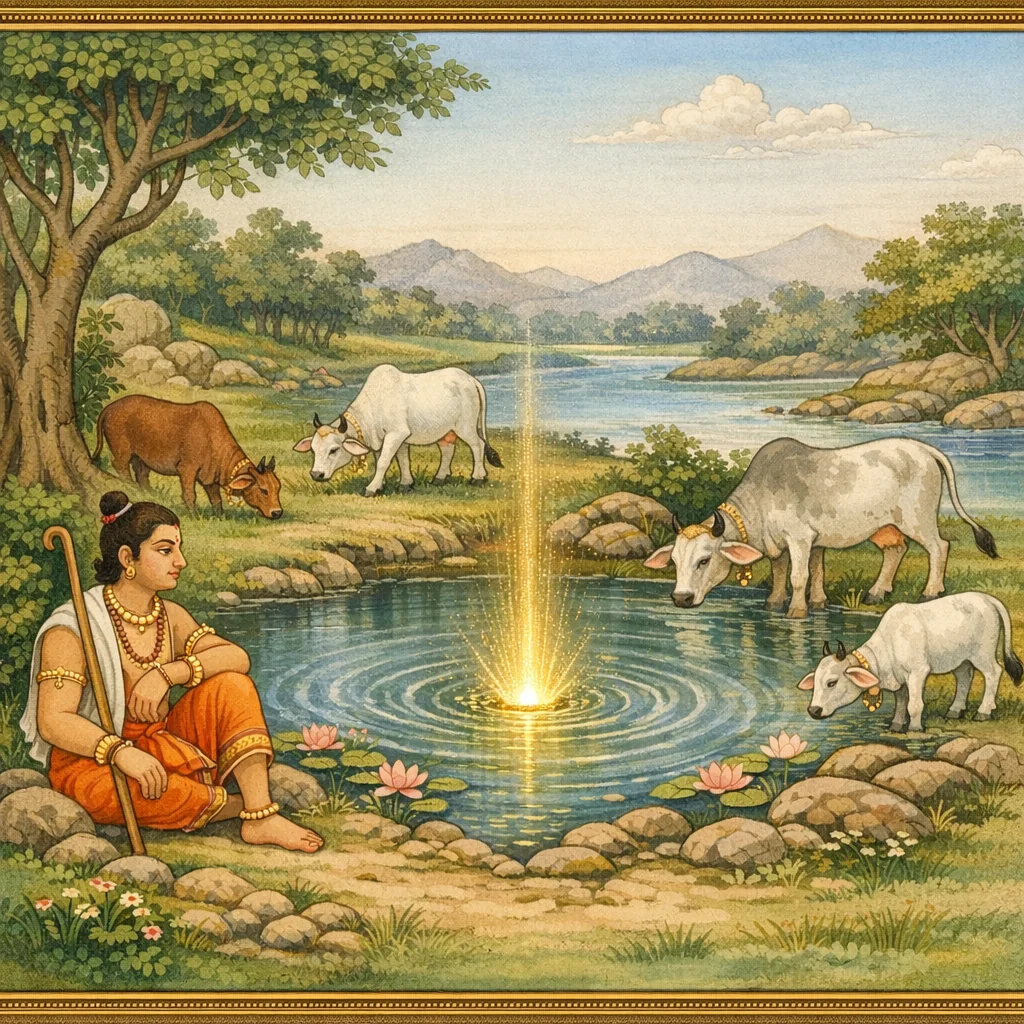
This chapter recounts the origin, concealment, and re-manifestation of Gomukha-tīrtha within Hāṭakeśvara-kṣetra. Sūta describes a local miracle: on an auspicious calendrical day, a thirsty cow uproots a tuft of grass, whereupon a stream bursts forth and spreads into a broad pool as many cows drink. A diseased cowherd enters the water and bathes; his affliction vanishes at once and his body becomes radiant. The report spreads, and the place becomes renowned as “Gomukha.” Asked why such water exists there, Sūta relates King Ambarīṣa’s tapas for his son afflicted with kuṣṭha, understood as karmic fruition of a prior-life brahma-hatyā—killing a brāhmaṇa mistaken for an intruder. Pleased, Viṣṇu draws up subterranean Jāhnavī (Gaṅgā) water through a subtle aperture and instructs immersion; the son is healed and the opening is concealed. In later times, the water is said to be disclosed again on earth through the “gomukha” episode. The chapter also proclaims phala: bathing with devotion removes pāpa and certain ailments; performing śrāddha in the Hāṭakeśvara region fulfills obligations to the ancestors. A Sunday dawn bath is singled out for particular therapeutic benefit, while the efficacy of devoted bathing on other days is likewise affirmed.
Shlokas
Verse 1
सूत उवाच । अथान्यदपि तत्रास्ति गोमुखाख्यं सुशोभनम् । यद्गोवक्त्रात्पुरा लब्धं सर्वपातकनाशनम्
Sūta said: “There, too, is another splendid sacred place called Gomukha, which in ancient times arose from a cow’s mouth and destroys all sins.”
Verse 2
पुरासीदत्र गोपालः कश्चित्कुष्ठसमावृतः । चमत्कारपुरं विप्र अतीव क्षामतां गतः
Formerly, in that place, there lived a cowherd covered with leprosy; O brāhmaṇa, in the town called Camatkārapura he had become exceedingly emaciated and weak.
Verse 3
कस्यचित्त्वथ कालस्य तेन मार्गेण गोकुलम् । मध्याह्नसमये प्राप्तं चंद्रे चित्रासमन्वितः
Then, after some time, along that route they reached Gokula at midday, when the Moon was in conjunction with the nakṣatra Citrā.
Verse 4
एकादश्यां तृषार्त्तं च भास्करे वृषसंस्थिते । एकयापि ततो धेन्वा तृणस्तम्बमतीव हि । नीलमालोकितं तत्र दूरादेत्य प्रहर्षिता
On an Ekādaśī day, when the Sun was in Vṛṣa (Taurus), a cow tormented by thirst saw from afar a clump of grass that appeared dark-blue; drawing near to that place, she became greatly delighted.
Verse 5
दन्तैर्द्रुतं समुत्पाट्य यावदाकर्षति द्विजाः । तावत्तज्जडमार्गेण तोयधारा विनिर्गता
Quickly uprooting it with her teeth and pulling at it, O twice-born ones, in that very moment a stream of water gushed forth along that rigid channel.
Verse 6
अथास्वाद्य तृणं तस्मात्तृषार्ता च शनैःशनैः । पपौ तोयं सुविश्रब्धा सुस्वादु क्षीरसंनिभम्
Then, having tasted that grass, the thirst-stricken cow slowly drank the water with full confidence—sweet in flavor and resembling milk.
Verse 7
तस्या वेगेन तत्तोयं पिबन्त्यास्तत्रभूतले । गर्ता जाता सुविस्तीर्णा सलिलेन समावृता
As she drank that water with force and eagerness, on that very ground a wide basin formed, and it became filled and covered with water.
Verse 8
ततोऽन्याः शतशो गावः पपुस्तोयं मुनिर्मलम् । तृषार्त्तास्तद्द्विजश्रेष्ठाः पीयूषरससंनिभम्
Then hundreds of other cows, tormented by thirst, drank that water—pure and stainless, O best of the twice-born—like the very essence of nectar.
Verse 9
यथायथा गता गावस्तत्र तोयं पिबंति ताः । सा गर्ता वक्त्रसंस्पर्शाद्वृद्धिं याति तथा तथा
As more and more cows came there and drank that water, so too the basin grew ever larger, expanding through the touch of their mouths.
Verse 10
ततश्च गोकुले कृत्स्ने जाते तृष्णाविवर्जिते । गोपालोऽपि तृषार्तस्तु तस्मिंस्तोये विवेश च
Then, when all of Gokula had become free from thirst, the cowherd too—though tormented by thirst—entered into that water.
Verse 11
अंगं प्रक्षाल्य पीत्वापो यावन्निष्क्रामति द्रुतम् । तावत्पश्यति गात्रं स्वं द्वादशार्कसमप्रभम्
Having washed his body and drunk that water, while it swiftly remained within him, he beheld his own limbs shining with a radiance equal to twelve suns.
Verse 12
ततो विस्मयमापन्नो गत्वा स्वीयं निकेतनम् । वृतांतं कथयामास लोकानां पुरतोऽखिलम्
Then, filled with wonder, he went to his own dwelling and recounted the entire occurrence in the presence of the people.
Verse 13
तृणस्तम्बं यथा धेन्वा तत्रोत्पाट्य प्रशक्तितः । यथा विनिर्गतं तोयं यथा तेनावगाहितम्
He described how, like a cow forcefully pulling up a clump of grass there, the water gushed forth—how it emerged, and how he bathed in it.
Verse 15
भवंति च विनिर्मुक्ता रोगैः पापैश्च तत्क्षणात् । अपापाश्च पुनर्यांति तत्क्षणात्त्रिदिवालयम्
They are instantly freed from diseases and sins; purified of all fault, at that very moment they depart to the abode of the gods.
Verse 16
ततःप्रभृति तत्ख्यातं तीर्थं गोमुखसंज्ञितम् । गोमुखाद्भूतले जातं यतश्चैवं द्विजोत्तमाः
From that time onward, that sacred ford became famed as ‘Gomukha’; for it arose upon the earth from a cow’s mouth—thus, O best of the twice-born.
Verse 17
अथ भीतः सहस्राक्षस्तद्दृष्ट्वा स्वर्गदायकम् । अक्लेशेन मनुष्याणां पूरयामास पांसुभिः
Then Sahasrākṣa (Indra), frightened on seeing that it granted heaven, filled it up with sand—so that humans might not obtain it with ease.
Verse 18
ऋषय ऊचुः । किं तत्कारणमादिष्टं येन तत्तादृशं जलम् । तस्मात्स्थानाद्विनिष्क्रांतं सूतपुत्र वदस्व नः
The sages said: ‘What is the ordained cause by which such water issued from that place? O son of Sūta, tell us.’
Verse 19
सूत उवाच । अत्र पूर्वं तपस्तप्तमम्बरीषेण भूभुजा । पुत्र शोकाभिभूतेन तोषितो गरुडध्वजः
Sūta said: ‘Here, in former times, King Ambarīṣa—overwhelmed by grief for his son—performed austerities; and Garuḍadhvaja (Viṣṇu) was pleased.’
Verse 20
तस्य पुत्रः सुविख्यातः सुवर्चा इति विश्रुतः । एको बभूव वृद्धत्वे कथंचिद्द्विजसत्तमाः
His son, renowned and celebrated, was known as Suvarcā; and when the king had grown old, somehow he was born as an only child, O best of the twice-born.
Verse 21
पूर्वकर्मविपाकेन स बालोऽपि च तत्सुतः । कुष्ठव्याधिसमाक्रांतः पितृमातृसुदुःखदः
By the ripening of former deeds, that son—though still a child—was afflicted with leprosy, bringing intense sorrow to his father and mother.
Verse 22
अथ तत्कामिकं क्षेत्रं स गत्वा पृथिवीपतिः । चकार रोगनाशाय स्वपुत्रार्थं महत्तपः
Then the king of the earth went to that wish-fulfilling sacred field (kṣetra) and undertook great austerity, seeking the destruction of the disease for the sake of his own son.
Verse 23
ततस्तुष्टिं गतस्तस्य स्वयमेव जनार्दनः । प्रदाय दर्शनं वाक्यं ततः प्रोवाच सादरम्
Then Janārdana Himself, pleased with him, granted him His divine vision (darśana); and thereafter, with respect, He spoke these words.
Verse 24
परितुष्टोऽस्मि ते वत्स तस्माच्चित्तेऽभिवांछितम् । प्रार्थयस्व प्रयच्छामि वरं पुत्र न संशयः
“Dear child, I am fully pleased with you. Therefore ask for what your heart desires; I shall grant you the boon, my son—of this there is no doubt.”
Verse 25
राजोवाच । ममायं संमतः पुत्रो ग्रस्तः कुष्ठेन केशव । बालोऽपि तत्कुरुष्वास्य कुष्ठव्याधिपरिक्षयम्
The King said: “O Keśava, this beloved son of mine has been seized by leprosy. Though he is still a child, please bring about the complete ending of this leprosy-disease in him.”
Verse 26
श्रीभगवानुवाच । एष आसीत्पुरा राजा मेघवाहनसंज्ञितः । ब्रह्मण्यश्च कृतज्ञश्च सर्वशास्त्रार्थपारगः
The Blessed Lord said: “In former times, this one was a king named Meghavāhana—devoted to the brāhmaṇas, grateful, and well-versed in the meanings of all śāstras.”
Verse 27
कस्यचित्त्वथ कालस्य ब्राह्मणोऽनेन घातितः । अंतःपुरे निशाकाले प्रविष्टो जारकर्मकृत
“But at a certain time, a brāhmaṇa was killed by him—one who had entered the inner palace at night, engaged in adulterous conduct.”
Verse 28
अथ पश्यति यावत्स प्रभातेऽभ्युदिते रवौ । यज्ञोपवीतसंयुक्तस्तावत्स द्विजरूपधृक्
“Then, when morning came and the sun had risen, he looked and saw him—wearing the sacred thread, bearing the appearance of a twice-born.”
Verse 29
अथ तं ब्राह्मणं मत्वा घृणाविष्टः सुदुःखितः । गत्वा काशीपुरीं पश्चात्तपश्चक्रे समाहितः
“Recognizing him as a brāhmaṇa, he was seized by remorse and deep sorrow. Thereafter he went to Kāśī (Vārāṇasī) and, with concentrated mind, performed austerity.”
Verse 30
राज्ये पुत्रं समाधाय वैराग्यं परमं गतः । नियतो नियताहारो भिक्षान्नकृतभोजनः
Placing his son upon the throne, he attained supreme dispassion. Self-restrained and measured in diet, he lived on alms-food, eating only what was obtained by begging.
Verse 31
ततः कालेन संप्राप्तो यमस्य सदनं प्रति । विपाप्मापि च चिह्नेन युक्तोऽयं पृथिवीपतिः
Then, in course of time, this king reached the abode of Yama; yet—even though purified of sin—he still bore a mark of that deed.
Verse 32
ब्रह्मघातोद्भवेनैव बालभावेऽपि संस्थिते । येऽत्र कुष्ठसमायुक्ता दृश्यंते मानवा भुवि । तैर्नूनं ब्राह्मणाघातो विहितश्चान्यजन्मनि
Even in childhood, those seen on earth afflicted with leprosy are so afflicted only from the consequence of brahma-slaying (brahma-hatyā); surely, in a former birth they committed the killing of a brāhmaṇa.
Verse 33
हाटकेश्वरजे क्षेत्रे यो गत्वा श्राद्धमाचरेत् । पितॄणां चैव सर्वेषामनृणः स प्रजायते
Whoever goes to the sacred field of Hāṭakeśvara and performs śrāddha becomes free from debt to all the ancestors (pitṛs).
Verse 34
न ब्राह्मणवधाद्बाह्यं कुष्ठव्याधिः प्रजायते । एतत्सत्यं विजानीहि वदतो मम भूपते
Leprosy arises from nothing other than the killing of a brāhmaṇa—know this to be true, O king, from my words.
Verse 35
अंबरीष उवाच । एतदर्थं सुराधीश मया त्वं पूजितः प्रभो । प्रसन्ने त्वयि देवेश नासाध्यं विद्यते भुवि
Ambarīṣa said: “For this very purpose, O Lord of the gods, I have worshipped You, O Master. When You are pleased, O God of gods, nothing on earth is impossible.”
Verse 36
एवमुक्तस्ततस्तेन भगवान्मधुसूदनः । पातालजाह्नवीतोयं स सस्मार समाधिना
Thus addressed by him, the Blessed Madhusūdana entered concentration and called to mind the waters of the subterranean Jāhnavī (Gaṅgā).
Verse 37
सा ध्याता सहसा तेन विष्णुना प्रभविष्णुना । कृत्वा तु विवरं सूक्ष्मं विनिष्क्रांताऽथ तत्क्षणात्
Meditated upon by that Viṣṇu—mighty in manifestation—she, the Jāhnavī water, at once made a subtle opening and emerged instantly.
Verse 38
ततः प्रोवाच वचनमंबरीषं चतुर्भुजः । निमज्जतु सुतस्तेऽत्र सुपुण्ये जाह्नवीजले
Then the Four-armed Lord spoke to Ambarīṣa: “Let your son immerse here in these supremely meritorious waters of the Jāhnavī.”
Verse 39
येन कुष्ठविनिर्मुक्तस्तत्क्षणादेव जायते । तथा ब्रह्मवधोद्भूतैः पातकैरुपपातकैः
By that immersion one becomes free from leprosy that very instant; and likewise one is freed from sins and secondary sins arising from brahma-slaughter (the killing of a brāhmaṇa).
Verse 40
एतस्मिन्नेव काले तु समानीय सुतं नृपः । स्नापयामास तत्तोयैः प्रत्यक्षं शार्ङ्गधन्वनः
At that very time, the king brought his son and bathed him with those waters, in the very presence of the wielder of the Śārṅga bow (Viṣṇu).
Verse 41
ततः स बालकः सद्यः स्नातमात्रो द्विजोत्तमाः । कुष्ठव्याधिविनिर्मुक्तो जातो बालार्कसंनिभः
Then that boy, O best of the twice-born, the moment he had bathed, was freed from the disease of leprosy and became radiant like the rising sun of early morning.
Verse 42
ततः प्रणम्य तं देवं हर्षेण महताऽन्वितः । पित्रा समं जगामाथ स्वकीयं भवनं द्विजाः
Then, having bowed down to that Lord, filled with great joy, the brāhmaṇa went together with his father to his own home.
Verse 43
तस्मिन्गते महीपाले सपुत्रे तत्क्षणाद्धरिः । तद्रंध्रं पूरयामास यथा नो वेत्ति कश्चन
When that king, along with his son, had departed, Hari at once filled up that opening, so that no one would come to know of it.
Verse 44
एतस्मात्कारणात्पूर्वं तत्तोयं सर्वपापहृत् । यद्गोमुखेन भूयोऽपि भूतले प्रकटीकृतम्
For this very reason, that water has long been a remover of all sins—since it was once again manifested upon the earth through Gomukha.
Verse 46
व्याधयोपि महारौद्रा दद्रुपामा समुद्भवाः । उपसर्गोद्भवाश्चैव विस्फोटकविचर्चिका
Even exceedingly dreadful diseases—ringworm and eczema arising from infection, as well as eruptive sores and other afflictions of the skin—are spoken of here.
Verse 47
निष्कामस्तु पुनर्मर्त्यो यः स्नानं तत्र भक्तितः । कुरुते याति लोकं स देवदेवस्य चक्रिणः
But the desireless mortal who, with devotion, bathes there, attains the world of the Discus-bearing Lord, the God of gods.
Verse 48
यस्मिन्दिने समानीता सा गंगा तत्र विष्णुना । तस्मिन्दिने वृषे सूर्यः स्थितश्चित्रासु चंद्रमाः
On the day when Viṣṇu brought that Gaṅgā there, on that very day the Sun was in Vṛṣa (Taurus) and the Moon was in Citrā (the nakṣatra).
Verse 49
अद्यापि तज्जलस्पर्शात्सुपवित्रो धरातले । यः स्नानं सूर्यवारेण कुरुतेऽर्कोदयं प्रति । तस्य नाशं द्रुतं यांति गलगंडादिका इह
Even today, by the touch of that water one becomes exceedingly purified upon the earth. Whoever bathes there on a Sunday, facing the sunrise, for him ailments such as goitre and the like quickly perish in this very world.
Verse 50
तथान्येऽपि दिने तस्मिन्यदि तोयमवाप्य च । स्नानं करोति सद्भक्त्या तत्फलं सोऽपि चाप्नुयात्
Likewise, even on other days, if one obtains that water and bathes with true devotion, he too attains that very fruit.
Verse 93
इति श्रीस्कांदे महापुराण एकाशीतिसाहस्र्यां संहितायां षष्ठे नागरखण्डे हाटकेश्वरक्षेत्रमाहात्म्ये गोमुखतीर्थमाहात्म्यवर्णनंनाम त्रिनवतितमोऽध्यायः
Thus ends the ninety-third chapter, entitled “The Description of the Greatness of Gomukha Tīrtha,” in the Hāṭakeśvara-kṣetra Māhātmya of the Nāgara Khaṇḍa, within the Skanda Mahāpurāṇa of the Ekāśīti-sāhasrī Saṃhitā.