Adhyaya 91
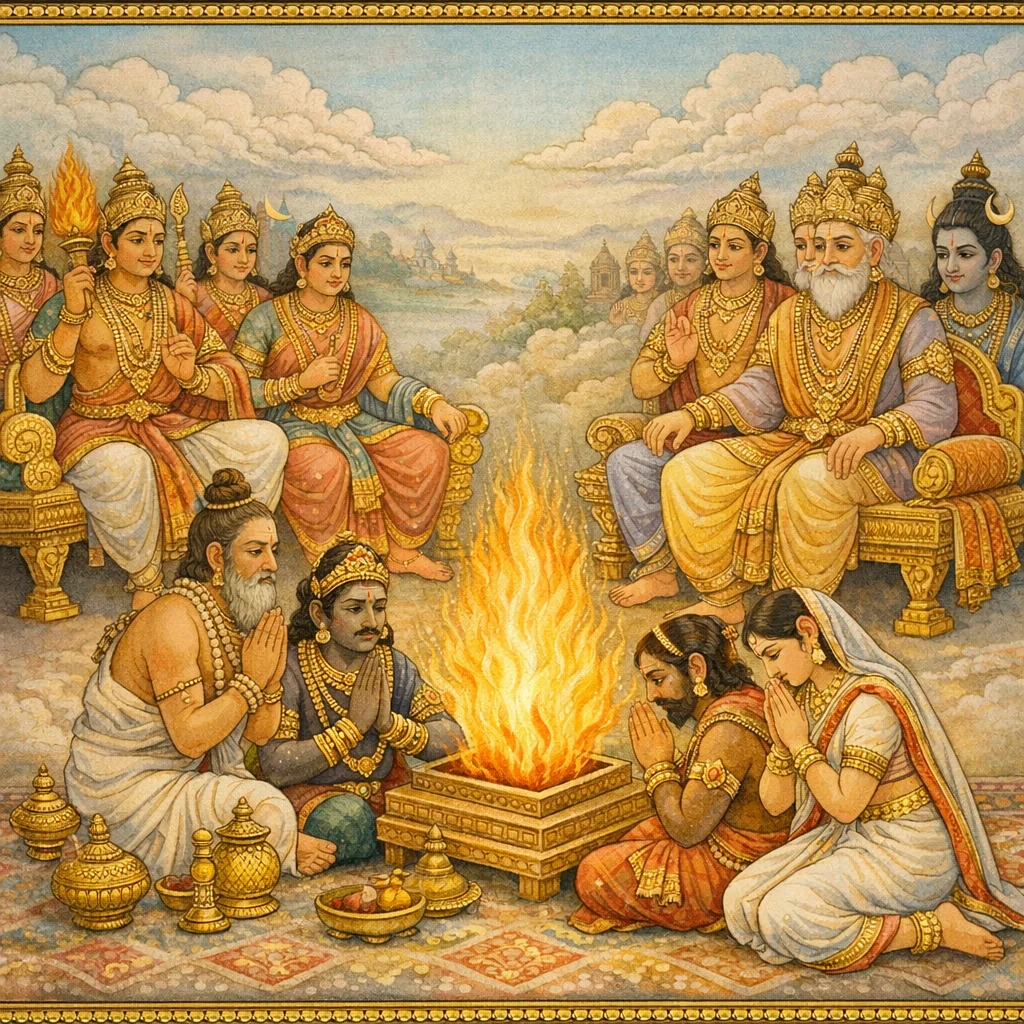
Sūta relates that Pitāmaha (Brahmā) pacifies the wrathful Pāvaka (Agni) and then withdraws. The assembled devas—led by Śakra, Viṣṇu, and Śiva—return to their respective abodes. Agni becomes firmly established in the agnihotra of the foremost twice-born, receiving oblations (havis) according to rite. There an eminent Agni-tīrtha is said to arise, and its practical fruit is declared: one who bathes there in the morning is freed from sins born of the day (dinaja). As the devas depart, afflicted beings—Gajendra, Śuka, and Maṇḍūka—approach, saying they were cursed by Agni “on your account,” and they seek a remedy concerning their tongues (jihvā). The devas console them: though their tongues are altered, they will remain capable and even be accepted in royal settings; Maṇḍūka, made “tongueless” by fire, is promised an extended mode of sound even as ‘vijihva’, and the devas depart after granting compassion.
Shlokas
Verse 1
सूत उवाच । एवमुक्त्वा स भगवान्विरराम पितामहः । संतोष्य पावकं क्रुद्धं स्वयमेव द्विजोत्तमाः
Sūta said: Having spoken thus, the revered Grandsire (Brahmā) fell silent; and he himself—O best of the twice-born—pacified the wrathful Fire, Agni.
Verse 2
ततः सर्वैः सुरैः सार्धं शक्रविष्णुशिवादिभिः । जगाम ब्रह्मलोकं च देवास्ते च निजं पदम्
Thereafter, accompanied by all the gods—Indra, Viṣṇu, Śiva, and the rest—he went to Brahmaloka; and those deities returned to their own abodes.
Verse 3
पावकोऽपि द्विजेंद्राणामग्निहोत्रेषु संस्थितः । हविर्जग्राह विधिवद्वसोर्द्धारोद्भवं तथा
Even Agni, the sacred Fire established in the agnihotra rites of the foremost brāhmaṇas, duly accepted the oblation (havis), born of the Vasordhārā offering, in accordance with the prescribed rule.
Verse 4
एवं तत्र समुद्भूतमग्नितीर्थमनुत्तमम् । यत्र स्नातो नरः प्रातर्मुच्यते दिनजादघात्
Thus there arose there the unsurpassed Agnitīrtha. Bathing there in the morning, a person is freed from the sins accrued day by day.
Verse 5
अथ संप्रस्थितान्दृष्ट्वा तान्देवान्स्वाश्रमं प्रति । गजेंद्रशुकमण्डूकास्ते प्रोचुर्दुःखसंयुताः
Then, seeing those gods setting out toward their own hermitage, the elephant-king, the parrot, and the frog—afflicted with sorrow—spoke up.
Verse 6
युष्मत्कृते वयं शप्ताः पावकेन सुरेश्वराः । तस्माज्जिह्वाकृतेऽस्माकमुपायश्चिंत्यतामपि
“Because of you, O lords of the gods, we have been cursed by Agni, the Fire. Therefore, do consider a remedy for us regarding this matter of the tongue.”
Verse 7
देवा ऊचुः । विपरीतापि ते जिह्वा यथान्येषां गजोत्तम । कार्यक्षमा न संदेहो भविष्यति विशेषतः
The gods said: “O best of elephants, even if your tongue is reversed like that of others, it will surely be fit for its function—there is no doubt—especially so.”
Verse 8
तथा यूयं नरेन्द्राणां मंदिरेषु व्यवस्थिताः । बहु मानसमायुक्ता मृष्टान्नं भक्षयिष्यथ
Likewise, you shall dwell in the palaces of kings; endowed with many pleasing dispositions, you shall partake of refined and choice foods.
Verse 9
यथा च शुक ते जिह्वा कृता मंदा हविर्भुजा । तथापि भूमिपालानां शंसनीया भविष्यति
And, O parrot, though your tongue has been made slow by Agni, the eater of offerings, it shall nevertheless be worthy of praise among kings.
Verse 10
श्रीमतां च तथान्येषामस्मदीयप्रसादतः । त्वं च मंडूक यत्तेन विजिह्वो वह्निना कृतः । तद्भविष्यति ते शब्दो विजिह्वस्यापि दीर्घगः
By our grace, so shall it be for the fortunate and for others as well. And you too, O Maṇḍūka—since fire made you ‘split-tongued’—your voice shall hereafter become long-ranging, even as one with a divided tongue.
Verse 11
एवमुक्त्वाऽथ ते देवाः स्वस्थानं प्रस्थितास्ततः । तेषामनुग्रहं कृत्वा कृपया परया युता
Having spoken thus, the gods then departed for their own abode. Having bestowed their favor, they went forth, endowed with supreme compassion.