Adhyaya 87
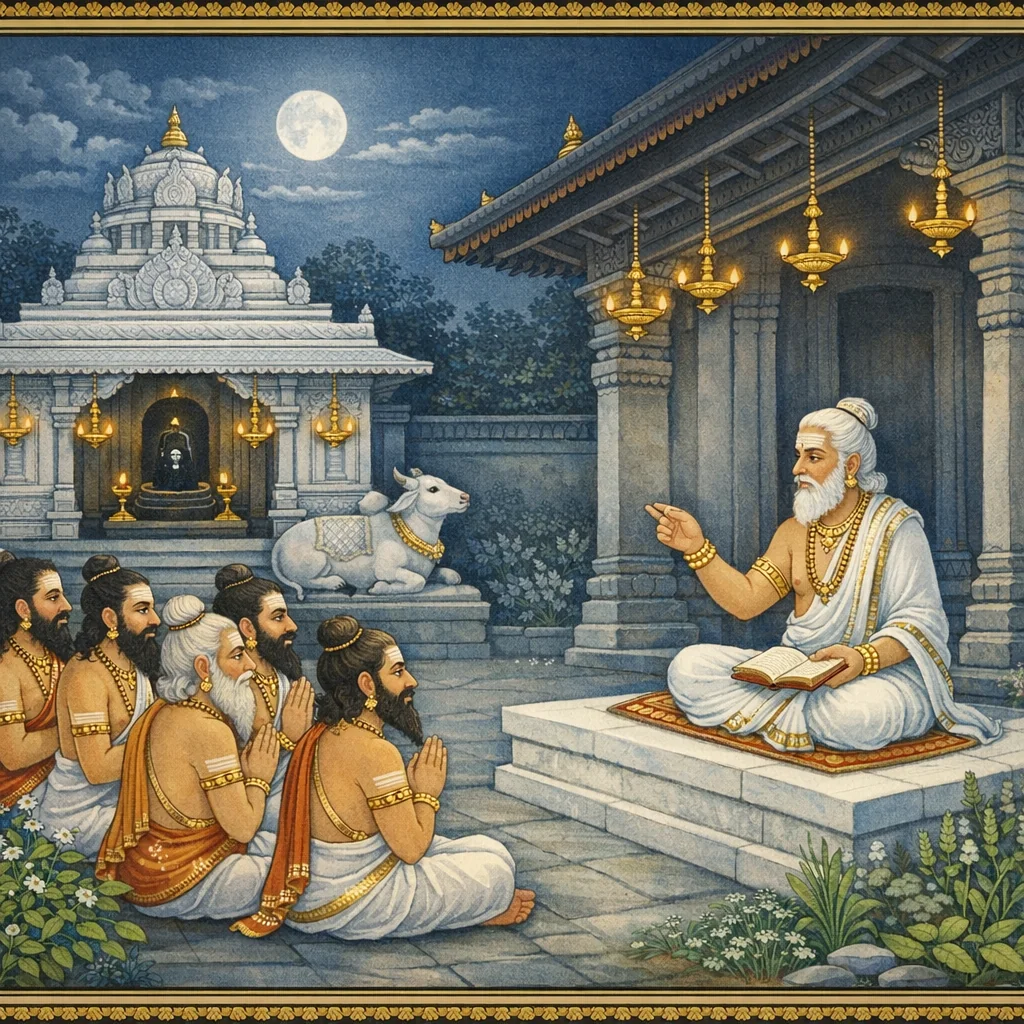
Chapter 87 unfolds as a dialogue in which Sūta praises an auspicious sanctuary of Soma (the Moon), declaring that mere darśana of it removes grave sins (pātakas). The ṛṣis ask how Candramā uniquely becomes a shared refuge (samāśraya) for the gods. Sūta explains through a cosmological and ritual logic: the world is remembered as “Somamaya,” with medicinal plants and crops infused with Soma; the gods gain satisfaction through Soma, and Soma-sacrifices such as the Agniṣṭoma rest upon this truth. The teaching then turns to the religious ethics of building a lunar prāsāda: proper calendrical alignment (Somavāra and other auspicious signs) and an intention purified by faith greatly increase merit, while improper construction is warned to yield harmful results. The narrative notes that Somaprāsādas are rare—built by Ambārīṣa, Dhandhumāra, and Ikṣvāku—and closes with a phalaśruti that reciting or hearing this account destroys sins.
Shlokas
Verse 1
सूत उवाच । तथा तत्रास्ति विप्रेन्द्राः सोमस्यायतनं शुभम् । यस्यापि दर्शनादेव मुच्यते पातकैर्नरः
Sūta said: Moreover, O best of brāhmaṇas, there is there a blessed sanctuary of Soma. By its mere sight alone, a man is freed from sins.
Verse 2
सोमवारे तु संप्राप्ते सोमस्य ग्रहणे नरः । यस्तं पश्यति पापोऽपि नरकं न स पश्यति
When Monday arrives—at the time of Soma’s eclipse—any person who beholds him, even if sinful, does not behold hell.
Verse 3
ऋषय ऊचुः । सर्वेषामेव देवानां दृश्यंतेऽत्र समाश्रयाः । अत्र चंद्रस्य चैवैकः कथं जातः समाश्रयः
The sages said: Here the abodes of all the gods are seen. But how did this single, special abode of Candra arise here?
Verse 4
एतन्नः सूतपुत्रातिचित्रं मनसि वर्तते । तस्माद्वद महाभाग सर्वं त्वं वेत्स्यशेषतः
This, O son of Sūta, appears exceedingly wondrous in our minds. Therefore, O fortunate one, speak—since you know everything completely.
Verse 5
सूत उवाच । एनज्जगद्द्विजश्रेष्ठाः सर्वं सोममयं स्मृतम् । तस्मात्प्रतिष्ठिते तस्मिंस्त्रैलोक्यं स्यात्प्रतिष्ठितम्
Sūta said: O best of brāhmaṇas, this entire world is remembered as pervaded by Soma. Therefore, when he is established there, the three worlds themselves become established.
Verse 6
एताश्चौषधयः सर्वाः सस्याद्याश्चेह भूतले । सर्वाः सोममयास्ताश्च याभिर्जीवंति जंतवः
All these herbs, and the crops and the like upon this earth—by which living beings endure—are indeed wholly pervaded by Soma.
Verse 7
तस्माद्ब्रह्मादयो देवाः सोमं प्राप्य क्रमाद्द्विजाः । तृप्तिं यांति परां हृष्टा यतस्तस्माद्वरोऽत्र सः
Therefore, O brāhmaṇas, the gods beginning with Brahmā, attaining Soma in due order, reach supreme satisfaction and rejoice; hence, in this sacred place, he is a great boon.
Verse 8
अग्निष्टोमादयो यज्ञास्तथा सोमे प्रतिष्ठिताः । तस्य पानाद्यतस्तृप्तिं तत्र यांति द्विजोत्तमाः
The sacrifices beginning with the Agniṣṭoma are established in Soma; since satisfaction is attained by drinking him, the best of the twice-born go to Soma for that fulfillment.
Verse 9
एतस्मात्कारणात्सोमः सर्वेषामधिकः स्मृतः । देवानां दानवानां च स हि पूज्यतमः स्मृतः
For this reason Soma is remembered as superior to all; among both the gods and the Dānavas, he is indeed regarded as the most worthy of worship.
Verse 10
यथान्येषां सुरेन्द्राणां हर्म्याणि धरणीतले । क्रियन्ते रात्रिनाथस्य तद्वत्कुर्वंति मानवाः
Just as palatial shrines are built on earth for other lords among the gods, so too do people build a palace-temple for the Lord of the Night, the Moon.
Verse 11
यैर्येर्नरैर्निशेशस्य प्रासादो विहितः क्षितौ । तेते मुक्तिपदं प्राप्ताः कृत्वाऽथ शुभसंचयम्
Whatever men have built upon the earth a palace-temple for the Lord of Night—those very ones attain the state of liberation, having gathered a treasury of auspicious merit.
Verse 12
यन्महेश्वरहर्म्याणां सहस्रेण भवेच्छुभम् । तदेके नैव चंद्रस्य प्राप्नुवंति शुभं नराः
The auspicious merit that would arise from a thousand palatial shrines of Maheśvara—some men attain that very same merit from building for Candra alone.
Verse 13
अथ चन्द्रोत्थहर्म्यस्य माहात्म्यं तद्द्विजोत्तमाः । ज्ञात्वा ब्रह्मादयो देवा भयसंत्रस्तमानसाः । तद्विघ्नार्थमिदं प्रोचुर्मेरुमूर्धानमाश्रिताः
Then, O best of the twice-born, having learned the greatness of this Candra-born palace-shrine, the gods beginning with Brahmā—alarmed in their hearts—took refuge upon the summit of Meru and spoke this plan to obstruct it.
Verse 14
सौम्यर्क्षे सोमवारेण सौम्ये मासि च संस्थिते । तिथौ च सोमदेवत्ये प्राप्ते सोमग्रहे तथा । सकारैः पंचभिर्युक्ते काले सोमस्य मंदिरम्
When the lunar mansion is auspicious—on a Monday (Somavāra), in an auspicious month, on a tithi presided over by Soma, and when Soma’s planet is also ascendant—at a time marked by five ‘sa’ factors, one should establish the temple of Soma.
Verse 15
य एकाहेन संपाद्य प्रासादं स्थापयिष्यति । चंद्रं स सर्वदेवोत्थहर्म्यस्याप्नोति सत्फलम्
Whoever, completing it within a single day, establishes a palace-temple for Candra—he attains the true fruit, equal to that of a palace-shrine born of the merit of all the gods.
Verse 16
सहस्रगुणितं सम्यक्छ्रद्धापूतेन चेतसा । अन्यथा यस्तु चंद्रस्य प्रासादं प्रकरिष्यति
When it is done rightly, with a mind purified by faith, the merit becomes a thousandfold. But if anyone undertakes the building of Candra’s palace-temple otherwise, without the proper spirit and rule…
Verse 17
वंशोच्छेदं समासाद्य नरकं स प्रयास्यति । एतस्मात्कारणाद्भीता न कुर्वंति नरा भुवि
Suffering the destruction of his lineage, he will go to hell. For this reason, people on earth, fearing the consequence, do not undertake it improperly.
Verse 18
प्रासादं रात्रिनाथस्य सुपुण्यमपि सद्द्विजाः । य एष रात्रिनाथस्य क्षेत्रेऽत्रैव व्यवस्थितः
O noble brāhmaṇas, this supremely meritorious temple of Rātrinātha stands established here itself, within the sacred field (kṣetra) of Rātrinātha.
Verse 19
प्रासादस्त्वंबरीषेण भूभुजा स विनिर्मितः । कथंचित्समयं प्राप्य यथोक्तं शास्त्रचिंतकैः
That temple was constructed by King Ambarīṣa, ruler of the earth. Gaining a fitting occasion, he built it exactly as prescribed by those learned in the śāstras.
Verse 20
तस्यैवोत्तरदिग्भागे द्वितीयोऽन्यः प्रतिष्ठितः । चन्द्रमा धंधुमारेण तद्वत्सोऽपि प्रतिष्ठितः
In the northern quarter of that very shrine, another—a second temple—was established. There Candramā, the Moon, was installed by Dhaṃdhumāra; likewise, his son too established a shrine.
Verse 21
ततश्च तौ महीपालौ तत्प्रभावादुभौ द्विजाः । गतौ च परमां सिद्धिं जन्ममृत्युविवर्जिताम्
Thereafter, by the power of that sacred place, those two kings attained the supreme perfection, free from birth and death, O brāhmaṇas.
Verse 22
प्रासादोऽन्यस्तृतीयस्तु क्षेत्रे प्राभासिके तथा । इक्ष्वाकुणा नरेंद्रेण श्रद्धायुक्तेन निर्मितः
And a third, another temple was likewise built in the sacred region of Prābhāsika, constructed with faith by King Ikṣvāku.
Verse 23
प्रासादत्रयमेतद्धि मुक्त्वात्र धरणीतले । अपरो नास्ति चन्द्रस्य सत्यमेतन्मयोदितम् । एकोऽस्ति नर्मदातीरे पुण्ये रेवोरिसंगमे
Indeed, apart from these three temples here on earth, there is no other shrine of Candra; this is the truth as spoken by me. Yet one more exists on the bank of the Narmadā, at the holy confluence with the Revā.
Verse 24
एतद्वः सर्वमाख्यातं चन्द्रमाहात्म्यमुत्तमम् । पठतां शृण्वतां चापि सर्वपातकनाशनम्
Thus I have fully narrated to you this supreme Māhātmya of Candra. For those who recite it and those who hear it, it becomes a destroyer of all sins.
Verse 87
इति श्रीस्कांदे महापुराण एकाशीतिसाहस्र्यां संहितायां षष्ठेनागरखण्डे हाटकेश्वरक्षेत्रमाहत्म्ये सोमप्रासादमाहात्म्यवर्णनंनाम सप्ताशीतितमोऽध्यायः
Thus ends the eighty-seventh chapter, entitled “The Description of the Glory of Soma’s Temple,” in the Hāṭakeśvara-kṣetra Māhātmya of the sixth Nāgara-khaṇḍa, within the Śrī Skanda Mahāpurāṇa of the Ekāśītisāhasrī Saṃhitā.