Adhyaya 75
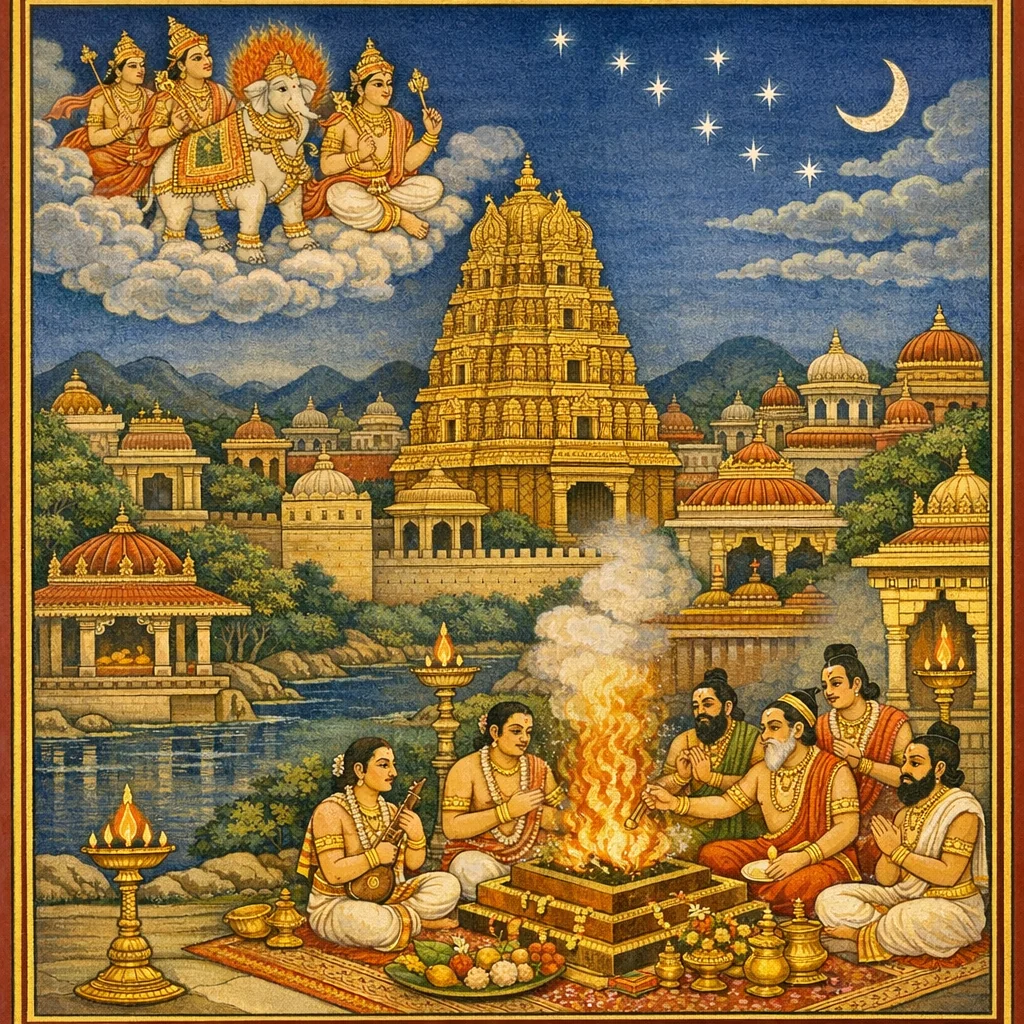
Sūta recounts an earlier sacred history: Rudra grants Brahmā an unsurpassed kṣetra (1–2), bound to the establishment of the liṅga named Hāṭakeśvara. Śambhu then entrusts that kṣetra to Ṣaṇmukha—Skanda/Kārttikeya—to protect brāhmaṇas from the defects ascribed to the Kali age (3). At Brahmā’s request, and in obedience to the father’s instruction, Gaṅgeya (Kārttikeya) takes up residence there (4). A ritual-calendrical note declares that one who has darśana of the Lord in Kārttikā, under the Kṛttikā conjunction, gains benefits across many lives—rebirth as a learned and prosperous brāhmaṇa (5). The chapter then describes Mahāsena’s splendid palace/temple as towering and visually dominant (6). Hearing of it, the gods arrive in curiosity, behold the highly purifying city, and perform sacrifices in the northern and eastern precincts, giving proper dakṣiṇā to the priests (7–9). The site becomes known as Devayajana, and an explicit merit-equivalence is proclaimed: one duly endowed sacrifice there yields the fruit of a hundred sacrifices performed elsewhere (10).
Shlokas
Verse 1
। सूत उवाच । पुरा कल्पे भगवता एतत्क्षेत्रमनुत्तमम् । रुद्रेण ब्रह्मणे दत्तं तुष्टेन द्विजसत्तमाः
Sūta said: In a former aeon, O best of the twice-born, this unsurpassed sacred field was granted by Rudra—well pleased—to Brahmā.
Verse 2
यदा तु स्थापितं लिंगं हाटकेश्वरसंज्ञितम् । देवैः प्रीतेन रुद्रेण प्रदत्तं ब्रह्मणे पुनः
And when the liṅga known as Hāṭakeśvara was established, Rudra—pleased by the gods—again bestowed it upon Brahmā.
Verse 3
एतत्क्षेत्रं तदा दत्तं शंभुना षण्मुखस्य ह । रक्षणार्थं हि विप्राणां कलिकालादिदोषतः
Then Śambhu granted this sacred region to Ṣaṇmukha indeed, for the protection of the brāhmaṇas from the faults that arise in the age of Kali and the like.
Verse 4
ब्रह्मणा प्रार्थितेनेदं स्वयमादिममुत्तमम् । पित्रादिष्टस्तु गांगेयस्तत्र वासमथाकरोत्
When Brahmā entreated, this primeval and most excellent kṣetra manifested of itself; then Gāṃgeya, commanded by his father, made his dwelling there.
Verse 5
कार्तिक्यां कृत्तिकायोगे यः कुर्यात्स्वामिदर्शनम् । सप्तजन्म भवेद्विप्रो धनाढ्यो वेदपारगः
Whoever beholds the Lord here in the month of Kārttika, under the Kṛttikā conjunction, becomes—through seven births—a brāhmaṇa, wealthy, and a master of the Vedas.
Verse 6
महासेनस्य देवस्य प्रासादं सुमनोहरम् । उच्चैः स्थितं सर्वलोके पातुकाममिवांबरम्
The charming temple‑palace of the god Mahāsena stands loftily, as though it wished to protect the whole world like the sky itself.
Verse 7
तच्छ्रुत्वा विबुधाः सर्वे कौतुकादेत्य सत्वरम् । वीक्षांचक्रुस्ततो गत्वा दृष्ट्वा मेध्यतमं पुरम्
Hearing of it, all the gods hurried there out of curiosity; going in, they beheld and surveyed that most purifying sacred city.
Verse 8
प्रासादस्योत्तरे देशे प्राच्ये देशे तथा द्विजाः । यज्ञक्रियासमारंभांश्चकुर्विप्रैर्यथोदितान्
To the north of the temple, and likewise on the eastern side, the twice-born began sacrificial rites, as prescribed by the brāhmaṇas.
Verse 9
इष्ट्वा च विबुधाः सर्वे दत्त्वा तेभ्यश्च दक्षिणाम् । जग्मुस्त्रिविष्टपं हृष्टा लब्ध्वा तत्स्थानजं फलम्
Having performed worship and bestowed upon them the proper dakṣiṇā, all the gods—having gained the fruit born of that holy place—departed joyfully to heaven.
Verse 10
ततस्तु देवयजनंनाम तस्य बभूव ह । यदन्यत्र शतं कृत्वा क्रतूनां फलमाप्नुयात् । तदत्रैकेन लभते क्रतुना दक्षिणावता
Therefore it came to be known as “Devayajana”. Whatever fruit one would gain elsewhere by performing a hundred sacrifices, here one attains by a single sacrifice, provided it is duly accompanied by dakṣiṇā.