Adhyaya 74
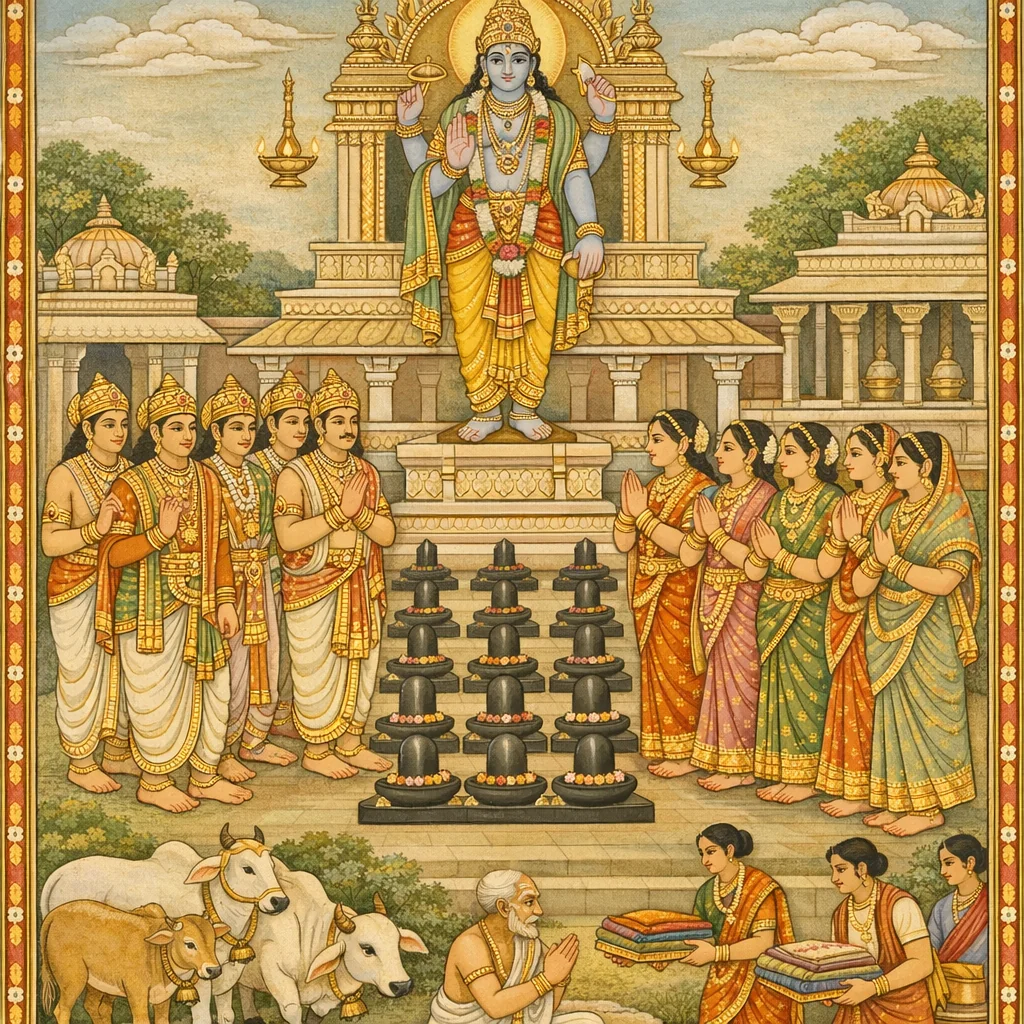
Sūta recounts, within the māhātmya of Hāṭakeśvara-kṣetra, an episode centered on the installation and consecration of Śiva-liṅgas. Dhṛtarāṣṭra—described as a king with a hundred sons—is said to establish 101 liṅgas there. The five Pāṇḍavas together install five liṅgas, and further installations are linked with eminent women such as Draupadī, Kuntī, Gāndhārī, and Bhānumatī, showing widespread royal participation in devotion. Many leading figures from the Kurukṣetra epic milieu—Vidura, Śalya, Yuyutsu, Bāhlīka, Karṇa, Śakuni, Droṇa, Kṛpa, and Aśvatthāman—each install a distinct liṅga with paramā bhakti, in connection with a vara-prāsāda, a distinguished temple structure. The motif of lofty shrines appears again as Viṣṇu too is said to establish a liṅga in a high, peak-crested prāsāda; thereafter the Sātvata/Yādava group—Sāmba, Balabhadra, Pradyumna, Aniruddha, and others—faithfully installs the principal set of ten liṅgas. The narrative concludes with communal satisfaction, prolonged residence, and extensive dāna—wealth, villages, fields, cattle, garments, and servants—followed by respectful leave-taking. The phala statement declares that devoted worship of these liṅgas grants desired aims, and Dhṛtarāṣṭra’s liṅga is explicitly praised as pāpa-destroying.
Shlokas
Verse 1
। सूत उवाच । धृतराष्ट्रेण भूपेन शतपुत्रान्वितेन च । लिंगानां स्थापितं तत्र शतमेकोत्तरं द्विजाः
Sūta said: “There, King Dhṛtarāṣṭra—together with his hundred sons—established one hundred and one Śiva-liṅgas, O twice-born ones.”
Verse 2
तथा च पांडवैः सर्वैः स्थापितं लिंगपंचकम् । द्रौपद्या चाऽथ कुन्त्याऽथ गांधार्याऽथ यदृच्छया
“Likewise, all the Pāṇḍavas established a set of five liṅgas; and so too did Draupadī, then Kuntī, and then Gāndhārī—according to their own impulse and occasion.”
Verse 3
भानुमत्या च गौरीणां स्थापितं च चतुष्टयम् । विदुरेणाथ शल्येन कलिं गेन युयुत्सुना
“Bhānumatī also established a set of four (liṅgas) of the Gaurīs; and Vidura, and then Śalya, and Kaliṅga, and Yuyutsu (each established liṅgas as well).”
Verse 4
बाह्लीकेन सपुत्रेण कर्णेनाथ ससूनुना । तथा शकुनिना तत्र द्रोणेन च कृपेण च
“There, Bāhlīka together with his son, and Karṇa together with his own son; likewise Śakuni, and also Droṇa and Kṛpa (established liṅgas).”}]}
Verse 5
अश्वत्थाम्ना पृथक्त्वेन लिङ्गमेकैकमुत्तमम् । स्थापितं परया भक्त्या वरप्रासादमाश्रितम्
Aśvatthāman, separately, established each most excellent liṅga, one by one, with supreme devotion, enshrining it in a splendid temple.
Verse 6
तथा संस्थापितं तत्र विष्णुना प्रभविष्णुना । लिंगं प्रासादमाधाय प्रोत्तुंगशिखरान्वितम्
Likewise, there Viṣṇu—mighty and all-powerful—established a liṅga, setting it within a temple adorned with a very lofty spire.
Verse 7
सात्वतेनापि सांबेन बलभद्रेण धीमता । प्रद्युमेनानिरुद्धेन तथान्यैर्मुख्ययादवैः
Sātvata, Sāmba, the wise Balabhadra, Pradyumna, Aniruddha, and other foremost Yādavas also joined in, taking part in the sacred undertaking bound to the holy field’s greatness.
Verse 8
चारुदेष्णादिभिः पुत्रै रुक्मिण्या दशभिः सुतैः । लिंगानां दशकं मुख्यं स्थापितं श्रद्धयान्वितैः
Along with sons such as Cārudeṣṇa and others—the ten sons born of Rukmiṇī—endowed with faith, they established a principal set of ten Śiva-liṅgas.
Verse 9
एवं संस्थाप्य लिङ्गानि ते सर्वे कुरुपांडवाः । यादवाश्च सुसंहृष्टा कृतकृत्यास्तदा ।ऽभवन्
Thus, having duly installed the liṅgas, all those Kauravas and Pāṇḍavas—and the Yādavas too—became greatly delighted, feeling that their duty had been fulfilled.
Verse 10
तत्र स्थित्वा चिरं कालं दत्त्वा दानान्यनेकशः । धनाढ्यान्ब्राह्मणान्कृत्वा चमत्कारपुरोद्भवान्
Dwelling there for a long time, they bestowed many kinds of gifts; and they made the brāhmaṇas richly endowed, bringing forth wondrous prosperity in that sacred settlement.
Verse 11
दत्त्वा तेभ्यो वरान्नागान्ह याञ्जात्याननेकशः । सद्ग्रामाणि विचित्राणि क्षेत्राणि च सुधेनवः
To them they gave excellent elephants and many fine-bred horses; they also granted good villages, various lands and fields, and fine milch-cows.
Verse 12
महोक्षांश्च सुवस्त्राणि भूस्थानान्याश्रयांस्तथा । दासीदासांस्तथा भृत्यान्दानानि विविधानि च
They also gave great bulls, fine garments, plots of land and dwellings; and likewise maidservants, male servants, attendants—indeed, many kinds of gifts.
Verse 13
तत आमन्त्र्य तान्सर्वान्प्रणिपत्य मुहुर्मुहुः । स्वस्थानं प्रति संहृष्टाः प्रजग्मुः सर्व एव ते
Then, having respectfully taken leave of them all, and bowing again and again, they all departed joyfully for their own respective places.
Verse 14
सूत उवाच । एतद्वः सर्वमाख्यातं स्थापितं तेन भूभुजा । तथा तद्धृतराष्ट्रेण लिंगं पातकनाशनम्
Sūta said: All this has been told to you—how it was established by that king; and likewise, the liṅga set up by Dhṛtarāṣṭra, which destroys sins.
Verse 16
यस्तानि पुरुषः सम्यक्पूजयेद्भक्तिभावितः । स लभेच्चाखिलान्कामान्वांछितान्स्वेन चेतसा
Whoever, filled with devotion, worships those liṅgas properly attains all desires—whatever he longs for within his own heart.
Verse 74
इति श्रीस्कांदे महापुराण एकाशीतिसाहस्र्यां संहितायां षष्ठेनागरखण्डे हाटकेश्वरक्षेत्रमाहात्म्ये कौरवपाण्डवयादवकृतलिंग प्रतिष्ठावृत्तांतवर्णनंनाम चतुःसप्ततितमोऽध्यायः
Thus ends the seventy-fourth chapter, entitled “The narration of the account of the liṅga consecrations performed by the Kauravas, Pāṇḍavas, and Yādavas,” in the Hāṭakeśvara-kṣetra Māhātmya, within the Sixth (Nāgara) Khanda of the Śrī Skanda Mahāpurāṇa, in the eighty-one-thousand-verse compendium.