Adhyaya 7
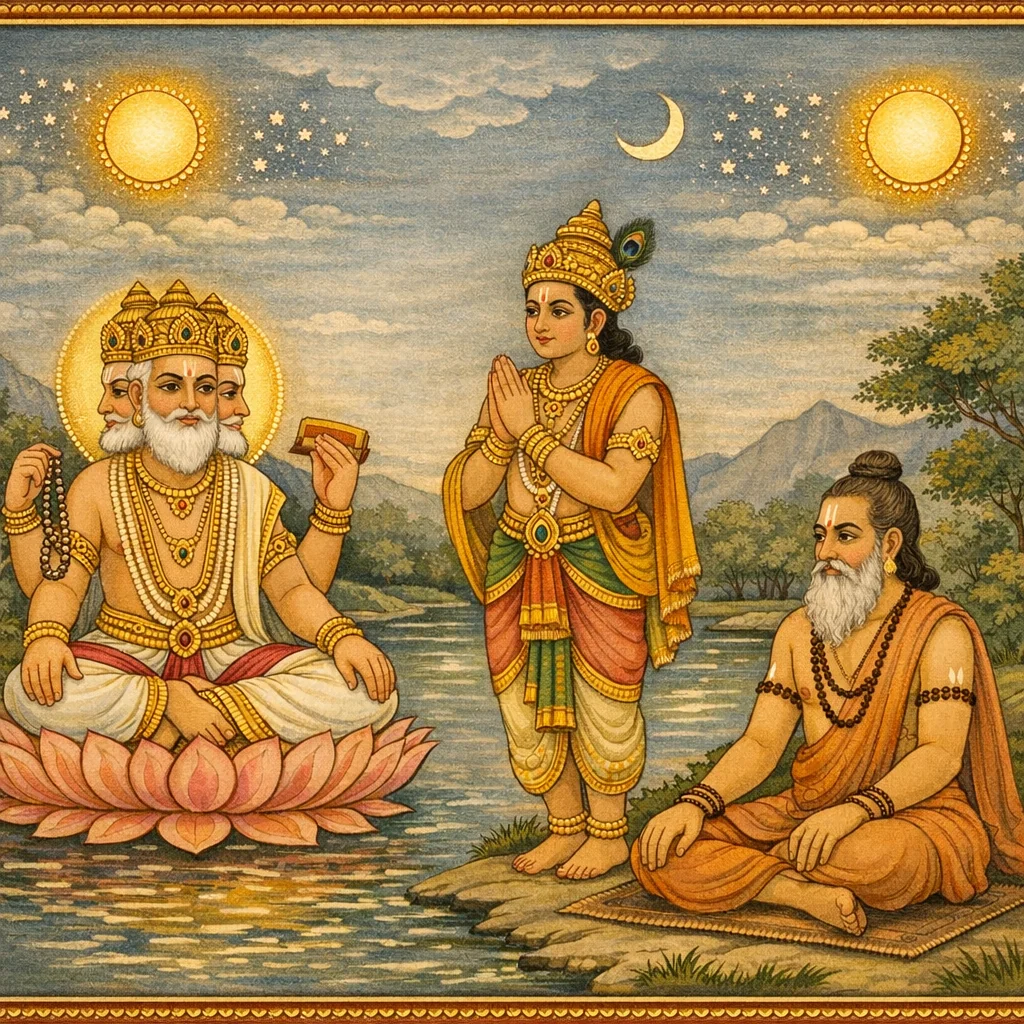
Sūta recounts a wondrous episode: Viśvāmitra, by the power of intense contemplation and firm saṅkalpa, enters the waters and brings forth a “twin twilight” (a doubled saṃdhyā) said to remain perceptible. He then generates a parallel creation—hosts of devas, aerial beings, stars and planets, humans, nāgas, rākṣasas, vegetation, even the seven ṛṣis and Dhruva—so that the cosmos appears doubled. The text describes two suns, doubled lords of night, and duplicated planets and constellations, creating confusion as rival celestial orders contend. Alarmed, Indra (Śakra) approaches Brahmā, the lotus-seated Creator, with the gods; they praise him in Vedic-style hymns and beg intervention before the new creation overwhelms the established world. Brahmā urges Viśvāmitra to cease, lest the gods be destroyed. Viśvāmitra agrees only on the condition that Triśaṅku be allowed to reach the divine realm in his present body. Brahmā consents, escorts Triśaṅku to Brahmaloka/Triviṣṭapa, and lauds Viśvāmitra’s unprecedented act, while setting a limit: the created order will remain stable, yet it will not be eligible for sacrificial rites. Brahmā then departs with Triśaṅku, and Viśvāmitra remains established in his ascetic station.
Shlokas
Verse 1
। सूत उवाच । एवं ध्यायमानेन जलमाविश्य काम्यया । सृष्टं संध्याद्वयं तच्च दृश्यतेऽद्यापि वै द्विजाः
Sūta said: Thus, as he meditated and entered the waters with a wish-driven intent, a pair of twilight-times (two sandhyās) was created—something that, O twice-born ones, is seen even today.
Verse 2
ततो देवगणाः सर्वे सृष्टास्तेन महात्मना । वैमानिकाश्च ये केचिन्नक्षत्राणि ग्रहास्तथा
Thereupon, that great-souled one created all the hosts of the gods; and also whatever celestial beings move in aerial cars, together with the constellations and the planets.
Verse 3
मनुष्योरगरक्षांसि वीरुधो वृक्षसंयुताः । सप्तर्षयो ध्रुवाद्याश्च ये चान्ये गगनेचराः
Humans, serpents (Nāgas), and rākṣasas were brought forth, as well as plants together with trees; the Seven Sages, Dhruva and others, and whatever other beings move through the sky.
Verse 4
एवं हि भगवान्सृष्ट्वा विश्वामित्रः स मन्युमान् । स्वकीयेष्वथ कृत्येषु योजयामास तांस्ततः
Having thus created, the revered Viśvāmitra—filled with wrathful resolve—then set them to work in tasks of his own design.
Verse 5
एतस्मिन्नेव काले तु द्वौ सूर्यो युगपद्दिवि । उदितौ रात्रिनाथौ च जाताश्च द्विगुणा ग्रहाः । द्विगुणानि च भान्येव सह सप्तर्षिभिर्द्विजाः
At that very time, two suns rose together in the sky; and two lords of the night (two moons) appeared. The planets became doubled, and likewise the shining constellations—together with the Seven Sages—O twice-born ones.
Verse 6
एवं वियति ते सर्वे स्पर्द्धमानाः परस्परम् । दृश्यंते द्विगुणीभूता जनविभ्रमकारकाः
Thus, in the sky they all appeared doubled, as though contending with one another—bewildering the people.
Verse 7
एतस्मिन्नन्तरे शक्रः सह सर्वेर्दिवालयैः । जगाम तत्र यत्रास्ते भगवान्कमलासनः
Meanwhile, Śakra (Indra), together with all the dwellers of heaven, went to the place where the Blessed One, the Lotus-seated (Brahmā), was abiding.
Verse 8
प्रोवाचाथ प्रणम्योच्चैः कृतांजलिपुटः स्थितः । स्तुतिं कृत्वा सुरैः सार्धं वेदोक्तैः स्तवनैर्द्विजाः
Then, having bowed low and standing with hands joined in reverence, he spoke aloud—after offering praise together with the gods through hymns in accordance with the Veda, O twice-born ones.
Verse 9
सृष्टिः कृता सुरश्रेष्ठ विश्वामित्रेण सांप्रतम् । मनुष्ययक्षसर्पाणां देवगंधर्वरक्षसाम्
O best of the gods, Viśvāmitra has just now brought forth a new creation—of humans, yakṣas, serpents (nāgas), gods, gandharvas, and rākṣasas.
Verse 10
तस्माद्वारय तं गत्वा स्वयमेव पितामह । यावन्न व्याप्यते सर्वं तत्सष्ट्येदं चराचरम्
Therefore, Grandfather (Brahmā), go yourself and restrain him, before this created world of moving and unmoving beings becomes wholly overrun by that (new) creation.
Verse 11
तस्य तद्वचनं श्रुत्वा तेनैव सहितो विधिः । गत्वोवाच जगन्मित्रं विश्वामित्रं मुनीश्वरम्
Hearing his words, Brahmā (Vidhi), accompanied by him, went and addressed Viśvāmitra—the lord among sages, the friend of the world.
Verse 12
निवृत्तिं कुरु विप्रर्षे सांप्रतं वचनान्मम । सृष्टैर्यावन्न नश्यंति सर्वे देवाः सवासवाः
Desist, O best of brahmins, now—at my word—before what has been created brings all the gods, together with Indra, to ruin.
Verse 13
विश्वामित्र उवाच । अनेनैव शरीरेण त्रिशंकुर्नृपसत्तमः । यदि गच्छति ते लोके तत्सृष्टिं न करोम्यहम्
Viśvāmitra said: If Triśaṅku, the foremost of kings, goes to your world in this very body, then I shall not make that (new) creation.
Verse 14
ब्रह्मोवाच । एष गच्छतु भूपालो मया सह त्रिविष्टपम् । अनेनैव शरीरेण त्वत्प्रसादान्मुनीश्वर
Brahmā said: Let this king go with me to Triviṣṭapa (heaven), in this very body—through your grace, O lord among sages.
Verse 15
विरामं कुरु सृष्टेस्त्वं नैतदन्यः करिष्यति । न कृतं केनचिल्लोके तत्कर्म भवता कृतम्
Now bring your act of creation to a close; no one else could accomplish this. A deed never done by anyone in the world—such a deed has been done by you.
Verse 17
तथाऽक्षयास्तु मे देव सृष्टिस्तव प्रसादतः । या कृता न करिष्यामि भूयो ऽन्यां पद्मसंभव
So be it. O God—by your grace let my creation remain imperishable. What has been created, I will not create another again, O Lotus-born (Brahmā).
Verse 18
व्रह्मोवाच । भविष्यति ध्रुवा विप्र सृष्टिर्या भवता कृता । परं सर्वेषु कृत्येषु यज्ञार्हा न भविष्यति
Brahmā said: O brāhmaṇa, the creation you have wrought shall indeed endure; yet, among all sacred duties, it shall not be worthy to receive the sacrificial offerings in yajña.
Verse 19
एवमुक्त्वा समादाय त्रिशंकुं प्रपितामहः । ब्रह्मलोकं गतो हृष्टो मुनिस्तत्रैव संस्थितः
Having spoken thus, the Great-Grandfather (Prāpītāmaha) took Triśaṅku and, delighted, went to Brahmā’s world; the sage remained established there itself.