Adhyaya 6
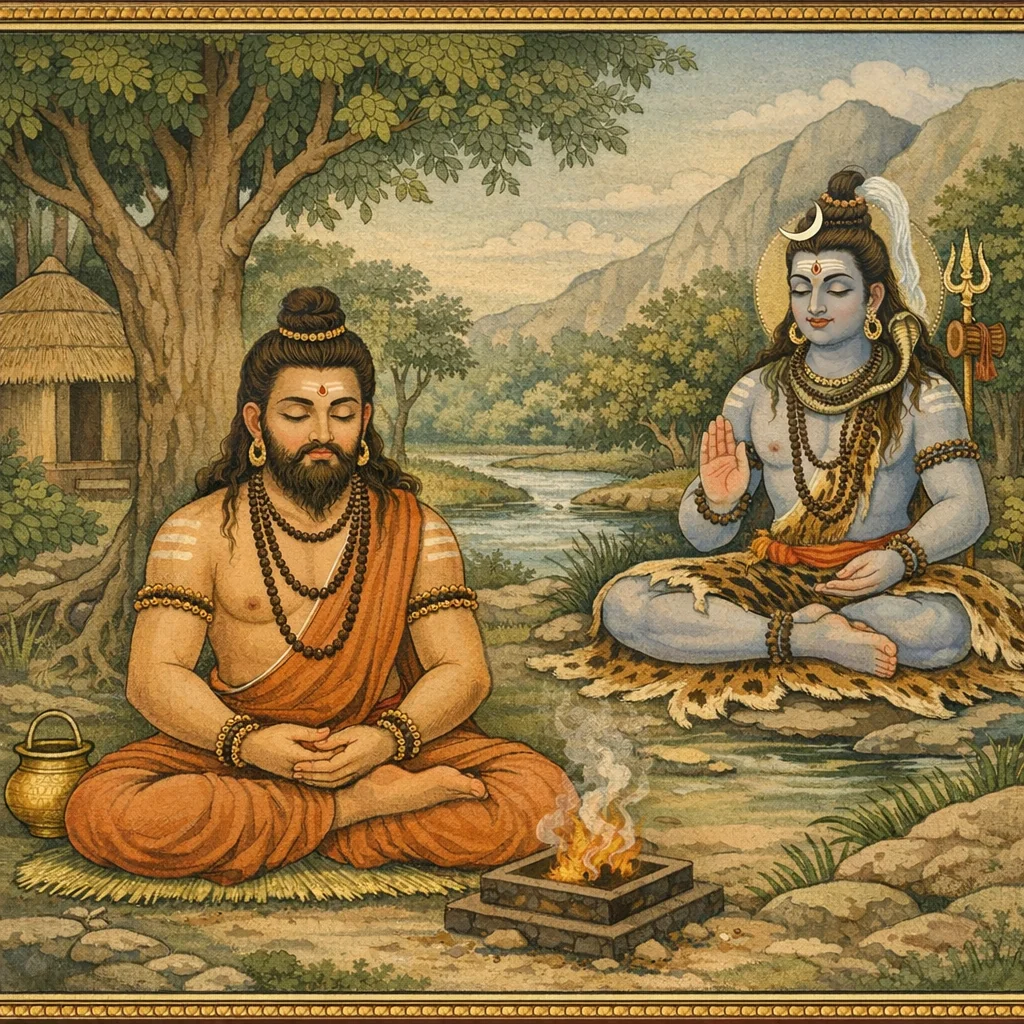
This chapter continues the king–sage dialogue within Sūta’s narration. Hearing Triśaṅku’s plight, Viśvāmitra reassures the king and vows to lead him to heaven in the very same body, highlighting the extraordinary force of saṅkalpa (resolute intention) and the contest over ritual authority. Viśvāmitra then challenges the celestial order, declaring that through tapas (ascetic power) he can begin a creation of his own. The narrative turns to devotion: he approaches Śiva—Śaṅkara, Śaśiśekhara—offers formal reverence, and chants a hymn that identifies Śiva with many cosmic functions and deities in a Purāṇic synthesis. Śiva graciously grants a boon; Viśvāmitra asks for “sṛṣṭi-māhātmya,” the potency and knowledge of creation by Śiva’s grace. Śiva consents and departs, while Viśvāmitra remains in deep meditation and proceeds to fashion a fourfold creation in rivalry, linking bhakti, power, and cosmological experimentation within a tīrtha-centered frame.
Shlokas
Verse 1
। सूत उवाच । तच्छ्रुत्वा वचनं तस्य त्रिशंकोर्मुनिपुंगवः । विश्वामित्रोऽब्रवीद्वाक्यं किंचिल्लज्जासमन्वितः
Sūta said: Hearing Triśaṅku’s words, Viśvāmitra, foremost among sages, spoke in reply—tinged with a slight embarrassment.
Verse 2
मा विषादं महीपाल विषयेऽत्र करिष्यसि । अनेनैव शरीरेण त्वां नयिष्याम्यहं दिवम्
“Do not grieve, O king, in this matter. With this very body I shall lead you to heaven.”
Verse 3
तत्तत्कर्म करिष्यामि स्वर्गार्थे नृपसत्तम । तवाभीष्टं करिष्यामि किं वा यास्यामि संक्षयम्
“For the sake of heaven, O best of kings, I shall perform whatever acts are required. I will fulfill your desire—or else I shall perish in the attempt.”
Verse 4
एवमुक्त्वा परं कोपं कृत्वोपरि दिवौकसाम् । उवाच च ततो रौद्रं प्रत्यक्षं तस्य भूपतेः
Having spoken thus, he roused fierce anger against the dwellers of heaven, and then, in the king’s very presence, uttered terrible words openly.
Verse 5
यथा मया द्विजत्वं हि स्वयमेवार्जितं बलात् । तथा सृष्टिं करिष्यामि स्वकीयां नात्र संशयः
Just as I myself, by the sheer power of austerity (tapas), attained the state of the twice-born, so shall I bring forth a creation of my own—of this there is no doubt.
Verse 6
ततस्तं स समालोक्य शंकरं शशिशेखरम् । प्रणम्य विधिवद्भक्त्या स्तुतिं चक्रे महामुनिः
Then, beholding Śaṅkara, the Moon-crested Lord, the great sage bowed in due form with devotion and composed a hymn of praise.
Verse 7
विश्वामित्र उवाच । जय देव जयाचिंत्य जय पार्वतिवल्लभ । जय कृष्ण जगन्नाथ जय कृष्ण जगद्गुरो
Viśvāmitra said: “Victory to You, O Lord—victory to the Inconceivable One; victory to the beloved of Pārvatī. Victory to You, O Kṛṣṇa, Lord of the universe; victory to You, O Kṛṣṇa, teacher of the world.”
Verse 8
जयाचिंत्य जयामेय जयानंत जयाच्युत । जयामर जयाजेय जयाव्यय सुरेश्वर
“Victory to the Inconceivable; victory to the Immeasurable; victory to the Endless; victory to the Unfallen. Victory to the Deathless; victory to the Unconquered; victory to the Imperishable—O Lord of the gods!”
Verse 9
जय सर्वग सर्वेश जय सर्वसुराश्रय । जय सर्वजनध्येय जय सर्वाघनाशन
“Victory to You who pervade all; victory to the Lord of all. Victory to the refuge of all the gods; victory to the One upon whom all people should meditate. Victory to the destroyer of every sin!”
Verse 10
त्वं धाता च विधाता च त्वं कर्ता त्वं च रक्षकः । चतुर्विधस्य देवेश भूतग्रामस्य शंकर
You are the sustainer and the ordainer; You are the doer, and You are the protector. O Lord of the gods, O Śaṅkara, You preside over and guard the entire multitude of beings in its fourfold divisions.
Verse 11
यथा तिलस्थितं तैलं यथा दधिगतं घृतम् । तथैवाधिष्ठितं कृत्स्नं त्वया गुप्तेन वै जगत्
Just as oil abides hidden within sesame seeds, and ghee is present within curd, so too this entire world is pervaded and upheld by You—secretly present within all.
Verse 12
त्वं ब्रह्मा त्वं हृषीकेशस्त्वं शक्रस्त्वं हुताशनः । त्वं यज्ञस्त्वं वषट्कारस्त्वमिन्दुस्त्वं दिवाकरः
You are Brahmā; You are Hṛṣīkeśa; You are Śakra; You are the Fire-god. You are the sacrifice itself; You are the vaṣaṭ-cry; You are the Moon, and You are the Sun.
Verse 13
अथवा बहुनोक्तेन किं स्तवेन तव प्रभो । समासादेव वक्ष्यामि विभूतिं श्रुतिनोदिताम्
Or else—what is the use of praising You at length, O Lord? I shall state briefly Your majesty, as declared in the Vedas.
Verse 14
यत्किंचित्त्रिषु लोकेषु स्थावरं जंगमं विभो । तत्सर्वं भवता व्याप्तं काष्ठं हव्यभुजा यथा
Whatever exists in the three worlds—moving or unmoving, O All-Powerful One—everything is pervaded by You, just as fire permeates wood (as its hidden potential).
Verse 15
श्रीभगवानुवाच । परितुष्टोऽस्मि भद्रं ते वरं प्रार्थय सन्मुने । यत्ते हृदि स्थितं नित्यं सर्वं दास्याम्यसंशयम्
The Blessed Lord said: “I am fully pleased with you; may auspiciousness attend you. Ask for a boon, O noble sage. Whatever is ever held in your heart, I shall grant it all—without doubt.”
Verse 16
विश्वामित्र उवाच । यदि तुष्टोसि देवेश यदि देयो वरो मम । तन्मे स्यात्सृष्टिमाहात्म्यं त्वत्प्रसादान्महेश्वर
Viśvāmitra said: “If You are pleased, O Lord of the gods—if a boon is to be granted to me—then, O Maheśvara, by Your grace let me obtain the sacred account of creation’s greatness.”
Verse 17
एवमस्त्विति तं चोक्त्वा भगवान्वृषभध्वजः । सर्वैर्गणैः समायुक्तस्ततश्चादर्शनं गतः
Saying to him, “So be it,” the Blessed Lord, whose banner bears the Bull, departed from sight—accompanied by all His gaṇas.
Verse 18
विश्वामित्रोऽपि तत्रैव स्थितो ध्यानपरायणः । चक्रे चतुर्विधां सृष्टिं स्पर्द्धया हंसगामिनः
Viśvāmitra too remained there, wholly devoted to meditation; and, out of rivalry with the Swan-moving One (Brahmā), he brought forth a fourfold creation.