Adhyaya 59
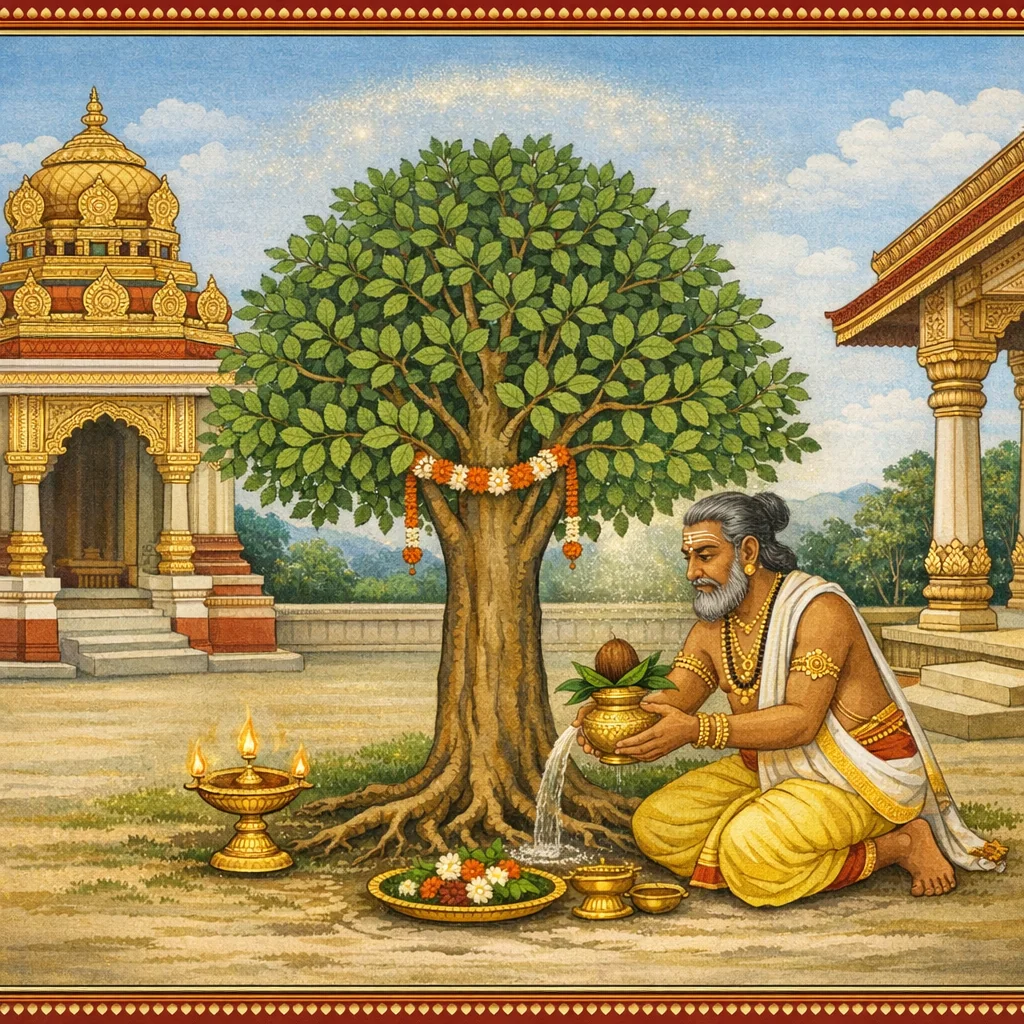
Sūta recounts a tradition in which Vidura, connected with Hastināpura, seeks instruction about the post-mortem state of one who dies without a son (aputra). The sage Gālava replies by classifying twelve kinds of “sons” acknowledged in dharma discourse, declaring that the lack of any such filial continuity brings grievous distress. Stricken by this teaching, Vidura is directed to establish a “son-tree”: an aśvattha invested with a Viṣṇu-linked identity at a supremely meritorious spot associated with Raktaśṛṅga and the Hāṭakeśvara kṣetra. Vidura plants and installs the aśvattha, performing a consecration-like rite and treating it as a filial substitute. He then founds a triadic sacred complex: a Māheśvara liṅga (Śiva) beneath a banyan, Viṣṇu beneath the aśvattha, together with worship of Sūrya—thus forming a threefold sanctuary (Sūrya, Śiva, Viṣṇu). He entrusts ongoing rites to local brāhmaṇas, who accept and pledge to maintain them through their lineage. The chapter also sets worship times: Sunday on Māgha saptamī for Sūrya; Monday, and especially bright-half aṣṭamī, for Śiva; and attentive worship of Viṣṇu during the observances of “sleeping and awakening.” Later the liṅga is said to be hidden by earth (ascribed to Pakāśāsana/Indra), until a bodiless voice reveals its location. Vidura restores the site, funds the building of a fitting prāsāda, establishes vṛtti endowments for brāhmaṇas, and returns to his āśrama.
Shlokas
Verse 1
। सूत उवाच । तस्मिन्क्षेत्रे रविः पूर्वं विदुरेण प्रतिष्ठितम् । शिवश्च परया भक्त्या तथा विष्णुर्द्विजोत्तमाः
Sūta said: In that sacred field, in former times, Vidura established Ravi, the Sun. And with supreme devotion he also established Śiva, and likewise Viṣṇu, O best among the twice-born.
Verse 2
यस्तान्पूजयते भक्त्या मानुषो भक्तितस्ततः । स यास्यति परं स्थानं यज्ञैरपि सुदुर्लभम्
Whoever, as a human being, worships those deities with bhakti—by that very devotion he will attain the supreme abode, exceedingly difficult to gain even through sacrifices (yajñas).
Verse 3
हस्तिनापुरसंस्थेन विदुरेण पुरा द्विजाः । गालवो मुनिशार्दूलः पृष्टः स्वगृहमागतः
O brāhmaṇas, long ago Vidura, who dwelt in Hastināpura, questioned Gālava—the tiger among sages—when he came to his house.
Verse 4
अपुत्रस्य गतिर्लोके कीदृक्संजायते परे । एतन्मे पृच्छतो ब्रूहि कृत्वा सद्भावमुत्तमम्
What destiny befalls a man without a son—what becomes of him in the world beyond? Tell me this, as I ask with the highest sincerity and reverent intent.
Verse 5
गालव उवाच । अपुत्रस्य गतिर्नास्ति मृतः स्वर्गं न गच्छति । द्वादशानामपि तथा यद्येकोऽपि न विद्यते
Gālava said: “For one without a son there is no proper onward course (gati); when he dies, he does not go to heaven. Likewise, among the twelve recognized kinds of sons, if not even one exists, this consequence is said to follow.”
Verse 6
औरसः क्षेत्रजश्चैव क्रयक्रीतश्च पालितः । पौनर्भवः पुनर्दत्तः कुंडो गोलस्तथा परः । कानीनश्च सहोढश्च अश्वत्थो ब्रह्मवृक्षकः
The natural-born son (aurasa), the kṣetraja son, the purchased son (kraya-krīta), and the fostered son (pālita); the son of a remarried woman (paunarbhava), the re-given son (punardatta), the kuṇḍa and the gola, and yet another; the kānīna and the sahoḍha, the aśvattha and the brahma-vṛkṣaka—these are enumerated as the traditional types of sons.
Verse 7
एतेषामपि यद्येकः पुरुषाणां न जायते । तन्नूनं नरके वासः पुंसंज्ञे वै प्रजायते
If, even among these, not even a single son is born to a man, then indeed it is said that his lot is a dwelling in hell—thus is it declared for one termed “a man” within this dharmic framing.
Verse 8
सूत उवाच । तच्छ्रुत्वा वचनं तस्य गालवस्य महात्मनः । अपुत्रत्वात्परं दुःखं जगाम विदुरस्तदा
Sūta said: Hearing those words of the great-souled Gālava, Vidura then fell into profound sorrow on account of his childlessness.
Verse 9
तप्तस्तं गालवः प्राह मा त्वं दुःखपदं व्रज । मद्वाक्यात्पुत्रकं वृक्षं विष्णुसंज्ञं द्रुतं कुरु
Moved with compassion, Gālava said to him: “Do not fall into the state of sorrow. By my word, quickly accept this tree as your son, and give it the name ‘Viṣṇu.’”
Verse 10
तस्मात्प्राप्स्यसि निःशेषं फलं पुत्रसमुद्भवम् । गत्वा पुण्यतमे देशे रक्तशृंगस्य मूर्धनि
“Therefore you shall obtain, in full, the fruit that arises from having a son—once you go to that most sacred land, to the summit of Raktāśṛṅga, the Red-peaked Mountain.”
Verse 11
हाटकेश्वरजे क्षेत्रे सर्ववृद्धिशुभोदये । तस्य तद्वचनं श्रुत्वा विदुरस्तत्क्षणाद्ययौ
In the holy kṣetra of Hāṭakeśvara—where every prosperity grows and auspiciousness arises—Vidura, having heard those words, set out at once.
Verse 12
तत्स्थानं गालवोद्दिष्टं हर्षेण महतान्वितः । तत्राश्वत्थतरुं स्थाप्य पुत्रत्वे चाभिषेच्य च
Reaching the place pointed out by Gālava, filled with great joy, he planted an aśvattha (pipal) tree there and, by consecration, established it in the status of a son.
Verse 13
वैवाहिकेन विधिना कृतकृत्यो बभूव ह । ततो बभ्राम तत्क्षेत्रं तीर्थयात्रापरायणः
By the prescribed wedding rite, he felt his duty fulfilled; then, devoted to pilgrimage, he wandered through that sacred region, visiting its tīrthas.
Verse 15
स दृष्ट्वा कुरुवृद्धस्य कीर्तनानि महात्मनः । ततश्चक्रे मतिं तत्र दिव्यप्रासादकर्मणि
Seeing the commemorations and renowned deeds of that great-souled elder of the Kurus, he resolved there to undertake the work of building a divine temple.
Verse 16
ततो माहेश्वरं लिंगं वटाधस्ताद्विधाय सः । विष्णुं च स्थापयामास अश्वत्थस्य तरोरधः
Then he established a Māheśvara liṅga beneath a banyan tree; and he also installed Viṣṇu beneath the aśvattha (pipal) tree.
Verse 17
निवेश्य च तथा दिव्यं ब्राह्मणेभ्यो न्यवेदयत् । एतद्देवत्रयं क्षेत्रे युष्माकं हि मया कृतम् । भवद्भिः सकला चास्य चिन्ताकार्या सदैव हि
Having thus established the divine shrines, he informed the brāhmaṇas: “This triad of deities in the kṣetra has been set up by me for you. Therefore, all of you must always undertake its complete care and maintenance.”
Verse 18
ब्राह्मणा ऊचुः । वयमस्य करिष्यामो यात्राद्याः सकलाः क्रियाः
The brāhmaṇas said: “We shall perform all the rites for this sacred establishment—beginning with the processions and including every required observance.”
Verse 19
तथा वंशोद्भवा ये च पुत्राः पौत्रास्तथापरे । करिष्यंति क्रियाः सर्वास्त्वं गच्छ स्वगृहं प्रति
“Likewise, the sons and grandsons born in our lineage, and those who come after them, will perform all the rites. You may now return to your own home.”
Verse 20
ततो जगाम विदुरः स्वपुरं प्रति हर्षितः । कृतकृत्यो द्विजास्ते च चक्रुर्वाक्यं तदुद्भवम्
Then Vidura, delighted, set out for his own city. Those brāhmaṇas too felt their purpose fulfilled and spoke words befitting that sacred occasion.
Verse 21
माघमासस्य सप्तम्यां सूर्यवारेण यो नरः । पूजयेद्भास्करं तत्र स याति परमां गतिम्
Whoever, on the seventh lunar day in the month of Māgha—when it falls on a Sunday—worships Bhāskara (the Sun) at that holy place, attains the supreme state.
Verse 22
शिवं वा सोमवारेण शुक्लाष्टम्यां विशेषतः । शयने बोधने विष्णुं सम्यक्छ्रद्धासमन्वितः
Or, on a Monday—especially on the bright-fortnight eighth (tithi)—one should worship Śiva; and at the observances of Viṣṇu’s “sleeping” and “awakening,” one should worship Viṣṇu properly, with steadfast faith.
Verse 23
तस्मात्सर्वप्रयत्नेन देवानां तत्त्रयं शुभम् । पूजनीयं विशेषेण नरैः स्वर्गतिमीप्सुभिः
Therefore, with every effort, that auspicious triad of deities should be worshipped—especially by those who seek the path to heaven.
Verse 24
तत्र सिद्धिं गताः पूर्वं मुनयः संशितव्रताः । विदुरेश्वरमाराध्य शतशोऽथ सहस्रशः
There, in former times, sages of firm vows attained spiritual accomplishment—having worshipped Vidureśvara—by the hundreds and even by the thousands.
Verse 25
ततस्तत्सिद्धिदं ज्ञात्वा लिंगं वै पाकशासनः । पांसुभिः पूरयामास यथा कश्चिन्न बुध्यते
Then, knowing that liṅga to be a giver of siddhi, Pākaśāsana (Indra) filled it over with dust, so that no one might recognize it.
Verse 26
कस्यचित्त्वथ कालस्य विदुरस्तत्र चागतः । दृष्ट्वा लोपगतं लिंगं दुःखेन महतान्वितः
After some time, Vidura came there again; seeing that the liṅga had vanished from view, he was overcome with great sorrow.
Verse 27
एतस्मिन्नेव काले तु वागुवाचाशरीरिणी । मा त्वं कुरु विषादं हि लिंगार्थे विदुराधुना
At that very time, a bodiless voice spoke: “Vidura, do not grieve now on account of the liṅga.”
Verse 28
योऽयं स दृश्यते वालो वटस्तस्य तले स्थिता । देवद्रोणिः सुरेशेन पांसुभिः परिपूरिता
That young banyan tree you behold—beneath it lies the Devadroṇī, filled with dust by Indra, Lord of the gods.
Verse 29
ततो गजाह्वयात्तूर्णं समानीय धनं बहु । शोधयामास तत्स्थानं दिवारात्रमतन्द्रितः
Then, swiftly bringing abundant resources from Gajāhvaya (Hastināpura), he cleansed that place day and night, without weariness.
Verse 30
ततो विलोक्य तान्देवान्हर्षेण महतान्वितः । प्रासादं निर्ममे तेषां योग्यं साध्वभिसंस्थितम्
Then, beholding those gods and filled with great joy, he built for them a fitting prāsāda—properly planned and firmly established.
Verse 31
कैलासशिखराकारं भास्करार्थे महामुनिः । जटामध्यगतं दृष्ट्वा वटस्य च महेश्वरम्
For the worship of the Sun, the great sage—having seen Maheśvara within the banyan tree, seated amid the matted jata—envisioned Him in a form like the peak of Kailāsa.
Verse 32
प्रासादं नाकरोत्तत्र लिंगं यावन्न चालयेत् । वासुदेवस्य योग्यां च कृत्वा शालां बृहत्तराम्
He did not raise the temple there so long as the liṅga was not to be disturbed; and he also made a spacious, fitting hall for Vāsudeva.
Verse 33
दत्त्वा वृत्तिं च संहृष्टो ब्राह्मणेभ्यो निवेद्य च । जगाम स्वाश्रमं भूयो विप्रानामंत्र्य तांस्ततः
Having granted livelihood-support and, rejoicing, duly offered it to the brāhmaṇas, he then took leave of those vipras and returned again to his own hermitage.