Adhyaya 58
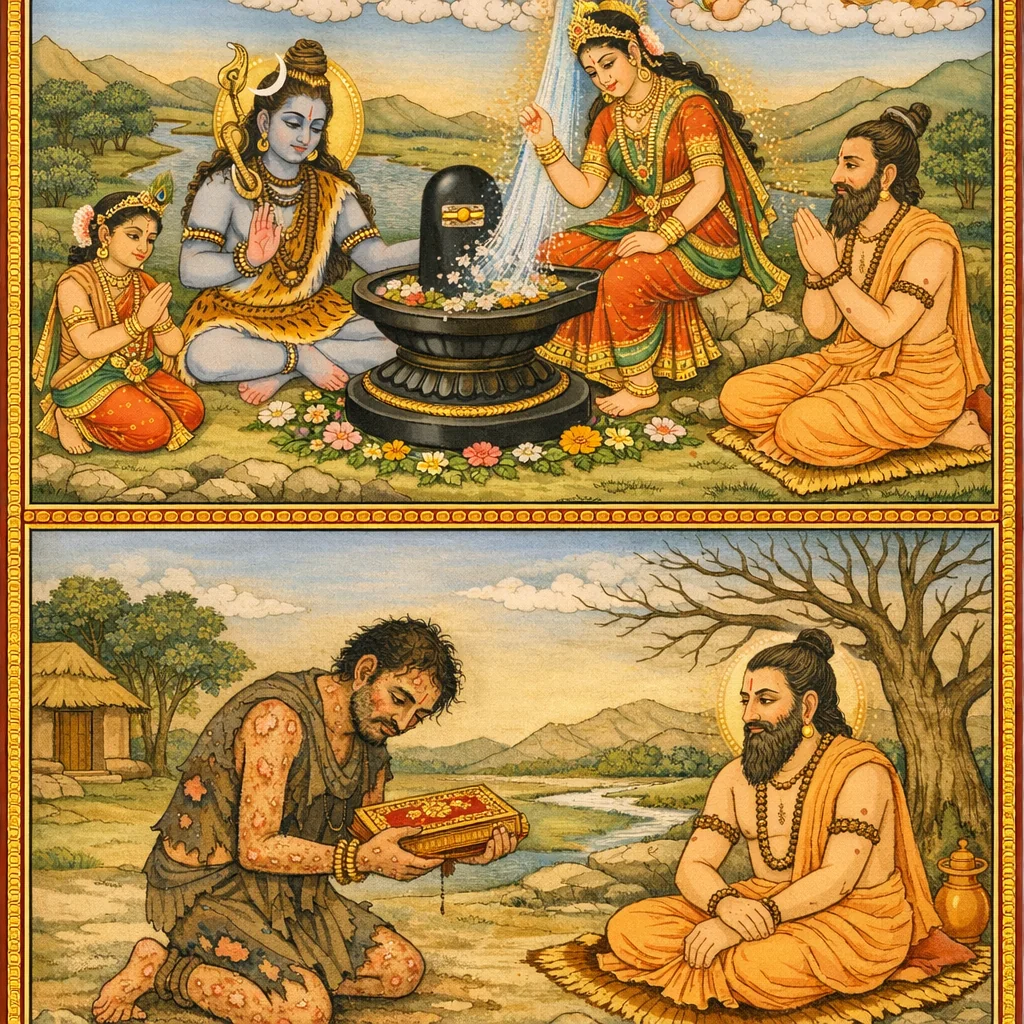
This chapter, set in the Hāṭakeśvara-kṣetra, describes the consecration of a sacred site and teaches pilgrimage ethics through warning. Gaṅgā, praised as the “tripathagāminī” (she who moves along three paths), is ritually established near a Śiva-liṅga after the installation of a divine quartet (devacatuṣṭaya). Bhīṣma, as an authoritative transmitter, recites the phalaśruti: one who bathes there and then beholds him with reverence is freed from sins and attains Śiva-loka. The praise is immediately balanced by a juridical-moral caution: a false oath at this tīrtha swiftly leads to Yama’s realm, showing that the holy place magnifies both merit and demerit according to truthfulness. A cautionary tale follows: a śūdra-born youth, Pauṇḍraka, jokingly steals a friend’s book, denies it, and after bathing in Bhāgīrathī waters participates in oath-taking. Karmic retribution comes quickly—kuṣṭha (leprosy), social abandonment, and impairment—attributed to “śāstra-caurya” (theft of sacred learning) and unethical speech. The chapter concludes that even in jest one should not swear, especially before sacred witnesses, affirming disciplined speech and conduct as the heart of tīrtha-dharma.
Shlokas
Verse 1
। सूत उवाच । एवं संस्थाप्य गांगेयः पुण्यं देवचतुष्टयम् । ततः संस्थापयामास गंगां त्रिपथगामिनीम्
Sūta said: “Thus, having installed the sacred group of four deities, Gaṅgeya (Bhīṣma) then proceeded to establish Gaṅgā—the river who flows along the three paths (heaven, earth, and the netherworld).”
Verse 2
कूपिकायां महाभाग शिवलिंगस्य पूर्वतः । ततः प्रोवाच तान्हृष्टः संपूज्य द्विजसत्तमान्
“In a small well (kūpikā), O noble one, to the east of the Śiva-liṅga—thereafter, delighted, he addressed those best of brāhmaṇas, having duly honored them.”
Verse 3
अस्यां यः पुरुषः स्नानं कृत्वा मां वीक्षयिष्यति । सर्वपापविनिर्मुक्तः शिवलोकं प्रयास्यति
Whoever bathes at this sacred place and then beholds me, becomes freed from all sins and attains the world of Śiva.
Verse 4
करिष्यति तथा यस्तु शपथं चात्र मानवः । असत्यं यास्यति क्षिप्रं स यमस्य गृहं प्रति
But the man who, here, makes an oath and then speaks falsely—he swiftly goes to the house of Yama.
Verse 5
एवमुक्त्वा महाभागो भीष्मः कुरुपितामहः । जगाम स्वपुरं तस्माद्धर्षेण महता वृतः
Having spoken thus, the greatly fortunate Bhīṣma, grandsire of the Kurus, departed from that place to his own city, filled with great joy.
Verse 6
सूत उवाच । तत्रासीच्छूद्रसंभूतः पौंड्रकोनाम नामतः । बालभावे समं मित्रैः स क्रीडति दिवानिशम्
Sūta said: There lived a man born in a Śūdra family, named Pauṇḍraka. In his childhood he played with his friends, day and night.
Verse 7
हास्यभावाच्च मित्रस्य पुस्तकं तेन चोरितम् । मित्रैः पृष्टः पौण्ड्रकः स प्राह नैव मया हृतम्
Out of a playful mood, he stole his friend’s book. When questioned by his friends, Pauṇḍraka said, “It was not taken by me at all.”
Verse 8
पुस्तकं चैव युष्माकं चिन्तनीयं सदैव तत् । भवद्भिर्यत्नमास्थाय दृश्यतां क्वापि पुस्तकम्
“That book is indeed yours; it should be kept in mind always. Make an effort and search, so that the book may be found somewhere.”
Verse 9
कृताश्च शपथास्तत्र स्नात्वा भागीरथीजले । अदुष्टचेतसा तेन दत्तं तत्पुस्तकं हृतम्
There, after bathing in the waters of the Bhāgīrathī, oaths were taken; and by him—whose mind was not suspect in their eyes—the stolen book was handed over as though rightly given.
Verse 10
पुनश्च रुचिरं हास्यं कृत्वा तेन समं बहु । अथासावभवत्कुष्ठी तत्क्षणादेव गर्हितः
Then again, after making much pleasant jest with him, that person at once became afflicted with leprosy—instantly becoming an object of reproach.
Verse 11
स त्यक्तो बांधवैः सर्वैः कलत्रैरपि वल्लभैः । ततो वैराग्यमापन्नो भृगुपातं पपात सः
Abandoned by all his kinsmen, even by his beloved wife or wives, he then entered into vairāgya—holy dispassion—and went to the tīrtha called Bhṛgupāta.
Verse 12
जातश्च तत्प्रभावेन कुष्ठेन परिवर्जितः । शास्त्रचौर्यकृताद्दोषान्मूकरूपः स हास्यकृत्
By the power of that (tīrtha/act), he was freed from leprosy. Yet, through the fault incurred by stealing śāstra—scripture and learning—the jester became mute in form.
Verse 13
न कार्यः शपथस्तस्मात्तस्याग्रेऽपि लघुर्द्विजाः । अपि हास्योपचारेण आत्मनः सुखमिच्छता
Therefore, O brāhmaṇas, one should not make oaths, nor treat them lightly even in his presence. Even as a jest, one who seeks his own welfare should refrain from such conduct.
Verse 58
इति श्रीस्कांदे महापुराण एकाशीतिसाहस्र्यां संहितायां षष्ठे नागरखण्डे हाटकेश्वरक्षेत्रमाहात्म्ये शिवगंगामाहात्म्यवर्णनंनाम अष्टपञ्चाशत्तमोऽध्यायः
Thus ends the fifty-eighth chapter, entitled “The Description of the Greatness of Śiva-gaṅgā,” in the Hāṭakeśvara-kṣetra Māhātmya, within the sixth Nāgara Khaṇḍa of the Śrī Skanda Mahāpurāṇa, in the Ekāśīti-sāhasrī Saṃhitā.