Adhyaya 56
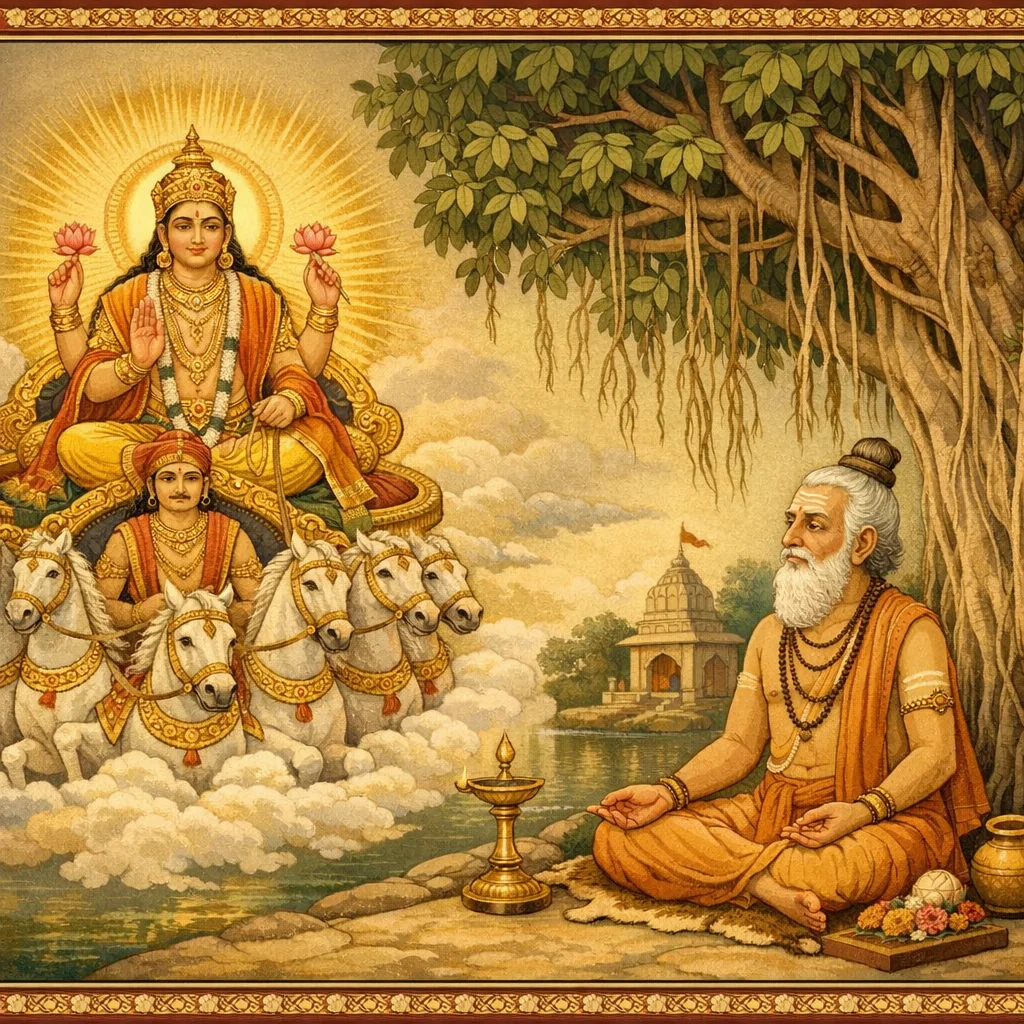
Chapter 56, narrated by Sūta, sets forth a tīrtha-centered theological teaching. It begins by proclaiming the power of darśana of Sāmbāditya/Sureśvara: one who beholds the Lord gains the cherished aims held within the heart; and especially, one who devoutly worships and beholds Him on Māgha śukla saptamī when it falls on a Sunday is said to be spared infernal destinies. An exemplum then follows: the sage-brāhmaṇa Gālava—disciplined in learning, calm in conduct, skilled in ritual, and grateful—reaches old age without a son and is overcome by grief. Setting aside household concerns, he undertakes sustained Sun-worship at that sacred spot, installs an image according to pañcarātra procedure, and performs long austerities through seasonal observances, sense-restraint, and fasting. After fifteen years the Sun-god appears near the banyan (vaṭa), grants a boon, and bestows upon Gālava a son to extend his lineage, linked to the saptamī fast. The child is named Vaṭeśvara, later builds a pleasing temple, and the deity becomes widely renowned as Vātāditya, celebrated as a giver of offspring. The closing verses expand the phalaśruti: orderly worship on saptamī/Sunday with upavāsa yields an excellent son for householders, while desireless worship is presented as leading toward mokṣa. A gāthā spoken by Nārada further magnifies the theme of fertility and progeny, placing this devotion above other means for attaining that end.
Shlokas
Verse 1
। सूत उवाच । तस्यापि नातिदूरस्थं सांबादित्यं सुरेश्वरम् । दृष्ट्वा कामानवाप्नोति सर्वान्मर्त्यो हृदि स्थितान्
Sūta said: Not far from that place is Sāmbāditya, the divine Lord. By beholding him, a mortal attains all desires that dwell within the heart.
Verse 2
यस्तु माघस्य शुक्लायां सप्तम्यां रविवासरे । भक्त्या संपश्यते मर्त्यो नरकान्न स पश्यति
But that mortal who, with devotion, beholds the Lord on the bright seventh lunar day of Māgha that falls on a Sunday—he does not behold the hells.
Verse 3
आसीत्पूर्वं द्विजो नाम गालवः स महामुनिः । स्वाध्यायनिरतो नित्यं वेदवेदांगपारगः
Formerly there lived a twice-born sage named Gālava, a great muni—ever devoted to sacred study (svādhyāya), and fully accomplished in the Vedas and their auxiliaries (vedāṅga).
Verse 4
शुचिव्रतपरः शांतो देवद्विजपरायणः । कृतज्ञश्च सुशीलश्च यज्ञकर्मविचक्षणः
He was devoted to pure vows, peaceful in nature, firmly dedicated to the gods and the twice-born; grateful, well-mannered, and skilled in the sacrificial rites of yajña.
Verse 5
तस्यैवं वर्तमानस्य संप्राप्तं पश्चिमं वयः । अपुत्रस्य द्विजश्रेष्ठास्ततो दुःखं व्यजायत
As he lived in this manner, his later age arrived; and since he was without a son, O best of the twice-born, sorrow arose in him.
Verse 6
ततः सर्वं परित्यज्य गृहकृत्यं स भक्तिमान् । सूर्यमाराधयामास क्षेत्रेऽत्रैव समाहितः
Therefore, abandoning all household concerns, that devoted one worshipped Sūrya—collected in mind—right here in this sacred field.
Verse 7
वटवृक्षं समाश्रित्य श्रद्धया परया युतः । स्थापयित्वा रवेरर्चां यथोक्तां पंचरात्रिके
Taking refuge beneath a banyan tree, endowed with supreme faith, he installed an image for the worship of Ravi (Sūrya), as prescribed in the Pañcarātra tradition.
Verse 8
वर्षास्वाकाशशायी च हेमंते जलसंश्रयः । पंचाग्निसाधको ग्रीष्मे निराहारो जितेन्द्रियः
In the rainy season he lay in the open sky; in winter he resorted to water; in summer he practiced the austerity of the five fires—fasting, with senses conquered.
Verse 9
ततः पंचदशे वर्षे संप्राप्ते भगवान्रविः । वटवृक्षं समाश्रित्य समीपस्थमुवाच तम्
Then, when the fifteenth year had come, the blessed Lord Ravi appeared, taking his station by the banyan tree, and spoke to him who stood nearby.
Verse 10
श्रीसूर्य उवाच । वरदोस्म्यद्य भद्रं ते वरं प्रार्थय गालव । अतिदुर्लभमप्याशु तव दास्याम्यसंशयम्
Śrī Sūrya said: “Today I am the bestower of boons to you—may auspiciousness be yours. Ask, O Gālava, for a boon; even if it is exceedingly hard to obtain, I shall grant it to you swiftly, without doubt.”
Verse 11
गालव उवाच । अपुत्रोऽहं सुरश्रेष्ठ पश्चिमे वयसि स्थितः । तस्माद्देहि सुतं मह्यं वंशवृद्धिकरं परम्
Gālava said: “O best among the gods, I am without a son and have reached the later stage of life. Therefore grant me a son—supreme, and a cause for the flourishing of my lineage.”
Verse 15
सप्तम्यश्च द्विजश्रेष्ठ निराहारस्तु भक्तितः या । स प्राप्स्यति न संदेहः पुत्रं वंशविवर्धनम्
O best of the twice-born, whoever with devotion observes the Saptamī fast without food will, without doubt, obtain a son who increases the lineage.
Verse 16
एवमुक्त्वा च सप्ताश्वो विरराम दिवाकरः । गालवोऽपि प्रहृष्टात्मा जगाम निजमंदिरम्
Having spoken thus, Divākara—the Sun drawn by seven steeds—fell silent; and Gālava too, joyful at heart, went to his own dwelling.
Verse 17
नातिदीर्घेण कालेन ततस्तस्याभव तत्सुतः । यथोक्तस्तेन देवेन सर्वलक्षणलक्षितः
Before long, a son was born to him—exactly as that deity had declared—endowed with every auspicious mark.
Verse 18
ततश्चक्रे पिता नाम वटेश्वर इति स्वयम् । वटस्थेन यतो दत्तः संतुष्टेनांशुमालिना
Then the father himself bestowed the name “Vaṭeśvara,” for he had been granted by Aṃśumālī (the Sun), who, abiding at the banyan tree, was well pleased.
Verse 19
वटेश्वरसुतान्दृष्ट्वा पौत्रांश्च द्विजसत्तमाः । गालवः सूर्यमापन्नः कृत्वा सुविपुलं तपः
O best of brāhmaṇas: having seen the sons of Vaṭeśvara and also his grandsons, Gālava, after performing exceedingly great austerity (tapas), attained the Sun.
Verse 20
वटेश्वरोऽपि संज्ञाय पित्रा संस्थापितं रविम् । तदर्थं कारयामास प्रासादं सुमनोहरम्
Vaṭeśvara too, realizing that his father had established Ravi (the Sun) there, caused a most beautiful temple to be built for that very purpose.
Verse 21
ततःप्रभृति लोके च स वटादित्यसंज्ञितः । पुत्रप्रदो ह्यपुत्राणां विख्यातो भुवनत्रये
From that time onward, he became known in the world as “Vaṭāditya,” famed throughout the three worlds as the giver of sons to the childless.
Verse 22
सप्तम्यां सूर्यवारेण उपवासपरायणः । यस्तं पूजयते भक्त्या सप्तर्मार्द्वादश क्रमात् । स प्राप्नोति सुतं श्रेष्ठं स्ववंशस्य विवर्धनम्
On Saptamī, when it falls on a Sunday, one devoted to fasting—who worships him with devotion in the proper sequence (the sevenfold rite and the twelvefold order)—obtains an excellent son who increases his own lineage.
Verse 23
निष्कामो वा नरो यस्तु तं पूजयति मानवः । स मोक्षमाप्नुयान्नूनं दुर्लभं त्रिदशैरपि
But if a person, free from desire, worships Him, that human surely attains mokṣa—liberation—something difficult to obtain even for the gods.
Verse 24
अथ गाथा पुरा गीता नारदेन सुरर्षिणा । दृष्ट्वा पुत्रप्रदं देवं वटादित्यं सुरेश्वरम्
Now, a verse was once sung by Nārada, the sage among the gods, upon beholding Vaṭāditya, the sovereign deity, bestower of sons.
Verse 25
अपि वर्षशता नारी वंध्या वा दुर्भगापि वा । सांबसूर्यप्रसादेन सद्यो गर्भवती भवेत्
Even if a woman has been barren for a hundred years, or is childless or ill-fated, by the grace of Sāmbasūrya she may become pregnant at once.
Verse 26
किं दानैः किं व्रतैर्ध्यानैः किं जपैः सोपवासकैः । पुत्रार्थं विद्यमानेऽथ सांबसूर्ये सुरेश्वरे
What need is there of gifts, vows, meditations, or fast-accompanied recitations, when for the sake of obtaining a son Sāmbasūrya—the Lord among the gods—is present here?
Verse 27
वर्षमेकं नरो भक्त्या यः पश्येत्सूर्यवासरे । कृतक्षणोऽत्र पुत्रं स लभते चोत्तमं सुखम्
A man who, with devotion, beholds (the Deity) on Sundays for one full year—making his time at this place fruitful—obtains a son and also the highest happiness.
Verse 28
तस्मात्सर्वप्रयत्नेन तं देवं यत्नतो द्विजाः । पश्येदात्महितार्थाय स्ववंशपरिवृद्धये
Therefore, O twice-born ones, with every effort and with due care, one should behold that Deity—for one’s own welfare and for the increase of one’s lineage.