Adhyaya 53
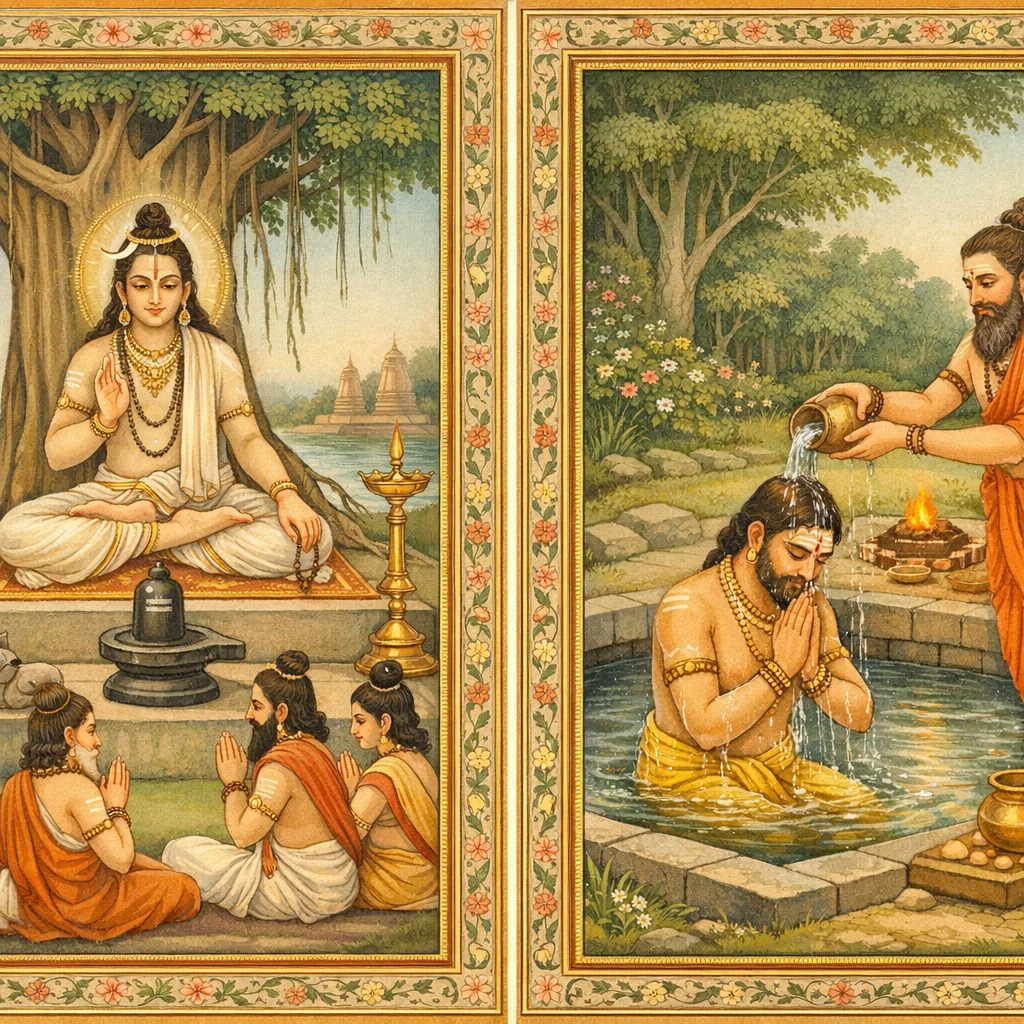
The chapter weaves two tīrtha-centered strands. First it extols Ujjayinī as a siddha-frequented pīṭha where Mahādeva abides as Mahākāla, and it prescribes merit-bearing observances in Vaiśākha—śrāddha, worship in the southern mode (dakṣiṇā-mūrti), veneration of yoginīs, fasting, and full-moon night vigil—promising uplift of ancestors and freedom from aging and death. It then introduces the vast, sin-destroying Bhṛūṇagarta and recounts King Saudāsa’s expiation. Though devoted to brāhmaṇas, he is drawn into grave impurity through a rākṣasa’s sabotage of a long sacrifice, a deceitful offering of forbidden meat, Vasiṣṭha’s curse, and his transformation into a rākṣasa who assaults brāhmaṇas and rites, until release comes after he slays Krūrabuddhi. Restored to human form, he still bears brahmahatyā-linked defilement—stench, loss of tejas, and social avoidance. Directed to tīrtha-yātrā and restraint, he falls into a water-filled pit at a kṣetra (in the narration’s Chamatkārapura setting) and rises radiant and purified; a heavenly voice confirms liberation by the tīrtha’s power. The text explains Bhṛūṇagarta’s origin in Śiva’s concealed presence and sets calendrical efficacy, especially śrāddha on Kṛṣṇa-caturdaśī, promising deliverance of ancestors through diligent bathing and charity.
Shlokas
Verse 1
। सूत उवाच । तत्रैवोज्जयनीपीठमस्ति कामप्रदं नृणाम् । प्रभूताश्चर्यसंयुक्तं बहुसिद्धनिषेवितम्
Sūta said: Right there is the sacred seat of Ujjayinī, a bestower of desired aims for people—filled with abundant wonders and frequented by many perfected beings (siddhas).
Verse 2
यस्य मध्यगतो नित्यं स्वयमेव महेश्वरः । महाकालस्वरूपेण स तिष्ठति द्विजोत्तमाः
In its very center, Maheśvara Himself abides eternally; in the form of Mahākāla He stands established there, O best of the twice-born ones.
Verse 3
वैशाख्यां यो नरस्तत्र कृत्वा श्राद्धं समाहितः । ततः पश्यति देवेशं महाकाल इति स्मृतम् । पूजयेद्दक्षिणां मूर्तिं समाश्रित्य द्विजोत्तमाः
Whoever, in the month of Vaiśākha, performs śrāddha there with a concentrated mind, thereafter beholds the Lord of the gods, remembered as Mahākāla. O best of the twice-born, one should worship the southern-facing Form, taking refuge in It.
Verse 4
दश पूर्वान्दशातीतानात्मानं च द्विजोत्तमाः । पुरुषान्स समुद्धृत्य शिवलोके महीयते
He uplifts ten generations before and ten generations after—together with himself, O best of the twice-born—and is honored in the world of Śiva.
Verse 5
यो यं काममभिध्याय तत्र पीठं प्रपूजयेत् । संपूज्य योगिनीवृंदं कन्यकावृन्दमेव च
Contemplating whatever desire, if one worships that pīṭha there—and duly worships the host of Yoginīs and also the assembly of maidens—
Verse 6
स तत्कृत्स्नमवाप्नोति यदपि स्यात्सुदुर्लभम् । तत्र वैशाखमासस्य पौर्णमास्यां समाहितः
He obtains all of that in full—even what may be exceedingly difficult to attain—especially when, there on the full-moon day of the month of Vaiśākha, he is composed and intent.
Verse 7
श्रद्धायुक्तो नरो यो वा उपवासपरः शुचिः । करोति जागरं तस्य पुरतः श्रद्धयान्वितः । स याति परमं स्थानं जरामरणवर्जितम्
Any person endowed with faith—pure and devoted to fasting—who keeps a night-long vigil before Him with devotion, reaches the supreme abode, free from old age and death.
Verse 8
किं व्रतैः किं वृथा दानैः किं जपैर्नियमेन वा । महाकालस्य ते सर्वे कलां नार्हंति षोडशीम्
What use are vows? What use are fruitless gifts? What use are recitations and disciplines? Even all of them together do not equal one sixteenth part of Mahākāla’s grace and merit.
Verse 9
सूत उवाच । तत्रैवास्ति महाभागा भ्रूणगर्तेति विश्रुता । गर्ता सुविपुलाकारा सर्वपातकनाशिनी
Sūta said: Right there is a greatly auspicious tīrtha famed as “Bhrūṇa-gartā.” It is a vast sacred pit that destroys all sins.
Verse 10
ब्रह्महत्याविनिर्मुक्तः सौदासो यत्र पार्थिवः । स्त्रीहत्यया विनिर्मुक्तः सुषेणो वसुधाधिपः
At that holy place, King Saudāsa was freed from the sin of brahmin-slaying; and King Suṣeṇa, lord of the earth, was likewise released from the sin of killing a woman.
Verse 11
ऋषय ऊचुः । ब्रह्महत्या कथं तस्य सौदासस्य महीपतेः । ब्रह्मण्यस्यापि संजाता तदस्माकं प्रकीर्तय
The sages said: “How did the sin of brahmin-slaying arise for King Saudāsa—though he was devoted to Brahmins? Please recount that to us.”
Verse 12
श्रूयते स महीपालो ब्राह्मणानां हिते रतः । कर्मणा मनसा वाचा ब्रह्मघ्नः सोऽभवत्कथम्
We have heard that this king was devoted to the welfare of Brahmins. How, then, did he become a “slayer of a Brahmin”—by deed, by thought, or by speech?
Verse 13
विमुक्तश्च कथं भूयो भ्रूणगर्तामुपाश्रितः । सापि गर्ता कथं जाता सर्वं नो वद विस्तरात्
And after being freed, how did he again take refuge in the ‘Bhrūṇa-gartā’—the pit linked with the sin of embryo-slaying? And how did that pit come into being? Tell us everything in full detail.
Verse 14
सूत उवाच । यदा लिंगस्य पातोऽभूद्देवदेवस्य शूलिनः । तदा स लज्जयाविष्टो लिंगाभावाद्द्विजोत्तमाः
Sūta said: “When the liṅga of Śūlin—the God of gods—fell, then, O best of the twice-born, he was overcome with shame because his liṅga was absent.”
Verse 15
कृत्वाऽतिविपुलां गर्तां प्रविवेश ततः परम् । न कस्यचित्तदात्मानं दर्शयामास शूलधृक्
Then the Trident-bearer made an exceedingly vast pit and entered it; thereafter he did not reveal himself to anyone.
Verse 16
एवं सा तत्र संजाता गर्ता ब्राह्मणसत्तमाः । यथा तस्यां विपाप्माभूत्सौ दासस्तद्वदाम्यहम्
Thus that pit came into being there, O foremost of Brahmins. Now I shall tell how, in that very place, Saudāsa became free from sin.
Verse 17
आसीन्मित्रसहोनाम राजा परमधार्मिकः । सौदासस्तत्सुतः साक्षात्सूर्यवंशसमुद्भवः
There was a supremely righteous king named Mitrasaha. Saudāsa was his son, born directly in the Solar dynasty.
Verse 18
तेनेष्टं विपुलैर्यज्ञैः सुवर्णवरदक्षिणैः । असंख्यातानि दानानि प्रदत्तानि महात्मना
That great-souled king performed abundant sacrifices, granting excellent dakṣiṇā-fees of gold, and he bestowed countless gifts in charity.
Verse 19
कस्यचित्त्वथ कालस्य सत्रे द्वादशवार्षिके । वर्तमाने यथान्यायं विधिदृष्टेन कर्मणा
Then, at a certain time, while a twelve-year satra was proceeding according to proper custom, with rites performed as laid down by rule,
Verse 20
क्रूराक्षः क्रूरबुद्धिश्च राक्षसौ बलवत्तरौ । यज्ञविघ्नाय संप्राप्तौ संप्राप्ते रजनीमुखे
As nightfall arrived, two exceedingly powerful rākṣasas—Krūrākṣa and Krūrabuddhi—came there with the intent of obstructing the sacrifice.
Verse 21
राक्षसैर्बहुभिः सार्धं तथान्यैर्भूतसंज्ञितैः । पिशाचैश्च दुराधर्षैर्यज्ञविध्वंसतत्परैः
Along with many rākṣasas—and also other beings known as bhūtas—there were fierce, unassailable piśācas, all intent on the destruction of the sacrifice.
Verse 22
अथ ते राक्षसाः सर्वे किंचिच्छिद्रमवेक्ष्य च । विविशुर्यज्ञवाटं तं प्रसर्पन्तः समंततः
Then all those rākṣasas, spying a small opening, entered the sacrificial enclosure, creeping in from every side.
Verse 23
निघ्नन्तो ब्राह्मणश्रेष्ठान्भक्षयन्तो हवींषि च । तथा यानि विचित्राणि यज्ञार्थे कल्पितानि च
They struck down the foremost brāhmaṇas and devoured the havis oblations, along with the many offerings and arrangements that had been prepared for the yajña.
Verse 24
एतस्मिन्नंतरे तत्र हाहाकारो महानभूत् । भक्ष्यमाणेषु विप्रेषु राक्षसैर्बलवत्तरैः
At that very moment, a great cry of distress arose there, as the mightier rākṣasas began to devour the brāhmaṇa sages.
Verse 25
ततो मैत्रसहिः क्रुद्धस्त्यक्त्वा दीक्षाव्रतं नृपः । आदाय सशरं चापं ध्वंसयामास वीक्ष्य तान्
Then King Maitrasahi, enraged, set aside his consecration vow (dīkṣā-vrata) and, taking up his bow with arrows, began to destroy them when he saw what was happening.
Verse 26
कृतरक्षो वसिष्ठेन स्वयमेव पुरोधसा । क्रूराक्षं सूदयामास राक्षसैर्बहुभिः सह
Ritually protected by Vasiṣṭha himself, his royal priest, the king slew Krūrākṣa—along with many other rākṣasas.
Verse 27
क्रूरबुद्धिरथो वीक्ष्य हतं श्रेष्ठं सहोदरम् । तं च पार्थिवशार्दूलमगम्यं ब्रह्मतेजसा
Then Krūrabuddhi, seeing his excellent elder brother slain, and seeing that tiger among kings made unapproachable by brahma-tejas, the brahminical splendor—
Verse 28
हतशेषान्समादाय राक्षसान्बलसंयुतः । पलायनं भयाच्चक्रे क्षतांगस्तस्य सायकैः
Gathering up the rākṣasas who yet survived, he—still possessed of strength—fled in fear, his body wounded by that king’s arrows.
Verse 29
ततस्तद्वैरमाश्रित्य भ्रातुर्ज्येष्ठस्य राक्षसः । छिद्रमन्वेषयामास तद्वधाय दिवानिशम्
Thereafter, clinging to that enmity for his elder brother, the rākṣasa searched day and night for a vulnerability by which to slay him.
Verse 30
एवं सवीक्षमाणस्य तस्य च्छिद्रं महात्मनः । समाप्तिमगमद्विप्राः सत्रं तद्द्वादशाब्दिकम्
Thus, even as that great-souled one was closely watched for any flaw, the Brahmins completed the twelve-year satra and brought it to its proper conclusion.
Verse 31
न सूक्ष्ममपि संप्राप्तं छिद्रं तेन दुरात्मना । वसिष्ठविहिता रक्षा सत्रे तस्य महीपतेः
Not even the subtlest fault could that wicked-minded one discover, for the protection ordained by Vasiṣṭha guarded the king’s sacrificial satra.
Verse 32
अथासौ ब्राह्मणान्सर्वान्विसृज्याहितदक्षिणान् । कृतांजलिपुटो भूत्वा वसिष्ठमिदमब्रवीत्
Then, having duly bestowed the honoraria (dakṣiṇā), he dismissed all the Brahmins; and with palms joined in reverence, he spoke these words to Vasiṣṭha.
Verse 33
स्वहस्तेन गुरोद्याहं त्वां भोजयितुमुत्सहे । क्रियतां तत्प्रसादो मे भुक्त्वाद्य मम मन्दिरे
O Guru, today I long to feed you with my own hands. Grant me this grace—please partake of a meal today in my home.
Verse 34
सूत उवाच । स तथेति प्रतिज्ञाय वसिष्ठो मुनिसत्तमः । क्षालितांघ्रिः स्वयं तेन निविष्टो भोजनाय वै
Sūta said: Vasiṣṭha, best among sages, agreed, saying, “So be it.” Then, after the king himself had washed his feet, he sat down to take the meal.
Verse 35
कूरबुद्धिरथो वीक्ष्य तदर्थं चामिषं शुभम् । सुसंस्कृतं विधानेन सूपकारैर्द्विजोत्तमाः
Then the dull-witted man, seeing the fine meat prepared for that purpose—well cooked according to proper rules by skilled cooks, O best of Brahmins—went forward with his scheme.
Verse 36
उखां कृत्वा ततस्तादृक्तत्प्रमाणामतर्किताम् । महामांसाभृतां कृत्वा तां जहारामिषान्विताम्
Then he had a pot made of that very size, unsuspected by others; filling it with great quantities of meat, he carried it away, laden with flesh.
Verse 37
अथासौ मुनिशार्दूलो भुंजानो बुबुधे हि तत् । महामांसमिति क्रुद्धस्तत्र प्रोवाच मन्युमान्
Then that tiger among sages, while eating, indeed realized it—“This is great meat!” Enraged and filled with wrath, he spoke there.
Verse 38
महामांसाशनं यस्मात्कारितोऽहं त्वयाधम । रक्षोवद्राक्षसस्तस्मात्त्वमद्यैव भविष्यसि
“Since you, wretch, have made me eat great meat, therefore this very day you shall become a Rākṣasa, like one possessed of rākṣasa-nature.”
Verse 39
ततः संशोधयामास तस्य मांसस्य चागमम् । निपुणं सूपकारांस्तान्दृष्ट्वा राजा पृथक्पृथक्
Then the king investigated the origin of that meat; and, seeing those expert cooks, he examined them one by one, separately.
Verse 40
तेऽब्रुवन्नैतदस्माभिः श्रपितं मांसमीदृशम् । श्रद्धीयतां महीपाल नान्येन मनुजेन वा
They said, “This kind of cooked meat was not prepared by us. Believe it, O king—no human being other than us has done this.”
Verse 41
राक्षसं वा पिशाचं वा दानवं वा विना विभो । एतज्ज्ञात्वा ततो नाथ यद्युक्तं तत्समाचर
“O mighty one, this cannot be without a rākṣasa, a piśāca, or a dānava. Knowing this, O lord, do what is proper.”
Verse 42
एतस्मिन्नंतरे तस्य नारदो मुनिसत्तमः । समागत्याब्रवीत्सर्वं तद्राक्षसविचेष्टितम्
Just then, Nārada, the best of sages, arrived and explained everything—how it was all the contrivance of a rākṣasa.
Verse 43
तच्छ्रुत्वा कोपमापन्नः स राजा शप्तुमुद्यतः । वसिष्ठं स्वकरे कृत्वा जलं सौदासभूपतिः । शापोद्यतं च तं दृष्ट्वा नारदो वाक्यमब्रवीत्
Hearing this, the king was seized by wrath and prepared to utter a curse. King Saudāsa, taking water in his own hand and holding Vasiṣṭha in his mind, stood ready to curse; seeing him thus poised, Nārada spoke to him.
Verse 44
निघ्नन्तो वा शपन्तो वा द्विषन्तो वा द्विजातयः । नमस्कार्या महीपाल तथापि स्वहितेच्छुना । गुरुरेष पुनर्मान्यस्तव पार्थिवसत्तम
Nārada said: “Even if the twice-born strike, curse, or even hate, they must still be saluted, O king—especially by one who seeks his own welfare. This teacher must be honored again by you, O best of rulers.”
Verse 45
तस्मान्नार्हसि शप्तुं त्वं प्रतिशापेन सन्मुनिम् । निषिद्धः स तथा भूपस्ततस्तत्सलिलं करात् । पादयोः कृत्स्नमुपरि प्रमुमोच ततः परम्
“Therefore you should not curse the good sage with a counter-curse.” Thus restrained, the king released the water from his hand, pouring it wholly upon his own feet.
Verse 46
अथ तौ चरणौ तस्य तप्त शापोदकप्लुतौ । दग्धौ कृष्णत्वमापन्नौ तत्क्षणाद्द्विजसत्तमाः
Then his two feet, drenched in the heated water meant for a curse, were scorched and at once turned black, O best of the twice-born.
Verse 47
कल्माषपाद इत्युक्तस्ततःप्रभृति स क्षितौ । भूपालो द्विजशार्दूला ना्म्ना तेन विशेषतः
From that time onward upon the earth, that king was called “Kalmāṣapāda” (“Black-footed”), O tigers among the twice-born—distinguished especially by that very name.
Verse 48
सूत उवाच । एतस्मिन्नंतरे विप्रो वसिष्ठो लज्जयान्वितः । ज्ञात्वा दत्तं वृथा शापं तस्य भूमिपतेस्तदा
Sūta said: Meanwhile, the brāhmaṇa Vasiṣṭha, filled with shame, realized then that the curse he had uttered against that king had been in vain.
Verse 49
उवाच व्यर्थः शापोऽयं तव दत्तो मया नृप । न च मे जायते वाक्यमसत्यं हि कथंचन
He said, “O king, this curse that I gave you has proved futile. Yet from me no false word ever arises in any way.”
Verse 50
तस्मात्त्वं राक्षसो भूत्वा कञ्चित्कालं नृपो त्तम । स्वरूपं लप्स्यसे भूयो यस्मिन्काले शृणुष्व तम्
“Therefore, O best of kings, you shall become a rākṣasa for some time. Yet you will regain your own true form again—hear from me the time and condition by which that will occur.”
Verse 51
यदा त्वं क्रूरबुद्धिं तं राक्षसं निहनिष्यसि । तदा त्वं लप्स्यसे मोक्षं राक्षसत्वात्सुदारुणात्
“When you slay that rākṣasa of cruel intent, then you will attain liberation (mokṣa), released from that exceedingly dreadful state of rākṣasa-hood.”
Verse 52
सूत उवाच । एतस्मिन्नन्तरे राजा यातुधानो बभूव सः । ऊर्ध्वकेशो महाकायः कृष्णदन्तो भया नकः
Sūta said: In the meantime, that king became a yātudhāna (rākṣasa). His hair stood on end; he was massive in body, with black teeth—terrifying to behold.
Verse 53
ततो जघान विप्रेन्द्रान्राक्षसं भावमाश्रितः । यज्ञान्विध्वंसयामास मुनीनामाश्रमानपि
Then, assuming the nature of a Rākṣasa, he struck down the foremost Brāhmaṇas, destroyed the sacrifices, and even the hermitages of the sages.
Verse 54
कस्यचित्त्वथ कालस्य क्रूर बुद्धिः स राक्षसः । ज्ञात्वा तं राक्षसीभूतमेकदाऽयुधवर्जितम्
After some time, that cruel-minded Rākṣasa, realizing that he had become a Rākṣasa and was once without weapons, seized the moment.
Verse 55
भ्रातुर्वधकृतं वैरं स्मरमाणस्ततः परम् । तद्वधार्थं समायातो राक्षसैर्बहुभिर्वृतः
Remembering the enmity caused by the killing of his brother, he then arrived to slay him, surrounded by many Rākṣasas.
Verse 56
ततस्तं वेष्टयित्वापि समंताद्राक्षसो नृपम् । प्रोवाच वचनं क्रुद्धो नादेनापूरयन्दिशः
Then, having surrounded the king on all sides, the Rākṣasa spoke in anger, filling the directions with his roar.
Verse 57
त्वया यो निहतोऽस्माकं ज्येष्ठो भ्राता सुदुर्मते । वसिष्ठस्य बलाद्यज्ञे तस्याद्य फलमाप्नुहि
O vile-minded one, you killed our eldest brother at the sacrifice through the power of Vasiṣṭha; receive the fruit of that deed today!
Verse 58
राजोवाच । यद्ब्रवीषि दुराचार कर्मणा तत्समाचर । शारदस्येव मेघस्य गर्जितं तव निष्फलम्
The king said: “O man of wicked conduct, whatever you boast of—prove it by deed. Your roaring bears no fruit, like the thunder of an autumn cloud.”
Verse 59
एवमुक्त्वा समादाय ततो वृक्षं स पार्थिवः । प्राद्रवत्संमुखं तस्य गर्जमानो यथा घनः
Having spoken thus, the king seized a tree and rushed straight at him, roaring like a thundercloud.
Verse 60
सोऽपि वृक्षं समुत्पाट्य क्रोधसंरक्तलोचनः । त्रिशंखां भृकुटीं कृत्वा तस्याप्यभिमुखं ययौ
He too uprooted a tree; his eyes were reddened with rage, and, knitting his brows into three deep furrows, he advanced straight toward him.
Verse 61
कृतवन्तौ वने तत्र बहुवृक्षक्षयावहम्
There in that forest, the two of them wrought great destruction, felling many trees.
Verse 62
अथ तं श्रांतमालोक्य कूरबुद्धिं महीपतिः । प्रगृह्य पादयोर्वेगाद्भ्रामयामास पुष्करे
Then, seeing that dull-witted one grown weary, the king seized him by the feet and, with force, whirled him around in the lotus-filled water.
Verse 63
ततश्चास्फोटयामास भूमौ कोपसमन्वितः । चक्रे चामिषखण्डं स पिष्ट्वापिष्ट्वा मुहुर्मुहुः
Then, filled with fury, he dashed him upon the ground; and he made him into lumps of flesh, crushing and crushing him again and again.
Verse 64
तस्मिंस्तु निहते शूरे राक्षसे स महीपतिः । राक्षसत्वाद्विनिर्मुक्तो लेभे कायं नृपोद्भवम्
When that heroic rākṣasa was slain, the king—freed from the state of rākṣasa-hood—regained a body befitting one born in the royal line.
Verse 65
ततस्ते राक्षसाः शेषाः समंतात्तं महीपतिम् । परिवार्य महावृक्षैर्जघ्नुः पाषाणवृष्टिभिः
Then the remaining rākṣasas surrounded the king on all sides and struck him—hurling great trees and showering him with stones.
Verse 66
ततस्तानपि भूपालो जघान प्रहसन्निव । वृक्षहस्तस्तु विश्रब्धो लीलया द्विजसत्तमाः
Then the king struck down even them, as though laughing; with a tree in his hand, calm and unafraid, he did it playfully—O best of twice-born ones.
Verse 67
ततश्च स्वपुरं प्राप्तः संप्रहृष्टतनूरुहः । राक्षसानां वधं कृत्वा लब्ध्वा देहं पुरातनम्
Then he returned to his own city, his hair standing on end with joy; having slain the rākṣasas, he had regained his former body.
Verse 68
ततस्तं तेजसा हीनं दुर्गंधेन समावृतम् । ब्रह्महत्योद्भवैश्चिह्नैरन्यैरपि पृथग्विधैः
Then they saw him—bereft of radiance, enveloped in a foul stench, and marked with various signs arising from brahma-hatyā, along with other diverse blemishes.
Verse 69
दृष्ट्वा ते मंत्रिणस्तस्य पुत्र पौत्रास्तथा परे । नोपसर्पंति भूपालं पापस्पर्शभयान्विताः
Seeing him thus, his ministers, his sons and grandsons, and others as well did not approach the king, fearing the touch of sin.
Verse 70
ऊचुश्च पार्थिवश्रेष्ठ न त्वमर्हसि संगमम् । कर्तुं सार्धमिहास्माभिर्ब्रह्महत्या न्वितो यतः
They said: “O best of kings, you are not fit to associate and mingle here with us, for you are tainted by the sin of brahmin-slaying (brahmahatyā).”
Verse 71
तस्माद्वसिष्ठमाहूय प्रायश्चित्तं समाचर । अशुद्धं शुद्धिमायाति येन गात्रमिदं तव
“Therefore, summon Vasiṣṭha and undertake an expiation, by which this impure body of yours may attain purity.”
Verse 72
ततः स पार्थिवस्तूर्णं वसिष्ठं मुनिपुंगवम् । समाहूयाब्रवीद्वाक्यं दूरस्थो विनयान्वितः
Then that king quickly summoned Vasiṣṭha, the foremost of sages; standing at a distance, with humility, he spoke these words.
Verse 73
तव प्रसादतो विप्र स हतो राक्षसो मया । मुक्तशापोऽस्मि संजातः परं शृणु वचो मुने
By your grace, O Brāhmaṇa, that rākṣasa has been slain by me. I am freed from the curse; now, O sage, hear my further words.
Verse 74
मम गात्रात्सुदुर्गंधः समुद्गच्छति सर्वतः । भाराक्रांतानि गात्राणि सर्वाण्येवाचलानि च
From my body a foul stench rises on every side; my limbs feel oppressed by a heavy weight, and all of them have become as if motionless.
Verse 75
तत्किमेतद्द्विजश्रेष्ठ तेजो हानिरतीव मे । मंत्रिणोऽपि तथा पुत्रा न स्पृशंति यतोऽद्य माम्
What is this, O best of the twice-born? My splendor has greatly diminished. Even my ministers and my sons do not touch me today.
Verse 76
वसिष्ठ उवाच । राक्षसत्वं प्रपन्नेन त्वया पार्थिवसत्तम । ब्राह्मणा बहवो ध्वस्तास्तथा विध्वंसिता मखाः । तेषां त्वं पार्थिवश्रेष्ठ संस्पृष्टो ब्रह्महत्यया
Vasiṣṭha said: “O best of kings, when you fell into the state of a rākṣasa, many Brāhmaṇas were destroyed by you, and sacrifices were likewise ruined. Therefore, O foremost ruler, you have become touched by the sin of brahmin-slaying.”
Verse 77
राजोवाच । तदर्थं देहि मे विप्र प्रायश्चित्तं विशुद्धये । येन निर्मुक्तपापोऽहं राज्यं प्राप्नोमि चात्मनः
The king said: “Therefore, O Brāhmaṇa, grant me an expiation for purification, by which—freed from sin—I may regain my rightful sovereignty and my own well-being.”
Verse 78
वसिष्ठ उवाच । अत्रार्थे तीर्थयात्रां त्वं कुरु पार्थिव सत्तम । निर्ममो निरहंकारस्ततः सिद्धिमवाप्स्यसि
Vasiṣṭha said: “For this purpose, O best of kings, undertake a pilgrimage to the sacred tīrthas. Free from possessiveness and ego (ahaṃkāra), you will then attain siddhi—purification and spiritual fulfillment.”
Verse 79
ततः स पार्थिवश्रेष्ठः संयतात्मा जितेंद्रियः । प्रयागादिषु तीर्थेषु स्नानं चक्रे समा हितः
Then that foremost king—self-restrained and master of his senses—performed sacred baths at holy places beginning with Prayāga, remaining composed and collected in mind.
Verse 80
न नश्यति स दुर्गंधो न च तेजः प्रवर्धते । न कायो लघुतां याति नालस्येन विमुच्यते
That foul stench does not disappear; nor does spiritual radiance increase. The body does not become light, and one is not freed from lethargy.
Verse 81
ततः संभ्रममाणश्च कदाचि द्द्विजसत्तमाः । चमत्कारपुरे क्षेत्रे स्नानार्थं समुपागतः
Then, O best of brāhmaṇas, once—anxious and agitated—he arrived at the sacred kṣetra of Camatkārapura in order to bathe.
Verse 82
सुश्रांतः क्षुत्पिपासार्तो निशीथे तमसावृते । गर्तायां पतितोऽकस्मात्पूर्णायां पयसा नृपः
Exhausted, tormented by hunger and thirst, in the dead of night covered by darkness, the king suddenly fell into a pit filled with water.
Verse 83
कृच्छ्रात्ततो विनिष्क्रांतस्तीर्थात्तस्मान्महीपतिः । यावत्पश्यति चात्मानं द्वादशार्कसमप्रभम्
With great difficulty the king emerged from that tīrtha, and then beheld himself radiant—equal in brilliance to twelve suns.
Verse 84
दुर्गंधेन परित्यक्तं सोद्यमं लघुतां गतम् । दृष्ट्वा च चिंतयामास नूनं मुक्तोऽस्मि पातकात्
Seeing himself freed from foul odor, filled with vigor, and become light, he reflected: “Surely, I have been released from sin.”
Verse 85
एतस्मिन्नेव काले तु वागुवाचाशरीरिणी । हर्षयन्ती महीपालं विमुक्तं ब्रह्महत्यया
At that very moment, a bodiless voice spoke, delighting the king—who had been freed from the sin of brahmahatyā.
Verse 86
विमुक्तोऽसि महाराज सांप्रतं पूर्वपातकैः । तीर्थस्यास्य प्रभावेन तस्माद्गच्छ निजं गृहम्
“O great king, you are now freed from your former sins by the power of this tīrtha. Therefore, go to your own home.”
Verse 87
अत्र संनिहितो नित्यं भ्रूणरूपेण शंकरः । कृष्णपक्षे विशेषेण चतुर्दश्यां महीपते
“Here Śaṅkara is ever present in the form of a fetus; and especially so, O king, on the fourteenth lunar day of the dark fortnight.”
Verse 88
यदा प्रपतितं लिंगं देवदेवस्य शूलिनः । द्विजशापेन गर्तैषा तदानेन विनिर्मिता
When the liṅga of the trident-bearing Lord of gods fell down because of a brāhmaṇa’s curse, this pit was formed at that very moment.
Verse 89
लज्जितेन स्ववासार्थं महद्दुःखयुतेन च । सतीवियोगयुक्तेन भ्रूणत्वं प्रगतेन च
Overcome with shame, seeking a place to dwell, burdened with great sorrow; afflicted by separation from Satī, and having entered the state of being a fetus…
Verse 90
सर्वपापहरा तेन गर्तेयं पृथि वीपते । भ्रूणगर्तेति विख्याता तस्य नामा जगत्त्रये
Therefore, O lord of the earth, this pit became the remover of all sins. Its name is renowned throughout the three worlds as “Bhrūṇagarta.”
Verse 91
सूत उवाच । एवमुक्त्वाथ सा वाणी विररामांऽतरिक्षगा । सोऽपि पार्थिवशार्दूलः प्रहृष्टः स्वपुरं ययौ
Sūta said: Having spoken thus, that voice in the sky fell silent. And that tiger among kings, filled with joy, went back to his own city.
Verse 92
ततस्तं पापनिर्मुक्तं तेजसा भास्करोपमम् । दृष्ट्वा पुत्रास्तथा मर्त्याः प्रणेमुस्तुष्टिसंयुताः
Then, seeing him freed from sin and radiant like the sun, his sons and the people bowed down, filled with satisfaction and joy.
Verse 93
सोऽपि ब्राह्मणशार्दूलो वसिष्ठस्तं महीपतिम् । समभ्येत्य ततः प्राह हर्षगद्गदया गिरा
Then Vasiṣṭha, the tiger among brāhmaṇas, approached that king and spoke in a voice trembling with joy.
Verse 94
दिष्ट्या मुक्तोसि राजेंद्र पापाद्ब्रह्मवधोद्भवात् । दिष्ट्या त्वं तेजसा युक्तः पुनः प्राप्तो निजं पुरम्
By good fortune, O lord of kings, you have been freed from the sin born of brahma-slaughter. By good fortune, endowed again with splendor, you have returned to your own city.
Verse 95
तस्मात्कीर्तय भूपाल कस्मिंस्तीर्थे समागतः । त्वं मुक्तः पातकाद्घोराद्ब्रह्महत्यासमुद्भवात्
Therefore, O protector of the earth, proclaim at which sacred ford you arrived—by which you were freed from the dreadful sin that arises from brahmahatyā.
Verse 96
ततः स कथयामास भ्रूणगर्तासमुद्भवम् । वृत्तांतं तस्य विप्रर्षेरनुभूतं यथा तथा
Then he recounted, just as it was experienced, the account of Bhrūṇagarta—how it came to be—(as told) by that brāhmaṇa-seer.
Verse 97
ततस्ते मंत्रिणो वृद्धाः स च राजा मुनीश्वरः । पुत्रं प्रतर्दनंनाम राज्ये संस्थाप्य तत्क्षणात्
Then the aged ministers and that king—foremost among sages in wisdom—installed his son named Pratardana upon the throne at once.
Verse 98
भ्रूणगर्तां समासाद्य तामेव द्विजसत्तमाः । तपश्चेरुर्महादेवं ध्यायमाना दिवा निशम्
Reaching that very Bhrūṇagarta, the foremost among the twice-born performed austerities, meditating on Mahādeva by day and by night.
Verse 99
गताश्च परमां सिद्धिं कालेनाल्पेन दुर्लभाम् । भ्रूणरूपधरं देवं पूजयित्वा महेश्वरम्
And in a short time they attained the supreme, hard-to-win spiritual accomplishment, having worshipped Maheśvara—the Lord who had assumed the form associated with Bhrūṇa (the embryo).
Verse 100
ततःप्रभृति सा गर्ता प्रख्याता धरणीतले । भ्रूणगर्तेति विप्रेंद्राः सर्वपातकनाशिनी
From that time onward, O best of brāhmaṇas, that sacred pit became renowned upon the earth as “Bhrūṇagarta,” the destroyer of all sins.
Verse 101
तत्र कृष्णचतुर्दश्यां यः श्राद्धं कुरुते नरः । स पितॄंस्तारयेन्नूनं दश पूर्वान्दशा परान्
Whoever performs śrāddha there on the fourteenth lunar day of the dark fortnight surely delivers his ancestors—ten generations before and ten generations after.
Verse 102
तस्मात्सर्वप्रयत्नेन तत्र श्राद्धं समाचरेत् । स्नानं च ब्राह्मणश्रेष्ठा दानं वापि स्वशक्तितः
Therefore, with every effort one should duly perform śrāddha there; and also bathing, O best of brāhmaṇas, and charity too, according to one’s capacity.