Adhyaya 52
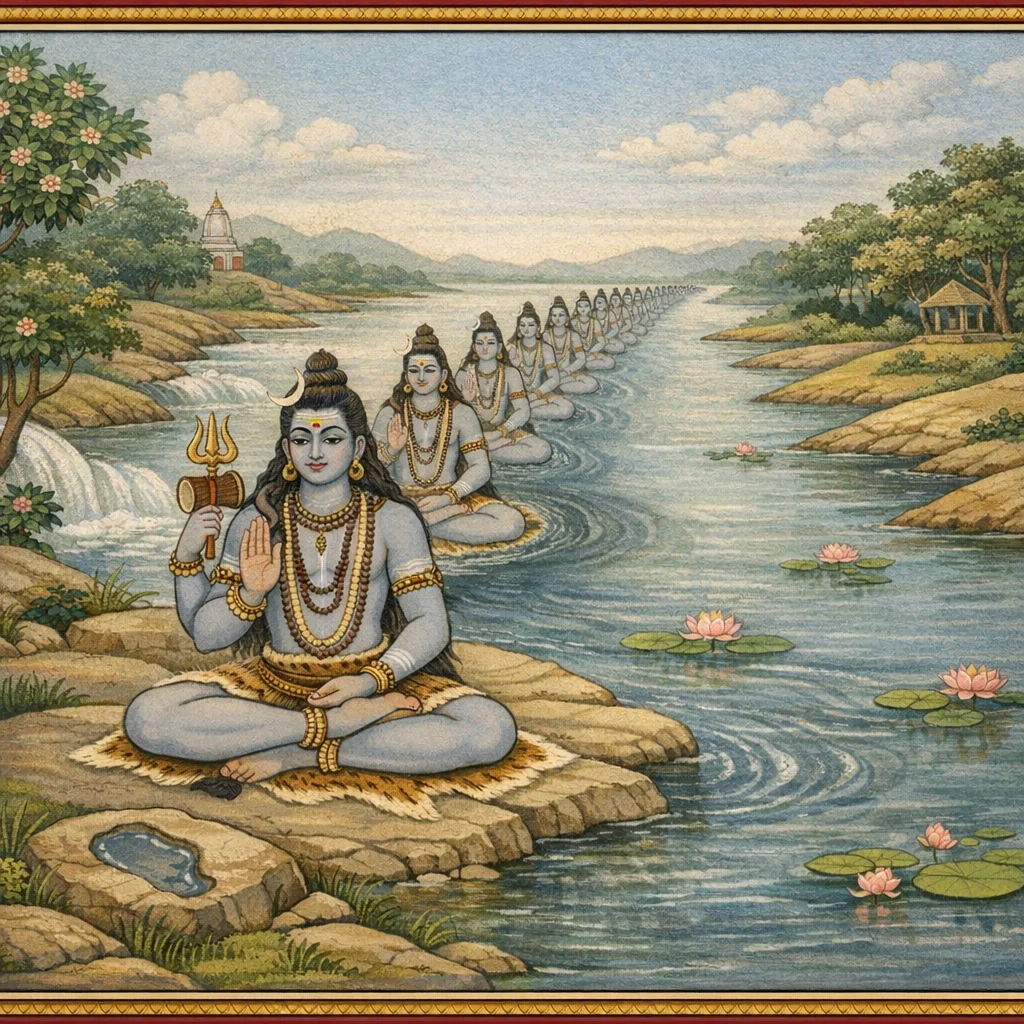
Chapter 52, narrated by Sūta, lays out a shrine-centered sacred micro‑geography: a king installs Umā–Maheśvara and builds a temple, with a pure pond before it. It then lists nearby merit‑sites by direction—an intensely purifying vāpī near Agastya‑kuṇḍa (east), the Kapilā river (south) linked to Kapila’s Sāṃkhya-born siddhi, and a Siddhakṣetra where countless siddhas attained accomplishment—along with a four‑sided Vaiṣṇavī śilā said to destroy sins. The chapter frames a confluence theology in which Sarasvatī stands between Gaṅgā and Yamunā, and the Triveṇī flowing in front grants worldly welfare and liberation. It also gives funerary guidance: cremation and rites at the Triveṇī are declared to bestow mokṣa, especially for brāhmaṇas, with a goṣpada-like visible mark cited as local proof. The discourse culminates in the Rudrakoṭi/Rudrāvarta legend: South Indian brāhmaṇas seeking priority in darśana meet Maheśvara manifested in “koṭi” forms, establishing the place-name. Prescribed observances include caturdaśī visits (notably in Āṣāḍha, Kārtika, Māgha, and Caitra), śrāddha rites, fasting with night‑vigil, gifting a kapilā cow to a worthy brāhmaṇa, mantra practices (ṣaḍakṣara japa; Śatarudrīya recitation), and devotional offerings of song and dance as merit-bearing worship.
Shlokas
Verse 1
। सूत उवाच । उमामहेश्वरौ तत्र स्थापितौ तेन भूभुजा । प्रासादं परमं कृत्वा साधुदृष्टिसुखप्रदम्
Sūta said: There the king installed Umā and Maheśvara, and having built a supremely splendid temple—one that grants joy to the very sight of the virtuous—he established that sacred shrine.
Verse 2
तस्याग्रतः शुभं कुंडं तत्र चैव विनिर्मितम् । स्वच्छोदकेन सम्पूर्णं पद्मिनीखंडमंडितम्
In front of that shrine a beautiful sacred pond (kuṇḍa) was also constructed, filled with clear water and adorned with clusters of lotus-plants.
Verse 3
स्नात्वा तत्र नरो भक्त्या तौ पश्येद्यः समाहितः । माघशुक्लचतुर्दश्यां न स भूयोऽत्र जायते
A man who bathes there with devotion and, with a collected mind, beholds that Divine Pair—on the bright fourteenth day of Māgha—does not take birth here again.
Verse 4
तस्यैव पूर्वदिग्भागेऽगस्त्यकुण्डसमीपतः । अस्ति वापी महापुण्या सर्वपातकनाशिनी
In the eastern quarter of that place, near Agastya’s Kuṇḍa, there is a most meritorious step-well (vāpī) that destroys all sins.
Verse 5
तस्यां यः कुरुते स्नानं मासि वै फाल्गुने नरः । सोपवासः सिताष्टम्यां वांछितं लभते च सः
Whoever bathes in that vāpī in the month of Phālguna, and fasts (upavāsa) on the bright eighth day, attains the boon he desires.
Verse 6
तस्या दक्षिणदिग्भागे तत्रास्ति कपिला नदी । कपिलो यत्र संप्राप्तः सिद्धिं सांख्यसमुद्भवाम्
To its southern side flows the Kapilā River—where Kapila attained the spiritual siddhi born of Sāṅkhya.
Verse 7
कपिलायाश्च पूर्वेण सिद्धक्षेत्रं प्रकीर्तितम् । यत्र सिद्धिं गताः सिद्धाः पुरा शत सहस्रशः
To the east of the Kapilā is famed the Siddha-kṣetra, where in ancient times Siddhas—by the hundreds of thousands—attained perfection.
Verse 8
यो यं काममभिध्याय तपस्तत्र समाचरेत् । षण्मासाभ्यंतरे नूनं स तमाप्नोति मानवः
Whatever desire a person contemplates and then performs tapas (austerity) there—within six months, assuredly, he attains that very aim.
Verse 9
तस्याधस्ताच्छिला विप्रा विद्यते वैष्णवी शुभा । भ्रमन्ती चतुरस्रा च सर्वपातकनाशिनी
Below that place, O brāhmaṇas, there is an auspicious Vaiṣṇavī stone-slab—circular in its turning course and also four-sided—destroying all sins.
Verse 10
सदा महानदीतोयक्षालिता मुक्तिदा नृणाम् । गंगायमुनयोर्मध्ये संनिविष्टा सरस्वती
Ever washed by the waters of the great river, she bestows liberation upon people—Sarasvatī, situated between the Gaṅgā and the Yamunā.
Verse 11
त्रिवेणी वहते तस्याः पुरतो भुक्तिमुक्तिदा । तस्यामुपरि दग्धानां ब्राह्मणानां विशेषतः
In front of it flows the Triveṇī, bestowing both worldly enjoyment and liberation; and especially for Brahmins whose bodies are cremated upon its banks (this merit is declared).
Verse 12
नूनं मुक्तिर्भवेत्तेषां चिता भस्मनि गोष्पदम् । दृश्यते तत्र तज्ज्ञात्वा संस्कार्या ब्राह्मणा मृताः
Surely liberation comes to them: there, in the ashes of the funeral pyre, a mark like a “cow’s hoofprint” is seen. Knowing this sign, deceased Brahmins should be duly consecrated there with the proper funerary rites.
Verse 13
तस्यैवोत्तरदिग्भागे रुद्रकोटिर्द्विजोत्तमाः । अस्ति संपूजिता विप्रै र्दाक्षिणात्यैर्महात्मभिः
On its northern side, O best of Brahmins, is the holy place called Rudrakoṭi—reverently worshipped by great-souled Brahmins from the southern country.
Verse 14
महायोगिस्वरूपेण दाक्षिणात्या द्विजोत्तमाः । चमत्कारपुरे क्षेत्रे श्रुत्वा स्वयमुमापतिम्
O best of Brahmins, the southern Brahmins—hearing that Umāpati (Śiva) himself was present in the holy kṣetra of Camatkārapura in the form of a great yogin—were stirred to go there.
Verse 15
ततः कौतूहलाविष्टाः श्रद्धया परया युताः । कोटिसंख्या द्रुतं जग्मुस्तस्य दर्शनवांछया
Then, seized by holy curiosity and filled with supreme faith, they—numbering in crores—quickly set out, longing for his darśana.
Verse 16
अहंपूर्वमहंपूर्वं वीक्षयिष्यामि तं हरम् । इति श्रद्धासमो पेताश्चक्रुस्ते शपथं गताः
“I first! I first shall behold that Hara!”—thus, carried along by their faith, they made an oath among themselves.
Verse 17
एतेषां मध्यतो यस्तं महायोगिनमीश्वरम् । चरमं देवमीक्षेत भविष्यति स पापकृत्
Among them, whoever would see that Lord—the great Yogin—last, would become a doer of sin.
Verse 18
ततस्तेषामभिप्रायं ज्ञात्वा देवो महेश्वरः । भक्तिप्रीतो हितार्थाय कोटिरूपैर्व्यवस्थितः
Then, understanding their intention, Lord Maheśvara—pleased by their devotion—arranged himself, for their welfare, in forms numbering a crore.
Verse 19
हेलया दर्शनं प्राप्तः सर्वेषां द्विजसत्तमाः । ततः प्रभृति तत्स्थानं रुद्रकोटीतिविश्रुतम्
With ease (without strain), all of them obtained his darśana, O best of Brahmins; from that time onward, that place became renowned as “Rudrakoṭi.”
Verse 20
तदर्थं पठितः श्लोको नारदेन पुरा द्विजाः । रुद्रावर्तं समालोक्य प्रहृष्टेन द्विजोत्तमाः
For this very purpose, O Brahmins, Nārada long ago recited a verse; and seeing the Rudrāvarta, the best of Brahmins rejoiced.
Verse 21
आषाढीं कार्तिकीं माघीं तथा चैत्रसमुद्भवाम् । धन्याः पृथिव्यां लप्स्यंते रुद्रावर्ते चतुर्दशीम्
Blessed indeed upon the earth are those who obtain the Fourteenth (tithi) at Rudrāvarta—whether it falls in Āṣāḍha, Kārtika, Māgha, or arises in the month of Caitra.
Verse 22
आजन्मशतसाहस्रं कृत्वा पापं नरः क्षितौ । रुद्रावर्तं समालोक्य विपाप्मत्वं प्रपद्यते
Even if a man on earth has committed sins for a hundred thousand births, merely beholding Rudrāvarta he attains freedom from sin.
Verse 23
रुद्रावर्त्ते नरो गत्वा दृष्ट्वा योगेश्वरं हरम् । शुक्लपक्षे चतुर्दश्यां विपाप्मा जायते ध्रुवम्
A man who goes to Rudrāvarta and beholds Hara, the Lord of Yoga, on the bright fortnight’s Fourteenth surely becomes free from sin.
Verse 24
यस्तत्र कुरुते श्राद्धं महायोगिपुरे द्विजाः । रुद्रावर्ते स चाप्नोति फलं शतमखोद्भवम्
O twice-born ones, whoever performs śrāddha there in Mahāyogipura, at Rudrāvarta, attains the merit-fruit that arises from a hundred sacrifices (Satamakha) of Indra.
Verse 25
उपवासपरो भूत्वा यः कुर्याद्रात्रिजागरम् । कामगेन विमानेन स स्वर्गे याति मानवः
Whoever, devoted to fasting, keeps vigil through the night—such a person goes to heaven in a celestial vimāna that moves according to one’s wish.
Verse 26
तत्र यः कपिलां दद्याद्ब्राह्मणायाहिताग्नये । स गणः स्यान्न संदेहो हरस्य दयितस्तथा
Whoever there gives a tawny cow (kapilā) to a brāhmaṇa who maintains the sacred fires becomes, without doubt, one of Śiva’s gaṇas, and likewise becomes dear to Hara.
Verse 27
षडक्षरं जपेद्यस्तु महायोगिपुरः स्थितः । मंत्रं तस्य भवेच्छ्रेयः षङ्गुणं राजसूयतः
But whoever, staying in Mahāyogipura, repeats in japa the six-syllabled mantra—its benefit for him becomes sixfold greater than that of the Rājasūya sacrifice.
Verse 28
यस्तस्य पुरतो भक्त्या जपेद्वा शतरुद्रियम् । चतुर्णामपि वेदानां सोऽधीतानां भजेत्फलम्
Whoever, with devotion, chants the Śatarudriya before Him attains the fruit of having studied all four Vedas.
Verse 29
गीतं वा यदि वा नृत्यं तत्पुरः कुरुते नरः । स सर्वेषां भजेच्छ्रेयो मखानां नात्र संशयः
Whether song or dance, a man who performs it before that Lord attains the highest good, equal to the merit of all sacrifices; of this there is no doubt.
Verse 30
एवमुक्त्वा द्विजश्रेष्ठाः स मुनिर्ब्रह्मसंभवः । विरराम ततो हृष्टस्तीर्थयात्रां गतो द्रुतम्
Having spoken thus, O best of the twice-born, that sage—Brahmā-born—then fell silent; and, delighted, he quickly set out on pilgrimage to the tīrthas.