Adhyaya 51
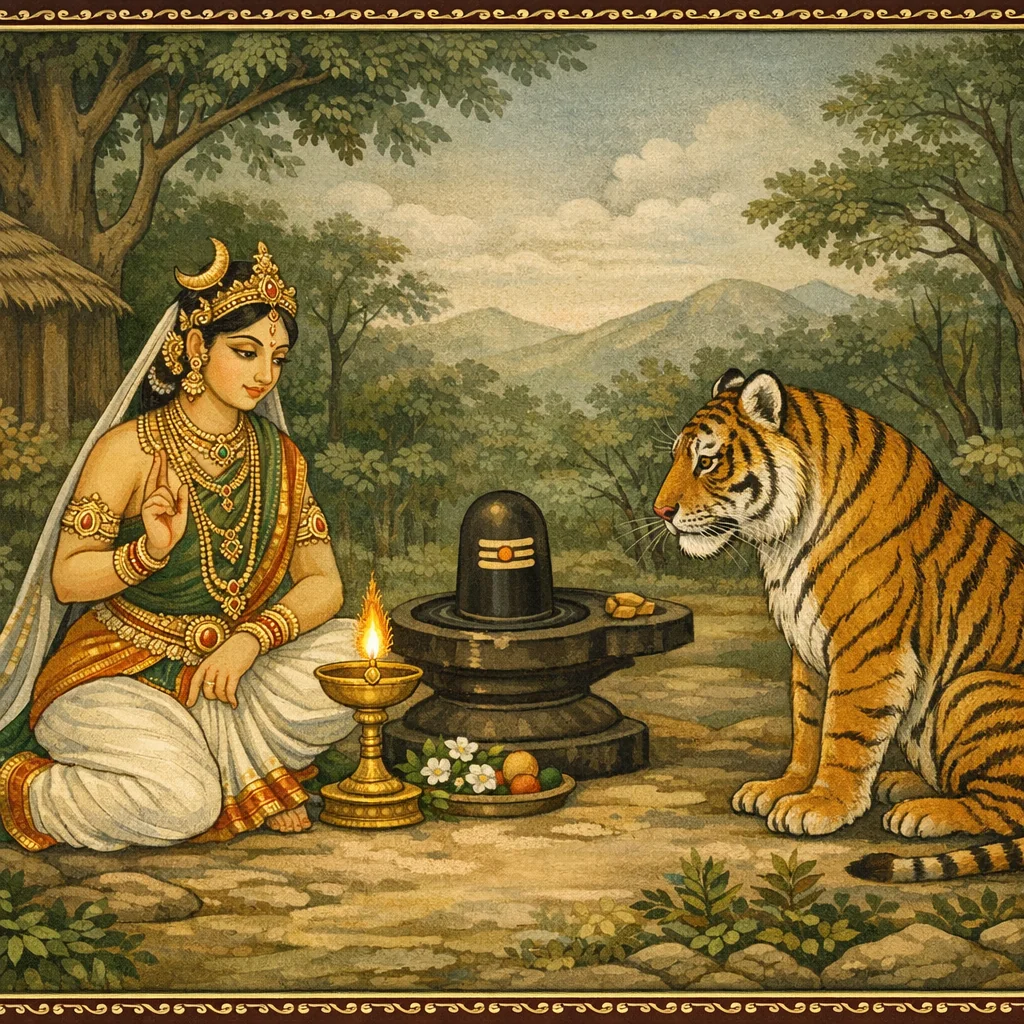
Sūta recounts an ethical-theological episode framed as a test of vows within sacred geography. Nandinī, a cow-mother, is seized by a tiger in the forest; she gains temporary release by solemnly swearing to return after nursing and safeguarding her calf. She goes to the calf, explains the danger, and teaches maternal devotion and practical forest ethics, warning against lobha (greed), pramāda (carelessness), and viśvāsa (reckless trust). The calf wishes to accompany her, praising the mother as the highest refuge, but Nandinī protects him by entrusting him to the herd. Nandinī asks the other cows’ forgiveness and assigns communal care for her soon-to-be orphaned calf. Though the herd argues that in extreme distress her oath could be treated as a “non-sinful untruth,” Nandinī declares satya (truth) to be the foundation of dharma and returns to the tiger. Confronted by her truthfulness, the tiger repents and seeks instruction for spiritual welfare despite living by हिंसा (violence). Nandinī teaches a yuga-based ethic—dāna (giving) as a key practice in Kali—and points him to a powerful liṅga (traditionally linked with Bāṇa-pratiṣṭhā). She directs the tiger to daily pradakṣiṇā and praṇāma; upon darśana of the liṅga, he is freed from the tiger-form and revealed as a cursed king, Kalāśa of the Haihaya line, who praises the place as Camatkārapura-kṣetra, the essence of all tīrthas and wish-fulfilling. The chapter ends with site-specific phalaśruti: offering lamps in Kārttika and devotional arts in Mārgaśīrṣa before the liṅga bring pāpa-kṣaya and Śivaloka, and reciting the māhātmya grants the same merit.
Shlokas
Verse 1
। सूत उवाच । अथ ताच्छपथाञ्छ्रुत्वा स व्याघ्रो विस्मयान्वितः । सत्यं मत्वा पुनः प्राह नन्दिनीं पुत्रवत्सलाम्
Sūta said: “Having heard those oaths, the tiger was filled with wonder. Taking them to be true, he spoke again to Nandinī, who was tender with motherly love for her child.”
Verse 2
यद्येवं तद्गृहं गच्छ वीक्षयस्व निजात्मजम् । सखीनामर्पयित्वाथ भूय आगमनं कुरु
“If that is so, then go to your home and look upon your own child. After entrusting him to your companions, return here again.”
Verse 3
सूत उवाच । इति व्याघ्रवचः श्रुत्वा सुशीला नन्दिनी तदा । गतालयं समुद्दिश्य यत्र बालः सुतः स्थितः
Sūta said: “Hearing these words of the tiger, the virtuous Nandinī then set out toward her dwelling—where her young son was staying.”
Verse 4
अथाकालागतां दृष्ट्वा मातरं त्रस्तचेतसम् । रंभमाणां समालोक्य वत्सः प्रोवाच विस्मयात्
Then, seeing his mother arrive at an unusual hour—her mind shaken with fear—and noticing her crying out, the child spoke in astonishment.
Verse 5
कस्मात् प्राप्तास्यकाले तु कस्मादुद्भ्रांतमानसा । वाष्पक्लिन्नमुखी कस्माद्वद मातर्द्रुतंमम
“Why have you come at this time? Why is your mind so disturbed? Why is your face wet with tears? Tell me quickly, Mother.”
Verse 6
नंदिन्युवाच । यदि पृच्छसि मां पुत्र स्तनपानं समाचर । येन तृप्तस्य ते सर्वं वृत्तांतं तद्वदाम्यहम्
Nandinī said: “If you ask me, my son, first drink at the breast. When you are satisfied, I will tell you the entire account.”
Verse 7
सूत उवाच । सोऽपि तद्वचनं श्रुत्वा पीत्वा क्षीरं यथोचितम् । आघ्रातश्च तया मूर्ध्नि ततः प्रोवाच सत्वरम्
Sūta said: “He too, hearing her words, drank the milk as was proper. Then she affectionately smelled (kissed) his head, and he spoke at once.”
Verse 8
सर्वं कीर्तय वृत्तांतमद्यारण्यसमुद्भवम् । येन मे जायते स्वास्थ्यं श्रुत्वा मातस्तवास्यतः
“Tell the whole account of what happened today in the forest, Mother—hearing it from your own mouth will restore my peace and well-being.”
Verse 9
नंदिन्युवाच । अहं गता महारण्ये ह्यद्य पुत्र यथेच्छया । व्याघ्रेणासादिता तत्र भ्रममाणा इतस्ततः
Nandinī said: “Today, my son, I went into the great forest as I wished; and there, while I was wandering here and there, a tiger confronted me.”
Verse 10
स मया प्रार्थितः पुत्र भक्षमाणो नखायुधः । शपथैरागमिष्यामि गोकुले वीक्ष्य चात्मजम्
My son, I entreated that claw-weaponed one who was ready to devour me. I bound myself with solemn oaths, saying, “I shall go to Gokula, behold my child, and then return.”
Verse 11
साहं तेन विनिर्मुक्ता शपथैर्बहुभिः कृतैः । भूयस्तत्रैव यास्यामि दृष्टः संभाषितो भवान्
Thus, after making many oaths, I was released by him. Now that I have seen you and spoken with you, I shall return again to that very place.
Verse 12
वत्स उवाच । अहं तत्रैव यास्यामि यत्र त्वं हि प्रगच्छसि । श्लाघ्यं हि मरणं सम्यङ्मातुरग्रे ममाधुना
Vatsa said: “I too shall go to that very place where you are going. For to die rightly before my mother is, for me now, a death worthy of honor.”
Verse 13
एकाकिनापि मर्तव्यं त्वया हीनेन वै मया । विनापि क्षीरपानेन स्वल्पेन समयेन तु
Even if I am alone, I must die, for I am bereft of you. And even without drinking milk, in a short time indeed, life will come to its end.
Verse 14
यदि मातस्त्वया सार्धं व्याघ्रो मां सूदयिष्यति । या गतिर्मातृभक्तानां सा मे नूनं भविष्यति
O Mother, if, together with you, a tiger should slay me, then the very destiny attained by those devoted to their mother—surely that shall be mine.
Verse 16
नास्ति मातृसमो बन्धुर्बालानां क्षीरजीविनाम् । नास्ति मातृसमो नाथो नास्ति मातृसमा गतिः
For children who live by milk, there is no kin like the mother; there is no protector like the mother; there is no refuge or destiny like the mother.
Verse 17
नास्ति मातृसमः पूज्यो नास्ति मातृसमः सखा । नास्ति मातृसमो देव इह लोके परत्र च
None is as worthy of worship as the mother; none is a friend like the mother; none is a god like the mother—here in this world and in the world beyond.
Verse 18
एवं मत्वा सदा मातुः कर्तव्या भक्तिरुत्तमैः । तमेनं परमं धर्मं प्रजापतिविनिर्मितम् । अनुतिष्ठंति ये पुत्रास्ते यांति परमां गतिम्
Knowing thus, the noble should always practice the highest devotion to their mother. This is the supreme dharma, fashioned by Prajāpati. Those sons who live by it attain the highest state.
Verse 19
तस्मादहं गमिष्यामि त्वं च तिष्ठात्र गोकुले । आत्मप्राणैस्तव प्राणान्रक्षयिष्याम्यसंशयम्
“Therefore I shall go, and you should stay here in Gokula. With my own life-breaths I will protect your life—without doubt.”
Verse 20
नंदिन्युवाच । ममैव विहितो मृत्युर्न ते पुत्राद्य वासरे । तत्कथं मम जीवं त्वं रक्षस्यसुभिरात्मनः
Nandinī said: “Death has been ordained for me alone, not for you, my son, on this very day. How then will you protect my life with your own life-breath?”
Verse 21
अपश्चिममिदं पुत्र मातृसंदिष्टमुत्तमम् । त्वया कार्यं प्रयत्नेन मद्वाक्यमनुतिष्ठता
My son, this is my final and most excellent instruction. Carry out my words with earnest effort and steadfast obedience.
Verse 22
भ्रममाणो वने पुत्र मा प्रमादं करिष्यसि । लोभात्संजायते नाश इहलोके परत्र च
While wandering in the forest, my son, do not fall into carelessness. From greed arises ruin—both in this world and in the world beyond.
Verse 23
समुद्रमटवीं युद्धं विशंते लोभमोहिताः । इह तन्नास्ति लोभेन यत्र कुर्वंति मानवाः
Deluded by greed, people plunge into the ocean-like wilderness and into battle. In this world there is no deed that human beings do which is not driven by greed.
Verse 24
लोभात्प्रमादाद्विश्रंभात्पुरुषो वध्यते त्रिभिः । तस्माल्लोभो न कर्तव्यो न प्रमादो न विश्वसेत्
By three things a person is ruined—greed, carelessness, and blind trust. Therefore one should not indulge greed, should not be negligent, and should not place trust without discernment.
Verse 25
आत्मा पुत्र त्वया रक्ष्यः सर्वदैव प्रय त्नतः । सर्वेभ्यः श्वापदेभ्यश्च भ्रमता गहने वने
O son, you must protect yourself at all times with steady effort—especially while wandering in the deep forest, from every kind of wild beast.
Verse 26
विषमस्थं तृणान्नाद्यं कथंचित्पुत्रक त्वया । नैकाकिना प्रगंतव्यं यूथं त्यक्त्वा निजं क्वचित्
Dear child, do not graze on grass that lies in treacherous places. And never go anywhere alone, leaving your own herd behind.
Verse 27
एवं संभाष्य तं वत्समवलिह्य मुहुर्मुहुः । शोकेन महताविष्टा बाष्पव्याकुललोचना
Having spoken thus, she licked her calf again and again. Overcome by great sorrow, her eyes were troubled with tears.
Verse 28
ततः सखीजनं सर्वं गता द्रष्टुं द्विजोत्तमाः । नन्दिनीं पुत्रशोकेन पीडितांगी सुविह्वला
Then all her companions went to see Nandinī—whose body was wracked by grief for her child, and who was utterly distraught.
Verse 29
ततः प्रोवाच ताः सर्वा गत्वाऽरण्यं द्विजोत्तमाः । चरंतीः स्वेच्छया हृष्टा वांछितानि तृणानि ताः
Then, O best of the twice-born, after going into the forest she spoke to them all—those cows who were happily roaming at will and grazing the grasses they desired.
Verse 30
बहुले चंपके दामे वसुधारे घटस्रवे । हंसनादि प्रियानंदे शुभक्षीरे महोदये
‘(Go and graze) in Bahulā, in Campaka, in Dāma, in Vasudhārā, in Ghaṭasrava; in Haṃsanāda, in Priyānanda, in Śubhakṣīra, and in Mahodaya.’
Verse 31
तथान्या धेनवो याश्च संस्थिता गोकुलांतिके । शृण्वंतु वचनं मह्यं कुर्वंतु च ततः परम् । अद्याहं निजयूथस्य भ्रमंती नातिदूरतः
Likewise, let the other cows who remain near the cowherd settlement hear my words and act accordingly. Today I shall wander, yet not far from my own herd.
Verse 32
ततश्च गहनं प्राप्ता वनं मानुषवर्जितम् । व्याघ्रेणासादिता तत्र भ्रमंती तृणवांछया
Then she reached a dense forest, devoid of people. There, while wandering in search of grass, she was confronted by a tiger.
Verse 33
युष्माकं दर्शनार्थाय सुतसंभाषणाय च । संप्राप्ता शपथैः कृच्छ्रात्तं विश्वास्य नखायुधम्
“I have come—though with great difficulty—only to see you and to speak with my son. Having bound the foe by solemn oaths and won his trust, I approached that one whose weapon is the claw.”
Verse 34
दृष्टः संभाषितः पुत्रः शासितश्च मया हि सः । अधुना भवतीनां च प्रदत्तः पुत्रको यथा
“Indeed, I have seen my son, spoken with him, and instructed him. Now I entrust the boy to you all—care for him as one placed in your keeping.”
Verse 35
अज्ञानाज्ज्ञानतो वापि भवतीनां मया कृतम् । यत्किंचिद्दुष्कृतं भद्रास्तत्क्षंतव्यं प्रसादतः
“Whether through ignorance or knowingly, if I have done any wrong toward you, O good ones, please forgive it, out of graciousness.”
Verse 36
अनाथो ह्यबलो दीनः क्षीरपो मम बालकः । मातृशोकाभिसंतप्तः पाल्यः सर्वाभिरेव सः
“My little one is helpless, weak, and wretched—still living only on milk. Burnt by grief for his mother, he must be protected by all of you.”
Verse 37
भ्रममाणोऽसमे स्थाने व्रजमानोऽन्यगोकुले । अकार्येषु च संसक्तो निवार्यः सर्वदाऽदरात्
“If he wanders into uneven places, or strays into another herd, or becomes attached to improper acts—he should always be restrained with attentive care.”
Verse 38
अहं तत्र गमिष्यामि स व्याघ्रो यत्र संस्थितः । अपश्चिमप्रणामोऽयं सर्वासां विहितो मया
“I shall go there—where that tiger stands. This is my final reverent salutation to all of you, offered as I take leave.”
Verse 39
धेनव ऊचुः । न गंतव्यं त्वया तत्र कथंचिदपि नंदिनि । आपद्धर्मं न वेत्सि त्वं नूनं येन प्रगच्छसि
The cows said: “You must not go there in any way, O Nandinī. Surely you do not understand the dharma for times of calamity—otherwise you would not proceed.”
Verse 40
न नर्मयुक्तं वचनं हिनस्ति न स्त्रीषु जातिर्न विवाहकाले । प्राणात्यये सर्वधनापहारे पंचानृतान्याहुरपातकानि
“A jesting word does not harm; nor (does untruth) with women, nor at the time of marriage. In peril of life and in the loss of all one’s wealth—these five ‘untruths’ are said to be non-sinful.”
Verse 41
तस्मात्तत्र न गंतव्यं दोषो नास्त्यत्र ते शुभे । पालयस्व निजं पुत्रं व्रजास्माभिर्निजं गृहम्
Therefore you must not go there; for you, O auspicious one, there is no fault in this. Protect your own son—let us return to our own home.
Verse 42
नंदिन्युवाच । परेषां प्राणयात्रार्थं तत्कर्तुं युज्यते शुभाः । आत्मप्राणहितार्थाय न साधूनां प्रशस्यते
Nandinī said: “For the sake of others’ survival, it is fitting to act so, O good ones. But acting merely for one’s own life’s advantage is not praised among the virtuous.”
Verse 43
सत्ये प्रतिष्ठितो लोको धर्मः सत्ये प्रतिष्ठितः । उदधिः सत्यवाक्येन मर्यादां न विलंघयेत्
The world stands founded upon truth, and dharma too is established upon truth. By the power of a truthful word, even the ocean does not transgress its appointed boundary.
Verse 44
विष्णवे पृथिवीं दत्त्वा बलिः पातालमाश्रितः । सत्यवाक्यं समाश्रित्य न निष्क्रामति दैत्यपः
Having given the earth to Viṣṇu, Bali took refuge in Pātāla. Bound by his truthful word, that lord of the Daityas does not depart from it.
Verse 45
यः स्वं वाक्यं प्रतिज्ञाय न करोति यथोदितम् । किं तेन न कृतं पापं चौरेणाकृत बुद्धिना
Whoever, after making a promise in his own words, does not act as declared—what sin is not committed by that senseless one, like a thief?
Verse 46
सख्य ऊचुः । त्वं नंदिनि नमस्कार्या सर्वेरपि सुरासुरैः । या त्वं सत्यप्रतिष्ठार्थं प्राणांस्त्यजसि दुस्त्यजान्
The companions said: “O Nandinī, you are worthy of reverence by all—gods and asuras alike—for to uphold the foundation of Truth you would relinquish even the life-breaths so hard to abandon.”
Verse 47
किं त्वां कल्याणि वक्ष्यामः स्वयं धर्मार्थवादिनीम् । सवरेंपि गुणैर्युक्ता नित्यं सत्ये प्रतिष्ठिताम्
“O auspicious one, what can we say to you—you who yourself speak what is dharmic and purposeful, endowed with every virtue, and ever established in Truth?”
Verse 48
तस्माद्गच्छ महाभागे न शोच्यः पुत्रकस्तव । भवत्या यद्वयं प्रोक्तास्तत्करिष्याम एव हि
“Therefore go, O greatly fortunate one; your child should not be mourned. Whatever you have told us, that indeed we shall do.”
Verse 49
एतत्पुनर्वयं विद्मः सदा सत्यवतां नृणाम् । न निष्फलः क्रियारंभः कथंचिदपि जायते
“This much we certainly know: for people devoted to Truth, the undertaking of righteous action never becomes fruitless—by any means.”
Verse 50
सूत उवाच । एवं संभाष्य तं सर्वं नंदिनी स्वसखीजनम् । प्रस्थिता व्याघ्रमुद्दिश्य पुत्रशोकेन पीडिता
Sūta said: Having thus spoken with all her circle of friends, Nandinī—tormented by grief for her child—set out, making her way toward the tiger.
Verse 51
शोकाग्निनापि संतप्ता निराशा पुत्रदर्शने । वियुक्ता चक्रवाकीव लतेव पतिता तरोः
Scorched by the fire of sorrow, with no hope of beholding her son, she was like a cakravākī parted from her mate—like a creeper fallen from its tree.
Verse 52
अंधेव दृष्टिनिर्मुक्ता प्रस्खलंती पदेपदे । वनाधिदेवताः सर्वाः प्राऽर्थयच्च सुतार्थतः
Like one blind and bereft of sight, stumbling at every step, she prayed to all the presiding deities of the forest, solely for her child’s sake.
Verse 53
प्रसुप्तं भ्रममाणं वा मम पुत्रं सुबालकम् । वनाधिदेवताः सर्वा रक्षंतु वचनान्मम
Whether my little son is asleep or wandering about, may all the presiding deities of the forest protect my good child—by the power of my spoken word.
Verse 54
एवं प्रलप्य मनसा संप्राप्ता तत्र यत्र सः । आस्ते विस्फूर्जितास्यश्च तीक्ष्णदंष्ट्रो भयावहः
Thus lamenting within her mind, she reached the place where he was. There he stood—his mouth gaping and quivering, his fangs sharp, terrifying to behold.
Verse 55
व्याघ्रः क्षुत्क्षामकण्ठश्च तस्या मार्गावलोककः । संरंभाटोपसंयुक्तः सृक्किणी परिलेहयन्
The tiger, his throat wasted by hunger, watched the path she would take—bristling with ferocity and pride, licking the corners of his mouth.
Verse 56
नंदिन्युवाच । आगताहं महाव्याघ्र सत्ये च शपथे स्थिता । कुरु तृप्तिं यथाकामं मम मांसेन सांप्रतम्
Nandinī said: “I have come, O great tiger, abiding in truth and in my solemn vow. Now, as you desire, satisfy your hunger with my own flesh.”
Verse 57
तां दृष्ट्वा सोऽपि दुष्टात्मा वैराग्यं परमं गतः । सत्याशया पुनः प्राप्ता संत्यज्य प्राणजं भयम्
Seeing her, even that wicked-hearted one attained the highest dispassion. Trusting in truth, she returned again, casting aside the fear that clings to life.
Verse 58
व्याघ्र उवाच । स्वागतं तव कल्याणि सुधेनो सत्यवादिनि । न हि सत्यवतां किंचिदशुभं विद्यते क्वचित्
The tiger said: “Welcome to you, auspicious lady—O Sudhenū, speaker of truth. For those who are truthful, nothing inauspicious ever arises anywhere.”
Verse 59
त्वयोक्तं शपथैर्भद्रे आगमिष्याम्यहं पुनः । तेन मे कौतुकं जातं किमेषा प्रकरिष्यति
“You declared with solemn oaths, ‘I shall come back again.’ From that, curiosity arose in me: what will she truly do?”
Verse 60
सोऽहं भद्रे दुराचारो नृशंसो जीवघातकः । यास्यामि नरकं घोरं कर्मणानेन सर्वदा
“O good lady, I am of evil conduct—cruel, a slayer of living beings. By this deed I shall surely go to dreadful hell.”
Verse 61
तस्मात्त्वं मे महाभागे पापास्यातिदुरात्मनः । उपदेशप्रदानेन प्रसादं कर्तुमर्हसि
Therefore, O greatly fortunate lady, show grace to me—sinful and very wicked—by granting instruction.
Verse 62
येन मे स्यात्परं श्रेय इह लोके परत्र च । न तेऽस्त्यविदितं किंचित्सत्याचारान्मतिर्मम
Teach me that by which I may attain the highest good—here in this world and in the next. For to you nothing is unknown; my mind has turned toward the conduct of truth.
Verse 63
तस्मात्त्वं धर्मसर्वस्वं संक्षेपान्मम कीर्तय । सत्संगमफलं येन मम संजायतेऽखिलम्
Therefore, tell me briefly the very essence of Dharma, by which the entire fruit of holy company (sat-saṅga) may arise for me in full.
Verse 64
नंदिन्युवाच । तपः कृते प्रशंसंति त्रेतायां ध्यानमेव च । द्वापरे यज्ञयोगं च दानमेकं कलौ युगे । सर्वेषामेव दानानां नास्ति दानमतः परम्
Nandinī said: In the Kṛta age they praise austerity; in Tretā, meditation alone; in Dvāpara, the discipline of sacrifice. But in the Kali age, charity is the one supreme path—for among all gifts, there is no gift higher than this.
Verse 65
चराचराणां भूतानामभयं यः प्रयच्छति । स सर्वभयनिर्मुक्तः परं ब्रह्मा धिगच्छति
Whoever grants fearlessness to beings—moving and unmoving—becomes free from every fear and attains the Supreme Brahman.
Verse 66
व्याघ्र उवाच । अन्येषां चैव भूतानां तद्दानं युज्यते शुभे । अहिंसया भवेद्येषां प्राणयात्रान्नपूर्वकम्
The tiger said: O auspicious lady, that gift of fearlessness is fitting for other creatures—those whose life may be sustained through non‑violence, supported by food.
Verse 67
न हिंसया विनाऽस्माकं यतः स्यात्प्राणधारणम् । तस्माद्ब्रूहि महाभागे किञ्चिन्मम सुखावहम् । उपदेशं सुधर्माय हिंसकस्यापि देहिनाम्
For without violence our survival cannot be maintained. Therefore, O noble lady, tell me something that brings me well‑being—an instruction toward true Dharma, even for embodied beings who are violent.
Verse 68
नन्दिन्युवाच । अत्रास्ति सुमहल्लिंगं पुरा बाणप्रतिष्ठितम् । गहने यत्प्रभावेन त्वया मुक्तास्म्यहं ध्रुवम्
Nandinī said: Here stands a very great Liṅga, established long ago by Bāṇa. In this deep forest, by its power, I shall surely be liberated through you.
Verse 69
तस्य त्वं प्रातरुत्थाय कुरु नित्यं प्रदक्षिणाम् । प्रणामं च ततः सिद्धिं वांछितां समवाप्स्यसि
Rise early each day and regularly circumambulate that (Liṅga); then offer your prostration, and you shall attain the fulfillment you desire.
Verse 70
नान्यस्य कर्मणः शक्तिर्विद्यते ते नखायुध । पूजादिकस्य हीनत्वाद्धस्ताभ्यामिति मे मतिः
O claw‑weaponed one, you have no capacity for other rites. Since you lack the means for formal worship and the like, in my view devotion by your own “two hands”—simple acts such as circumambulation and bowing—alone is suitable.
Verse 71
एवमुक्त्वाथ सा धेनुर्व्याघ्रस्याथ वनांतिके । तल्लिंगं दर्शयामास पुरः स्थित्वा द्विजोत्तमाः
Thus having spoken, that cow at the forest’s edge showed the tiger that sacred Liṅga, standing before it—O best of the twice-born.
Verse 72
सोऽपि संदर्शनात्तस्य तत्क्षणान्मुक्तिमाप्तवान् । व्याघ्रत्वात्पार्थिवो भूयः स बभूव यथा पुरा
By merely beholding it, he too attained release at that very moment; freed from tigerhood, he again became a king, as he had been before.
Verse 73
शापं दुर्वाससा दत्तं राज्यं स्वं सहितैः सुतैः । सस्मार स नृपश्रेष्ठस्ततः प्रोवाच नंदिनीम्
Remembering the curse bestowed by Durvāsas—by which he had lost his own kingdom along with his sons—the best of kings then addressed Nandinī.
Verse 74
नृपः कलशनामाहं हैहयान्वयसंभवः । शप्तो दुर्वाससा पूर्वं कस्मिंश्चित्कारणांतरे
“I am a king named Kalaśa, born in the Haihaya lineage. Formerly, for some reason, I was cursed by Durvāsas.”
Verse 75
ततः प्रसादितेनोक्तस्तेनाहं नंदिनी यदा । दर्शयिष्यति तल्लिंगं तदा मुक्तिर्भविष्यति
“Then, when he was propitiated, he told me: ‘O Nandinī, when you reveal that Liṅga, then liberation will come to pass.’”
Verse 76
सा नूनं नन्दिनी त्वं हि ज्ञाता शापान्ततो मया । तत्त्वं ब्रूहि प्रदेशोऽयं कतमो वरधेनुके
Surely you are Nandinī—I have recognized you as my curse has come to its end. Tell me the truth: what place is this, O boon-giving cow?
Verse 77
येन गच्छाम्यहं भूयः स्वगृहं प्रति सत्वरम् । मार्गं दृष्ट्वा महाभागे मानुषं प्राप्य कञ्चन
By which way may I quickly return again to my own home? O fortunate one—having seen the path, may I obtain some human guide.
Verse 78
नंदिन्युवाच । चमत्कारपुरक्षेत्रमेतत्पातकनाशनम् । सर्वतीर्थमयं राजन्सर्वकामप्रदायकम्
Nandinī said: “This is the sacred field of Camatkārapura, the destroyer of sins. O King, it embodies all tīrthas and grants every worthy desire.”
Verse 79
यदन्यत्र भवेच्छ्रेयो वत्सरेण तपस्विनाम् । दिनेनैवात्र तत्सम्यग्जायते नात्र संशयः
Whatever spiritual excellence ascetics attain elsewhere in a year—here it is fully gained in a single day; of this there is no doubt.
Verse 80
एवं मत्वा मया लिंगं स्नापितं पयसा सदा । एतद्यूथं परित्यज्य भक्त्या पूतेन चेतसा
Knowing this, I have always bathed the Liṅga with milk. Having left this herd behind, with a mind purified by devotion…
Verse 81
राजोवाच । गच्छ नन्दिनि भद्रं ते निजं प्राप्नुहि बालकम् । गोकुलं च सखीः स्वाश्च तथान्यं च सुहृज्जनम्
The king said: “Go, Nandinī—may auspiciousness be yours. Rejoin your own calf, your Gokula, your companions, and all the rest of your well-wishers.”
Verse 82
एतत्क्षेत्रं मया पूर्वं ब्राह्मणानां मुखाच्छ्रुतम् । वांछितं च सदा प्रष्टुं न च द्रष्टुं प्रपारितम्
“Earlier I had heard of this sacred region from the mouths of brāhmaṇas. I always longed to inquire about it, yet I was never able to behold it.”
Verse 83
राज्यकर्मप्रसक्तेन भोगासक्तेन नंदिनि । स्वयमेवाधुना लब्धं नाहं सन्त्यक्तुमुत्सहे
“O Nandinī, entangled in the duties of kingship and attached to worldly enjoyments, I do not have the courage to renounce what I have only now obtained of my own accord.”
Verse 84
दिष्ट्या मे मुनिना तेन दत्तः शापो महात्मना । कथं स्यादन्यथा प्राप्तिः क्षेत्रस्यास्य सुशोभने
“By good fortune, that great sage has laid a curse upon me; O fair one, how else could I have come to attain this splendid sacred field?”
Verse 85
सूत उवाच । एवमुक्त्वा महीपालो नन्दिनीं तां विसृज्य च । स्थितस्तत्रैव तल्लिंगं ध्यायमानो दिवानिशम्
Sūta said: Having spoken thus, the king dismissed Nandinī and remained there itself, meditating day and night upon that very liṅga.
Verse 86
प्रासादं तत्कृते मुख्यं विधायाद्भुतदर्शनम् । कैलासशिखराकारं तपस्तेपे तदग्रतः
He built for it a principal temple of wondrous beauty, shaped like the summit of Kailāsa, and performed austerities before it.
Verse 87
ततस्तस्य प्रभावेन स्वल्पैरेव दिनैर्द्विजाः । संप्राप्तः परमां सिद्धिं दुर्लभां याज्ञिकैरपि
Then, by its sacred power, O twice-born ones, within only a few days he attained the supreme spiritual perfection—rare even for ritualists devoted to sacrifices.
Verse 88
तत्र यः कार्तिके मासि दीपकं संप्रयच्छति । सर्वपापविनिर्मुक्तः शिवलोके महीयते
Whoever, at that place, offers a lamp in the month of Kārtika becomes freed from all sins and is honored in Śiva’s world.
Verse 89
मार्गशीर्षे च सम्प्राप्ते गीतनृत्यादिकं नरः । तदग्रे कुरुते भक्त्या स गच्छति परां गतिम्
And when Mārgaśīrṣa arrives, a person who, with devotion, performs singing, dancing, and the like before it (the liṅga) attains the highest state.
Verse 90
एतद्वः सर्वमाख्यातं सर्वपातकनाशनम् । कलशेश्वरमाहात्म्यं विस्तरेण द्विजोत्तमाः
Thus I have explained to you in full, O best of the twice-born, the Māhātmya of Kalaśeśvara—the destroyer of all great sins.
Verse 91
भक्त्या पठति यश्चैतच्छ्रद्धया परया युतः । सोऽपि पापविनिर्मुक्तः शिवलोके महीयते
Whoever recites this with devotion, endowed with supreme faith—he too is freed from sins and is honored in Śiva’s world.
Verse 151
अथवा ये त्वया तस्य विहिताः शपथाः शुभे । ते संतु मम तिष्ठ त्वं तस्मादत्रैव गोकुले
Or else, O auspicious lady, let the oaths you imposed upon him stand for me; therefore remain here itself, in this cow-settlement (Gokula).