Adhyaya 50
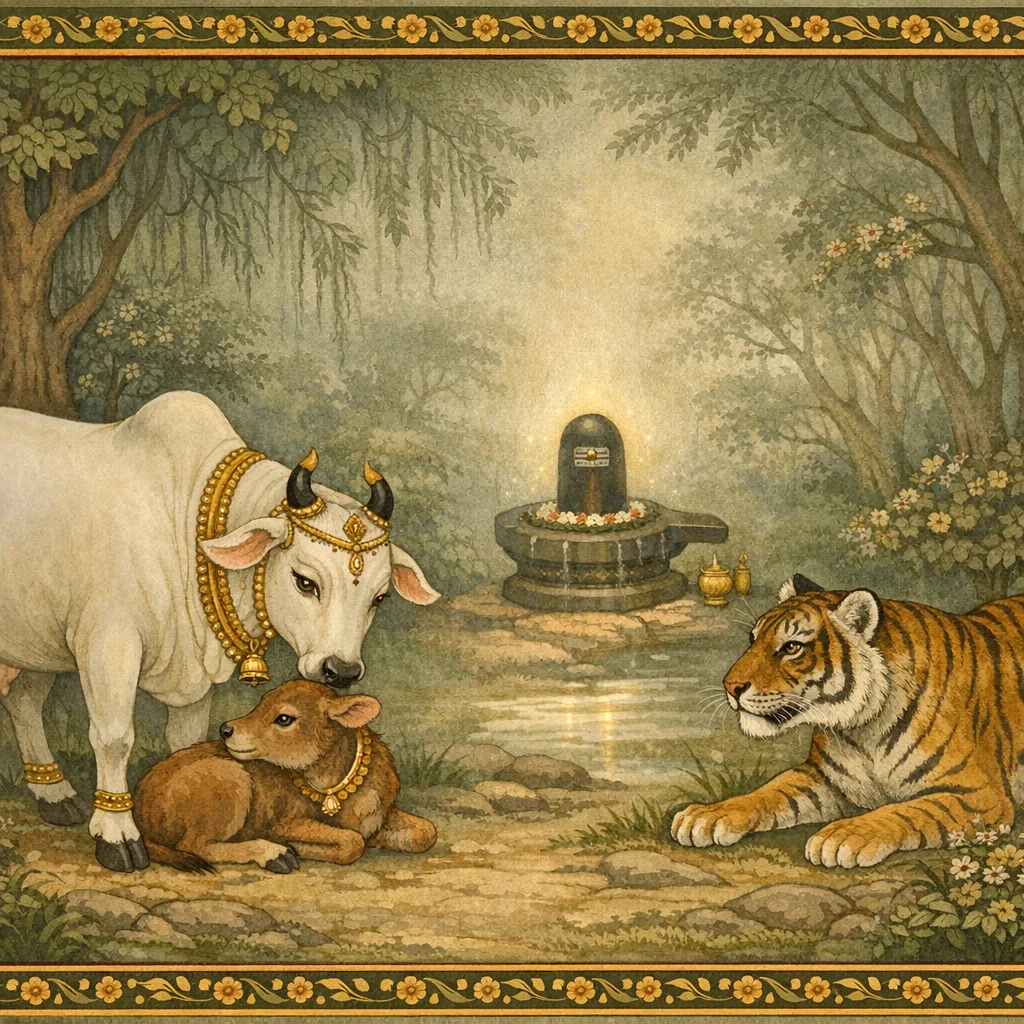
This chapter unfolds an ethical and theological episode in a forest beside a pastoral gokula. A cow named Nandinī, marked by auspicious traits, wanders to the grove’s edge and beholds a radiant Śiva-liṅga, blazing like twelve suns. In steady devotion she stands near it and pours forth abundant milk as snāpana—the ritual bathing of the Liṅga—performed quietly in the wilderness. A fearsome tiger later arrives and sights her. Nandinī grieves not for her own life, but for her calf tethered in the gokula, whose sustenance depends on her return. She begs the tiger for leave to go, feed and entrust the calf, and then come back. The tiger doubts she will return from the “mouth of death.” Nandinī answers with solemn vows grounded in satya (truth): if she does not return, she accepts the defilement of grave sins—brahmahatyā, deceiving parents, impure sexual misconduct, betrayal of trust, ingratitude, harming cows/maidens/brāhmaṇas, wasteful cooking and wrongful meat-eating, breaking vows, falsehood, and malicious speech or violent wrongdoing. The chapter teaches that devotion to Śiva is inseparable from moral integrity: ritual service is confirmed by truthfulness under extreme trial, and vows function as binding ethical instruments within sacred space.
Shlokas
Verse 1
। एवं तस्य नरेन्द्रस्य व्याघ्ररूपस्य कानने । जगाम सुमहान्कालो निघ्नतो विविधान्द्विज
In this manner, while that king—now in the form of a tiger—dwelt in the forest, a very long time passed as he kept slaying various beings, O brāhmaṇa.
Verse 2
कस्यचित्त्वथ कालस्य तस्मिन्देशे द्विजोत्तमाः । आ यातं गोकुलं रम्यं गोपगोपीसमाकुलम्
Then, after some time, O best of brāhmaṇas, there came to that region a delightful cowherd settlement—Gokula—filled with cowherds and cowherd women.
Verse 3
तत्रास्ति नन्दिनीनाम धेनुः पीनपयोधरा । विस्तीर्णजघनाभोगा हंसवर्णा घटस्रवा
There was a cow there named Nandinī, her udders full; broad and well-built in her hindquarters, swan-white in hue, and pouring forth milk as from a pot.
Verse 4
अथ सा निजयूथस्य सदाग्रे तृणवांछया । भ्रममाणा निकुञ्जांते लिंगं देवस्य शूलिनः
Then she, moving at the head of her own herd in search of grass, wandered to the edge of a grove and there encountered the liṅga of the Lord who bears the trident (Śiva).
Verse 5
अपश्यत्तेजसा युक्तं स्वयमेव व्यवस्थितम् । द्वादशार्कप्रतीकाशं चित्ताह्लादकरं परम्
She saw it endowed with radiance, standing established of itself—shining like twelve suns, supreme, and gladdening the mind.
Verse 6
ततस्तस्योपरि स्थित्वा सुस्राव सुमहत्पयः । श्रद्धया परया युक्ता तस्य स्नानकृते द्विजाः
Then, standing over it, she let flow a mighty stream of milk—filled with the highest faith—to bathe it, O brāhmaṇas.
Verse 7
एवं तां स्नपनं तस्य सदा लिंगस्य कुर्वतीम् । न जानाति जनः कश्चिद्वने वृक्षसमाकुले
Thus, as she continually performed that bathing of the liṅga, no one at all knew of it in that forest thick with trees.
Verse 8
अन्यस्मिन्दिवसे तत्र स्थाने व्याघ्रः समागतः । तीक्ष्णदंष्ट्रो महाकायः सर्वजन्तुभयावहः
On another day, a tiger came to that very spot—sharp-fanged, huge-bodied, and terrifying to all creatures.
Verse 9
अथ सा तत्र आयाता पतिता दृष्टिगोचरे । नन्दिनी द्वीपिनस्तस्य दैवयोगाद्द्विजोत्तमाः
Then Nandinī came there and, by fate’s conjunction, fell within the tiger’s range of sight, O best of brāhmaṇas.
Verse 10
ततः सा गोकुले बद्धं स्मृत्वा स्वं लघुवत्सकम् । अतृणादं पयोवृत्तिं करुणं पर्यदेवयत्
Then she, remembering her little calf tied up in the cow-pen, lamented piteously: the calf—living only on milk and not yet able to graze on grass—would suffer without her.
Verse 11
अद्यैकाहं च संप्राप्ता कानने जनवर्जिते । पुत्रं बालं परित्यज्य गोपैर्गोष्ठे नियंत्रितम्
‘Today I have come here alone into this people-forsaken forest, leaving behind my young child, kept confined in the cow-pen by the cowherds.’
Verse 12
येन सत्येन भक्त्याद्य स्नपनायाहमागता । शिवस्य तेन सत्येन भूयान्मे सुतसंगमः
‘By that truth—by which, out of devotion, I have come today to bathe at this sacred place for Śiva—by that very truth, may reunion with my child be granted to me again.’
Verse 13
एवं सा करुणं यावन्नन्दिनी विलपत्यलम् । तावद्व्याघ्रः स्मितं कृत्वा प्रोवाच परुषाक्षरम्
As Nandinī wailed in deep compassion, the tiger, smiling, spoke harsh words to her.
Verse 14
व्याघ्र उवाच । प्रलापान्किं मुधा धेनो करोषि वशगा मम । तस्मादिष्टतमं देवं स्मर स्वर्गकृते शुभे
The tiger said: “Why do you prattle in vain, O cow, since you are under my control? Therefore, O auspicious one, remember your most beloved deity—for the sake of heaven.”
Verse 15
धेनुरुवाच । नाहमात्मकृते व्याघ्र विलपामि सुदुः खिता । शिवार्चनकृते मृत्युर्मम जातः शुभावहः
The cow said: “O tiger, I do not lament for my own sake, though I am deeply distressed. If death has come to me in connection with worship of Śiva, it is surely auspicious.”
Verse 16
वत्सो मे गोकुले बद्धः स्मरमाणो ममागमम् । सन्तिष्ठते पयोवृत्तिः कथं स्यात्स मया विना
“My calf is tied in the cowshed, thinking of my return. It lives only by milk—how could it survive without me?”
Verse 17
एतस्मात्कारणाद्व्याघ्र विलपामि सुदुःखिता । न चात्मजीवनार्थाय सत्येनात्मानमालभे
“For this reason, O tiger, I lament in great sorrow. And I will not, for the sake of my own life, violate truth by bargaining with myself dishonestly.”
Verse 18
तस्मान्मुंच महाव्याघ्र मां सद्यः सुतवत्सलाम् । सखीजनस्य तं दत्त्वा समागच्छामि तेंतिकम्
Therefore, O great tiger, release me at once—I am devoted to my child. Having entrusted him to my female companions, I shall return and come back to you.
Verse 19
व्याघ्र उवाच । कथं मृत्युमुखं प्राप्य निष्क्रम्य च कथञ्चन । भूयस्तत्रैव निर्यासि तस्मात्त्वां भक्षयाम्यहम्
The tiger said: “Having reached the very mouth of death, how could you somehow get away and then go back there again? Therefore, I shall eat you.”
Verse 20
नन्दिन्युवाच । शपथैरागमिष्यामि यैः पुनर्व्याघ्र तेंऽतिकम् । तानाकर्णय मे वक्त्रात्ततो युक्तं समाचर
Nandinī said: “O tiger, I shall return to you again, bound by solemn oaths. Hear those vows from my own mouth; then do what is proper and fitting.”
Verse 21
यत्पापं ब्रह्महत्यायां मातापित्रोश्च वंचने । तेन पापेन लिप्येहं नागच्छामि पुनर्यदि
“Whatever sin lies in brahmin-slaying, and whatever sin lies in deceiving one’s mother and father—may I be stained by that sin here, if I do not return again.”
Verse 22
विवस्त्रं स्नानसक्तानां दिवामैथुनगामिनाम् । यत्पापं तेन लिप्येऽहं नागच्छामि पुनर्यदि
“Whatever sin belongs to those who are attached to bathing while unclothed, and to those who indulge in sexual union by day—may I be stained by that sin if I do not return again.”
Verse 23
रजस्वलानुसक्तानां यत्पापं नग्नशायिनाम् । तेन पापेन लिप्येऽहं नागच्छामि पुनर्यदि
Whatever sin belongs to those who consort with a menstruating woman, and whatever sin belongs to those who lie down naked—may I be stained by that sin if I do not return again.
Verse 24
विश्वासघातकानां च कृतघ्नानां च यद्भवेत् । तेन पापेन लिप्येऽहं नागच्छामि पुनर्यदि
Whatever sin accrues to betrayers of trust, and whatever sin accrues to the ungrateful—may I be stained by that sin if I do not return again.
Verse 25
गोकन्याब्राह्मणानां च दूषकानां च यद्भवेत् । तेन पापेन लिप्येऽहं नागच्छामि पुनर्यदि
Whatever sin belongs to those who violate or defile cows, maidens, and brāhmaṇas—may I be stained by that sin if I do not return again.
Verse 26
वृथापाकप्रकर्तृणां वृथामांसाशिनां च यत् । तेन पापेन लिप्येऽहं नागच्छामि पुनर्यदि
Whatever sin belongs to those who cook food in vain (without dharmic purpose), and whatever sin belongs to those who eat meat in vain—may I be stained by that sin if I do not return again.
Verse 27
व्रतभंगप्रकर्तृणामनृतौ गामिनां च यत् । तेन पापेन लिप्येऽहं नागच्छामि पुनर्यदि
Whatever sin belongs to those who break vows, and whatever sin belongs to those who resort to falsehood—may I be stained by that sin if I do not return again.
Verse 28
पैशुन्यसूचकानां च यत्पापं शस्त्रकर्मणाम् । तेन पापेन लिप्येऽहं नागच्छामि पुनर्यदि
Whatever sin belongs to slanderers and informers, and whatever sin belongs to those who live by violent weapons—may I be stained by that sin if I do not return again.