Adhyaya 46
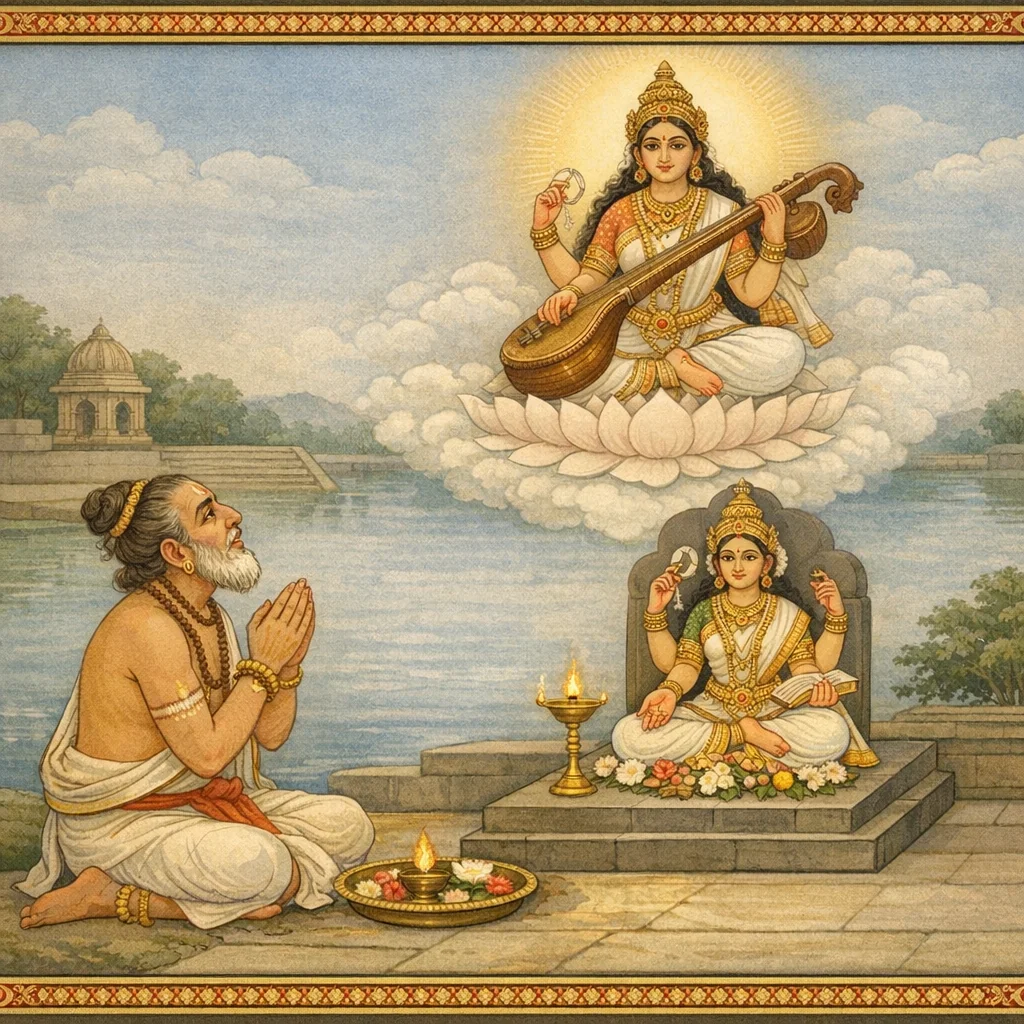
The chapter begins with sages asking Sūta for a fuller, orderly account of the tīrthas. Sūta then extols the eminent Sārasvata tīrtha, declaring that bathing there can turn even one with impaired speech into a discerning speaker and can grant desired aims, even up to exalted worlds. A royal tale follows: King Balavardhana’s son Ambuvīci grows up mute. After the king falls in battle, ministers enthrone the mute child, and the realm descends into turmoil as the strong oppress the weak. Seeking remedy, the ministers consult Vasiṣṭha, who instructs them to have the king bathe at the Sārasvata tīrtha in Hāṭakeśvaraja-kṣetra. Upon bathing, the king immediately regains clear speech. Realizing the river’s power, he fashions a four-armed image of Sarasvatī from clay on the bank, installs it upon a clean stone, and worships with incense and unguents, reciting a long hymn that praises the Goddess as present in speech, intellect, perception, and the many sustaining powers within beings. Sarasvatī manifests, grants a boon, and agrees to abide in the installed image; she promises wish-fulfillment for those who bathe and worship on Aṣṭamī and Caturdaśī, especially with white flowers and disciplined devotion. The phalāśruti adds that devotees gain eloquence and intelligence across births, family lines are protected from folly, hearing dharma before the Goddess yields long heavenly reward, and gifts of learning (books, dharma-texts) and Vedic study in her presence bear fruits equal to great Vedic sacrifices such as the Aśvamedha and Agniṣṭoma.
Shlokas
Verse 1
। ऋषय ऊचुः । अन्यानि तत्र तीर्थानि यानि संति महामते । तानि कीर्तय सर्वाणि परं कौतूहलं हि नः
The sages said: “O great-minded one, what other sacred bathing-places (tīrthas) are there in that region? Recount them all, for our curiosity is keen.”
Verse 2
सूत उवाच । तत्र सारस्वतं तीर्थमन्यदस्ति सुशोभनम् । यत्र स्नातोऽतिमूकोऽपि भवेद्वाक्यविचक्षणः
Sūta said: “There is another splendid sacred place there, called Sārasvata Tīrtha. By bathing there, even one who is exceedingly mute becomes skilled and discerning in speech.”
Verse 3
लभते चेप्सितान्कामान्मानुषान्दैविकानपि । ब्रह्मलोकादिपर्यतांस्तथालोकान्द्विजोत्तमाः
O best of the twice-born, he gains the desired aims—human as well as divine—and attains worlds extending even up to Brahmaloka.
Verse 4
पुरासीत्पार्थिवो ना्ना विख्यातो बलवर्धनः । समुद्रवलयामुर्वीं बुभुजे यो भुजार्जिताम्
In former times there was a renowned king named Balavardhana, who enjoyed the earth girdled by the ocean—won by the strength of his own arms.
Verse 5
तस्य पुत्रः समुत्पन्नः सर्वलक्षणसंयुतः । तस्य नाम पिता चक्रे संप्राप्ते द्वादशेऽहनि । अम्बुवीचिरिति स्पष्टं समाहूय द्विजोत्तमान्
To him a son was born, endowed with every auspicious mark. On the twelfth day the father performed the naming rite, summoning the best of the twice-born and clearly giving the name “Ambuvīci.”
Verse 6
ततः स ववृधे बालो लालितस्तेन भूभुजा । मूकभावं समापन्नो न शक्रोति प्रजल्पितुम्
Thereafter the boy grew up, cherished and nurtured by that king; yet, having fallen into muteness, he was unable to speak at all.
Verse 7
ततोऽस्य सप्तमे वर्षे संप्राप्ते बलवर्धनः । पंचत्वं समनुप्राप्तः संग्रामे शत्रुभिर्हतः
Then, when his seventh year arrived, Balavardhana met his end—slain by enemies in battle, he passed into the state of the five elements.
Verse 8
ततो मूकोऽपि बालोपि मंत्रिभिस्तस्य भूपतेः । स सुतः स्थापितो राज्ये अभावेऽन्यसुतस्य च
Then, though he was mute and still a child, the ministers of that king installed that son upon the throne, since there was no other son.
Verse 9
एवं तस्य महीपस्य राज्यस्थस्य जडात्मनः । बालत्वे वर्तमानस्य राज्यं विप्लवमध्यगात्
Thus, though that king sat in sovereign rule, his mind was dull and he was still in childhood; the kingdom fell into turmoil and disorder.
Verse 10
ततो जलचरन्यायः संप्रवृत्तो महीतले । पीड्यंते सर्वलोकास्तु दुर्बला बलवत्तरैः
Then, upon the earth, the “law of aquatic creatures” prevailed: the strong oppressed the weak, and all people were afflicted.
Verse 11
ततस्ते मंत्रिणः प्रोचुर्वसिष्ठं स्वपुरोहितम् । वचोऽर्थं नृपतेरस्य कुरूपायं महामुने
Then those ministers addressed Vasiṣṭha, their royal priest: “Great sage, devise a remedy for this king’s plight.”
Verse 12
पश्य कृत्स्नं धरापृष्ठे शून्यतां समुपस्थितम् । जडत्वान्नृपतेरस्य तस्मात्कुरु यथोचितम्
“See—across the whole face of the earth a void has arisen; because this king is dull and incapable, therefore do what is fitting.”
Verse 13
ततस्तु सुचिरं ध्यात्वा दीनान्प्रोवाच मंत्रिणः । सर्वानार्तिसमोपेताञ्छृण्वतस्तस्य भूपतेः
Then, after reflecting for a long time, he spoke to the dejected ministers—burdened with every distress—while that king listened.
Verse 14
अस्ति सारस्वतं तीर्थं सर्वकामप्रदं नृणाम् । हाटकेश्वरजे क्षेत्रे तत्रायं स्नातु भूपतिः
There is a sacred tīrtha called Sārasvata, bestowing all desired aims upon people. In the holy region of Hāṭakeśvara, let this king bathe there.
Verse 15
अथ तद्वचनात्सद्यः स गत्वा तत्र सत्वरम् । स्नानात्तीर्थेऽथ संजातस्तत्क्षणात्स कल स्वनः
At those words he went there at once, in haste; and by bathing in that tīrtha, in that very moment his speech became clear and complete.
Verse 16
तत्प्रभावं सरस्वत्याः स विज्ञाय महीपतिः । श्रद्धया परया युक्तो ध्यायमानः सरस्वतीम्
Having understood the mighty spiritual power of Sarasvatī, the king—endowed with supreme faith—began to meditate upon Goddess Sarasvatī.
Verse 17
ततस्तूर्णं समादाय मृत्तिकां स नदीतटात् । चकार भारतीं देवीं स्वयमेव चतुर्भुजाम्
Then, quickly taking clay from the riverbank, he himself fashioned an image of Goddess Bhāratī, four-armed in form.
Verse 18
दधतीं दक्षिणे हस्ते कमलं सुमनोहरम् । अक्षमालां तथान्यस्मिञ्जिततारक वर्चसम्
He fashioned her holding, in a right hand, a most beautiful lotus; and in another hand, a rosary (akṣamālā), radiant with a splendor that outshone the stars.
Verse 19
कमण्डलुं तथान्यस्मिन्दिव्यवारिप्रपूरितम् । पुस्तकं च तथा वामे सर्वविद्यासमुद्भवम्
And in another hand he placed a kamaṇḍalu filled with divine water; and in her left hand, a book—the very source from which all learning arises.
Verse 20
ततो मेध्ये शिलापृष्ठे तां निवेश्य प्रयत्नतः । पूजयामास सद्भक्त्या धूपमाल्पानुलेपनैः
Then, carefully placing her upon a clean stone-surface, he worshipped with true devotion—offering incense and simple unguents.
Verse 21
चकार च स्तुतिं पश्चाच्छ्रद्धापूतेन चेतसा । तदग्रे प्रयतो भूत्वा स्वरेण महता नृपः
Afterwards, with a heart purified by faith, the king—standing attentively before her—offered a hymn of praise in a loud, clear voice.
Verse 22
सदसद्देवि यत्किञ्चिद्बन्धमोक्षात्मकं पदम् । तत्सर्वं गुप्तया व्याप्तं त्वया काष्ठं यथाग्निना
O Goddess, whatever exists—good or ill—whatever state pertains to bondage or liberation: all of it is pervaded by you, hidden within, as fire lies concealed within wood.
Verse 23
सर्वस्य सिद्धिरूपेण त्वं जनस्य हृदि स्थिता । वाचारूपेण जिह्वायां ज्योतीरूपेण चक्षुषि
As the very form of accomplishment, you dwell in the hearts of all; as speech you abide upon the tongue, and as light you abide in the eyes.
Verse 24
भक्तिग्राह्यासि देवेशि त्वमेका भुवनत्रये । शरणागतदीनार्तपरित्राणपरायणे
O Sovereign Goddess, you are attained through devotion alone; you are the One throughout the three worlds—ever intent on protecting those who seek refuge, the poor and the afflicted.
Verse 25
त्वं कीर्तिस्त्वं धृतिर्मेधा त्वं भक्तिस्त्वं प्रभा स्मृता । त्वं निद्रा त्वं क्षुधा कीर्तिः सर्वभूतनिवासिनी
You are fame; you are steadfastness and intelligence; you are devotion, and you are remembered as radiance. You are sleep; you are hunger; you are renown—dwelling within all beings.
Verse 26
तुष्टिः पुष्टिर्वपुः प्रीतिः स्वधा स्वाहा विभावरी । रतिः प्रीतिः क्षितिर्गंगा सत्यं धर्मो मनस्विनी
O Sovereign Goddess, you are Contentment and Nourishment; you are Beauty of form and Love; you are Svadhā (the offering to the ancestors) and Svāhā (the offering to the gods), and the Night. You are Delight and Affection; you are the Earth and the Gaṅgā; you are Truth and Dharma, and the power of a steadfast, discerning mind.
Verse 27
लज्जा शांतिः स्मृतिर्दक्षा क्षमा गौरी च रोहिणी । सिनीवाली कुहू राका देवमाता दितिस्तथा
You are Modesty and Peace; you are Memory and Skill; you are Forbearance. You are Gaurī and Rohiṇī; you are Sinīvālī, Kuhū, and Rākā (the lunar phases), and you are Devamātā, and Diti as well.
Verse 28
ब्रह्माणी विनता लक्ष्मीः कद्रूर्दाक्षायणी शिवा । गायत्री चाथ सावित्री कृषिर्वृष्टिः श्रुतिः कला
You are Brahmāṇī, and Vinatā; you are Lakṣmī and Kadrū; you are Dākṣāyaṇī, Śivā. You are Gāyatrī and also Sāvitrī; you are Agriculture and Rain, you are Śruti (revealed scripture) and every sacred art.
Verse 29
बलानाडी तुष्टिकाष्ठा रसना च सरस्वती । यत्किञ्चित्त्रिषु लोकेषु बहुत्वाद्यन्न कीर्तितम्
O Goddess, you are Balānāḍī, Tuṣṭikāṣṭhā, and Rasānā; you are Sarasvatī herself. Whatever exists in the three worlds—so vast in its abundance—has not been fully named by me.
Verse 30
इंगितं नेंगितं तच्च तद्रूपं ते सुरेश्वरि । गन्धर्वाः किन्नरा देवाः सिद्धविद्याधरोरगाः
O Lady of the Gods, both movement and stillness—indeed that very state—is your form. Gandharvas, Kinnaras, the Devas, Siddhas, Vidyādharas, and Nāgas…
Verse 31
यक्षगुह्यकभूताश्च दैत्या ये च विनायकाः । त्वत्प्रसादेन ते सर्वे संसिद्धिं परमां गताः
Yakṣas, Guhyakas, and Bhūtas, the Daityas, and those Vināyakas as well—all of them, by your grace, have attained the highest fulfillment.
Verse 32
तथान्येऽपि बहुत्वाद्ये न मया परिकीर्तिताः । आराधितास्तु कृच्छ्रेण पूजिताश्च सुविस्तरैः । हरंतु देवताः पापमन्ये त्वं कीर्तिताऽपि च
So too, many others—because they are countless—have not been fully praised by me. Some are propitiated only with hardship and are worshipped with elaborate rites. Let those other deities remove sin; but you—even by being merely praised—do so as well.
Verse 33
एवं स्तुता सा देवेशी भूभुजा तेन भारती । ययौ प्रत्यक्षतां तूर्णं प्राह चेदं सुहर्षिता
Thus praised by that king, the Goddess—Bhāratī, Sovereign Lady—swiftly manifested in visible form, and, filled with joy, spoke these words.
Verse 34
सरस्वत्युवाच । स्तोत्रेणानेन भूपाल भक्त्या सुस्थिरया सदा । परितुष्टास्मि तेनाशु वरं वृणु यथेप्सितम्
Sarasvatī said: O king, by this hymn—and by your devotion, ever firm and steadfast—I am wholly pleased. Quickly choose a boon according to your desire.
Verse 35
राजोवाच । अद्यप्रभृति मद्वाक्यात्त्वया स्थेयमसंशयम् । अत्रार्चायां त्रिलोकेस्मि न्यावत्कीर्तिर्मम स्थिरा
The king said: From today onward, by my word, dwell here without doubt—within this sacred icon—throughout the three worlds, for as long as my fame endures.
Verse 36
यस्त्वामाराधयेत्सम्यगत्रस्थां मन्निमित्ततः । भक्त्यानुरूपमेवाशु तस्मै देयं त्वया हि तत्
Whoever worships you properly here, in this very place, for my sake—grant that person swiftly the boon that accords with their devotion.
Verse 37
सरस्वत्युवाच । यो मामत्र स्थितां नित्यं स्नात्वाऽत्र सलिले शुभे । अष्टम्यां च चतुर्दश्यां पूजयिष्यति मानवः
Sarasvatī said: Whoever, after bathing daily in the auspicious waters here, worships me as I abide in this place—especially on the eighth and the fourteenth lunar days—
Verse 38
तस्याहं वांछितान्कामान्संप्रदास्यामि पार्थिव । सूत उवाच । एवं तत्र स्थिता देवी स्वयमेव सरस्वती
To that person, O king, I shall bestow the wishes they desire. Sūta said: Thus the goddess Sarasvatī herself remained established there, in that sacred place.
Verse 39
ततःप्रभृति लोकानां हिताय परमेश्वरी । अष्टम्यां च चतुर्दश्यामुपवासपरायणः
From that time onward, for the welfare of the worlds, the Supreme Goddess ordained this observance: on the eighth and the fourteenth lunar days, one should be devoted to fasting.
Verse 40
यस्तां पूजयते मर्त्यः श्वेतपुष्पानुलेपनैः । स स्याद्वाग्ग्मी सुमेधावी सदा जन्मनिजन्मनि
Any mortal who worships her with white flowers and fragrant unguents becomes eloquent and keen-minded, in every birth, again and again.
Verse 41
सरस्वत्याः प्रसादेन जायमानः पुनःपुनः । अन्वयेऽपि न तस्यैव कश्चिन्मूर्खः प्रजायते
By the grace of Sarasvatī, even when one is born again and again, in that person’s lineage no fool is ever born.
Verse 42
यो धर्मश्रवणं तस्याः पुरतः कुरुते नरः । स नूनं वसति स्वर्गे तत्प्रभावाद्युगत्रयम्
Whoever performs the hearing of dharma in her presence surely dwells in heaven, by that power, for three yugas.
Verse 43
विद्यादानं नरो यश्च तस्या ह्यायतने सदा । करोति श्रद्धया युक्तः सोऽश्वमेधफलं लभेत्
And any person who, endowed with faith, regularly gives the gift of learning at her sacred abode attains the merit of the Aśvamedha sacrifice.
Verse 44
यो यच्छति द्विजेन्द्राय धर्मशास्त्रसमुद्भवम् । पुस्तकं वाजिमेधस्य स समग्रं फलं लभेत्
Whoever offers to a foremost brāhmaṇa a book born of the Dharmaśāstra tradition shall obtain the complete fruit of the Vājimedha sacrifice.
Verse 458
यो वेदाध्ययनं तस्याः करोति पुरतः स्थितः । सोऽग्निष्टोमस्य यज्ञस्य कृत्स्नं फलमवाप्नुयात्
Whoever, standing in her presence, recites and studies the Veda shall attain the full fruit of the Agniṣṭoma sacrifice.