Adhyaya 39
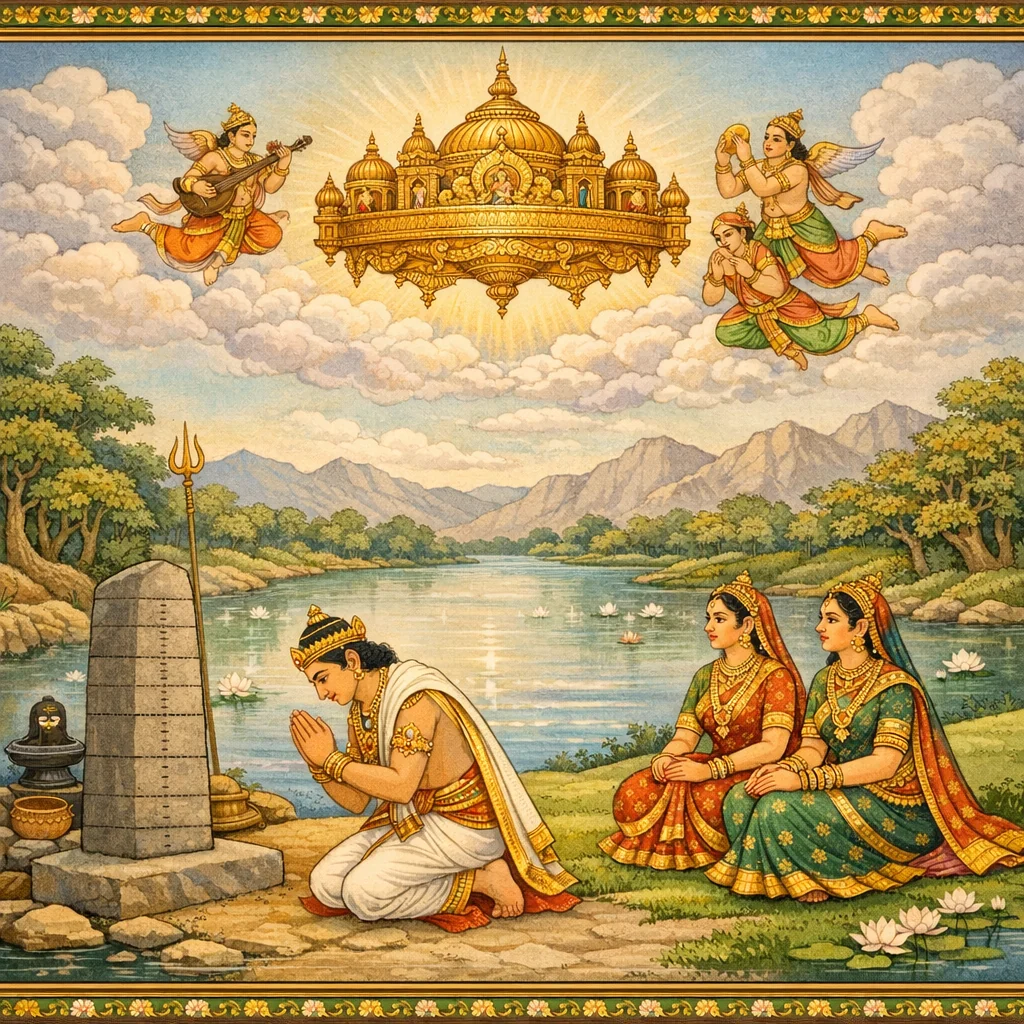
Told through Sūta’s narration, this chapter highlights a sacred kṣetra north of Dhundhumāreśvara where King Yayāti establishes an “excellent liṅga.” His queens, Devayānī and Śarmiṣṭhā, are expressly linked with the rite, and the liṅga is praised as granting the fruit of all desires (sarva-kāma-phala). When Yayāti becomes satiated with worldly enjoyments, he hands sovereignty to his son and seeks a higher good. In humility he approaches the sage Mārkaṇḍeya, requesting a discerning account of the most principal and purifying among all tīrthas and kṣetras. Mārkaṇḍeya declares Cāmatkārapura to be a kṣetra “adorned by all tīrthas,” where the Gaṅgā, as Viṣṇupadī, removes sin and divine presences are said to abide. A further sacred marker is given: a stone measuring fifty-two hastas, released by Pitāmaha for the delight of the twice-born, along with the principle of intensified merit—what is achieved elsewhere in a year is attained there even in a day. Following this, Yayāti journeys with his queens, consecrates a liṅga of Śiva (Śūlin), worships with faith, and ascends to heaven in a splendid vimāna, praised by kinnara and cāraṇa, radiant like twelve suns—forming the chapter’s phala conclusion.
Shlokas
Verse 1
। सूत उवाच । तस्यैवोत्तरदिग्भागे धुन्धुमारेश्वरस्य च । ययातिना नरेंद्रेण स्थापितं लिंगमुत्तमम्
Sūta said: In its northern quarter—near Dhundhumāreśvara—King Yayāti established an excellent Śiva-liṅga.
Verse 2
देवयान्या तथान्यच्च तथा शर्मिष्ठया द्विजाः । भार्यया भूपतेस्तस्य सर्वकामफलप्रदम्
O twice-born ones, that Liṅga was also established by Devayānī and likewise by Śarmiṣṭhā—the king’s queens—granting the fruit of all desired aims.
Verse 3
स यदा सर्वभोगानां तृप्तिं प्राप्तो द्विजोत्तमाः । तदा पुत्रस्य राज्यं स्वं वपुश्चैव न्यवेदयत्
O best of the twice-born, when he had become satisfied with every enjoyment, he then handed over his own kingdom to his son—and even surrendered his body, entering the path of renunciation.
Verse 4
जरामादाय तद्गात्राद्भार्याभ्यां सहितस्तदा । पप्रच्छ विनयोपेतो मार्कंडं मुनिसत्तमम्
Then, taking old age upon his own limbs, and accompanied by his two queens, he respectfully questioned Śrī Mārkaṇḍeya, the foremost of sages.
Verse 5
भगवन्सर्वतीर्थानां क्षेत्राणां च वदस्व मे । यत्प्रधानं पवित्रं यत्तदस्माकं प्रकीर्तय
O Blessed One, tell me of all tīrthas and all holy kṣetras; proclaim to us which among them is foremost and which is most purifying.
Verse 6
श्रीमार्कंडेय उवाच । क्षेत्राणामिह सर्वेषां तीर्थैः सर्वैरलंकृतम् । चमत्कारपुरं क्षेत्रं सांप्रतं प्रतिभाति नः
Śrī Mārkaṇḍeya said: Among all the sacred regions here, adorned with every tīrtha, the holy field called Camatkārapura now shines to us as preeminent.
Verse 7
यत्र विष्णुपदी गंगा जंतूनां पापनाशिनी । स्वयं स्थिता नृपश्रेष्ठ तथा देवा हरादयः
O best of kings, there the Gaṅgā—Viṣṇupadī, born from Viṣṇu’s foot—abides of her own accord, destroying the sins of all beings; and there too dwell the gods, beginning with Hara (Śiva).
Verse 8
तथान्यानि च तीर्थानि यानि संति धरातले । तेषां यत्र च सांनिध्यं सर्वदा नृपसत्तम
O best of kings, all other tīrthas that exist upon the earth also abide there in constant proximity.
Verse 9
शिला यत्र द्विपञ्चाशद्धस्तानां परिसंख्यया । पितामहेन निर्मुक्ता प्रमोदाय द्विजन्मनाम्
There is a stone there, fifty-two cubits in measure, released by Pitāmaha (Brahmā) for the delight of the twice-born.
Verse 10
यदन्यत्र शुभं कर्म वर्षेणैकेन सिध्यति । तत्तत्र दिवसेनापि सिद्धिं याति क्षितीश्वर
O lord of the earth, whatever auspicious act is accomplished elsewhere in a single year—there attains success even in a single day.
Verse 11
तस्मात्तत्र द्रुतं गत्वा तपः कुरु महीपते । येन प्राप्स्यसि चित्तस्थांल्लोकान्भार्यासमन्वितः
Therefore, O king, go there at once and undertake austerity—by which you will attain the worlds you hold in your heart, together with your wife.
Verse 12
तस्य तद्वचनं श्रुत्वा स राजा नहुषात्मजः । चमत्कारपुरे क्षेत्रे भार्याभ्यां सहितो ययौ
Hearing those words, that king—the son of Nahuṣa—departed for the sacred field at Camatkārapura, accompanied by his two wives.
Verse 13
ततः संस्थाप्य तल्लिंगं देवदेवस्य शूलिनः । सम्यगाराधयामास श्रद्धया परया युतः
Then, after installing that liṅga of Śūlin, the God of gods, he worshipped with due rites—endowed with the highest faith.
Verse 14
ततस्तस्य प्रभावेन भार्याभ्यां सहितो नृपः । विमानवरमारूढो जगाम त्रिदिवालयम्
By the power of that sacred act, the king—together with his two wives—mounted a splendid celestial chariot and went to the heavenly abode.
Verse 15
किन्नरैर्गीयमानश्च स्तूयमानश्च चारणैः । स्पर्द्धमानः समं देवैर्द्वादशार्कसमप्रभः
Sung by the Kinnaras and praised by the Cāraṇas, he shone with the radiance of twelve suns, as though rivaling even the gods.