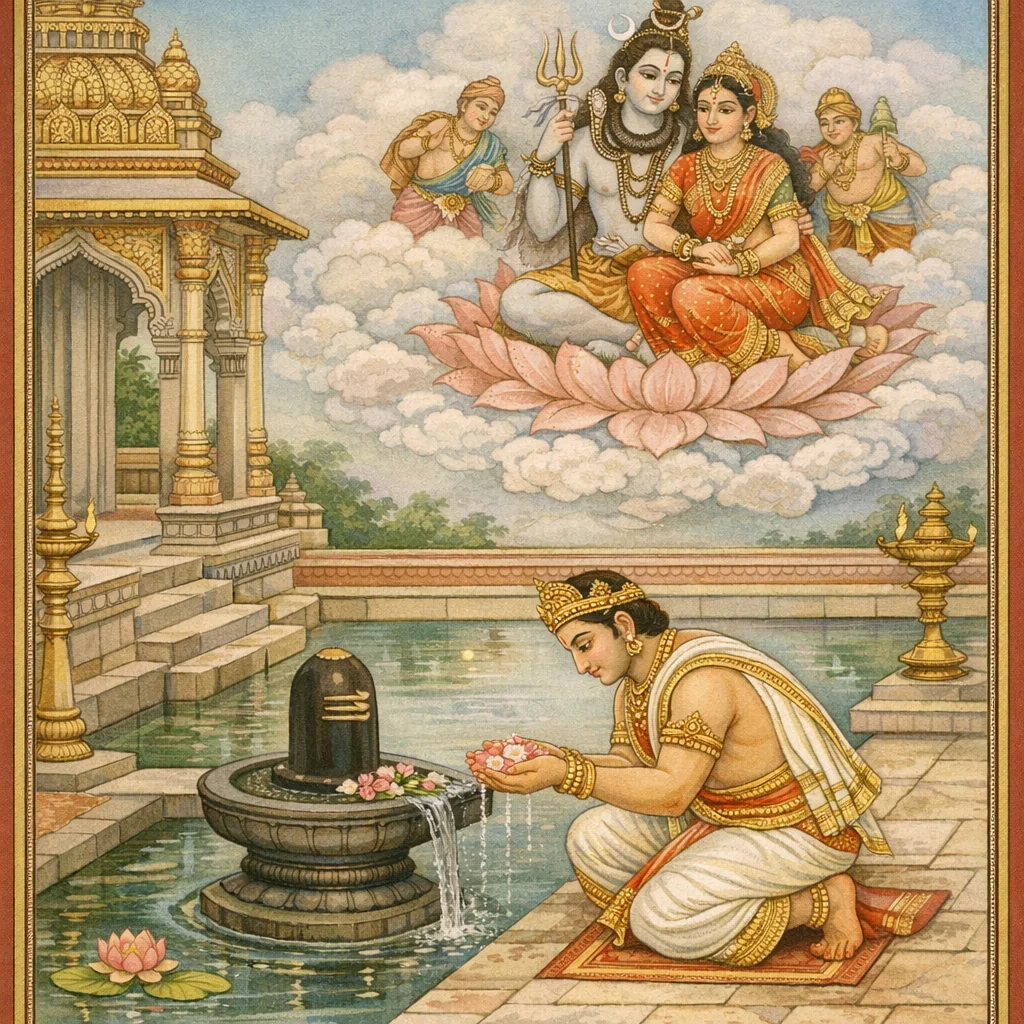
Adhyaya 38
Chapter 38 is framed as a Sūta–ṛṣi dialogue preserving the sanctification of a particular Śaiva sacred place. King Dhundhumāra installs a liṅga, commissions a gem-adorned prāsāda, and performs severe tapas in a nearby āśrama. A vāpī (pond/well) is also established close by, praised as pure, auspicious, and equal to all tīrthas. A phalaśruti follows: one who bathes there and beholds Dhundhumāreśvara does not face the “durgas,” the harsh hardships of hell-realms within Yama’s domain. In response to the ṛṣis’ questions, Sūta states the king’s Sūryavaṃśa lineage, his link with the epithet Kuvalayāśva, and how his fame arose from slaying the daitya Dhundhu in the Maru region. The narrative culminates in Śiva’s direct manifestation with Gaurī and the gaṇas, granting a boon. The king asks for Śiva’s perpetual presence in the liṅga; Śiva grants it and highlights Caitra śukla caturdaśī as a specially significant day. The chapter closes by reaffirming that snāna and pūjā at the liṅga lead to Śiva’s loka, and that the king abides there, oriented toward liberation.
Shlokas
Verse 1
। सूत उवाच । तत्रैव स्थापितं लिंगं धुन्धुमारेण भूभुजा । सर्वरत्नमयं कृत्वा प्रासादं सुमनोहरम्
Sūta said: There itself, the king Dhundhumāra installed a liṅga, and he built a most enchanting temple, fashioned of every kind of jewel.
Verse 2
तत्र कृत्वाऽश्रमं श्रेष्ठं तपस्तेपे सुदारुणम् । यत्प्रभावादयं देवस्तस्मिंल्लिङ्गे व्यवस्थितः
There, having made an excellent hermitage, he performed very severe austerities; by the power of that, this Deva abides established in that liṅga.
Verse 3
तस्य संनिहिता वापी कृता तेन महात्मना । सुनिर्मलजलापूर्णा सर्वतीर्थोपमा शुभा
Near it, that great-souled one made a stepwell, filled with very pure water—auspicious, and comparable to all tīrthas.
Verse 4
धुन्धुमारेश्वरं पश्येत्तत्र स्नात्वा नरोत्तमः । न स पश्यति दुर्गाणि नरकाणि यमालये
Having bathed there, the best of men should behold Dhundhumāreśvara; he does not behold the dreadful hells in Yama’s abode.
Verse 5
ऋषय ऊचुः । धुंधुमारो महीपालः कस्मिन्वंशे बभूव सः । कस्मिन्काले तपस्तप्तं तेनात्र सुमहात्मना
The sages said: ‘King Dhundhumāra—of what lineage was he? And in what period did that great-souled one perform austerities here?’
Verse 6
सूत उवाच । सूर्यवंशसमुद्भूतो बृहदश्वसुतो बली । ख्यातः कुवलयाश्वेति धंधुमारस्तथैव सः
Sūta said: From the Solar dynasty was born the mighty son of Bṛhadaśva, renowned by the name Kuvalayāśva; he was also known as Dhundhumāra.
Verse 7
तेन धुन्धुर्महादैत्यो निहतो मरुजांगले । धुन्धुमारः स्मृतस्तेन विख्यातो भुवनत्रये
By him the great demon Dhundhu was slain in the desert wilderness; therefore he is remembered as Dhundhumāra, famed throughout the three worlds.
Verse 8
चमत्कारपुरं क्षेत्रं स गत्वा पावनं महत् । तपस्तेपे वयोंऽते च ध्यायमानो महेश्वरम्
He went to the holy field of Camatkārapura, a greatly purifying place, and there—toward the end of his life—he practiced austerities, meditating upon Maheśvara.
Verse 9
संस्थाप्य सुमहल्लिंगं प्रासादे रत्नमंडिते । बलिपूजोपहाराद्यैः पुष्पधूपानुलेपनैः
Having installed a most magnificent Liṅga in a palace-temple adorned with jewels, he worshiped with offerings and ritual honors—flowers, incense, and fragrant unguents.
Verse 10
ततस्तस्य महादेवः स्वयमेव महेश्वरः । प्रत्यक्षोऽभूद्वृषारूढो गौर्या सह तथा गणैः
Then Maheśvara—Mahādeva himself—became manifest before him, mounted upon the bull, together with Gaurī and his attendant gaṇas.
Verse 11
उवाच वरदोऽस्मीति प्रार्थयस्व यथेप्सितम् । सर्वं तेऽहं प्रदास्यामि यद्यपि स्यात्सुदुर्लभम्
He said, “I am the giver of boons—ask for whatever you desire. I shall grant you everything, even if it be exceedingly difficult to obtain.”
Verse 12
धुन्धुमार उवाच । यदि देयो वरोऽस्माकं त्वया सर्वसुरेश्वर । संनिधानं प्रकर्तव्यं लिंगेऽस्मिन्वृषभध्वज
Dhundhumāra said: “If you are to grant me a boon, O Lord of all the gods—O Bull-bannered One—then establish your abiding presence in this Liṅga.”
Verse 13
श्रीभगवानुवाच । चैत्रे शुक्लचतुर्दश्यां सांनिध्यं नृपसत्तम । अहं सदा करिष्यामि गौर्या सार्धं न संशयः
The Blessed Lord said: “On the bright fourteenth day of the month of Caitra, O best of kings, I shall indeed maintain my special presence—always—together with Gaurī; of this there is no doubt.”
Verse 14
तत्र वाप्यां नरः स्नात्वा यो मां संपूजयिष्यति । लिंगेऽस्मिन्संस्थितं भूप मम लोकं स यास्यति
There, whoever bathes in the sacred tank and worships me—who am established in this Liṅga, O king—shall go to my world.
Verse 15
सूत उवाच । एवमुक्त्वा स भगवांस्ततश्चादर्शनं गतः । सोऽपि राजा प्रहृष्टा त्मा स्थितस्तत्रैव मुक्तिभाक्
Sūta said: Having spoken thus, the Blessed Lord then vanished from sight. That king too, rejoicing in his heart, remained there itself—one who attained liberation.