Adhyaya 35
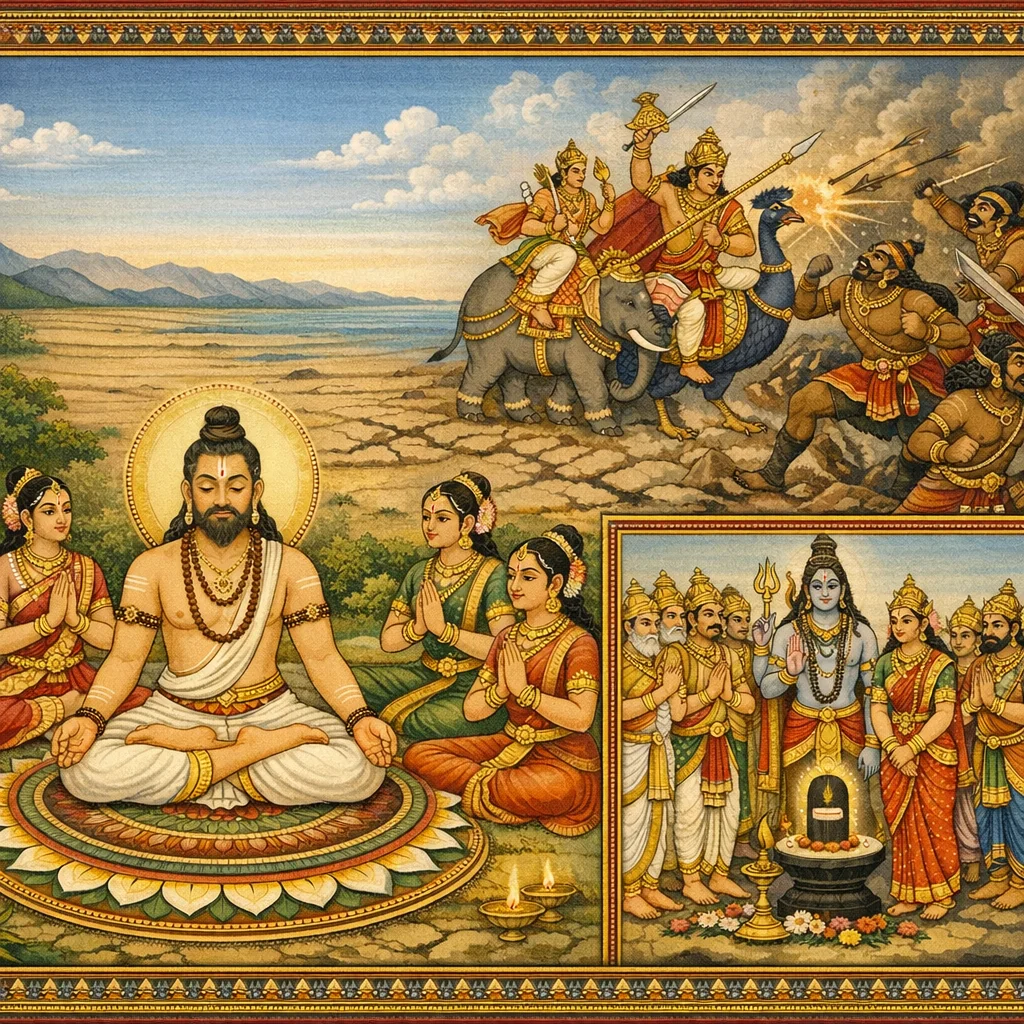
The chapter describes a crisis caused by the Kāleya daityas who, taking refuge in the ocean, pursue dharma-destruction: by night they assault ascetics, yajña-performers, and dharma-minded communities, collapsing ritual life across the earth. Deprived of their yajña-shares, the devas fall into distress and realize the foe cannot be confronted while shielded by the sea. They therefore seek Ṛṣi Agastya and find him in the sacred field of Cāmatkārapura. Agastya receives them with reverence and agrees to dry up the ocean at the year’s end through vidyā-bala and Yoginī-associated power. He ritually establishes pīṭhas, worships the Yoginī groups (especially their maiden-forms), honors the guardians of the directions and the kṣetra-pālas, and propitiates an aerial-moving deity identified with a “drying” vidyā. When success is granted, Agastya asks the deity to enter his mouth, enabling him to drink the ocean. With the ocean turned land-like, the devas defeat the exposed daityas; the survivors flee underground. Asked to restore the waters, Agastya explains that the ocean will be refilled in the future, prophetically linking this to King Sagara, the digging of his sixty-thousand sons, and Bhagiratha’s bringing of the Gaṅgā, whose flow will replenish the sea. Finally, Agastya requests that the gathered pīṭhas remain permanently in Cāmatkārapura; worship on aṣṭamī and caturdaśī grants desired results. The devas affirm this, name a pīṭha “Citreśvara,” and promise swift attainment of aims even for those bearing moral burden, within the chapter’s theological-ritual frame.
Shlokas
Verse 1
। सूत उवाच । एवं तेषु प्रभग्नेषु हतेषु च सुरोत्तमाः । प्रहृष्टमनसः सर्वे स्तुत्वा देवं महेश्वरम्
Sūta said: Thus, when they were routed and slain, all the foremost gods, their minds filled with joy, praised the Lord Maheśvara.
Verse 2
तेनैव चाथ निर्मुक्ताः प्रणम्य च मुहुर्मुहुः । स्वंस्वं स्थानमथाजग्मुः शक्रविष्णुपुरःसराः
Released by him, they bowed again and again in reverence; then, led by Śakra (Indra) and Viṣṇu, they returned each to their own proper abodes.
Verse 3
तेऽपि दानवशार्दूला हताशाश्च सुरोत्तमैः । मंत्रं प्रचक्रिरे सर्वे नाशाय त्रिदिवौकसाम्
Those tiger-like Dānavas too—their hopes shattered by the foremost of the gods—collectively devised a mantra, intent on bringing about the destruction of the dwellers of the three heavens.
Verse 4
तेषां मंत्रयतामेष निश्चयः समपद्यत । नान्यत्र धर्मविध्वंसाद्देवानां जायते क्षयः
As they deliberated together, this firm conclusion was reached: the decline of the gods arises from nothing else but the destruction of dharma.
Verse 5
तस्मात्तपस्विनो यै च ये च यज्ञपरायणाः । तथान्ये निरता धर्मे निहन्तव्या निशागमे
Therefore, ascetics, those devoted to sacrifice, and others steadfast in Dharma must be slain at nightfall.
Verse 6
एवं ते निश्चयं कृत्वा निष्क्रम्य वरुणालयात् । रात्रौ सदैव निघ्नंति जनान्धर्मपरायणान्
Having resolved thus, they emerged from Varuṇa's abode and continually struck down the Dharma-devoted people at night.
Verse 7
यत्र यत्र भवेद्यज्ञः सत्रं ऽप्युत्सवोऽथवा । तत्र गत्वा निशायोगे प्रकुर्वंति जनक्षयम्
Wherever a sacrifice, a long session, or a festival was held, they went there at nightfall and carried out the slaughter of people.
Verse 8
तैः प्रसूता मखा ध्वस्ता दीक्षिता विनिपातिताः । ऋत्विजश्च तथान्येऽपि सामान्या द्विजसत्तमाः
Sacrifices were ruined by them; the initiated were struck down. The priests and other noble Brahmins were also destroyed.
Verse 9
आश्रमे मुनिमुख्यस्य शांडिल्यस्य महात्मनः । सहस्रं ब्राह्मणेंद्राणां भक्षितं तैर्दुरात्मभिः
In the hermitage of the great-souled Sage Śāṇḍilya, a thousand eminent Brahmins were devoured by those wicked beings.
Verse 10
शतानि च सहस्राणि निहतानि द्विजन्मनाम् । विश्वामित्रस्य पञ्चैव सप्तात्रेश्चैव धीमतः
Hundreds and thousands of the twice-born (Brāhmaṇas) were slain—five by Viśvāmitra, and seven also by Ātreya, the wise son of Atri.
Verse 11
एतस्मिन्नेव काले तु समस्तं धरणीतलम् । नष्टयज्ञोत्सवं जातं कालेयभयपीडितम्
Just at that very time, the whole surface of the earth was bereft of the festive joy of sacrifice (yajña), oppressed by fear of the Kāleyas.
Verse 12
न कश्चिच्छयनं रात्रौ प्रकरोति मही तले । धृतायुधा जनाः सर्वे तिष्ठंति सह तापसैः
At night, no one lies down to sleep upon the ground. All the people, weapons in hand, keep watch together with the ascetics.
Verse 13
रात्रौ स्वपंति ये केचिद्विश्वस्ता धर्मभाजनाः । तेषामस्थीनि दृश्यंते प्रातरेव हि केवलम्
Those who, trusting in safety though worthy of dharma, fall asleep at night—by morning, only their bones are seen.
Verse 14
अथ देवगणाः सर्वे यज्ञभागविनाकृताः । प्रजग्मुः परमामार्ति ब्रह्मविष्णुपुरस्सराः
Then all the hosts of gods, deprived of their shares in sacrifice, were plunged into extreme distress—led by Brahmā and Viṣṇu.
Verse 15
ततो गत्वा समुद्रांतं वधाय सुरविद्विषाम् । न शेकुर्विषमस्थांस्तान्मनसापि प्रधर्षितुम्
Then they went to the ocean’s edge to destroy the enemies of the gods, yet they could not assail those foes, entrenched in a perilous position—not even in thought.
Verse 16
ततः समुद्रनाशाय मंत्रं चक्रुः सुदुःखिताः । तस्मिन्नष्टे भवन्त्येव वध्या दानवसत्तमाः
Then, in grievous sorrow, they fashioned a mantra to destroy the ocean; for when it is gone, even the foremost of the Dānavas become slayable.
Verse 17
अगस्त्येन विना नैष शोषं यास्यति सागरः । तस्मात्संप्रार्थयामोत्र कृत्ये गत्वा मुनीश्वरम्
Without Agastya, this ocean will not dry up. Therefore, for this task, let us go and earnestly petition that lord of sages.
Verse 18
चमत्कारपुरे क्षेत्रे स तिष्ठति च सन्मुनिः । तस्मात्तत्रैव गच्छामो येन गच्छति सत्वरम्
That noble sage dwells in the holy region of Camatkārapura. Therefore, let us go there at once, so that he may proceed swiftly (to accomplish the work).
Verse 19
एवं निश्चित्य ते सर्वे त्रिदशास्तस्य चाश्रमम् । संप्राप्ता मुनिमुख्यस्य मित्रावरुण जन्मनः
Having thus resolved, all those gods reached his hermitage—the abode of that foremost sage, born of Mitra and Varuṇa.
Verse 20
सोऽपि सर्वान्समालोक्य संप्राप्तान्सुरसत्तमान् । प्रहृष्टः सम्मुखस्तूर्णं जगामातीव सन्मुनिः
He too, beholding all those most excellent gods who had arrived, was filled with delight; and that noble sage swiftly went forth to meet them face to face.
Verse 21
प्रोवाच प्रांजलिर्वाक्यं हर्ष गद्गदया गिरा । ब्रह्मादींस्तान्सुरान्दृष्ट्वा विस्मयोत्फुल्ललोचनः
With hands folded in reverence, he spoke words in a voice choked with joy; seeing those gods headed by Brahmā, his eyes widened in wonder.
Verse 22
चमत्कारपुरं क्षेत्रमेतन्मेध्यमपि स्थितम् । भूयो मेध्यतरं जातं युष्माकं हि समाश्रयात्
This sacred field called Cāmatkārapura is indeed pure and auspicious. Yet by your very presence and by your taking refuge here, it has become even more sanctified than before.
Verse 23
तस्माद्वदत यत्कृत्यं मया संसिद्ध्यतेऽधुना । तत्सर्वं प्रकरिष्यामि यद्यपि स्यात्सुदुष्करम्
Therefore, tell me what duty is to be accomplished now through me. I shall undertake and complete it all—even if it is exceedingly difficult.
Verse 24
देवा ऊचुः । कालेया इति दैत्या ये हतशेषाः सुरैः कृताः । ते समुद्रं समाश्रित्य निघ्नंति शुभकारिणः
The gods said: “Those Daitiyas known as the Kāleyas, who survived after being struck down by the Devas, have taken refuge in the ocean; from there they slay those who work for auspiciousness and the welfare of the world.”
Verse 25
शुभे नाशमनुप्राप्ते ध्रुवं नाशो दिवौकसाम् । तस्मात्तेषां वधार्थाय त्वं शोषय महार्णवम्
If auspiciousness is destroyed, then surely the ruin of the dwellers in heaven follows. Therefore, in order to slay them, dry up the great ocean.
Verse 26
येन ते गोचरं प्राप्ता दृष्टेर्दानवसत्तमाः । बध्यंते विबुधैः सर्वे जायंते च मखा इह
So that those foremost among Dānavas come within the range of sight and perception; then all of them can be bound by the gods, and sacrifices may flourish here once again.
Verse 27
अगस्त्य उवाच । अहं संवत्सरस्यांते शोषयिष्यामि सागरम् । विद्याबलं समाश्रित्य योगिनीनां सुरोत्तमाः
Agastya said: ‘At the end of a year I shall dry up the ocean, relying upon the power of sacred knowledge—O best among the gods—(and) the yogic might of the yoginīs.’
Verse 28
तस्माद्व्रजत हर्म्याणि यूयं याति हि वत्सरम् । यावद्भूयोऽपि वर्षांते कार्यमागमनं ध्रुवम्
Therefore, go back to your palaces; a full year will pass. Then, at the year’s end, you must surely return again for what is to be done.
Verse 29
ततो मया समं गत्वा शोषिते वरुणालये । हंतव्या दानवा दुष्टा हन्त यैः पीड्यते जगत्
Then, coming together with me when Varuṇa’s abode (the ocean) has been dried up, those wicked Dānavas must be slain—by whom the world is tormented.
Verse 30
ततो देवगणाः सर्वे गताः स्वेस्वे निकेतने । अगस्त्योऽपि समुद्योगं चक्रे विद्यासमुद्भवम्
Then all the hosts of the gods returned to their own abodes. Agastya too set his hand to his undertaking—an effort born of the power of sacred knowledge (Vidyā).
Verse 31
ततः सर्वाणि पीठानि यानि संति धरातले । तानि तत्रानयामास मंत्रशक्त्या महामुनिः
Thereafter, the great sage, by the power of mantra, brought to that place all the sacred pīṭhas that exist upon the earth.
Verse 32
अष्टम्यां च चतुर्दश्यां तेषु संपूज्य भक्तितः । योगिनीनां च वृन्दानि कन्यकानां विशेषतः
On the eighth and the fourteenth lunar days, worship them there with devotion—especially the groups of Yoginīs, and in particular the maiden-forms (kanyās).
Verse 33
विद्यां विशोषिणीनाम समाराधयत द्विजः । पूजयित्वा दिशां पालान्क्षेत्रपालानपि द्विजः । आकाशचारिणीं चैव देवतां श्रद्धया द्विजः
That twice-born one duly propitiated the Viśoṣiṇī Vidyā. Having worshipped the Guardians of the Directions (Dikpālas) and also the kṣetrapālas, guardians of the sacred precinct, the twice-born worshipped with faith the sky-moving goddess (Ākāśacāriṇī) as well.
Verse 34
ततः संवत्सरस्यांते प्रसन्ना तस्य देवता । प्रोवाच वद यत्कृत्यं सिद्धाहं तव सन्मुने
Then, at the end of a year, that deity—pleased—spoke to him: “O noble sage, speak what is to be done; I stand accomplished and ready for you.”
Verse 35
अगस्त्य उवाच । यदि देवि प्रसन्ना मे तदास्यं विश सत्वरम् । येन संशोषयाम्याशु समुद्रं देवि वाग्यतः
Agastya said: “If you are pleased with me, O Goddess, then swiftly enter my mouth, so that by the power of your sacred speech/boon I may quickly dry up the ocean.”
Verse 36
सा तथेति प्रतिज्ञाय प्रविष्टा सत्वरं मुखे । संशोषणी महाविद्या तस्यर्षेर्भावितात्मनः
She vowed, “So be it,” and swiftly entered his mouth—the great Vidyā called Saṃśoṣaṇī—into that seer whose self was disciplined and consecrated by practice.
Verse 37
एतस्मिन्नंतरे प्राप्ताः सर्वे देवाः सवासवाः । धृतायुधकरा हृष्टाः संनद्धा युद्धहेतवे
Meanwhile, all the gods arrived—along with Indra—bearing weapons in their hands, delighted and fully armed, ready for the cause of battle.
Verse 38
ततः संप्रस्थितो विप्रो देवैः सर्वैः समाहितः । वारिराशिं समुद्दिश्य संशुष्कवदनस्तदा
Then the brāhmaṇa-sage set out, attended by all the gods in focused resolve; fixing his purpose upon the ocean-mass, his face grew dry at that time with the desiccating power.
Verse 39
अथ गत्वा समुद्रांतं स्तूयमानो दिवालयैः । पिपासाकुलितोऽतीव सर्वान्देवानुवाच ह
Then, having reached the ocean’s edge, praised by the dwellers of heaven, and greatly distressed by thirst, he spoke to all the gods.
Verse 40
एषोऽहं सागरं सद्यः शोषयिष्यामि सांप्रतम् । यूयं भवत सोद्योगा वधाय सुरविद्विषाम्
Now I shall dry up the ocean at once. You all be ready and set forth to slay the enemies of the gods.
Verse 41
सूत उवाच । एवमुक्त्वा मुनिः सोऽथ मत्स्यकच्छपसंकुलम् । हेलया प्रपपौ कृत्स्नं ग्राहैः कीर्णं महार्णवम्
Sūta said: Having spoken thus, that sage then—without strain—drank up the entire great ocean, crowded with fish and tortoises and filled with crocodiles.
Verse 42
ततः स्थलोपमे जाते ते दैत्याः सुरसत्तमैः । वध्यन्ते निशितैर्बाणैः समन्ताद्विजिगीषुभिः
Then, when the battlefield became like solid ground, those Dānavas were slain on every side by the best of the gods—eager for victory—using sharp-pointed arrows.
Verse 43
अथ कृत्वा महद्युद्धं यथा शक्त्यातिदारुणम् । हतभूयिष्ठशेषा ये भित्त्वा भूमिं गता अधः
Thereupon, after waging a great and exceedingly fierce battle to the full extent of their power, those who remained—most of their host slain—broke through the earth and went down below.
Verse 44
ततः प्रोचुः सुराः सर्वे स्तुत्वा तं मुनिसत्तमम् । परित्यज जलं भूयः पूरणार्थं महोदधेः
Then all the gods, having praised that best of sages, said: “Release the waters again, for the refilling of the great ocean.”
Verse 45
नैषा वसुमती विप्र समुद्रेण विनाकृता । राजते वस्तुसंत्यक्ता यथा नारी विभूषिता
O brāhmaṇa, this earth, deprived of the ocean, does not shine; bereft of its essential treasure, it is like a woman adorned—yet lacking what truly completes her.
Verse 46
अगस्त्य उवाच । या मयाऽराधिता विद्या वर्षंयावत्प्रशोषणी । तया पीतमिदं तोयं परिणामगतं तथा
Agastya said: “The sacred power (vidyā) that I have propitiated can dry the waters for as long as a year. By that power this water has been drunk by me, and thus it has passed into transformation within me.”
Verse 47
एष यास्यति वै पूर्तिं भूयोऽपि वरुणालयः । खातश्चागाधतां प्राप्तो गंगातोयैः सुनिर्मलैः
This abode of Varuṇa—the ocean—will indeed be filled again; and the trench that was dug has become deep, to be replenished by the exceedingly pure waters of the Gaṅgā.
Verse 48
सगरोनाम भूपालो भविष्यति महीतले । तत्पुत्राः षष्टिसाहस्राः खनिष्यंति न संशयः
A king named Sagara will arise upon the earth. His sons—sixty thousand in number—will dig the earth without doubt.
Verse 49
तस्यैवान्वयवान्राजा भविष्यति भगीरथः । स ज्ञातिकारणाद्गंगां ब्रह्मांडादानयिष्यति
In that very lineage, a king named Bhagīratha will be born. For the sake of his kinsmen, he will bring the Gaṅgā down from the cosmic sphere, from Brahmā’s realm.
Verse 50
प्रवाहेण ततस्तस्याः समंतादंभसांनिधिः । भविष्यति सुसंपूर्णः सत्यमेतन्मयोदितम्
Then, by her flowing current, the ocean—the treasure-house of waters—will become completely full on every side. This is truly what I declare.
Verse 51
देवा ऊचुः । देवकृत्यं मुनिश्रेष्ठ भवता ह्युपपादितम् । तस्मात्प्रार्थय चित्तस्थं वरं सर्वं मुनीश्वर
The gods said: “O best of sages, you have indeed accomplished the gods’ task. Therefore, O lord among sages, ask for whatever boon your heart desires.”
Verse 52
अगस्त्य उवाच । चमत्कारपुरे क्षेत्रे मया पीठान्यशेषतः । आनीतानि प्रभावेन मंत्राणां सुरसत्तमाः
Agastya said: “O best of the gods, by the power of mantras I brought all the sacred pīṭhas, without remainder, into the holy field at Camatkārapura.”
Verse 53
तस्मात्तेषां सदा वासस्तत्रैवास्तु प्रभावतः । सर्वासां योगिनीनां च मातॄणां च विशेषतः
Therefore, by that very power, let their dwelling always remain there itself—especially the abode of all the Yoginīs and the Mothers (Mātṛkās).
Verse 54
अष्टम्यां च चतुर्दश्यां तानि यः श्रद्धयाऽन्वितः । पूजयिष्यति तस्य स्यात्समस्तं मनसेप्सितम्
Whoever, endowed with faith, worships those on the eighth and on the fourteenth lunar day—everything desired in the mind will come to be his.
Verse 55
देवा ऊचुः । यस्माच्चित्राणि पीठानि त्वयानीतानि तत्र हि । तस्माच्चित्रेश्वरं नाम पीठमेकं भविष्यति
The gods said: Since the wondrous pīṭhas have indeed been brought there by you, therefore one pīṭha in that place shall be known by the name “Citreśvara”.
Verse 56
यो यं काममभिध्याय तत्र पूजां करिष्यति । योगिनीनां च विद्यानां मातॄणां च विशेषतः
Whoever, meditating upon a particular desire, performs worship there—especially of the Yoginīs, the Vidyās (goddess-powers), and the Mothers—
Verse 57
तंतं कामं नरः शीघ्रं संप्राप्स्यति महामुने । अस्माकं वरदानेन यद्यपि स्यात्सुपापकृत्
That very desire will a person quickly attain, O great sage, by the boon we grant, even if he be a grievous sinner.
Verse 58
एवमुक्त्वा सुराः सर्वे तमामन्त्र्य मुनीश्वरम् । गतास्त्रिविष्टपं हृष्टाः सोऽप्यगस्त्यः स्वमाश्रमम्
Having spoken thus, all the gods took leave of the lordly sage and, delighted, went to heaven; and Agastya too returned to his own hermitage.
Verse 59
सूत उवाच । एतद्वः सर्वमाख्यातं यथा स पयसांनिधिः । अगस्त्येन पुरा पीतो देवकार्यप्रसिद्धये
Sūta said: I have told you all of this—how, long ago, Agastya drank up that ocean, the reservoir of waters, for the successful accomplishment of the gods’ purpose.