Adhyaya 32
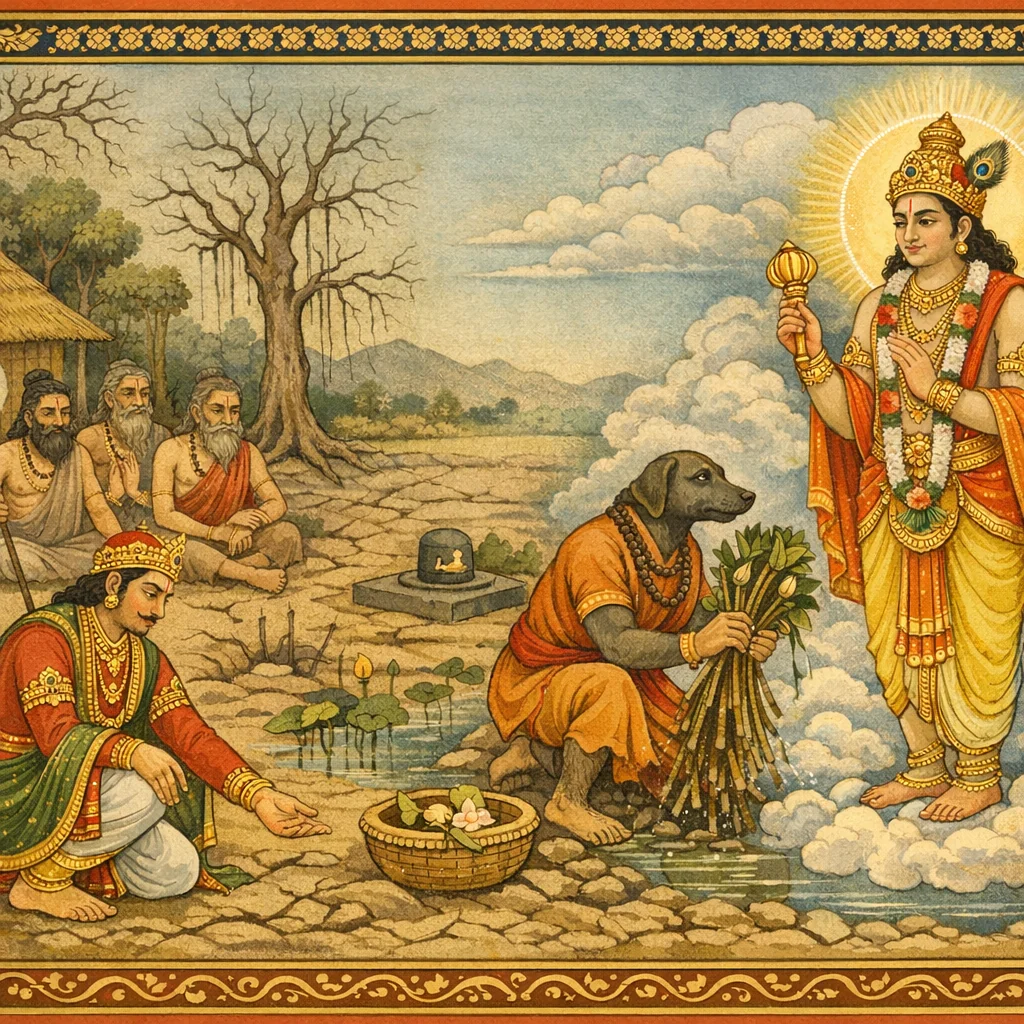
Sūta proclaims the sanctity of a famed Saptarṣi āśrama within an auspicious kṣetra and lays down observances tied to sacred time: bathing on the Śrāvaṇa full-moon/15th day grants desired results, and a śrāddha offered with simple forest foods yields merit equal to great soma-sacrifices. He also describes a Bhādrapada śukla-pañcamī rite of sequential worship, with mantras invoking Atri, Vasiṣṭha, Kaśyapa, Bharadvāja, Gautama, Kauśika (Viśvāmitra), Jamadagni, and Arundhatī. The narrative then turns to famine: a twelve-year drought collapses social norms, and the starving sages are tempted toward wrongdoing. Confronted by King Vṛṣādarbhi, they refuse royal gifts (pratigraha) as morally perilous. When the king tests them by hiding gold in udumbara fruits, they reject the concealed wealth and teach aparigraha, contentment, and how desire only expands when fed. In Camatkārapura-kṣetra they meet a dog-faced mendicant—revealed as Indra/Purandara—who takes away their gathered lotus-stalks to draw forth vows and ethical admonitions. Indra discloses the test, praises their freedom from greed, and offers boons; the sages ask that their āśrama remain an enduring, sin-destroying tīrtha. Indra grants that śrāddha there in Śrāvaṇa fulfills aims, and that desireless rites lead to mokṣa. The sages remain for tapas, attain a deathless state, establish a Śiva-liṅga whose sight and worship purify and liberate, and the chapter ends with a phalaśruti praising this narration as life-enhancing and sin-destroying.
Shlokas
Verse 1
। सूत उवाच । तथान्योऽस्ति द्विजश्रेष्ठास्तस्मिन्क्षेत्रे शुभावहे । सप्तर्षीणां सुविख्यात आश्रमः सर्वकामदः
Sūta said: Moreover, O best of Brāhmaṇas, in that auspicious sacred region there is another place—the well-renowned hermitage of the Seven Ṛṣis—bestowing the fulfillment of all desires.
Verse 2
तत्र श्रावणमासस्य पंचदश्यां समाहितः । यः करोति नरः स्नानं स लभेद्वांछितं फलम्
There, on the fifteenth lunar day of the month of Śrāvaṇa, any man who, with a collected mind, performs a sacred bath attains the desired fruit.
Verse 3
कन्दमूलफलैः शाकैर्यस्तत्र श्राद्धमाचरेत् । स प्राप्नोति फलं कृत्स्नं राजसूयाश्वमेधयोः
Whoever there performs Śrāddha using roots, tubers, fruits, and vegetables attains the full merit of the Rājasūya and the Aśvamedha sacrifices.
Verse 4
पंचम्यां शुक्लपक्षे तु मासि भाद्रपदे द्विजाः । यस्तान्पूजयते भक्त्या पुष्पधूपानुलेपनैः । विधिनानेन विप्रेन्द्राः सर्वानेव यथाक्रमम्
O twice-born ones: whoever, on the fifth day of the bright fortnight in the month of Bhādrapada, worships them with devotion—using flowers, incense, and unguents—following this prescribed method, O best of brāhmaṇas, and honoring all in due order—(gains the stated merit).
Verse 5
ॐ अत्रये नमः । ॐ वसिष्ठाय नमः । ॐ कश्यपाय नमः । ॐ भरद्वाजाय नमः । ॐ गौतमाय नमः । ॐ कौशिकाय नमः । ॐ जमदग्नये नमः । ॐ अरुंधत्यै नमः । पूजामंत्रः । जह्नुकन्यापवित्रांगा गृहीतजपमालिकाः । गृह्णंत्वर्घं मया दत्तमृषयः सर्वकामदाः
“Oṃ, homage to Atri. Oṃ, homage to Vasiṣṭha. Oṃ, homage to Kaśyapa. Oṃ, homage to Bharadvāja. Oṃ, homage to Gautama. Oṃ, homage to Kauśika. Oṃ, homage to Jamadagni. Oṃ, homage to Arundhatī.”—these are the worship-mantras. “O ṛṣis, whose bodies are purified by the daughter of Jahnu (Gaṅgā), who hold the japa-rosary: accept the arghya offered by me—O bestowers of all desired aims.”
Verse 6
ऋषय ऊचुः । तत्र सप्तर्षिभिस्तीर्थं कस्मिन्काले व्यवस्थितम् । विस्तरात्सूतज ब्रूहि परं कौतूहलं हि नः
The sages said: “At that place, at what time was the tīrtha established by the Seven Sages (Saptarṣi)? O son of Sūta, tell us in detail, for great indeed is our curiosity.”
Verse 7
सूत उवाच । अनावृष्टिः पुरा जाता लोके द्वादशवार्षिकी । सर्वोषधिक्षयो जातस्ततो लोकाः क्षयार्दिताः
Sūta said: “Formerly, a drought lasting twelve years arose in the world. All medicinal herbs and crops were exhausted; therefore people were afflicted by ruin and decline.”
Verse 8
अस्थिशेषा निरुत्साहास्त्यक्तधर्मव्रतक्रियाः । अभक्ष्यभक्षणपरास्तथैवापेयपायिनः
Reduced to mere bones and devoid of energy, they abandoned dharma, vows (vrata), and ritual duties; they became intent on eating what should not be eaten, and likewise on drinking what should not be drunk.
Verse 9
त्यजंति मातरः पुत्रान्कलत्राणि तथा नराः । भृत्यान्स्वानपि वित्तेशाः का कथान्यसमुद्भवान्
Mothers abandoned their sons, and men abandoned their wives; even the wealthy abandoned their own servants—what need to speak of those of other households?
Verse 10
संत्यक्तान्यग्निहोत्राणि ब्राह्मणैर्याजकैरपि । व्रतानि व्रतिभिर्दांतैरपि वृद्धतमैर्द्विजाः
Even the brāhmaṇas who served as priests abandoned the Agnihotra rites; even disciplined keepers of vows—indeed even the eldest among the twice-born—gave up their observances.
Verse 11
दृश्यते चैव यत्रैव सस्यं वापि कथंचन । ह्रियते लज्जया हीनैस्तत्र क्षुत्क्षामकैर्नरैः
Wherever any grain-crop was seen at all, it was carried off there by men emaciated with hunger, bereft of shame.
Verse 12
एवमन्नक्षये जाते पीडिते धरणीतले । सप्तर्षयः क्षुधाविष्टा बभ्रमुस्तत्रतत्र च
Thus, when the food supply had been exhausted and the surface of the earth was afflicted, the Seven Sages—overpowered by hunger—wandered from place to place.
Verse 13
अत्रिश्चैव वसिष्ठश्च कश्यपः सुमहातपाः । भरद्वाजस्तथा चान्यो गौतमः संशितव्रतः । कौशिको जमदग्निश्च तथैवारुंधती सती
Atri and Vasiṣṭha, and Kaśyapa of mighty austerities; Bharadvāja and Gautama, steadfast in vows; Kauśika and Jamadagni, and likewise Arundhatī, the virtuous and chaste sātī.
Verse 14
अथ तेषां समस्तानां चंडाभूत्परिचारिका । पशुवक्त्रस्तथा भृत्यो विनयेन समवितः
Then, before them all, there appeared a Caṇḍāla woman serving as an attendant, and also a servant with an animal-like face—both endowed with humble, submissive courtesy.
Verse 15
ततस्ते विषयं प्राप्ता वृषादर्भिमहीपतेः । क्षुत्क्षामा मुनयोऽत्यर्थं देशे चानर्तसंज्ञके
Thereafter they reached the realm of King Vṛṣādarbhī; the sages, utterly wasted by hunger, came to the region known as Anarta.
Verse 17
ततस्तैः पतितो भूमौ दृष्टो मृतकुमारकः । मंत्रयित्वा मिथः पश्चाद्गृहीतो भक्षणाय च
Then they saw a dead boy lying on the ground; after consulting among themselves, they took him up—even for the purpose of eating.
Verse 18
अपचन्यावदग्नौ तं क्षुधया परिपीडिताः । वृषादर्भिर्नृपः प्राप्तः श्रुत्वा तेषां विचेष्टितम्
Tormented by hunger, they began to cook him upon the fire; then King Vṛṣādarbhī arrived, having heard of their dreadful act.
Verse 19
वृषादर्भिरुवाच । किमिदं गर्हितं कर्म क्रियते मुनिसत्तमाः । राक्षसानामयं धर्मो महामांसस्य भक्षणम्
Vṛṣādarbhī said: “What is this blameworthy deed being done, O best of sages? Eating gross flesh is the very code of the Rākṣasas.”
Verse 20
सोऽहं सस्यं प्रदास्यामि ग्रामान्व्रीहीन्यवानपि । मम वाक्यादसंदिग्धं त्यजर्ध्वं मृतबालकम्
“I shall provide grain—villages, rice, and barley as well. Trust my word without doubt; abandon the dead child.”
Verse 21
ऋषय ऊचुः । प्रायश्चित्तं समादिष्टं महामांसस्य भक्षणात् । प्रतिग्रहस्य भूपाला दापत्कालेऽपि नो नृप
The sages said: “Expiation (prāyaścitta) has been enjoined for eating gross flesh; and, O king, even in times of calamity, acceptance of gifts (pratigraha) is not for us.”
Verse 22
पश्चात्तपश्चरिष्यामो महामांससमुद्भवम् । पातकं नाशयिष्यामो भक्षयामो वयं ततः
“Afterwards we shall practice austerities (tapas) to remove the sin born of eating gross flesh; having destroyed that wrongdoing, then we shall eat.”
Verse 23
वृषादर्भि रुवाच । प्रतिग्रहो द्विजातीनां प्रोक्ता वृत्तिरनिंदिता । ग्राह्यो मत्तस्ततः सर्वैर्नात्र कार्या विचारणा
Vṛṣādarbhi said: “Accepting gifts (pratigraha) is declared to be a blameless means of livelihood for the twice-born (dvija). Therefore, all of you should accept it from me—there is no need for any deliberation here.”
Verse 24
ऋषय ऊचुः । राज प्रतिग्रहो घोरो मध्वास्वादो विषोपमः । स दूराद्ब्राह्मणैस्त्याज्यो विशेषात्कृतिभिर्नृप
The sages said: “O King, accepting gifts is dreadful—sweet to the taste like honey, yet comparable to poison. Therefore it should be avoided from afar by Brāhmaṇas, especially by the discerning and accomplished, O ruler.”
Verse 25
दशसूनासमश्चक्री दशचक्रिसमो ध्वजी । दश ध्वजिसमा वेश्या दशवेश्यासमो नृपः
One ‘cakrī’ is equal to ten slaughterers; one ‘dhvajī’ equals ten ‘cakrī’; one prostitute equals ten ‘dhvajīs’; and one king equals ten prostitutes.
Verse 26
दशसूनासहस्रेण तुल्यो राजप्रतिग्रहः । कस्तस्य प्रतिगृह्णाति लोभाढ्यो ब्राह्मणो यथा
A royal gift (rāja-pratigraha) is equal to ten thousand slaughterers. Who would accept such a gift—except a Brāhmaṇa swollen with greed?
Verse 27
रौरवादिषु सर्वेषु नरकेषु स पच्यते । तस्माद्गच्छ गृहे भूप स्वस्ति तेऽस्तु सदैव हि
He is cooked in all the hells beginning with Raurava. Therefore, O king, go back to your home; may wellbeing be yours always.”
Verse 28
वयमन्यत्र यास्यामो ग्रहीष्यामो न ते धनम् । एवमुक्त्वाथ ते सर्वे मुनयः शंसितव्रताः
“We shall go elsewhere; we will not accept your wealth.” Having spoken thus, all those sages—of praised vows—prepared to depart.
Verse 29
परित्यज्य कुमारं तं मृतं तमपि भूमिपम् । चमत्कारपुरं क्षेत्रं समुद्दिश्य ततो ययुः
Leaving behind that dead prince—and even that king—they then set out, directing their minds toward the sacred field of Camatkārapura.
Verse 30
सोऽपि राजा ततस्तैस्तु भर्त्सितोऽतिरुषान्वितः । जिज्ञासार्थं ततस्तेषां चक्रे कर्म द्विजोत्तमाः
That king too—rebuked by them and filled with great anger—then, in order to test them, contrived an action against those excellent Brāhmaṇas.
Verse 31
ततः सुवर्णपूर्णानि विधायोदुम्बराणि च । तेषां मार्गाग्रतो भूमौ समंतादथ चाक्षिपत्
Then, having prepared udumbara vessels filled with gold, he cast them upon the ground on every side, before the sages along their path.
Verse 32
सूत उवाच । अथ ते मुनयो दृष्ट्वा पतितानि धरातले । उदुम्बराणि संदृष्ट्वा जगृहुः क्षुधयार्दिताः
Sūta said: Then those sages, seeing the udumbara vessels fallen upon the ground, took them, afflicted by hunger.
Verse 33
अथ तानि समालक्ष्य गुरूणि मुनिसत्तमाः । अत्रिरेकं परिस्फोट्य सुवर्णं वीक्ष्य चाब्रवीत्
Then the best of sages, observing that they were heavy, Atri split one open; and on beholding gold within it, he spoke.
Verse 34
अत्रिरुवाच । नास्माकं मुनयोऽज्ञानं नास्माकं गृहबुद्धयः । हैमानिमान्विजानंतो ग्रहीष्याम उदुम्बरान्
Atri said: “We sages are not ignorant, nor are our minds turned toward household life. Knowing these to be golden and deceptive, we shall instead take the udumbara fruits.”
Verse 35
तस्मादेतानि संत्यज्य हेमगर्भाणि दूरतः । उदुम्बराणि यास्यामः फलानि विगतस्पृहाः
Therefore, casting these gold-filled ones far away, we shall go to the udumbara fruits, free from craving.
Verse 36
सार्वभौमो महीपाल एकोऽन्यश्च निरीहकः । सुभगस्तु तयोर्नित्यं भूयाद्भूयो निरीहकः
One may be a universal monarch, guardian of the earth; another may be desireless, without striving. Yet of the two, the truly blessed—again and again—is the one who is free from craving.
Verse 37
धर्मार्थमपि विप्राणां संचयोऽर्थस्य गर्हितः । प्रक्षालनाद्धि पंकस्य दूरादस्पर्शनं वरम्
Even for the sake of dharma, the hoarding of wealth by brāhmaṇas is censured. Better than washing off mud is not touching it at all from a distance.
Verse 38
त्यजतः संचयान्सर्वान्यांति हानिमुपद्रवाः । न हि सर्वार्थवान्कश्चिद्दृश्यते निरुपद्रवः
For one who abandons all hoarding, troubles go away and lose their force. For no one is seen to possess every kind of wealth and yet remain free from calamity.
Verse 39
निर्धनत्वं तथा राज्यं तुलायां धारयेद्बुधः । अकिंचनत्वमधिकं जायते संमतिर्मम
Let a wise man weigh poverty and kingship on a balance. My considered view is that possessing nothing (akiñcana) is the greater good.
Verse 40
कश्यप उवाच । अनर्थोऽयं मुने प्राप्तो यदर्थस्य परिग्रहः । अर्थैश्वर्यविमूढात्मा श्रेयसा मुच्यते हि सः
Kaśyapa said: “O sage, this is a misfortune—that the taking up and grasping of wealth has arisen. One whose mind is deluded by riches and power is indeed liberated only by the higher good (śreyas).”
Verse 41
अर्थसंपद्विमोहाय विमोहो नरकाय च । तस्मादर्थं प्रयत्नेन श्रेयोऽर्थी दूरतस्त्यजेत्
Wealth leads to delusion, and delusion leads to hell. Therefore, one who seeks the highest good should, with effort, abandon wealth from afar.
Verse 42
योर्थेन साध्यते धर्मः क्षयिष्णुः स प्रकीर्तितः । यः पुनस्तपसा साध्यः स मोक्षायेति मे मतिः
The dharma accomplished through wealth is declared to be perishable. But that which is accomplished through austerity—this, in my view, leads to liberation.
Verse 43
भरद्वाज उवाच । जीर्यंति जीर्यतः केशा दंता जीर्यंति जीर्यतः । चक्षुः श्रोत्रे तथा पुंसस्तृष्णैका तरुणायते
Bharadvāja said: As a man grows old, his hair grows old; his teeth grow old; his eyes and ears too grow old. Yet desire (tṛṣṇā) alone remains ever young within him.
Verse 44
सूच्या सूत्रं यथा वस्त्रं संचारयति सूचिका । तद्वत्संसारसूत्रं च वांछयात्मा नयत्यसौ
Just as a needle carries a thread through cloth, so does the self, driven by craving, draw along the thread of saṁsāra (repeated worldly becoming).
Verse 45
यथा शृंगं हि कायेन वर्द्धमानेन वर्धते । तद्वत्तृष्णापि वित्तेन वर्द्धमानेन वर्द्धते
As horns grow as the body grows, so too does craving grow as wealth increases.
Verse 46
अनंतपारा दुष्पूरा तृष्णा दुःखशतावहा । अधर्मबहुला चैव तस्मात्तां परिवर्जयेत्
Craving has no far shore, is hard to satisfy, and brings hundreds of sorrows; it abounds in adharma—therefore one should abandon it.
Verse 47
गौतम उवाच । संतुष्टः केन चाल्योऽस्ति फलैरपि विवर्जितः । सर्वोपीन्द्रियलौल्येन संकटे भ्रमति द्विजाः
Gautama said: Who can disturb one who is content, even if he is devoid of rewards? Yet everyone, through fickleness toward the senses, wanders into distress, O brāhmaṇas.
Verse 48
सर्वत्र संपदस्तस्य संतुष्टं यस्य मानसम् । उपानद्गूढपादस्य ननु चर्मास्तृतेव भूः
For the one whose mind is content, prosperity is everywhere. For one whose feet are covered with sandals, the earth is as though spread with leather.
Verse 49
संतोषामृततृप्तानां यत्सुखं शांतचेतसाम् । कुतस्तद्धनलुब्धानामितश्चेतश्च धावताम्
The happiness of those whose peaceful minds are satisfied with the nectar of contentment—how could that ever belong to the wealth-greedy, whose minds run here and there?
Verse 50
असंतोषः परं दुःखं संतोषः परमं सुखम् । सुखार्थी पुरुषस्तस्मात्संतुष्टः सततं भवेत्
Discontent is supreme sorrow; contentment is supreme happiness. Therefore, a person who seeks happiness should always remain content.
Verse 51
विश्वामित्र उवाच । कामं कामयमानस्य यदि कामः स सिध्यति । तथान्यो जायते पुंसस्तत्क्षणादेव कल्पितः
Viśvāmitra said: Even when the desire of a man who longs is fulfilled, in that very moment another desire is born within him, newly imagined.
Verse 52
न जातु कामी कामानां सहस्रैरपि तुष्यति । हविषा कृष्णवर्त्मेव वांछा तस्य विवर्धते
A man of desire is never satisfied even by thousands of enjoyments; like a fire fed with oblations, his craving only grows.
Verse 53
कामानभिलषन्मोहान्न नरः सुखमाप्नुयात् । श्येनालयतरुच्छायां व्रजन्निव कपिञ्जलः
A man, deluded by craving for desires, does not attain happiness—like a francolin that goes to rest beneath the shade of a tree that is the dwelling of a hawk.
Verse 54
नित्यं सागरपर्यन्तां यो भुङ्क्ते पृथिवीमिमाम् । तुल्याश्मकाश्चनश्चैव स कृतार्थो महीपतेः
Even if a king were to enjoy, day after day, this earth bounded by the ocean, only when stone and gold are the same to him is a ruler truly fulfilled.
Verse 55
जमदग्निरुवाच । योऽर्थं प्राप्याधमो विप्रः शोचितव्येपि हृष्यति । न च पश्यति मन्दात्मा नरकं चा कुतोभयः
Jamadagni said: A base brāhmaṇa, having obtained wealth, rejoices even in what should be lamented. That dull-souled man does not see hell—so how could he feel fear?
Verse 56
प्रतिग्रहसमर्थानां निवृत्तानां प्रतिग्रहात् । य एव ददतां लोकास्त एवाप्रतिगृह्णताम्
For those who are able to receive gifts yet refrain from accepting them—the very worlds attained by givers are also attained by those who do not accept.
Verse 57
अरुन्धत्युवाच । बिसतंतुर्यथाऽनन्तो नालमासाद्य संस्थितः । तृष्णा चैवमनाद्यन्ता स्थिता देहे शरीरिणाम्
Arundhatī said: ‘Just as the lotus-fibre seems endless, rooted in its stalk, so too craving is without beginning or end, abiding in the bodies of embodied beings.’
Verse 58
या दुस्त्यजा दुर्मतिभिर्या न जीर्यति जीर्यतः । याऽसौ प्राणान्तिको रोगस्तां तृष्णां त्यजतः सुखम्
That craving which the misguided find hard to abandon; which does not grow old even as one ages; which is a disease ending in death—by abandoning that thirst, one finds happiness.
Verse 60
पशुमुख उवाच यदाचरन्ति विद्वांसः सदा धर्मपरायणाः । तदेव विदुषा कार्यमात्मनो हितमिच्छता
Paśumukha said: ‘Whatever the learned—ever devoted to dharma—practice, that indeed should be done by a wise person who seeks his own true welfare.’
Verse 62
चमत्कारपुरेक्षेत्रे विविशुस्ते ततः परम् । ददृशुः सहसा प्राप्तं परिव्राजं शुनोमुखम्
Then they entered the sacred field of Cāmatkārapura. There they suddenly saw an arriving wandering mendicant—Śunomukha.
Verse 63
तेनैव सहितास्तत्र गत्वा किञ्चिद्वनान्तरम् । दृष्टवन्तस्ततो हृद्यं सरः पंकजशोभितम्
Accompanied by him, they went a little way into the forest; then they beheld a delightful lake, beautified with lotuses.
Verse 64
ततो बुभुक्षयाविष्टा बिसान्यादाय भूरिशः । तीरे निक्षिप्य सरसश्चक्रुः पुण्यां जल क्रियाम्
Then, overcome by hunger, they gathered many lotus-stalks; placing them on the lake’s bank, they performed a meritorious water-rite.
Verse 65
अथोत्तीर्यजलात्सर्वे ते समेत्य परस्परम् । बिसानि तान्यपश्यन्त इदं वचनमब्रुवन्
Then all of them climbed out of the water and gathered together. Not seeing those lotus-stalks, they spoke these words to one another.
Verse 66
ऋषय ऊचुः । केन क्षुधाभितप्तानामस्माकं निर्दयात्मना । मृणालानि समस्तानि स्थानादस्माद्धृतानि च
The sages said: “By whom—cruel of heart—have all these lotus-stalks been taken away from this place, while we are tormented by hunger?”
Verse 67
ते शंकमाना अन्योन्यमृषयः शंसितव्रताः । प्रचक्रुः शपथान्रौद्रानात्मनः प्रविशुद्धये
Suspecting one another, those sages—renowned for their vows—pronounced fierce oaths, seeking the purification of themselves and the clearing of guilt.
Verse 68
कश्यप उवाच । सर्वभक्षः सदा सोऽस्तु न्यासलोभं करोतु वा । कूटसाक्षित्वमभ्ये तु बिसस्तैन्यं करोति यः
Kaśyapa said: “He who steals lotus-stalks—let him become ever a devourer of all things, even the impure; or let him be driven by greed for goods held in trust; and let him also incur the sin of false witness.”
Verse 69
धर्मं करोतु दंभेन राजानं चोपसेवताम् । मधुमांसं सदाश्नातु बिसस्तैन्यं करोति यः
“He who steals lotus-stalks—let him practice ‘dharma’ in hypocrisy, attend upon kings for gain, and continually eat honey and meat.”
Verse 70
वसिष्ठ उवाच । अनृतौ मैथुनं यातु दिवा वाप्यथ पर्वणि । अतिथिः स्यात्ततोऽन्योन्यं बिसस्तैन्यं करोति यः
Vasiṣṭha said: “He who steals lotus-stalks—let him resort to intercourse at improper times, by day or on sacred festival days; and let him become a ‘guest’ who lives off others and turns against them in discord.”
Verse 71
भरद्वाज उवाच । योधिगम्य गुरोः शास्त्रं निष्क्रयं न प्रयच्छति । तस्यैनसा स युक्तोस्तु बिसस्तैन्यं करोति यः
Bharadvāja said: “He who steals lotus-stalks—let him be bound to the sin of one who, having learned sacred teaching from a guru, does not offer the due fee (dakṣiṇā) in return.”
Verse 72
नृशंसोऽस्तु स सर्वत्र समृद्ध्या चाप्यहंकृतः । मत्सरी पिशुनश्चैव बिसस्तैन्यं करोति यः
“He who steals lotus-stalks—let him be cruel everywhere; and even in prosperity, let him be arrogant through ego—jealous and slanderous as well.”
Verse 73
विश्वामित्र उवाच । एकाकी मृष्टम श्नातु प्रशंस्यादथ चात्मनः । वेदविक्रयकर्तास्तु बिसस्तैन्यं करोति यः
Viśvāmitra said: “Let the one who steals lotus-stalks eat rich food alone, praise himself, and become a seller of the Veda.”
Verse 74
जमदग्निरुवाच । कन्यां यच्छतु वृद्धाय स भूयाद्वृषली पतिः । अस्तु वार्धुषिको नित्यं बिसस्तैन्यं करोति यः
Jamadagni said: “Let the one who steals lotus-stalks give his daughter to an old man; let him become the husband of a lowborn woman, and let him ever be a usurer.”
Verse 75
गौतम उवाच । स गृह्णात्वविकादानं करोतु हयविक्रयम् । प्रकरो तु गुरोर्निंदां बिसस्तैन्यं करोति यः
Gautama said: “One may accept what is not given, one may even engage in the trade of horses; but whoever indulges in reviling the guru commits a grave offence—like theft, even of lotus-stalks.”
Verse 76
अत्रिरुवाच । मातरं पितरं नित्यं दुर्मतिः सोऽवमन्यताम् । शूद्रं पृच्छतु धर्मार्थं बिसस्तैन्यं करोति यः
Atri said: “Let that ill-minded man be regarded as one who constantly dishonours his mother and father—he who, in matters of dharma, goes to question a Śūdra, and who steals lotus-stalks.”
Verse 77
प्रतिश्रुत्य न यो दद्याद्ब्राह्मणाय गवादिकम् । तस्यैनसा स युज्येत बिसस्तैन्यं करोति यः
Whoever, having promised, does not give a brāhmaṇa cows and the like becomes bound by that sin; he is deemed one who steals lotus-stalks.
Verse 78
अरुंधत्युवाच । करोतु पत्युः पूर्वं सा भोजनं शयनं तथा । नारी दुष्टसमाचारा बिसस्तैन्यं करोति या
Arundhatī said: “Let her first attend to her husband, providing his meal and also his resting-place. A woman of wicked conduct is she who steals lotus-stalks (bisa).”
Verse 79
चण्डोवाच । स्वामिनः प्रतिकूलास्तु धर्मद्वेषं करोतु च । साधुद्वेषपरा चैव बिसस्तैन्यं करोति या
Caṇḍa said: “She who is hostile to her husband, who fosters hatred for dharma, who delights in despising the virtuous, and who steals—even something as small as lotus-fibres (bisa)—is to be known as sinful.”
Verse 80
पशुमुख उवाच । स्वामिद्रोहरतो नित्यं स भूयात्पापकृन्नरः । साधु द्वेषपरश्चैव बिसस्तैन्यं करोति यः
Paśumukha said: “The man who is ever intent on betraying his master becomes a sinner. Likewise, whoever is devoted to hating the virtuous and who steals lotus-stalks (bisa)—he too is a doer of sin.”
Verse 81
शुनोमुख उवाच । वेदान्स पठतु न्यायाद्गृहस्थः स्यात्प्रियातिथिः । सत्यं वदतु चाजस्रं बिसस्तैन्यं करोति यः
Śunomukha said: “Let the householder study the Vedas in a righteous manner and be dear to guests. Let him speak truth unceasingly. But whoever steals bisa (lotus-stalks) incurs sin and falls from dharma.”
Verse 82
ऋषय ऊचुः । इष्ट एव द्विजातीनां यस्त्वया शपथः कृतः । बिसस्तैन्यं हि चास्माकं तन्नूनं भवता कृतम्
The sages said: “The oath you have taken is indeed fitting for the twice-born. Yet the theft of our lotus-stalks (bisa) has surely been committed by you—without doubt, this is your doing.”
Verse 83
शुनोमुख उवाच । मया हृतानि सर्वेषां बिसानीमानि वो द्विजाः । धर्मान्वै श्रोतुकामेन मां जानीत पुरंदरम्
Śunomukha said: “O twice-born ones, I have taken away all these lotus-stalks of yours. Yet know me as Purandara (Indra), for I did so only out of longing to hear of Dharma.”
Verse 84
युष्माकं परितुष्टोऽस्मि लोभाभावाद्द्विजोत्तमाः । तस्मात्स्वर्गं मया सार्द्धं शीघ्रमागम्यतामिति ।ा
“O best of Brāhmaṇas, I am wholly pleased with you, for you are free from greed. Therefore, come at once with me to heaven,” he said.
Verse 85
ऋषय ऊचुः । मोक्षमार्गं समासक्ता न वयं स्वर्गलिप्सवः । तस्मात्तपश्चरिष्यामः सरसीह विमुक्तये
The sages said: “We are devoted to the path of liberation (mokṣa); we do not yearn for heaven. Therefore, O Indra, we shall practice austerity at this sacred lake for final release.”
Verse 86
पूर्णा सागरपर्यंतां चरित्वा पृथिवी मिमाम् । प्राणयात्रां प्रकुर्वाणा मृणालैर्मुनिसत्तमाः । तस्माद्गच्छ तव श्रेयो भूयादस्मात्समागमात्
Having traversed this earth up to the encircling ocean, the best of sages, sustaining life on lotus-stalks, continue their life’s pilgrimage. Therefore, depart—may great good come to you from this meeting with us.
Verse 87
शक्र उवाच । न वृथा दर्शनं मे स्यात्कदाचिदपि सुव्रताः । तस्माद्गृह्णीत यच्चित्ते सदाभीष्टं व्यवस्थितम्
Śakra (Indra) said: “O you of excellent vows, may my appearing before you never be in vain. Therefore, choose whatever cherished desire stands firm within your hearts.”
Verse 88
ऋषय ऊचुः आश्रमोऽयं सुविख्यातो भूयाच्छक्र महीतले । नाम्नास्माकं तथा नृणां सर्वपातकनाशनः
The sages said: “O Śakra, may this āśrama become widely renowned upon the earth; and, bearing our name, may it be for people the destroyer of all sins.”
Verse 89
वयं स्थास्यामहे नित्यमत्रैव सुरसत्तम । तपोऽर्थं भावितात्मानो यावन्मोक्षगतिर्ध्रुवा
“O best of the gods, we shall dwell here always—our selves refined for the sake of austerity—until the sure course to liberation (mokṣa) is attained.”
Verse 90
इन्द्र उवाच । त्रैलोक्येऽपि सुविख्यात आश्रमो वो भविष्यति । तथा कामप्रदश्चैव लोकानां संभविष्यति
Indra said: “Your āśrama will become renowned even throughout the three worlds; and it will also arise as a bestower of desired boons for people.”
Verse 91
यो यं काममभिध्याय श्राद्धमत्र करिष्यति । श्रावणे पौर्णमास्यां च स तं सर्वमवा प्स्यति
“Whoever, contemplating a particular desire, performs Śrāddha here—especially on the full-moon day of Śrāvaṇa—will obtain all of that desired fruit.”
Verse 92
निष्कामो वा नरो यस्तु श्राद्धं दानमथापि वा । प्रकरिष्यति मोक्षं स समवाप्स्यत्यसंशयम्
“Or, if a man is desireless and performs Śrāddha or even charity (dāna) here, he will attain liberation (mokṣa)—without doubt.”
Verse 93
ये चात्र देहं त्यक्ष्यंति युष्माकं चाश्रमे शुभे । अपि पापसमायुक्तास्ते यास्यंति परां गतिम्
And those who relinquish their bodies here, in your auspicious āśrama—even if burdened with sins—shall go to the supreme state.
Verse 94
इंगुदैर्बदरैर्वापि बिल्वैर्भल्लातकैरपि । पितॄनुद्दिश्य यः श्राद्धं करिष्यति समाहितः
Whoever, with a collected mind, performs Śrāddha for the ancestors—using iṅguda fruits, or jujubes (badara), or bilva fruits, or even bhallātaka—shall obtain its due fruit.
Verse 95
स यास्यति परां सिद्धिं दुर्लभां त्रिदशैरपि । सर्वपापविनिर्मुक्तः स्तूयमानश्च किंनरैः
He shall attain the supreme perfection—rare even for the gods—freed from all sins, and praised by the Kiṃnaras.
Verse 96
जगामादर्शनं तेऽपि स्थितास्तत्र द्विजोत्तमाः
He passed out of sight; and those excellent Brāhmaṇas remained there.
Verse 97
ततः काले गते तेऽपि कृत्वा तीव्रं महत्तपः । संप्राप्ताः परमं स्थानं जरामरणवर्जितम्
Then, as time passed, they too performed intense and great austerities (tapas), and attained the supreme abode—free from old age and death.
Verse 98
तैस्तत्र स्थापितं लिङ्गं देवदेवस्य शूलिनः । तस्य संदर्शनादेव नरः पापाद्विमुच्यते
There they installed the Liṅga of Śūlin, the God of gods; by merely beholding it, a person is released from sin.
Verse 99
यस्तल्लिंगं पुनर्भक्त्या पुष्पधूपानुलेपनैः । अर्चयेत्स ध्रुवं मुक्तिं प्राप्नोति द्विजसत्तमाः
Whoever again worships that Liṅga with devotion—using flowers, incense, and unguents—surely attains liberation, O best of the twice-born.
Verse 100
एतत्पवित्र मायुष्यं सर्वपातकनाशनम् । सप्तर्षोणां समाख्यातमाश्रमस्यानुकीर्तनम्
This sacred account promotes longevity and destroys all sins: it is the celebrated narration of the hermitage of the Seven Ṛṣis.