Adhyaya 30
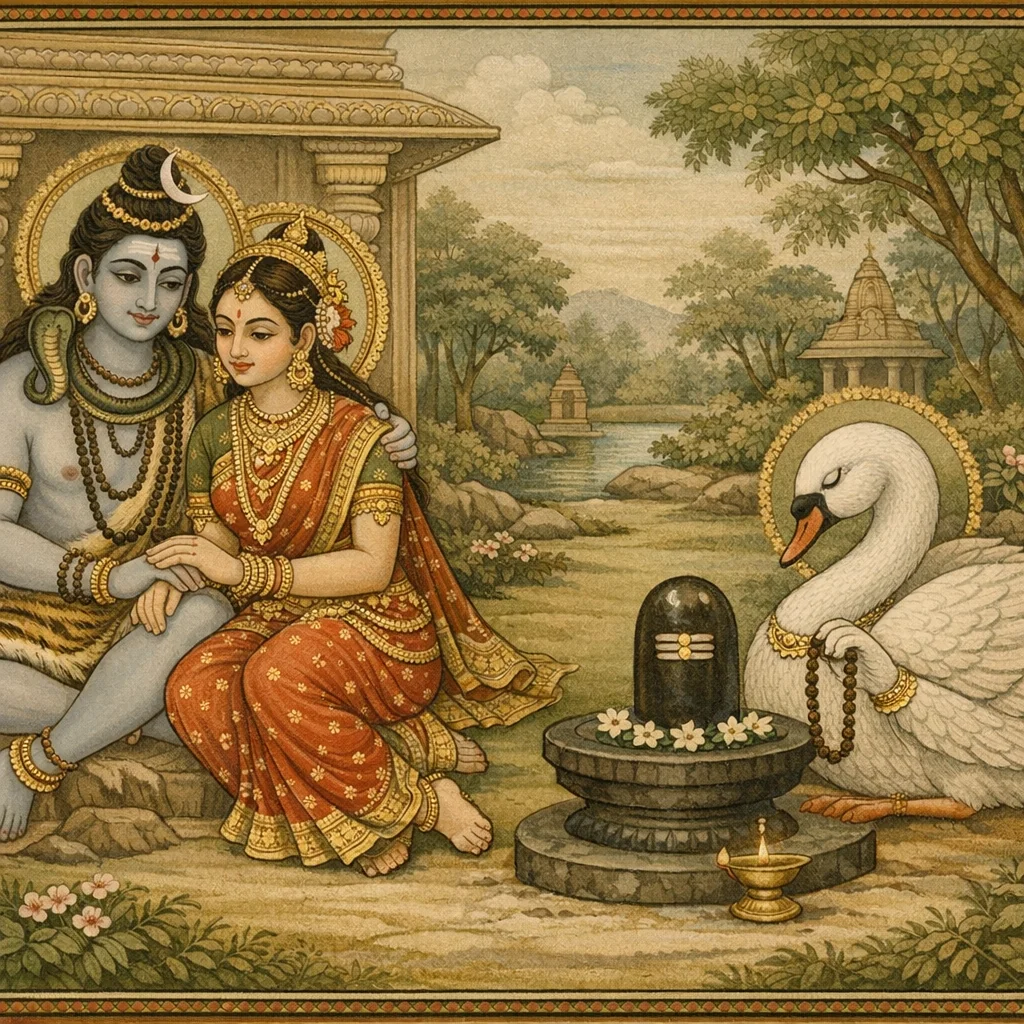
The chapter begins with sages asking how Siddheśvara (Śiva) became pleased at that place. Sūta recounts an earlier tale of the siddha Haṃsa, distressed by childlessness and advancing age. Seeking a sure means—pilgrimage, a vow (vrata), or a pacificatory rite—he approaches Bṛhaspati, son of Aṅgiras, and asks for guidance to obtain offspring. After reflection, Bṛhaspati directs him to the sacred kṣetra called Camatkārapura and instructs him to perform tapas there, declaring it the auspicious path to gain a worthy son who can uphold the lineage. Haṃsa reaches the site, worships the liṅga according to rule, and continues disciplined devotion day and night with offerings, music, and austerities—cāndrāyaṇa, kṛcchra, prājāpatya/parāka-type observances, and month-long fasts. After a thousand years, Mahādeva appears with Umā, grants darśana, and invites Haṃsa to ask a boon. Haṃsa requests sons for the restoration of his line. Śiva establishes the liṅga’s enduring presence and proclaims a general promise: whoever worships him there with bhakti gains the desired fruit; and whoever performs japa from the liṅga’s southern side receives the ṣaḍakṣara-mantra and blessings such as longevity and sons. Śiva then vanishes; Haṃsa returns home and attains sons. The chapter ends by prescribing careful reverence—touching, worship, prostration, and powerful recitation of the ṣaḍakṣara—for seekers of difficult aims.
Shlokas
Verse 1
। ऋषय ऊचुः । तोषितः केन सिद्धेन तत्र सिद्धेश्वरो विभुः । एतत्सर्वं समाचक्ष्व विस्तरात्सूतनन्दन
The sages said: By which perfected siddha was the mighty Lord Siddheśvara pleased there? Tell us all of this in detail, O son of Sūta.
Verse 2
सूत उवाच । आसीत्सिद्धाधिपोनाम पुरा हंस इति स्मृतः । अनपत्यतया तस्य कालश्चक्राम भूरिशः
Sūta said: Long ago there was a lord among the siddhas, remembered by the name Haṃsa. Because he had no offspring, much time passed for him.
Verse 3
ततश्चिन्ता प्रपन्नः स गत्वा देवपुरोहितम् । पप्रच्छागिरसः पुत्रं विप्रश्रेष्ठं बृहस्पतिम्
Then, overcome by anxiety, he went to the priest of the gods and questioned Bṛhaspati—the son of Aṅgiras, foremost among Brahmins—seeking guidance.
Verse 4
भगवंश्चानपत्यस्य वार्द्धकं मे समागतम् । तस्मादपत्यलाभाय ममोपायं प्रकीर्तय
He said: “O venerable one, old age has come upon me while I remain without a child. Therefore, declare to me the means by which I may obtain offspring.”
Verse 5
तीर्थयात्रां व्रतं वापि शांतिकं वा द्विजोत्तम । येन स्यात्संततिः शीघ्रं त्वत्प्रसादाद्बृहस्पते
“O best of the twice-born, whether it be a pilgrimage to the sacred tīrthas, a vow (vrata), or a rite of pacification (śāntika)—tell me, by your grace, O Bṛhaspati, that by which progeny may arise swiftly.”
Verse 6
बृहस्पतिश्चिरं ध्यात्वा सिद्धं प्राह ततः परम् । चमत्कारपुरं क्षेत्रं गत्वा तत्र तपः कुरु
Bṛhaspati, having meditated for a long time, then spoke to the Siddha: “Go to the sacred kṣetra of Camatkārapura and perform tapas (austerity) there.”
Verse 7
ततः प्राप्स्यसि सत्पुत्रं वंशोद्धारक्षमं शुभम् । नान्यं पश्यामि सिद्धेश सुतोपायं शुभावहम्
“Then you will obtain a virtuous son—auspicious and able to sustain and uplift your lineage. O lord among Siddhas, I see no other means of gaining a son that brings such good.”
Verse 8
ततस्तत्क्षेत्रमासाद्य स सिद्धः श्रद्धयान्वितः । लिंगं संपूजयामास यथोक्तविधिना स्वयम्
Thereupon, reaching that sacred region, the Siddha—filled with faith—personally worshiped the Śiva-liṅga according to the prescribed rite.
Verse 9
ततश्चाराधयामास दिवानक्तमतंद्रितः । बलि पूजोपहारेण गीतवाद्योच्छ्रयादिभिः
Then, tirelessly worshiping day and night, he propitiated (Śiva) with offerings (bali), acts of pūjā, gifts and presentations, along with singing, instrumental music, and other devotional observances.
Verse 10
चांद्रायणैस्तथा कृच्छ्रैः पाराकैर्द्विजसत्तमाः । तथा मासोपवासैश्च तोषयामास शंकरम्
By Cāndrāyaṇa observances, by severe Kṛcchra and Pārāka austerities, and also by month-long fasts, the best among the twice-born satisfied Śaṅkara (Śiva).
Verse 11
ततो वर्षसहस्राभ्यां तस्य तुष्टो महेश्वरः । प्रोवाच दर्शनं गत्वा वृषारूढः सहोमया
Then, after a thousand years, Maheśvara was pleased with him; mounted upon the bull and accompanied by Umā, He granted him His darśana and spoke.
Verse 12
हंसाद्य तव तुष्टोऽहं तस्मात्प्रार्थय वांछितम् । अहं ते संप्रदास्यामि दुष्प्राप्यमपि निश्चितम्
“O Haṃsa, today I am pleased with you; therefore ask for what you desire. I shall indeed grant it to you—even what is difficult to obtain—without doubt.”
Verse 13
हंस उवाच । अपत्यार्थं समारंभो मयाऽद्य विहितः पुरा । तस्मात्त्वं देहि मे पुत्रान्वंशोद्धारक्ष मान्विभो
Haṃsa said: “Formerly I undertook this observance for the sake of offspring. Therefore, O all-pervading Lord, grant me sons—saviours who will uphold and restore my lineage.”
Verse 14
त्वया चैव सदा लिंगे स्थेयमत्र सुरोत्तम । मम वाक्यादसंदिग्धं सर्वलोकहितार्थतः
“And you, O best among the gods, should abide here always in this liṅga. By my word this is beyond doubt—done for the welfare of all worlds.”
Verse 16
यो मामत्र स्थितं मर्त्यः पूजयिष्यति भक्तितः । तस्याहं संप्रदास्यामि चित्तस्थं सकलं फलम्
“Any mortal who worships me here, established in this place, with devotion—I shall grant him in full the fruit he holds in his heart.”
Verse 17
यो मे लिंगस्य याम्याशां स्थित्वा मंत्रं जपिष्यति । षडक्षरं प्रदास्यामि तस्यायुष्यं सुतान्वितम्
Whoever stands to the south of my liṅga and repeats the mantra in japa, I shall bestow upon him the six-syllabled mantra and grant him long life together with children.
Verse 18
एवमुक्त्वा महादेवस्ततश्चादर्शनं गतः । हंसोऽपि च गृहं गत्वा पुत्रानाप महोदयान्
Having spoken thus, Mahādeva then vanished from sight. Haṃsa too returned home and obtained sons of great fortune and prosperity.
Verse 19
तस्मात्सर्वप्रयत्नेन तल्लिंगं यत्नतो द्विजाः । स्पर्शनीयं च पूज्यं च नमस्कार्यं प्रयत्नतः
Therefore, O twice-born ones, with every effort and careful attention, that liṅga should be touched, worshipped, and saluted with reverent prostration.
Verse 20
षडक्षरेण मन्त्रेण कीर्तनीयं च शक्तितः । वांछद्भिर्वांछितान्कामान्दुर्लभांस्त्रिदशैरपि
And, to the best of one’s ability, the six-syllabled mantra should be recited and proclaimed; for those who desire, it grants wished-for aims—boons difficult to obtain even for the gods.