Adhyaya 28
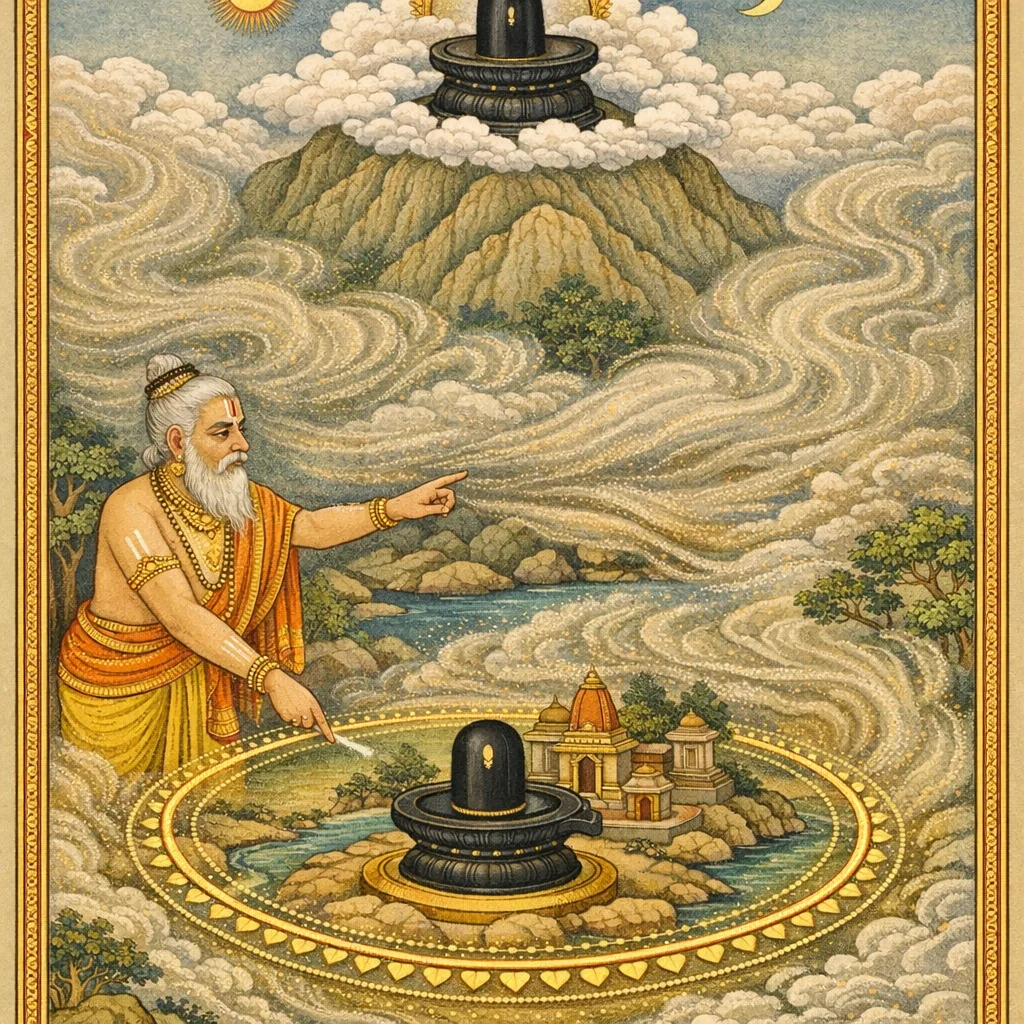
The chapter is framed as Sūta’s narration to an assembly of sages. In a divine council, embodied tīrthas (including Prabhāsa and others) grow anxious at the coming of Kali-yuga and ask for a protected abode where they may remain spiritually efficacious without being tainted by impure contact. Indra (Śakra), moved by compassion, consults Bṛhaspati to find a kṣetra “untouched by Kali” that can serve as a common refuge for the tīrthas. After reflection, Bṛhaspati points to the unsurpassed kṣetra called Hāṭakeśvara, said to have arisen from the “falling” (pātana) of Śiva’s liṅga (Śūlin), and linked to Viśvāmitra’s earlier tapas for King Triśaṅku. The narrative recalls Triśaṅku’s transformation—casting off a stigmatized condition and attaining heaven with his body—thus portraying the site as a place of ethical and ritual reversal. Protective arrangements are then described: by Indra’s command the fierce wind Saṃvartaka once filled the tīrtha with dust; in Kali, Hāṭakeśvara is said to guard below while Acaleśvara protects above. The region, measured as five krośas, is declared beyond Kali’s reach. The tīrthas therefore relocate there in partial aspects (aṃśa), and the chapter closes by noting their immeasurable number and introducing a forthcoming catalogue of names, locations, and effects, with a general phalaśruti: merely hearing of these tīrthas can free one from sin, as can meditation, bathing, gifting, and touch.
Shlokas
Verse 1
। सूत उवाच । तस्यां देवसभायां च संस्थिता ये द्विजोत्तमाः । प्रभासादीनि तीर्थानि मूर्तानि सकलानि च
Sūta said: In that divine assembly were present the foremost of the twice-born; and all the sacred tīrthas—Prabhāsa and the rest—were there, embodied in visible forms.
Verse 2
तानि श्रुत्वा वचस्तस्य देवाचार्यस्य तादृशम् । भयं कृत्वा महच्चित्ते प्रोचुश्च त्रिदिवेश्वरम्
Hearing such words of the preceptor of the gods, they became greatly fearful in their hearts and spoke to the Lord of heaven.
Verse 3
यद्येवं देवदेवेश भविष्य त्यशुभं युगम् । वयं नाशं समेष्यामो न स्थास्यामो जगत्त्रये
If it is so, O Lord of the gods, an inauspicious age will come; we shall meet destruction and will not remain established in the three worlds.
Verse 4
पुरंदराद्य चास्माकं स्थानं किंचित्प्रदर्शय । तस्मात्कीर्तय नः स्थानं किंचित्क्वापि पुरंदर
O Purandara, today show us some place of refuge; therefore, O Purandara, declare to us some abode—somewhere—where we may remain.
Verse 5
यदाश्रित्य नयिष्यामो रौद्रं कलियुगं विभो । अस्पृष्टानि नरैर्म्लेच्छैः प्रभावसहितानि च । पाताले स्वर्गलोके वा मर्त्ये वा सुरसत्तम
O Lord, relying on that place we shall pass through the fierce Kali age—untouched by men who are mlecchas, and endowed with sacred potency—whether in the netherworld, in heaven, or on earth, O best of the gods.
Verse 6
तेषां तद्वचनं श्रुत्वा कृपाविष्टः शतक्रतुः । प्रोवाच ब्राह्मणश्रेष्ठं भूय एव बृहस्पतिम्
Hearing their words, Śatakratu (Indra), moved with compassion, again addressed Bṛhaspati, the best among brāhmaṇas.
Verse 7
अस्पृष्टं कलिना स्थानं किंचि द्वद बृहस्पते । समाश्रयाय तीर्थानां यदि वेत्सि जगत्त्रये
O Bṛhaspati, tell us of some place untouched by Kali, to serve as a common refuge for the tīrthas—if you know of it in the three worlds.
Verse 8
शक्रस्य तद्वचः श्रुत्वा चिरं ध्यात्वा वृहस्पतिः । तत्र प्रोवाच तीर्थानि भया द्भीतानि हर्षयन्
Hearing Śakra’s words, Bṛhaspati pondered for a long time; then he spoke there, gladdening the tīrthas that were trembling in fear.
Verse 9
हाटकेश्वरमित्युक्तमस्ति क्षेत्रमनुत्तमम् । लिंगस्य पतनाज्जातं देवदेवस्य शूलिनः
There is an unsurpassed sacred region called Hāṭakeśvara, born from the manifest descent—the falling—of the liṅga of the God of gods, the trident-bearing Lord (Śūlin).
Verse 10
यत्र पूर्वं तपस्तप्तं विश्वामित्रेण धीमता । त्रिशंकोर्भूमिपालस्य कृते तीर्थे महात्मना
This is the sacred ford (tīrtha) where, in ancient times, the wise and great-souled Viśvāmitra performed intense austerities, establishing this tīrtha for the sake of King Triśaṅku.
Verse 11
यत्र स्थित्वा सभूपालस्त्रिशंकुः पापवर्जितः । चण्डालत्वं परित्यज्य सदेह स्त्रिदिवं गतः
Having come to that place, King Triśaṅku became free from sin; abandoning the condition of being a caṇḍāla, he went to heaven (Tridiva) in his very body.
Verse 12
यत्र शक्रसमादेशात्पूरितं पांसुभिः पुरा । संवर्तकेन रौद्रेण वायुना तीर्थमुत्तमम्
It is there that, long ago, by Śakra’s command, that supreme tīrtha was filled with dust by the fierce, world-ending wind called Saṃvartaka.
Verse 13
यत्र रक्षत्यधस्ताच्च स स्वयं हाटकेश्वरः । उपरिष्टात्प्रदेशं च कलौ देवोऽचलेश्वरः
There, Hāṭakeśvara Himself protects the region below; and in the age of Kali, the god Acaleśvara safeguards the tract above.
Verse 14
हाटकेश्वरमाहात्म्यादस्पृष्टं कलिना हि तत् । पंचक्रोशप्रमाणेन अचलेश्वरजेन च
By the greatness of Hāṭakeśvara, that region is indeed untouched by Kali—measured as a circuit of five krośas—and likewise through the power arising from Acaleśvara.
Verse 15
तस्मास्वांशेन गच्छंतु तत्र तीर्थान्यशेषतः । तेषां कलिभयं शक्र नैव तत्रास्त्यसंशयम्
Therefore, let all the tīrthas go there with their own portions (essences), entirely. For them, O Śakra, there is no fear of Kali there—of this there is no doubt.
Verse 16
तच्छ्रुत्वा वचनं तस्य सर्वतीर्थानि तत्क्षणात् । हाटकेश्वरसंज्ञं तत्क्षेत्रं जग्मुर्द्विजोत्तमाः
Hearing his words, all the tīrthas at that very moment went to that sacred field known as Hāṭakeśvara—O best of twice-born.
Verse 17
यज्ञोपवीतमात्राणि कृत्वा स्थानानि चात्मनः । क्षेत्रमासादयामासुस्तत्सर्वहि द्विजोत्तमाः
Establishing for themselves their respective stations, marked only by the sacred thread, all of them approached that kṣetra, O best of twice-born.
Verse 18
एतस्मात्कारणाजात क्षेत्रं पुण्यतमं हि तत् । हाटकेश्वरदेवस्य महापातकनाशनम्
For this reason, that kṣetra became supremely holy; it is the abode of Hāṭakeśvara Deva, which destroys even the great sins.
Verse 19
ऋषय ऊचुः । अत्याश्चर्यमिदं सूत यत्त्वयैतदुदाहृतम् । संगमं सर्वतीर्थानां क्षेत्रे तत्र प्रकीर्तितम्
The sages said: “Most wondrous is this, O Sūta—what you have proclaimed: that in that kṣetra the confluence of all tīrthas is declared.”
Verse 20
तावन्मात्रप्रभावाणि तत्स्थानि प्रभवंति किम् । तानि तीर्थानि नो ब्रूहि विस्तरेण महामते
What is the measure and nature of the power of those sacred places established there? O great-minded one, tell us—describe in detail those holy tīrthas.
Verse 21
नामतः स्थानतश्चैव तथा चैव प्रभावतः । सर्वाण्यपिमहाभाग परं कौतूहलं हि नः
By their names, by their locations, and also by their spiritual power—O greatly fortunate one, we are filled with the highest curiosity to know them all.
Verse 22
सूत उवाच । तिस्रः कोट्योऽर्धकोटिश्च तीर्थानां द्विजसत्तमाः । हाटकेश्वरजं क्षेत्रं व्याप्य सर्वं व्यवस्थिताः
Sūta said: “O best of the twice-born, three crores and another half-crore of tīrthas are established there, pervading the entire sacred region of Hāṭakeśvara.”
Verse 23
न तेषां कीर्तनं शक्यं कर्तुं वर्षशतैरपि । तथा स्वायंभुवस्यादौ कल्पस्य प्रथमस्य च
Their enumeration cannot be accomplished even in hundreds of years—so it has been from the beginning of the Svāyambhuva (Manu’s) era, and from the very first kalpa.
Verse 24
कृतः समाश्रयस्तत्र क्षेत्रे तीर्थैः शुभावहे । बहुत्वादथ कालस्य बहूनि द्विजसत्तमाः
In that auspicious, welfare-bestowing kṣetra, the tīrthas made it their common refuge. But as time grew vast, O best of twice-born ones, many (of them) changed.
Verse 25
उच्छेदं संप्रयातानि तीर्थान्यायतनानि च । यान्यहं वेद कार्त्स्न्येन प्रभावसहितानि च । तानि वः कीर्तयिष्यामि शृणुध्वं सुसमाहिताः
Many tīrthas and sanctuaries have passed into disappearance. Yet those which I know completely—together with their powers—I shall recount to you. Listen with full concentration.
Verse 26
येषां संश्रवणादेव नरः पापात्प्रमुच्यते । ध्यानात्स्नानात्तथा दानात्स्पर्शनाद्विजसत्तमाः
Of those tīrthas, by merely hearing about them a person is freed from sin; likewise by meditating upon them, by bathing there, by giving charity, and by reverently touching them—O best of twice-born ones.