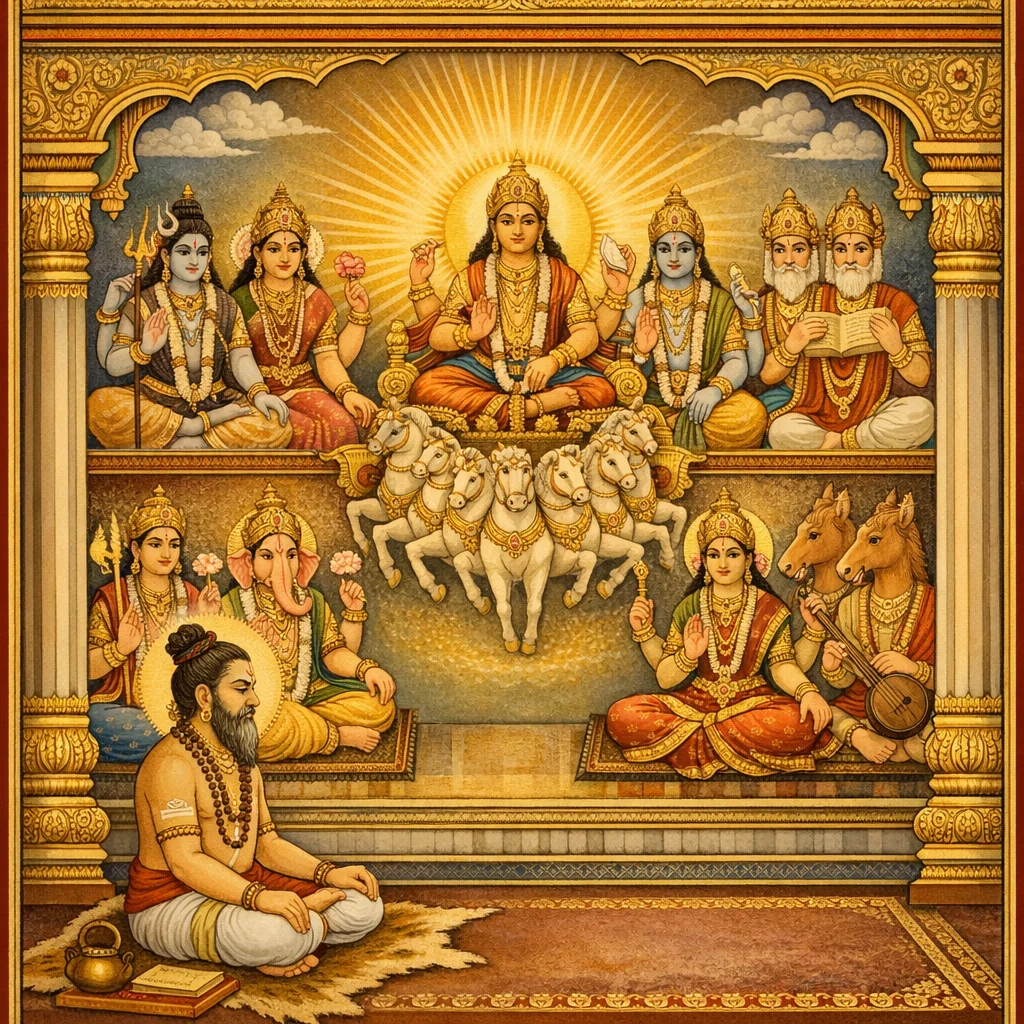
Adhyaya 278
Chapter 278 is framed as a dialogue in which Sūta explains to the ṛṣis why, though the sun appears as one in the sky, twelve solar forms are ritually established in the Hāṭakeśvara-kṣetra. These solar installations are linked to Yājñavalkya’s consecration, and the narrative recalls Brahmā’s descent under Sāvitrī’s curse, raising dharmic tensions about marital order and ritual propriety. The account then turns to Yājñavalkya’s conflict with his guru Śākalya: repeated royal requests for śānti rites lead to disrespect, refusal, and a guru–disciple dispute that ends with Yājñavalkya being forced to “expel” the learning he had received, symbolizing renunciation of prior instruction. Seeking restoration, he undertakes disciplined devotion to Sūrya, creates and installs twelve solar mūrtis, names them in a canonical list, and worships them with offerings. Sūrya appears, grants a boon, and transmits Vedic knowledge through an extraordinary motif—learning at the ear of the solar horse—thereby reauthorizing Yājñavalkya’s Vedic competence. The chapter closes by establishing this teaching as a tradition, declaring pilgrimage merits (release from sins, ascent, and liberation for reciters and explainers), and highlighting Sunday darśana as especially efficacious.
Shlokas
Verse 1
सूत उवाच । ये चान्ये भास्करा स्तत्र संति ब्राह्मणसत्तमाः । हाटकेश्वरजे क्षेत्रे याज्ञवल्क्यप्रतिष्ठिताः
Sūta said: O best of brāhmaṇas, there too are other forms of Bhāskara (the Sun), established by Yājñavalkya in the sacred kṣetra of Hāṭakeśvara.
Verse 2
यस्तान्पूजयते भक्त्या हृदि कृत्वाऽभिवांछितान् । सप्तम्यां चैव सप्तम्यां लभते नात्र संशयः
Whoever worships them with devotion, holding the desired aim within the heart—on Saptamī, the seventh lunar day, he attains that very wish; of this there is no doubt.
Verse 3
ऋषय उचुः । एक एव स्थितः सूर्यो दृश्यते च नभस्तले । तत्कथं द्वादशैते च तत्र क्षेत्रे प्रतिष्ठिताः । कस्मिन्काले तथा कृत्ये किमर्थं सूतनन्दन
The sages said: The Sun is seen as one, abiding in the vault of heaven. How then are these twelve established in that sacred field? At what time, in what circumstance, and for what purpose, O son of Sūta?
Verse 4
सूत उवाच । आसीत्पूर्वं कृतिर्नाम शुनःशेपसमुद्भवः
Sūta said: Formerly there was one named Kṛti, born in the lineage of Śunaḥśepa.
Verse 5
तस्य पुत्रः शुनः पुत्रो बभूव मुनिसत्तमः । चारायणः सुतस्तस्य वभूव मुनिसत्तमः
From him was born a son—Śuna’s son—who became an excellent sage; and his son Cārāyaṇa too became a foremost among seers.
Verse 6
कस्यचित्त्वथ कालस्य ब्रह्मा लोक पितामहः । सावित्रीशापनिर्दग्धो ह्यवतीर्णो धरातले
Then, at a certain time, Brahmā—the grandsire of the worlds—scorched by Savitrī’s curse, descended upon the earth.
Verse 7
गायत्री च यदा विप्रास्तेनोढा यज्ञकर्मणि । प्राक्स्थितां च परित्यज्य सर्वदेवसमागमे । कालात्ययो भवेन्नैव सावित्र्यागमने स्थिरे
O brāhmaṇas, when Gāyatrī was wedded for the performance of the sacrifice—setting aside Savitrī who had departed earlier—then, in the assembly of all the gods, no delay of time was tolerated, even though Savitrī’s arrival was awaited.
Verse 8
ततस्तस्य समादेशाद्गायत्री गोपकन्यका । शक्रेण च समानीता दिव्यलक्षणलक्षिता
Then, by his command, Gāyatrī—manifest as a cowherd maiden—was brought by Śakra (Indra), adorned with divine marks.
Verse 9
गोपकन्यां च तां ज्ञात्वा गोश्च वक्त्रेण पद्मजः । प्रवेश्याकर्षयामास गुह्येन च ततः परम्
Knowing her to be that cowherd maiden, Padmaja (Brahmā) made her enter through a cow’s mouth, and thereafter drew her to himself by a secret means.
Verse 10
ब्राह्मणानां गवां चैव कुलमेकं द्विधा स्थितम् । एकत्र मन्त्रास्तिष्ठंति हविरेकत्र संस्थितम्
The lineage of brāhmaṇas and of cows is one, though it stands in two forms: in one place abide the mantras, and in the other is established the havis, the sacred oblation.
Verse 11
तेन तां ब्राह्मणीं कृत्वा पश्चात्तस्याः परिग्रहम् । गृह्योक्तविधिना चक्रे पुरःस्थोऽपि पितामहः
Thus he made her a brāhmaṇa woman; thereafter the Grandsire (Brahmā), though seated at the fore, performed her acceptance as wife according to the procedure taught in the Gṛhya rites.
Verse 12
पत्नीशालोपविष्टायां ततस्तस्यां द्विजोत्तमाः । सावित्री समनुप्राप्ता देवपत्नीभिरावृता
O best of the twice-born, when she was seated in the wife’s pavilion, Savitrī then arrived, surrounded by the wives of the gods.
Verse 13
ततस्तां सा समालोक्य रशनासमलंकृताम् । दौर्भाग्यदुःखमापन्ना शशाप च विधिं ततः
Then, seeing her adorned with a girdle, Sāvitrī—overcome by the sorrow of misfortune—thereupon cursed Vidhi (Brahmā).
Verse 14
सावित्र्युवाच । यस्मात्त्वया परित्यक्ता निर्दोषाहं पितामह । पितामहोऽसि मे नूनमद्यप्रभृति संगमे
Sāvitrī said: “Since I, though blameless, have been cast aside by you, O Grandsire—therefore from today onward, in matters of union you shall be to me only a ‘grandsire’ indeed.”
Verse 15
मनुष्याणां भवेत्कृत्यमन्यनारीपरिग्रहः । एतत्त्वया कृतं यस्मान्मा नुषस्त्वं भविष्यसि
“For human beings, taking another’s woman becomes a ruinous deed. Since you have done this, therefore you shall become a human.”
Verse 16
कामार्तश्च विशेषेण मम वाक्यादसंशयम्
“And, tormented especially by desire—of this there is no doubt, by my very words.”
Verse 17
एवमुक्त्वा तु सावित्री त्यक्त्वा तं यज्ञमंडपम् । गिरेः शिखरमारूढा तपश्चक्रे महत्ततः
Having spoken thus, Sāvitrī left that sacrificial pavilion; ascending the mountain’s peak, she then undertook great austerities.
Verse 18
पितामहोऽपि तच्छापाच्चारायणनिवेशने । अवतीर्णो धरापृष्ठे कालेन महता ततः
Even Pitāmaha (Brahmā), because of that curse, in the settlement of Cārāyaṇa, descended upon the earth’s surface after a long passage of time.
Verse 19
स यदा यौवनं भेजे मानुषं च पुरा स्थितः । तथातथा च तापेन कामोत्थेन प्रपीड्यते
When he attained human youth, though formerly established otherwise, he was tormented again and again by the burning heat born of desire.
Verse 20
ततोऽसौ वीक्षते नारीं कन्यां वाथ तपस्विनीम् । अविकल्पमना भेजे रूपसौभाग्यगर्वितः
Then he beheld a woman—either a maiden or an ascetic woman—and, his mind without restraint, he yielded to her, puffed up with pride in his beauty and good fortune.
Verse 21
ततस्तं ब्यसनार्तं च दृष्ट्वा चारायणो मुनिः । स्वयं निःसारयामास प्रकोपेन निजाश्रमात्
Seeing him distressed by misfortune, the sage Cārāyaṇa himself, in anger, drove him out from his own hermitage.
Verse 22
स च पित्रा परित्यक्तो भ्रममाणस्ततस्ततः । चमत्कारपुरं प्राप्तः शाकल्यो यत्र तिष्ठति
Abandoned by his father, wandering from place to place, he reached Camatkārapura, where Śākalya dwelt.
Verse 23
नाम्ना ब्राह्मणशार्दूलो नागरो वेदपारगः । वृतः शिष्य सहस्रेण वेदविद्यां प्रचारयन्
There was a Nāgara brāhmaṇa named Brāhmaṇaśārdūla, a master of the Vedas; surrounded by a thousand disciples, he spread Vedic knowledge.
Verse 24
अथ तं स प्रणम्योच्चैः शिष्यत्वं समुपागतः । वेदाध्ययनसंपन्नो बभूवाथ चिरादपि
Then, bowing to him with reverence, he entered discipleship; and in due time he too became accomplished in Vedic study.
Verse 25
एतस्मिन्नेव काले नु आनर्ताधिपतिः स्वयम् । आगतस्तिष्ठते यत्र जलशायी हरिः स्वयम्
At that very time, the ruler of Ānarta himself arrived and stayed at the place where Hari—manifest as Jalaśāyī, the Lord who reclines upon the waters—abides.
Verse 26
चातुर्मास्यव्रतं तेन गृहीतं तत्पुरस्तदा । प्रार्थितस्तु ततो विप्राः शाकल्यस्तैन भूभुजा
There, in the Lord’s presence, he undertook the Cāturmāsya vow. Then the king requested the brāhmaṇas—especially Śākalya—to perform the required rites.
Verse 27
शांतिकं पौष्टिकं नित्यं त्वया कार्यं ममालये । यावत्तिष्ठाम्यहं चात्र प्रसादः क्रियतामिति
The king said: “In my abode you should daily perform the śāntika rites of pacification and the pauṣṭika rites that bestow prosperity; as long as I remain here, let this favor be granted.”
Verse 28
बाढमित्येव स प्रोक्त्वा दाक्षिण्येन द्विजोत्तमाः । एकैकं प्रेषयामास स्वशिष्यं तस्य मंदिरे
Saying, “So be it,” the foremost of brāhmaṇas, out of graciousness, sent his own disciples one by one to the king’s residence to carry out their appointed duties.
Verse 29
स शांतिकं विधायाथ दत्त्वाशीः पार्थिवस्य च । संप्राप्य दक्षिणां तस्मात्पुनरेति च तं द्विजम्
Having performed the śānti rite and bestowed blessings upon the king, he received the dakṣiṇā from him and then returned again to that brāhmaṇa teacher.
Verse 30
शाकल्याय च तां दत्त्वा दक्षिणां निजमंदिरे । जगाम नित्यमेवं हि व्यवहारो व्यवस्थितः
And after handing that dakṣiṇā to Śākalya in his own dwelling, he departed. Thus, day after day, this arrangement of service became firmly established.
Verse 31
अन्यस्मिन्नहनि प्राप्ते शाकल्येन विसर्जितः । शांत्यर्थं याज्ञवल्क्यस्तु पार्थिवस्यनिवेशनम्
On another day, Yājñavalkya, dispatched by Śākalya for the sake of performing the śānti rite, went to the king’s residence.
Verse 32
तस्य भूपस्य रूपाढया मंथरास्ति विलासिनी । रात्रौ च कामिता तेन कामाढयेन सुकामिनी
That king had a pleasure-loving woman named Mantharā, richly endowed with beauty; and at night she was desired by him, overflowing with passion, while she too was eager for love.
Verse 33
भावैर्वात्स्यायनप्रोक्तैः समालिंगनपूर्वकैः । स तया विविधैः कृत्तो मयूरपदकादिभिः । शरीरे चाधरे चैव तथा मणिप्रवालकैः
Using the amorous arts taught by Vātsyāyana, beginning with embraces, she made many marks upon him—peacock-foot designs and the like—upon his body and even upon his lips, as well as imprints made with jewels and coral.
Verse 34
संप्राप्तोऽध्ययनार्थाय यावच्छाकल्यसन्निधौ । तावत्संप्रेषितस्तेन शांत्यर्थं भूपमंदिरे
When he came into Śākalya’s presence for the sake of study, at that very time Śākalya sent him to the king’s palace to perform a śānti rite for pacification.
Verse 35
सोऽपि संप्रेषितस्तेन गत्वा तं पार्थिवालयम् । शांतिकं च ततश्चक्रे यथोक्तविधिना द्विजाः
Sent by him, the brāhmaṇa went to the king’s residence; and there, O twice-born ones, he performed the pacificatory śānti rite exactly according to the prescribed procedure.
Verse 36
शांतिकस्यावसाने तु प्रगृह्य कलशोदकम् । पंचांगैः कल्पितं रुद्रैः स्वयमेवाभिमंत्रितैः
When the śānti rite concluded, he took up the water from the ritual jar (kalaśa)—prepared with the five requisites and consecrated by Rudra-mantras, self-invoked and duly empowered.
Verse 37
साक्षतं सुमनोयुक्तं समादाय गतस्ततः । संतिष्ठते नृपो यत्र आनर्तो त्रतसंयुतः
Then, taking akṣata (unbroken rice-grains) together with flowers, he went to the place where the king of Ānarta stood, attended by his retinue.
Verse 38
द्यामालेखीति मंत्रं स प्रोच्चार्य विधिपूर्वकम् । छंदर्षिसहितं चैव यावत्क्षिपति मस्तके । तावन्निरीक्षितस्तेन नखलेखाविकर्तितः
Reciting in due order the mantra beginning “dyāmālekhī…”, together with its chandas and ṛṣi, he cast it upon the king’s head. At that very moment he was noticed—his lip disfigured, as though cut by a fingernail’s scratch.
Verse 39
खंडितेनाधरेणैव ततोऽभूद्दुर्मना नृपः
Then the king became deeply dejected, for his lip was indeed split and disfigured.
Verse 40
विटप्रायं तु तं दृष्ट्वा मलिनांबरधारिणम् । तं प्रोवाच विहस्योच्चै देहि विप्राऽक्षताञ्जलम्
Seeing him wretched, clad in soiled garments, someone addressed him loudly with a laugh: “O brāhmaṇa, give me a handful of akṣata (unbroken rice)!”
Verse 41
मंदुरायां स्थितं यच्च काष्ठमेतत्प्रदृश्यते । याज्ञवल्क्यस्ततो दृष्ट्वा सकोपस्तमुपाद्रवत्
“And this piece of wood that is seen lying in the stable…”—when Yājñavalkya saw that, he became enraged and rushed at him.
Verse 42
क्षिप्त्वा तत्र जलं विप्राः साक्षतं गृहमागमत् । अगृह्य दक्षिणां तस्य पार्थिवस्य यथास्थिताम्
After casting the water there, the brāhmaṇas returned home with their akṣata—without accepting the king’s fee (dakṣiṇā) that had been set aside.
Verse 43
एतस्मिन्नंतरे तस्य धवकाष्ठस्य सर्वतः । निष्क्रांता विविधाः शाखाः पल्लवैः समलंकृताः
Meanwhile, from that piece of dhava-wood, branches of many kinds sprang forth on every side, beautifully adorned with fresh shoots and leaves.
Verse 44
तद्दृष्ट्वा विस्मितः सोऽथ आनर्ताधिपतिर्नृपः । पश्चात्तापं परं चक्रे धिङ्मयैवमनुष्ठितम्
Seeing that, the king—lord of Ānarta—was astonished; and then he fell into profound remorse, saying, “Shame on me for having acted in this way!”
Verse 45
स नूनं विबुधः कोऽपि विप्ररूपेण संगतः । येनेदृशः प्रभावोऽयं तस्य मंत्रस्य संस्थितः
Surely some divine being has come here in the form of a brāhmaṇa; by him this mantra has been established with such extraordinary power.
Verse 46
यद्यहं प्रतिगृह्णामि तस्य मन्त्रोदितं जलम् । जरामरणहीनस्तु तद्भवाभि न संशयः
If I accept that water—consecrated by his mantra—then I would become free from old age and death; of that there is no doubt in my mind.
Verse 47
एवं चिंतयतस्तस्य तद्दिनं विस्मितस्य च । पार्थिवस्य द्विजश्रेष्ठा जातं वर्षशतोपमम्
As he pondered thus—astonished—O best of brāhmaṇas, that single day of the king seemed like a hundred years.
Verse 48
दिवसे तु समाक्रांते कथंचित्तस्य भूपतेः । विभावरी क्षयं याति कथंचिन्नैव शारदी
When at last day arrived for that king, the night somehow came to its end—yet it did not pass in the ordinary manner of an autumn night.
Verse 49
ततः प्रभातसमये समुत्थाय महीपतिः । आह्वयामास शाकल्यं पुरुषैराप्तकारिभिः
Then, at dawn, the king rose and summoned Śākalya through his trusted attendants.
Verse 50
ततः प्रोवाच विनयात्सादरं प्रांजलिः स्थितः । कल्ये शिष्यः समायातो यस्त्वदीयो ममांतिकम्
Then, standing with joined palms and speaking respectfully, he said: “This morning your disciple has arrived near me—he who belongs to you.”
Verse 51
शांत्यर्थं प्रेषणीयस्तु सोऽद्यापि च द्विजोत्तम । तस्योपरि परा भक्तिर्मम जाताऽद्य केवलम्
“He should still be dispatched for the rite of pacification (śānti), O best of brāhmaṇas. Indeed, today my highest devotion has arisen toward him alone.”
Verse 53
गच्छ वत्स त्वमद्यैव पार्थिवस्य निवेशनम् । शांत्यर्थं तेन भूयोऽपि त्वमेवाशुनिमंत्रितः
“Go, my child, today itself to the king’s residence. For the sake of pacification (śānti), he has summoned you again—quickly.”
Verse 54
याज्ञवल्क्य उवाच । नाहं यास्यामि तद्धर्म्ये शांत्यर्थं द्विजपुंगव । अनादरेण दृष्टोऽहं नाशीर्मे च समाहृता
Yājñavalkya said: “I will not go there, O foremost among brāhmaṇas, for that rite of pacification. I was regarded with disrespect, and no honor was offered to me.”
Verse 55
काष्ठोपरि मया दत्ता तस्य वाक्यादसंशयम् । तस्मात्प्रेषय चान्यं त्वं गुरो शिष्यं विचक्षणम् । आनर्तं रंजयेद्यस्तु विवेकेन समन्वितम्
“Without doubt, because of his words I was made to sit upon a mere piece of wood. Therefore send another discerning disciple of the teacher, endowed with discrimination (viveka), who can properly satisfy and guide that king.”
Verse 56
शाकल्य उवाच । राजाऽदेशः सदा कार्यः पुरुषैर्देशवासिभिः । योगक्षेमविधानाय तथा लाभाय केवलम्
Śākalya said: “The king’s command should always be carried out by the men who dwell in his realm, for it is meant to secure yogakṣema—welfare and protection—and indeed prosperity as well.”
Verse 57
प्रतिकूलो भवेद्यस्तु पाथिवानां स मन्दधीः । न तस्य जायते सौख्यं कथंचिद्द्विजसत्तम
“But whoever becomes hostile to kings is dull-witted; for him, O best of the twice-born, happiness does not arise in any manner.”
Verse 58
ये जात्यादि महोत्सेकान्न नरेंद्रानुपासते । तेषामामरणं भिक्षा प्रायश्चित्तं विनिर्मितम्
“Those who, puffed up with pride of birth and the like, do not honor and attend upon kings—for them, begging alms until death has been set forth as an expiation (prāyaścitta).”
Verse 59
एवं तयोर्विवदतोस्तदा वै गुरुशिष्ययोः । भूयोऽपि तत्र संप्राप्ताः पुरुषाः पार्थिवेरिताः
While the guru and the disciple were thus disputing, men dispatched by the king arrived there once again.
Verse 60
प्रोचुश्च त्वरया युक्ताः शाकल्यं प्रांजलिस्थिताः । शिष्यं तं प्रेषय क्षिप्रं राजा मार्गं प्रतीक्षते
Hastening, and standing with folded hands, they spoke to Śākalya: “Send that disciple quickly—the king is waiting on the road.”
Verse 61
असकृत्प्रोच्यमानोऽपि यदा गच्छति नैव सः । तदा संप्रेषयामास उद्दालकमथारुणिम्
Though repeatedly urged, when he still would not go, then Śākalya sent Uddālaka, the son of Aruṇi.
Verse 62
शिष्यं विनयसंपन्नं कृतांजलिपुटं स्थितम् । गच्छ वत्स समादेशात्सांप्रतं नृपमंदिरम्
To the disciple—endowed with humility, standing with hands folded—he said: “Go, my son, by my command, now to the king’s palace.”
Verse 63
शांतिकर्म विधायाथ स्वाध्यायं च ततः कुरु
Having performed the rite of pacification (śānti-karman), then undertake your Vedic recitation and study (svādhyāya).
Verse 64
स तथेति प्रतिज्ञाय गत्वा तं पार्थिवालयम् । चकार शांतिकं कर्म विधिदृष्टेन कर्मणा
He assented, saying, “So be it,” and went to the king’s residence. There he performed the pacificatory rite (śāntika) according to the procedure enjoined by rule.
Verse 65
ततः कलशतोयं स साक्षतं सुमनोन्वितम् । गृहीत्वोपाद्रवत्तत्र यत्र राजा व्यवस्थितः
Then, taking water from a ritual pot (kalaśa)—together with akṣata (unbroken grains of rice) and adorned with flowers—he hurried to the place where the king was stationed.
Verse 66
राजोवाच । स्वकीयमन्त्रलिंगेन अभिषेकं तु यच्छ भोः । काष्ठस्यास्य यदग्रे ते प्रोत्थितं तिष्ठते द्विज
The king said: “O reverend one, bestow the abhiṣeka, the consecratory bathing, by means of your own mantra and liṅga. O brāhmaṇa, do so for this piece of wood—upon whose front that manifestation has arisen and stands.”
Verse 67
ततस्तेन शुभं मंत्रं प्रोच्याभीष्टं जलं स्वयम् । अभिषिच्य च तत्काष्ठं ततश्च स्वगृहं ययौ
Then, uttering that auspicious mantra, he himself took the desired water; having consecrated that piece of wood with abhiṣeka, he thereafter went to his own home.
Verse 68
तावद्रूपं च तत्काष्ठं दृष्ट्वाऽनर्तो महीपतिः । विषादसहितश्चैव पश्चात्तापसमन्वितः
Seeing that very form upon the piece of wood, the king became distressed—filled with sorrow and burdened with remorse.
Verse 69
भूयस्तु प्रेषयामास याज्ञवल्क्यकृते तदा । अन्यं दूतं विदग्धं च शाकल्यस्य द्विजाश्रयम्
Then again, on account of Yājñavalkya, he sent another messenger—clever and capable—to Śākalya, the refuge of the brāhmaṇas.
Verse 70
वेदना कायसंस्था मे वर्तते द्विजसत्तम । शांत्यर्थं प्रेषया क्षिप्रं तं शिष्यं पूर्वसंचितम्
“O best of brāhmaṇas, a bodily pain afflicts me. For pacification, send quickly that disciple who was prepared beforehand.”
Verse 71
अपमानं कृतं तस्य मया कल्ये द्विजोत्तम । तेन मे सहसा व्याधिराशीर्वादमनिच्छतः
“O best of brāhmaṇas, I insulted him yesterday. Because of that, a sudden illness has come upon me—though he did not wish to bestow any blessing.”
Verse 72
तस्मात्प्रेषय मे शीघ्रं येन मे स्वस्थता भवेम् । असकृत्प्रोच्यमानोऽपि यदा नैव स गच्छति
“Therefore send him to me quickly, so that I may regain health. Even when repeatedly requested, if he still does not go…”
Verse 73
याज्ञवल्क्यस्ततः शिष्यमन्यं प्रोवाच सादरम् । ततस्तं मधुकं पैग्यं प्रेषयामास तद्गृहे
Then Yājñavalkya respectfully addressed another disciple; thereafter he sent Madhuka Paigya to that house.
Verse 74
तेनापि विहितं तच्च यथोद्दालकनिर्मितम् । आशीर्वादो नृपोद्देशाद्दत्तः काष्ठस्य तस्य च
He too performed it in the same manner as Uddālaka had done. And at the king’s request, a blessing was bestowed—even upon that piece of wood.
Verse 76
असकृत्प्रोच्यमानोऽपि याज्ञवल्क्यो व्रजेन्न हि । यदा तदा बहुगुणमन्यं शिष्यं प्रदिष्टवान्
Though repeatedly entreated, Yājñavalkya did not go there. At that time, he instead appointed another disciple—one endowed with many virtues.
Verse 77
प्रचूडं भागवित्तिं च सोऽपि गत्वा यथा पुरा । चकार शांतिकं कर्म यथा ताभ्यां पुरा कृतम्
He too went to Pracūḍa and Bhāgavitti, as before, and performed the pacificatory rite (śānti-karman) exactly as those two had done earlier.
Verse 78
ततः शांत्युदकं तस्मिन्प्राक्षिपच्चैव दारुणि । मंत्रवच्च तथाप्येव तद्रूपं च व्यवस्थितम्
Then he cast consecrated peace-water (śānty-udaka) upon that dreadful thing; yet, though done with mantra, that very form remained fixed as it was.
Verse 79
तद्रूपमपि तत्काष्ठं दृष्ट्वा भूयोऽपि पार्थिवः । अन्यं संप्रेषयामास याज्ञवल्क्यकृते नरम्
Seeing that the piece of wood still remained in the same form, the king once again sent another man—this time to fetch Yājñavalkya.
Verse 80
प्रणम्य स द्विजश्रेष्ठः शाकल्यं च द्विजोत्तमम् । शांत्यर्थं मम हर्म्ये त्वं कल्ये शिष्यं समादिश । येन मे जायते शांतिः शरीरस्य द्विजोत्तम
Having bowed, that foremost Brāhmaṇa addressed Śākalya, the best of the twice-born: “For the sake of pacification, please appoint a disciple to come to my palace tomorrow morning—one by whom peace and relief may arise for my body, O excellent Brāhmaṇa.”
Verse 81
ततः प्रोवाच शाकल्यो याज्ञवल्क्यं द्विजोत्तमाः । भूयोऽपि शृण्वतस्तस्य आनर्तस्य महीपतेः
Then Śākalya, the excellent Brāhmaṇa, spoke to Yājñavalkya, while that king of Ānarta listened once more.
Verse 82
याज्ञवल्क्य द्रुतं गच्छ ममादेशान्नृपालयम् । राज्ञोस्य रोगनाशाय शांतिकं कुरु पुत्रक
“Yājñavalkya, go quickly—by my command—to the royal residence. For the destruction of this king’s illness, perform the pacificatory rite (Śānti), my son.”
Verse 83
याज्ञवल्क्य उवाच । नाहं तत्र गमिष्यामि गुरो मैवं ब्रवीहि माम् । अपमानः कृतोऽनेन गुरो मम महीभुजा
Yājñavalkya said: “I will not go there, Guru—do not speak to me thus. That king has insulted me, O teacher.”
Verse 84
तस्य तद्वचनं श्रुत्वा स कोपं परमं गतः । अब्रवीद्भर्त्समानस्तु याज्ञवल्क्यं ततः परम्
Hearing those words of his, he became exceedingly angry; then, rebuking him, he spoke further to Yājñavalkya.
Verse 85
एकमप्यक्षरं यस्तु गुरुः शिष्ये निवेदयेत् । पृथिव्यां नास्ति तद्द्रव्यं यद्दत्त्वा चानृणी भवेत्
Even if a guru imparts to a disciple but a single syllable, there is nothing on earth that one could give and thereby be freed from that sacred debt.
Verse 86
यस्मात्त्वं शिष्यतां गत्वा मम वाक्यं करोषि न । तस्मात्त्वां योजयिष्यामि ब्रह्म शापेन सांप्रतम्
Since, though you have taken the station of a disciple, you do not carry out my word, therefore I shall now bind you with a brahmanical curse.
Verse 87
याज्ञवल्क्य उवाच । अन्यायेन हि चेच्छापं गुरो मम प्रदास्यसि । अहमप्येव दास्यामि प्रतिशापं तवाधुना
Yājñavalkya said: “If, O teacher, you intend to lay a curse upon me unjustly, then I too, at this very moment, shall pronounce a counter-curse upon you.”
Verse 88
गुरोरप्यवलिप्तस्य कार्याकार्यमजानतः । उत्पथे वर्तमानस्य परित्यागो विधीयते
Even a guru—if arrogant, ignorant of what should and should not be done, and proceeding on a wrongful path—may rightly be abandoned; such abandonment is enjoined.
Verse 89
तस्मात्त्वं हि मया त्यक्तः सांप्रतं हि न मे गुरुः । अविशषेण शिष्यार्थं यदादेशं प्रयच्छसि
Therefore I have renounced you; at present you are no longer my guru. Yet, without distinction, grant whatever instruction you would give for a disciple’s good.
Verse 90
यावंतस्ते स्थिताः शिष्यास्तावद्भिर्दिवसैरहम् । तवादेशं करिष्यामि नोचेद्यास्यामि दूरतः
“For as many days as your disciples remain with you, for that many days I shall carry out your command; otherwise, I will depart far away.”
Verse 91
शाकल्य उवाच । यदि गच्छसि चान्यत्र तत्त्वं विद्यां परित्यज । यां मया पाठितः पाप व्रज पश्चात्कुशिष्य भोः
Śākalya said: “If you go elsewhere, then abandon the sacred knowledge and its true import that I taught you. Depart—O sinful one, O wretched disciple—go behind and away!”
Verse 92
मयाभिमंत्रितं तोयं क्षुरिकामुण्डसंभवम् । पिब तस्याः प्रभावेण शीघ्रमेव त्यजिष्यसि । जठरान्मामकीं विद्यां त्वयाधीता पुरा तु या
“Drink this water, which I have consecrated with mantras, born of the fierce ‘Kṣurikāmuṇḍa’ rite, sharp as a razor. By its power you will swiftly cast out from your belly the knowledge that is mine, which you once learned from me.”
Verse 93
एवमुक्त्वा स चामंत्र्य मंत्रैराथर्वणैर्जलम् । पानाय प्रददौ तस्मै वांत्यर्थं सद्विजोत्तमः
Having spoken thus, that best of the twice-born consecrated the water with Atharvan mantras and gave it to him to drink, in order to induce vomiting.
Verse 94
याज्ञवल्क्योऽपि तत्पीत्वा जलं तेनाभिमंत्रितम् । वांतिं कृत्वा सहान्नेन तद्विद्यां तां परित्यजत्
Yājñavalkya too drank that water consecrated by him; and after vomiting—along with his food—he abandoned that received learning.
Verse 95
ततो मूढत्वमापन्नो विश्वामित्रह्रदं शुभम् । गत्वा स्नातो विधानेन शुचि र्भूत्वा समाहितः
Then, having fallen into bewilderment, he went to the auspicious lake of Viśvāmitra. Bathing there according to the prescribed rite, he became purified and steady, his mind composed.
Verse 96
चकार मूर्तीस्ता भक्त्या रवेर्द्वादशसंख्यया । प्रतिष्ठाप्य ततः सर्वाः पूजयामास भक्तितः
With devotion he fashioned twelve images of Ravi, the Sun. Having duly installed them all, he worshipped them with heartfelt bhakti.
Verse 97
धाता मित्रोऽर्यमा शक्रो वरुणः सांब एव च । भगो विवस्वान्पूषा च सविता दशमस्तथा । एकादशस्तथा त्वष्टा विष्णुर्द्वादश उच्यते
Dhātā, Mitra, Aryaman, Śakra, Varuṇa, and Sāṃba; Bhaga, Vivasvān, Pūṣan, and Savitṛ as the tenth; then the eleventh, Tvaṣṭṛ; and Viṣṇu is declared the twelfth—these are the twelve forms of the Sun spoken of here.
Verse 98
एवं द्वादशधा सूर्यः स्थापितोऽत्र विपश्चिता । आराधितस्ततो नित्यं गन्धपुष्पानुलेपनैः
Thus the wise one established the Sun here in twelvefold form; thereafter he worshipped Him daily with fragrances, flowers, and sacred unguents.
Verse 99
ततः कालेन महता गत्वा प्रत्यक्षतां रविः । प्रोवाच सुन्दरं प्रीत्या वाक्यमेतन्मुनिं प्रति
After a long time, Ravi, the Sun, manifested visibly. Pleased, he spoke to the sage these gracious and beautiful words.
Verse 100
याज्ञवल्क्य प्रतुष्टोऽहं तव ब्राह्मणसत्तम । इष्टं ददामि ते ब्रूहि यद्यत्संप्रति वांछितम्
“Yājñavalkya, best among brāhmaṇas, I am pleased with you. I shall grant you the boon you desire—tell me what you wish for now.”
Verse 101
याज्ञवल्क्य उवाच । वरं ददासि चेन्मह्यं वेदपाठे नियोजय । मां विभो येन शिष्यत्वं तव गच्छामि सांप्रतम्
Yājñavalkya said: “If you are granting me a boon, O Lord, appoint me to the recitation and study of the Vedas, so that I may now attain discipleship under you.”
Verse 102
आदित्य उवाच । मया पर्यटनं कार्यं सदैव द्विजसत्तम । मेरोः प्रदक्षिणार्थाय लोकालोककृते द्विज
Āditya said: “O best of the twice-born, I must ever move upon my course—circling Meru for the sake of the worlds and their boundaries, to uphold the ordering of light and darkness, O brāhmaṇa.”
Verse 103
तत्कथं योजयामि त्वां वेदपाठेन स द्विज
“How, then, can I engage you in Vedic recitation, O twice-born?”
Verse 104
तस्मात्त्वं लघुतां गत्वा मम मुख्यहयस्य च । श्रवणे तिष्ठ मद्वाक्यात्तेजसा चैव येन मे
“Therefore, become subtle and enter the ear of my foremost horse; remain there, sustained by my command and by my radiance (tejas).”
Verse 105
न दह्यसि महाभाग तत्र स्थोऽध्ययनं कुरु । स तथेति प्रतिज्ञाय प्रविश्यादित्यवाजिनः
“You will not be burned, fortunate one; remain there and pursue your sacred study.” He assented, vowing, “So be it,” and entered Āditya’s steed.
Verse 106
कर्णेऽपठत्ततो वेदांश्चतुरोऽपि च तन्मुखात् । अंगोपांगसमोपेतान्परिशिष्टसमन्वितान्
Then, through the ear, he learned from that mouth all four Vedas—together with their aṅgas and upāṅgas, and with the ancillary appendices (pariśiṣṭas).
Verse 107
ततः समाप्ते स प्राह प्रार्थयस्व विभो हि माम् । प्रदास्यामि न सन्देहस्तवाद्य गुरुदक्षिणाम्
When the study was completed, he said: “O venerable one, ask of me. Without doubt, today I shall offer you your guru-dakṣiṇā, the honorarium due to the teacher.”
Verse 108
आदित्य उवाच । यानि सूक्तानि ऋग्वेदे मदीयानि द्विजोत्तम । सावनानि यजुर्वेदे सामानि च तृतीयके
Āditya said: “O best of the twice-born, the sūktas in the Ṛgveda that are mine, the Sāvana formulas in the Yajurveda, and the Sāman chants in the third Veda, the Sāmaveda—”
Verse 110
ये द्विजास्तानि सर्वाणि कीर्तयिष्यंति मे पुरः । ते सर्वे पाप निर्मुक्ताः प्रयास्यंति दिवालयम्
Those twice-born who recite all of these before me—every one of them, freed from sin, shall attain the heavenly abode.
Verse 111
व्याख्यास्यंति पुनर्ये च मम भक्तिपरायणाः । ते यास्यंति द्विजा मुक्तिं सत्यमेतन्मयोदितम्
And those twice-born who, devoted to me in bhakti, will again expound these teachings—they shall attain liberation (moksha). This is truly spoken by me.
Verse 112
सूत उवाच । एवं वेदान्पठित्वा स प्रदत्त्वा गुरुदक्षिणाम् । सूर्यायाभ्यागतो भूयश्चमत्कारपुरं प्रति
Sūta said: “Thus, having studied the Vedas and having offered the guru-dakṣiṇā (the teacher’s honorarium), he again came to Sūrya, and then proceeded toward Camatkārapura.”
Verse 113
ततः शाकल्यमभ्येत्य गुरुस्त्वं प्राङ् मम स्थितः । प्रार्थयस्व महाभाग दास्यामि गुरुदक्षिणाम्
Then, approaching Śākalya, he said: “You are my teacher, standing before me. O fortunate one, ask— I shall give the guru’s honorarium (guru-dakṣiṇā).”
Verse 114
ज्येष्ठो भ्राता पिता चैव माता चैव गुरुस्तथा । वैरुद्ध्येनापि वर्तंते यद्येते द्विजसतम । तथापि पूजनीयाश्च पुरुषेण न संशयः
An elder brother, father, mother, and likewise the guru—O best of the twice-born—even if they act in opposition, still they must be honored by a person; of this there is no doubt.
Verse 115
सांगोपांगा मयाधीता वेदाश्चत्वार एव च । अधीताश्चैव सर्वेषां तेषामर्थोऽवधारितः
I have studied the four Vedas together with their aṅgas and upāṅgas, the auxiliary and subsidiary disciplines; and having studied them all, I have grasped their meanings.
Verse 116
तत्त्वं वद महाभाग कां ते यच्छामि दक्षिणाम्
Speak the truth, O illustrious one: what dakṣiṇā (sacred offering) shall I give you?
Verse 117
शाकल्य उवाच । यानि वेदरहस्यानि सूर्येण कथितानि ते
Śākalya said: “Those secret teachings of the Veda that were spoken to you by Sūrya—”
Verse 118
यैः स्यात्पापप्रणाशश्च व्याख्यातैः पठितैस्तथा । तानि मे कीर्तय क्षिप्रमेषा मे गुरुदक्षिणा
“Tell me quickly of those teachings by which sin is destroyed—when they are studied and also explained. This will be my guru-dakṣiṇā, my offering to the teacher.”
Verse 119
याज्ञवल्क्य उवाच । तदागच्छ मया सार्धं यत्र सूर्याः प्रतिष्ठिताः । मया द्वादश तेषां च कीर्तयिष्यामि चात्रतः
Yājñavalkya said: “Then come with me to the place where the images of Sūrya are established. There, here and now, I shall describe the twelve of them.”
Verse 120
तच्छ्रुत्वा शिष्यसंयुक्तः शाकल्यस्तैश्च सद्द्विजैः । शिष्यैस्तिष्ठन्ति ये तत्र स्थापितास्तेन भास्कराः
Hearing this, Śākalya—accompanied by his disciples and by those worthy brāhmaṇas—went to the place where the Bhāskaras (forms of Sūrya) installed by him stood, with disciples present.
Verse 121
ततस्तु कीर्तयामास व्याख्यानं तत्पुरः स्थितः । वेदान्तानां च सर्वेषां यथोक्तं रविणा पुरा
Then, standing before them, he delivered the exposition of all the Vedāntas—just as the Sun (Ravi) had taught in ancient times.
Verse 122
अवसाने च तेषां तु चतुश्चरणसंभवैः । ब्राह्मणैर्याज्ञवल्क्यस्तु वेदान्तज्ञैः प्रतोषितः
And at the conclusion of that teaching, Yājñavalkya was greatly pleased by the brāhmaṇas—masters of Vedānta—born of the four ‘feet’ (i.e., grounded in the fourfold Vedic tradition).
Verse 123
प्रोक्तस्तव प्रसादेन वेदांतज्ञा वयं स्थिताः । श्रुताध्ययनसंपन्ना याचस्व गुरुदक्षिणाम्
“By your grace, we have been instructed and now stand established as knowers of Vedānta, accomplished in hearing and study. Ask, then, for your teacher’s fee (guru-dakṣiṇā).”
Verse 124
याज्ञवल्क्य उवाच । एतेषां भास्कराणां च मदीयानां पुरो द्विजाः । कीर्तयिष्यंति ये विप्रास्तेषां युष्मत्प्रसादतः । भूया स्वर्गगतिर्विप्रा एषा मे गुरु दक्षिणा
Yājñavalkya said: “O twice-born ones, by your favor, may those brāhmaṇas who recount (the glory of) these Bhāskaras established by me, in your presence, attain ever greater passage to heaven. This is the teacher’s fee I ask.”
Verse 125
ये पुनर्भक्तिसंयुक्ताः करिष्यंति विचारणम् । तेषां तुर्यपदं यच्च जरामरणवर्जितम्
But those who, endowed with devotion, undertake reflective inquiry—for them there is that ‘fourth state’ (turya), free from old age and death.
Verse 126
ब्राह्मणा ऊचुः । भविष्यति कलौ विप्रा दौस्थ्यभावसमन्विताः । पठने नैव शक्ताश्च व्याख्यानस्य च का कथा
The brāhmaṇas said: “In the age of Kali, brāhmaṇas will be weighed down by poverty and hardship—unable even to study; what then can be said of giving explanations?”
Verse 127
तस्मात्सारस्वतं ब्रूहि वेदानां द्विजसत्तम । अपि दौस्थ्यसमायुक्ता येन ते कीर्तयंति च
“Therefore, O best of the twice-born, teach the Sārasvata recitation of the Vedas—by which even those afflicted by hardship may still recite and proclaim them.”
Verse 129
चित्रं देवानामिति च तथान्यत्तस्य वल्लभम् । हंसः शुचिषदित्युक्तं ततश्चापि प्रहर्षदम्
“‘Citraṃ devānām’—and also another hymn dear to Him; ‘Haṃsaḥ śuciṣad’ as it is proclaimed; and thereafter that which bestows delight—(these Vedic praises are to be recited here).”
Verse 130
पावमानं तथा सूक्तं ये पठिष्यंति बह्वृचः । इत्येषामाद्यमेवं तु ते यास्यंति परां गतिम्
“And the Ṛg-veda reciters (Bahvṛcas) who recite the Pāvamāna Sūkta—thus beginning in this manner—shall attain the supreme state.”
Verse 131
एकविंशतिसामानि आदित्येष्टानि यानि च । सामगाः कीर्तयिष्यंति येऽत्रस्थाः शुचयः स्थिताः
“And the Sāma-chanters present here—pure and steady—will sing the twenty-one Sāmans prescribed for the worship of Āditya (Sūrya).”}]}
Verse 132
निश्चयं तु परं धृत्वा येऽपि स्तोष्यंति भास्करम् । ततस्तेऽपि प्रयास्यंति निर्भिद्य रविमंडलम्
Even those who, holding firm the highest resolve, praise Bhāskara (the Sun), they too shall pass onward, as though piercing the solar orb.
Verse 133
क्षुरिकासंपुटं चैव सूर्यकल्पं तथैव च । शांतिकल्पसमायुक्तं कीर्तयिष्यंति ये द्विजाः
And the twice-born who recite the Kṣurikā-saṃpuṭa, the Sūrya-kalpa, and that which is joined to the Śānti-kalpa—these too attain the stated merit.
Verse 134
अथर्वपाठकास्तेऽपि प्रयास्यंति परां गतिम् । मूर्खा अपि समागत्य संप्राप्ते सूर्यवासरे
Those who recite the Atharva-veda too shall attain the supreme state. Even the unlearned, merely by arriving when the Sun’s day (Sunday) has come…
Verse 135
प्रणामं ये करिष्यंति श्रद्धया परया युताः । सप्तरात्रकृतात्पापान्मुक्तिं प्राप्संति ते द्विजाः
Those twice-born who offer prostration, endowed with the highest faith, shall obtain liberation from sins committed over seven nights (the last seven days).
Verse 136
सूत उवाच । तथेति तैः प्रतिज्ञाते चतुश्चरणसंभवैः । ब्राह्मणैर्याज्ञवल्क्यस्तु विज्ञातो येन केन तु
Sūta said: “When those Brahmins—born of the four ‘feet’ of the Veda—had assented, saying, ‘So be it,’ Yājñavalkya became known to the king, in some manner or other.”
Verse 137
विदेहेन ततः प्राप्तः श्रवणार्थं नराधिपः । वेदांतानां च सर्वेषां रत्नाख्येन महीभुजा
Then the lord of men, the king of Videha named Ratna, came in order to listen to the teaching of all the Vedāntas.
Verse 138
तेनापि च परिज्ञाय माहात्म्यं सूर्यसं भवम् । ततः संस्थापितः सूर्यस्तस्मिन्स्थाने द्विजोत्तमाः
And he too, having understood the greatness that arises from Sūrya, then established Sūrya in that very place, O best of the twice-born.
Verse 139
तं चापि सूर्यवारेण यः प्रपश्यति मानवः । सप्तरात्रकृतात्पापान्मुच्यते नात्र संशयः
Whoever beholds that sacred presence on a Sunday, O man, is freed from the sins committed over seven nights—of this there is no doubt.
Verse 140
एतद्वः कथितं सर्वं माहात्म्यं सूर्यसंभवम् । यः शृणोति नरो भक्त्या अश्वमेधफलं लभेत्
Thus I have told you completely this greatness born of the power of Sūrya. Any man who listens with devotion obtains the fruit of an Aśvamedha sacrifice.
Verse 191
संक्रांतौ यत्प्रदानेन सूर्ये वा श्रवणेन तु । तत्फलं समवाप्नोति श्रुत्वा माहात्म्यमुतमम्
By whatever gift is given at Saṅkrānti—or by listening on a Sunday—one attains that very fruit, simply by hearing this supreme Māhātmya.
Verse 278
इति श्रीस्कांदे महापुराण एकाशीतिसाहस्र्यां संहितायां षष्ठे नागरखण्डे श्रीहाटकेश्वरक्षेत्रमाहात्म्ये द्वादशार्कोत्पत्तिरत्नादित्योत्पत्तिमाहात्म्ये याज्ञवल्क्यवृत्तांतवर्णनं नामाष्टसप्तत्युत्तरद्विशततमोऽध्यायः
Thus ends chapter 278, entitled “The Description of the Account of Yājñavalkya,” in the Śrī Skanda Mahāpurāṇa, in the Ekāśītisāhasrī Saṃhitā, in the sixth division called the Nāgara-khaṇḍa, within the Māhātmya of the Śrīhāṭakeśvara-kṣetra—specifically, the Māhātmya of the manifestation of the Twelve Suns and of Ratnāditya.
Verse 582
स तथेति प्रतिज्ञाय गत्वाऽथ निजमन्दिरम् । प्रोवाच याज्ञवल्क्यं च शांत्यर्थं श्लक्ष्णया गिरा
He assented, saying, “So be it,” and then went to his own dwelling; and, for the sake of reconciliation, he spoke to Yājñavalkya in gentle words.
Verse 1293
याज्ञवल्क्य उवाच । रथं युञ्जंति सूक्तं यत्प्रथमं वित्तलक्षणम् । त्रिष्टुभेति च यत्सूक्तं तथाद्यं ब्राह्मणोत्तमाः
Yājñavalkya said: “The hymn that begins with ‘They yoke the chariot’ is the first, marked as pertaining to wealth; and the hymn that begins with ‘In Triṣṭubh’ is likewise the first, O best of brāhmaṇas.”