Adhyaya 276
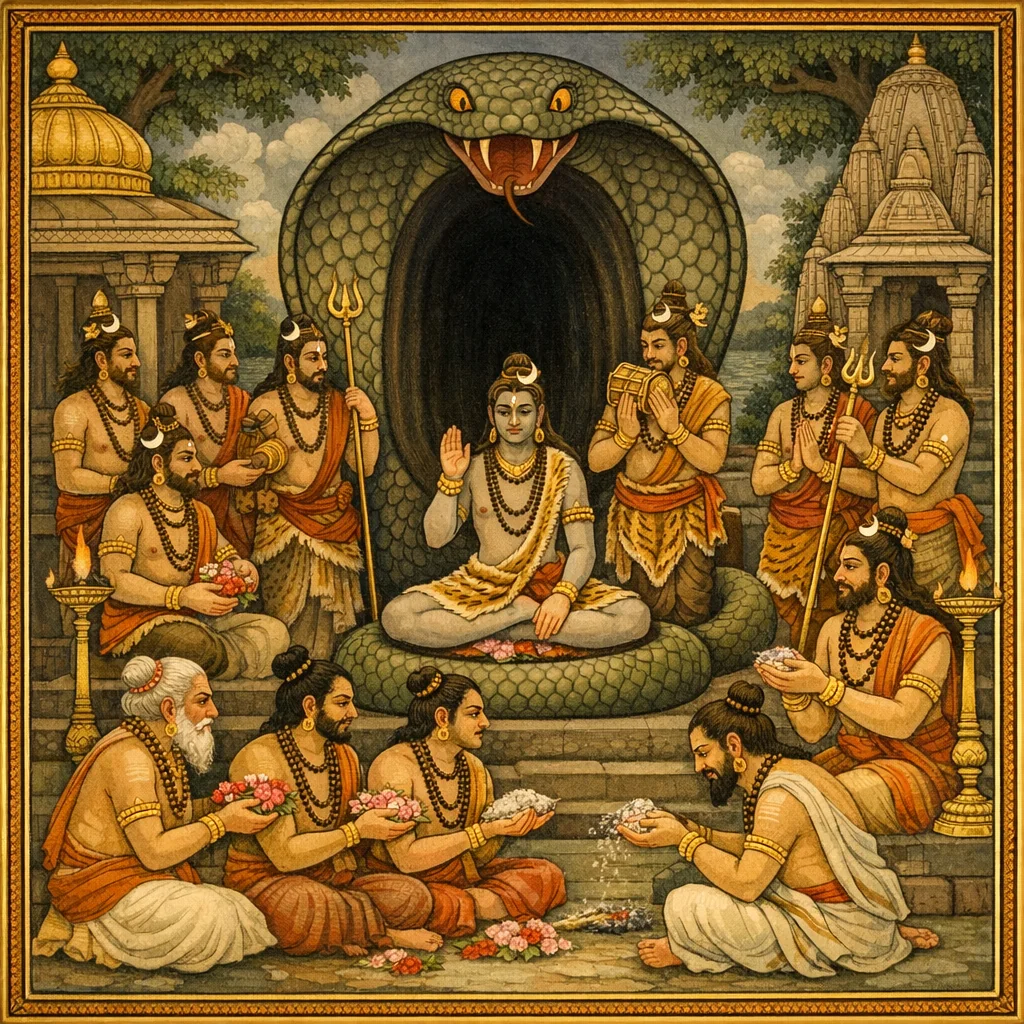
This chapter unfolds as a clarifying dialogue. The ṛṣis ask how tradition can speak of one Rudra—Gaurī as his consort and Skanda as his son—yet also teach eleven Rudras. Sūta affirms Rudra’s essential oneness and explains that the “eleven” is a situational manifestation of the One. In an embedded account at Vārāṇasī, ascetics vow to gain the first darśana of Hāṭakeśvara, giving rise to rivalry and a rule that whoever fails to see first must bear the collective fault born of shared fatigue. Śiva, discerning the competitive intent yet honoring their devotion, emerges from the subterranean realm through a nāga-opening and appears in an elevenfold form, marked by the triśūla, three eyes, and kaparda hair. The ascetics prostrate and hymn the Rudras associated with cosmic directions and protective powers. Śiva declares himself “elevenfold,” grants a boon, and—at the ascetics’ request—agrees to remain at Hāṭakeśvara-kṣetra as eleven mūrtis, a site praised as “all tīrthas,” while one form remains on Kailāsa. He establishes a worship regimen: bathe at Viśvāmitra-hrada, honor the mūrtis by name, and know that such worship yields multiplied merit. The phalaśruti lists fruits—spiritual ascent, prosperity for the poor, progeny for the childless, health for the sick, and victory over foes—heightened for initiates who keep the ash-bath discipline, and attainable even through minimal offerings with the ṣaḍakṣara mantra. The chapter closes by reaffirming the eleven Rudras as Mahādeva’s embodied forms and by marking Caitra bright fortnight, fourteenth day, as an especially potent time for worship.
Shlokas
Verse 1
सूत उवाच । तथान्येऽपि वसन्तीह रुद्रा एकादशैव तु । सञ्जाता ब्राह्मणश्रेष्ठा मुनीनां हितकाम्यया
Sūta said: Here too dwell other Rudras—indeed eleven in number—who have manifested, O best of Brāhmaṇas, out of the desire to promote the welfare of the sages.
Verse 2
यैर्दृष्टैः पूजितै र्वापि स्तुतैर्वाथ नमस्कृतैः । विपाप्मा जायते मर्त्यः सर्वदोषविवर्जितः
By whomever they are seen, worshipped, praised, or saluted, a mortal becomes free from sin and devoid of all faults.
Verse 3
ऋषय ऊचुः । एक एव श्रुतो रुद्रो न द्वितीयः कथंचन । गौरी भार्याप्रिया यस्य स्कन्दः पुत्रः प्रकीर्तितः
The sages said: “We have heard that Rudra is One alone—never a second in any way. He whose beloved wife is Gaurī, and whose son is celebrated as Skanda.”
Verse 4
तेनैकं विद्महे रुद्रं नान्यमीशं कथंचन । तस्माद्ब्रूहि महाभाग सर्वानेतान्सुविस्तरात्
“Therefore we recognize Rudra as the One alone, and no other Lord in any way. So, O greatly fortunate one, tell us all these matters in full detail.”
Verse 5
सूत उवाच । सत्यमेतन्महाभागा यद्भवद्भिरुदाहृतम् । एक एव स्थितो रुद्रो न द्वितीयः कथंचन
Sūta said: “True indeed, O noble ones, is what you have spoken. Rudra stands as One alone—there is no second in any manner.”
Verse 6
परं यथा च सञ्जाता रुद्रा एकादशात्र भोः । तथाहं कीर्तयिष्यामि शृणुध्वं सुसमाहिताः
Now I shall recount, just as it came to pass, how the eleven Rudras arose here. Listen with steady, well-collected attention.
Verse 7
वाराणस्यां पुरा संस्था मुनयः शंसितव्रताः । हाटकेश्वरदेवस्य दर्शनार्थं समुत्सुकाः
Formerly, in Vārāṇasī, sages established in praised vows grew eager to behold the Lord Hāṭakeśvara.
Verse 8
प्रस्थिताः समयं कृत्वा स्पर्धमानाः परस्परम् । अहंपूर्वमहं पूर्वं वीक्षयिष्यामि तं विभुम्
They set out after fixing the time, vying with one another: “I first! I first! I shall be the first to behold that Lord.”
Verse 9
सर्वेषामग्रतो भूत्वा पाताले हाटकेश्वरम् । यश्चादौ तत्र गत्वा च नेक्षयिष्यति तं हरम् । सर्वेषां श्रमजं पापं तस्यैकस्य भविष्यति
“Whoever, going ahead of all, reaches Hāṭakeśvara in the nether realm of Pātāla, and though arriving first does not behold that Hara—upon that one alone shall fall the sin born of the toil of all.”
Verse 10
एवमुक्त्वा ततः सर्वे वाराणस्यां ततः परम् । प्रस्थिता धावमानाश्च वेगेन महता ततः
Having spoken thus, they all set out from Vārāṇasī, running onward with great speed.
Verse 11
एतस्मिन्नन्तरे देवो हाटकेश्वरसंज्ञितः । ज्ञात्वा तेषामभिप्रायं मिथः स्पर्द्धासमुद्भवम् । आत्मनो दर्शनार्थाय बहुभक्तिपुरस्कृतम्
Meanwhile, the god known as Hāṭakeśvara, discerning their intention—born of mutual rivalry—and seeing that they longed for his darśana, came forth to grant his vision, preceded by abundant devotion.
Verse 12
लघुना रक्ष्यमाणेन सर्वेषां च महात्मनाम् । नागरंध्रेण निष्क्रम्य पातालाच्चैव तत्क्षणात्
Guarded by a swift attendant, and for the sake of all those great-souled ones, he came out through the “Nāgara-opening” and in that very instant emerged from Pātāla.
Verse 13
एकादशप्रकारं स कृत्वा रूपं मनोहरम् । त्रिशूलभृत्त्रिनेत्रं च कपर्देन विभूषितम्
Assuming an enchanting form in elevenfold manifestation, he appeared bearing the trident, three-eyed, and adorned with the knotted matted hair (kaparda)—an auspicious vision of Śiva.
Verse 15
ततस्ते वै समालोक्य पुरस्थं वृषभध्वजम् । जानुभ्यां धरणीं गत्वा स्तुतिं चक्रुस्ततस्ततः
Then, beholding the Bull-bannered Lord (Vṛṣabhadhvaja) standing before them, they sank to the earth upon their knees and again and again sang hymns of praise.
Verse 16
एको जानाति देवोऽयं मम संदर्शनं गतः । देवदेवो महादेवः प्रथमं भक्तवत्सलः
This God alone truly knows: he has come into my sight—the God of gods, Mahādeva himself, foremost of all, tenderly devoted to his devotees.
Verse 17
अन्यो जानाति मे पूर्वं जातस्ते तापसोत्तमः । स्तुतिं चक्रुश्च विप्रेंद्रा जानुभ्यामवनिं गताः
Another knows my former deeds—O best of ascetics. And the foremost among the brāhmaṇas, sinking to the earth upon their knees, offered hymns of praise.
Verse 18
तापसा ऊचुः । नमो देवाधिदेवाय सर्वदेवमयाय च । नमः शांताय सूक्ष्माय नमश्चांधकभेदिने
The ascetics said: “Salutations to the God above all gods, who embodies all the deities. Salutations to the peaceful and subtle One; salutations to the slayer of Andhaka.”
Verse 19
नमोऽस्तु सर्वरुद्रेभ्यो ये दिवं संश्रिताः सदा । जीवापयंति जगतीं वायुभिश्च पृथग्विधैः
Salutations to all the Rudras who ever abide in the heavens, who sustain the world with the many kinds of vital winds.
Verse 20
नमोऽस्तु सर्वरुद्रेभ्यो ये स्थिता वारुणीं दिशम् । रक्षंति सर्वलोकांश्च पिशाचानां दुरात्मनाम्
Salutations to all the Rudras who stand in Varuṇa’s quarter (the western direction), who protect all the worlds from the wicked piśācas.
Verse 21
नमोऽस्तु सर्वरुद्रेभ्यो दिशमूर्ध्वं समाश्रिताः । रक्षंति सकलांल्लोकान्भूतार्नां जंभकाद्भयात्
Salutations to all the Rudras who abide in the upward direction, who protect all the worlds from the fear of hordes of beings and from Jaṃbhaka.
Verse 22
नमोऽस्तु सर्वरुद्रेभ्यो येऽध ऊर्ध्वं समाश्रिताः । रक्षंति सकलांल्लोकान्कूष्मांडानां भयात्सदा
Salutations to all the Rudras who abide below and above; they ever protect all the worlds from the fear of the kūṣmāṇḍas.
Verse 23
असंख्याताः सहस्राणि ये रुद्रा भूमिमाश्रिताः । नमस्तेभ्योऽपि सर्वेभ्यस्तेषां रक्षंति ये रुजः
Countless thousands of Rudras dwell upon the earth; salutations to all of them as well—those who protect beings from pains and afflictions.
Verse 24
एवं स्तुतास्तु ते रुद्रा एकादशतपस्विभिः । एकादशापि तान्प्रोचुर्भक्तिनम्रांस्तु तापसान्
Thus praised by the eleven ascetics, those eleven Rudras, seeing the sages bowed down in devotion, addressed them.
Verse 25
रुद्रा ऊचुः । एकादशप्रकारोऽहं तुष्टो वस्तापसोत्तमाः । बहुभक्त्यतिरेकेण व्रियतां च यथेप्सितम्
The Rudras said: “I am present in eleven forms, and I am pleased with you, O best of ascetics. Because of your abundant and surpassing devotion, choose whatever you desire.”
Verse 26
तापसा ऊचुः । यदि तुष्टोसि नो देव यदि यच्छसि वांछितम् । एकादशप्रकारैस्तु सदा स्थेयमिहैव तु
The ascetics said: “If you are pleased with us, O Lord, and if you grant what is desired—then, indeed, remain here forever in your eleven forms.”
Verse 27
हाटकेश्वरजे क्षेत्रे सर्वतीर्थमये शुभे । आराधनं प्रकुर्वाणा वसामो येन वै वयम्
In the auspicious sacred region of Hāṭakeśvara—an embodiment of all tīrthas—may we dwell, ever performing worship, so that by that adoration we may abide there.
Verse 28
श्रीभगवानुवाच । एकादशप्रकारा या मूर्तयो निर्मिता मया । एताभिरेव सर्वाभिः स्थास्याम्यत्र सदैव हि
The Blessed Lord said: “The forms I have manifested in eleven modes—by all those very forms I shall indeed abide here forever.”
Verse 29
आद्या तु मम या मूर्तिः सा कैलासं समाश्रिता । संतिष्ठति सदैवात्र कैलासे पर्वतोत्तमे
“But my first manifestation abides upon Kailāsa; it stands there forever—on Kailāsa, the foremost of mountains.”
Verse 30
एतास्तु मूर्तयोऽस्माकं स्थास्यंत्यत्रैव सर्वदा । सर्वेषामेव लोकानां हिताय द्विजसत्तमाः
“These manifestations of ours shall remain right here forever, O best of the twice-born, for the welfare of all worlds.”
Verse 31
नामभिश्च क्रमेणैव युष्मदीयैः स्वयं द्विजाः । विश्वामित्रह्रदे स्नात्वा एता मूर्तीर्ममात्र वै । पूजयिष्यंति ये मर्त्यास्ते यास्यंति परां गतिम्
“And, O brāhmaṇas, you yourselves shall, in due order, bestow your own names upon them. Those mortals who, after bathing in Viśvāmitra’s lake, worship these forms of mine here, shall attain the supreme state.”
Verse 32
किं वाचा बहुनोक्तेन भूयोभूयो द्विजोत्तमाः । या तासां क्रियते पूजा एकादशगुणा भवेत्
O best of brāhmaṇas, why speak at length again and again? Any worship offered to those forms becomes elevenfold in merit.
Verse 33
एवमुक्त्वा त्रिनेत्रस्तु तत्रैवादर्शनं गतः । तेऽपि तत्राश्रमं कृत्वा श्रद्धया परया युताः । मूर्तीश्च ताः समाराध्य संप्राप्ताः परमं पदम्
Having spoken thus, the Three-eyed Lord became invisible there. And those ascetics, establishing an āśrama on that very spot and endowed with supreme faith, worshiped those forms and attained the highest abode.
Verse 34
अन्योऽपि यः पुमांस्ताश्च आराधयति श्रद्धया । स याति परमं स्थानं यत्र देवो महेश्वरः
Any other person also—whoever worships those forms with faith—attains the supreme abode where Lord Maheśvara (Śiva) dwells.
Verse 35
ततः प्रभृति ते जाता रुद्रा एकादशैव तु । संख्यया देवदेवस्य महेश्वरवपुर्धराः
From that time onward, there arose eleven Rudras in number—embodiments bearing the very form of Maheśvara, the God of gods.
Verse 36
तेजोत्तमास्ते संयुक्तास्त्रिनेत्राः शूलपाणयः । एतद्वः सर्वमाख्यातं यत्पृष्टोऽस्मि द्विजोत्तमाः
Radiant in splendor, united in purpose, three-eyed and bearing tridents—such are they. O best of the twice-born, I have now told you everything that I was asked.
Verse 37
एकादशप्रकारस्तु यथा जातो महेश्वरः । चैत्रे मासि सिते पक्षे चतुर्दश्यां दिने स्थिते
How Maheśvara arose in eleven modes—this took place in the month of Caitra, in the bright fortnight, on the fourteenth lunar day (Caturdaśī).
Verse 38
यस्तान्पूजयते भक्त्या स याति परमां गतिम् । अधनो धनमाप्नोति ह्यपुत्रः पुत्रवान्भवेत्
Whoever worships them with devotion attains the highest state. The poor gains wealth, and one without a son becomes blessed with offspring.
Verse 39
सरोगो रोगमुक्तस्तु पराभूतो रिपुक्षयम् । तत्समाराधनादेव कामानंत्यमवाप्नुयात्
The sick becomes freed from disease; the defeated finds the destruction of enemies. By that very devoted propitiation, one attains unending fulfillment of desired aims.
Verse 40
यः पुनः शिवदीक्षाढ्यो भस्मस्नानपरायणः । तत्समाराधनं कुर्याच्छृणु तस्यापि यत्फलम्
And further—one who is endowed with Śiva-initiation and devoted to bathing with sacred ash (bhasma): if he performs that propitiation, then hear the fruit that comes to him as well.
Verse 41
यदन्यः प्राप्नुयान्मर्त्यस्तत्पूजासंभवं फलम् । षडक्षरेण मंत्रेण पुष्पेणैकेन तत्फलम्
Whatever fruit another mortal would obtain from that worship—the initiated devotee gains that same fruit by the six-syllabled mantra and by offering just a single flower.
Verse 42
शिवदीक्षाधरो यस्तु शतघ्नं लभते फलम् । तस्माच्छतघ्नमाप्नोति शैवात्पाशुपतश्च यः । तस्मात्कालमुखो यश्च महाव्रतधरश्च यः
One who bears Śiva’s initiation (Śiva-dīkṣā) gains a hundredfold fruit. Higher than that, the Pāśupata devotee gains a hundredfold beyond the Śaiva. Higher still are the Kālamukha, and the bearer of the Mahāvrata.
Verse 43
मूर्तीर्यास्ताश्च ये भक्त्या विनताः पूजयंति च । सर्वेषामेव तेषां तु फलं शतगुणं भवेत्
Those who, bowing in humility, worship those sacred forms with devotion—for all of them indeed, the fruit becomes a hundredfold.
Verse 183
शशिखंडधरं चैव रुण्डमालाप्रधारकम् । समं चैव स्थितस्तेषां दर्शने शंकरः प्रभुः
Beholding those Rudra-forms—one bearing the crescent-moon crest and another wearing a garland of severed heads—Lord Śaṅkara stood before them, equal and unwavering in his vision.
Verse 276
इति श्रीस्कांदे महापुराण एकाशीतिसाहस्र्यां संहितायां षष्ठे नागरखण्डे हाटकेश्वरक्षेत्रमाहात्म्य एकादशरुद्रोत्पत्ति वर्णनं नाम षट्सप्तत्युत्तरद्विशततमोऽध्यायः
Thus, in the revered Skanda Mahāpurāṇa, in the eighty-one-thousand-verse compilation, in the sixth book—the Nāgara Khaṇḍa—within the Māhātmya of the Hāṭakeśvara sacred region, ends the two-hundred-and-seventy-sixth chapter, entitled “The Description of the Manifestation of the Eleven Rudras.”