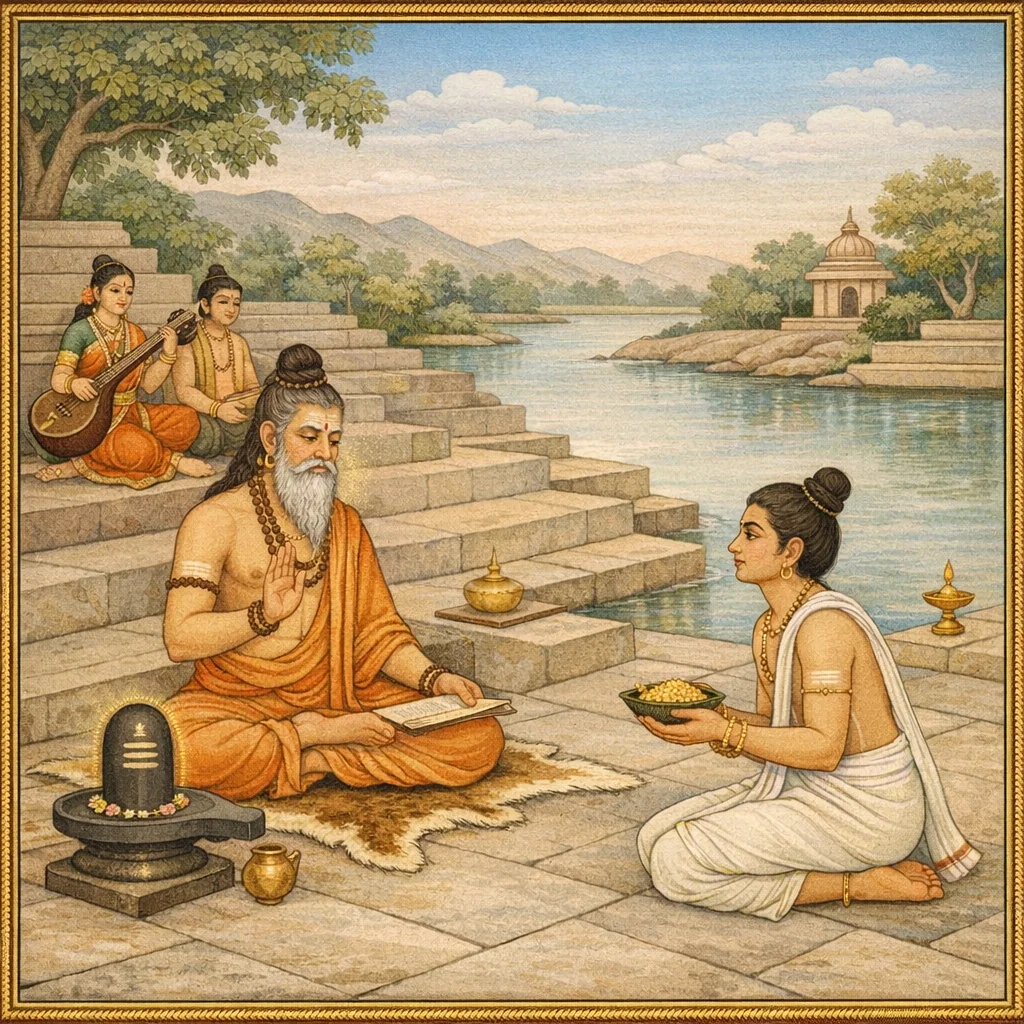
Adhyaya 274
Chapter 274 unfolds as a Sūta–ṛṣi dialogue, first pointing out the Trinetra Śiva-liṅga established by the sage Durvāsas, and then presenting a moral-ritual case narrative. A monastery head worships the liṅga yet hoards wealth gained through worldly dealings, locking gold in a chest. A thief, Duḥśīla, enters by feigning renunciation, receives Śaiva dīkṣā, and waits for his chance. On a journey, during a halt near the sacred river Muralā, the guru’s trust grows; the chest is briefly left accessible, and Duḥśīla steals the gold and escapes. Later, as a householder, he meets Durvāsas at a pilgrimage center and witnesses devotional dance and song before the liṅga. Durvāsas explains he installed the liṅga because Maheśvara delights in such bhakti, and prescribes expiation and ethical repair: gifting a black antelope skin (kṛṣṇājina), regularly donating sesame in vessels (tilapātra) with gold, and completing a half-built shrine (prāsāda) as guru-dakṣiṇā, along with offerings, flowers, and devotional arts. The chapter ends with phalaśruti: darśana in the month of Chaitra removes a year’s sin; bathing/ablution rites remove sins of decades; and performing dance and song before the deity can free one from life-long sin and yield liberation-oriented merit.
Shlokas
Verse 1
। सूत उवाच । तथान्यदपि तत्रास्ति दुर्वासःस्थापितं पुरा । तल्लिंगं देवदेवस्य त्रिनेत्रस्य महात्मनः
Sūta said: Moreover, there is another holy object there, established long ago by Durvāsas—namely, the liṅga of the God of gods, the great Three-eyed Lord.
Verse 2
चैत्रमासि नरो यस्तु तमाराधयते द्विजाः । नृत्यगीतप्रवाद्यैश्च त्रिकालं विहितक्षणः । स नूनं तत्प्रसादेन गन्धर्वाधिपतिर्भवेत् १
O twice-born ones, whoever worships Him in the month of Caitra—at the three daily times, with the prescribed observances and with dance, song, and instrumental music—by that Lord’s grace will surely become the chief of the Gandharvas.
Verse 3
ऋषय ऊचुः । दुर्वासा नामकश्चायं केनायं स्थापितो हरः । कस्मिन्काले महाभाग सर्वं नो विस्तराद्वद
The sages said: “This liṅga is called ‘Durvāsā’—by whom was this Hara installed? At what time did it occur, O fortunate one? Tell us everything in detail.”
Verse 4
सूत उवाच । आसीत्पुरा निंबशुचो वैदिशे च पुरोत्तमे
Sūta said: “Formerly, in the excellent city of Vidiśā, there lived a man named Nimbaśuca.”
Verse 5
स च पूजयते लिंगं किंचिन्मठपतिः स्थितः । स यत्किंचिदवाप्नोति वस्त्राद्यं च तथा परम्
He, a resident head of a monastery (maṭha), worshipped the Liṅga. Whatever he obtained—clothes and other goods, and even more besides—
Verse 6
माहेश्वरस्य लोकस्य विक्रीणीते ततस्ततः । ततो गृह्णाति नित्यं स हेम मूल्येन तस्य च
—he would repeatedly “sell” the promise of access to Maheśvara’s world, and from that he would daily take gold as its price.
Verse 7
न करोति व्ययं तस्य केवलं संचये रतः । ततः कालेन महता मंजूषाऽस्य निरर्गला । जाता हेममयी विप्राः कार्पण्यनिरतस्य च
He spent nothing at all, taking delight only in hoarding. In the course of much time, O brāhmaṇas, his chest—without even a lock—became filled with gold, for he was devoted to miserliness.
Verse 8
अथ संस्थाप्य भूमध्ये मंजूषां तां प्रपूरिताम् । करोति व्यवहारं स कक्षां तां नैव मुंचति
Then, having placed that fully filled chest in the middle of the floor, he carried on his dealings, never leaving that room at all.
Verse 9
कदाचिद्देवपूजायां सोऽपि ब्राह्मणसत्तमाः । विश्वासं नैव निर्याति कस्यचिच्च कथंचन
At times, even during worship of the deity, that man—O best of brāhmaṇas—would not place trust in anyone, in any way.
Verse 10
कस्यचित्त्वथ कालस्य परवित्तापहारकः । अलक्षद्ब्राह्मणस्तच्च दुःशीलाख्यो व्यचिंतयत्
Now at a certain time, a stealer of others’ wealth—a brāhmaṇa known as Duḥśīla—noticed this and began to scheme.
Verse 11
ततः शिष्यो भविष्यामि विश्वासार्थं दुरात्मनः । सुदीनैः कृपणैर्वाक्यैश्चाटुकारैः पृथग्विधैः
“Then I shall become his disciple, to win that wicked man’s trust—using pitiful, miserly words and various kinds of flattery.”
Verse 12
आलस्यं च दिवानक्तं साधयिष्याम्यसंशयम् । अन्यस्मिन्नहनि प्राप्ते दृष्ट्वा तं मठमध्यगम्
“And I shall cultivate indolence day and night—without doubt.” Then, on another day, seeing him within the monastery’s precincts,
Verse 13
ततः समीपमगमद्दंडाकारं प्रणम्य च । अब्रवीत्प्रांजलिर्भूत्वा विनयावनतः स्थितः
Then he went near, bowed down full-length like a staff, and, with joined palms, spoke while standing bent with humility.
Verse 14
भगवंस्ते प्रभावोऽद्य तपसा वै मया श्रुतः
O Blessed Lord, today I have heard—through the account of your austerities—the true greatness of your spiritual power.
Verse 15
यदन्यस्तापसो नास्ति ईदृशोऽत्र धरातले । तेनाहं दूरतः प्राप्तो वैराग्येण समन्वितः
Because there is no other ascetic on this earth like you, I have come from far away—endowed with detachment—to seek your guidance.
Verse 16
संसारासारतां ज्ञात्वा जन्ममृत्युजरात्मिकाम् । अर्थात्स्वप्नप्रतीकाशं यौवनं च नृणा मिह
Having understood the world’s hollowness—made of birth, death, and decay—and realizing that even human youth here is, in truth, like a dream’s fleeting appearance…
Verse 17
यद्वत्पर्वतसंजाता नदी च क्षणभंगुरा । पुत्राः कलत्राणि च वा ये चान्ये बांधवादयः
Just as a river that springs from a mountain is fleeting and fragile, so too are sons, wives, and all other relations and attachments—impermanent by nature.
Verse 18
ते सर्वे च परिज्ञेया यथा पाप समागमाः । तत्संसारसमुद्रस्य तारणार्थं ब्रवीहि मे
All these should be understood as mere worldly entanglements, like occasions that lead to sin. Therefore, tell me the means by which I may cross this ocean of saṃsāra.
Verse 19
उपायं कंचिदद्यैव उपदेशे व्यवस्थितम् । तरामि येन संसारं प्रसादात्तव सुव्रत
Set forth in your instruction—this very day—a practicable means by which I may cross saṃsāra, by your grace, O you of noble vows.
Verse 20
तस्य तद्वचनं श्रुत्वा रोमांचित तनूरुहः । ज्ञात्वा माहेश्वरः कोऽयं चिंतावान्समुपस्थितः
Hearing his words, the ascetic’s hairs stood on end in rapturous devotion. Reflecting, he thought, “Who indeed is this devotee of Maheśvara?”—and, thoughtful, he drew near.
Verse 21
यथा ब्रवीषि धन्योऽसि यस्य ते मतिरीदृशी । तारुण्ये वर्तमानस्य सुकुमारस्य चैव हि
As you speak, you are truly blessed—for such understanding is yours even while you abide in youth, tender and full of vitality.
Verse 22
तारुण्ये वर्तमानो यः शांतः सोऽत्र निगद्यते । धातुषु क्षीयमाणेषु शमः कस्य न जायते
He who is peaceful even while still in youth is truly spoken of here as exceptional; for when the bodily constituents waste away, in whom does calm not arise?
Verse 23
यद्येवं सुविरक्तिः स्यात्संसारोपरि संस्थिता । समाराधय देवेशं शंकरं शशिशेखरम्
If such firm detachment has arisen, standing above the claims of worldly life, then worship with full devotion the Lord of gods—Śaṅkara, the moon-crested One.
Verse 24
नान्यथा घोरजाप्येन तीर्यते भवसागरः । मया सम्यक्परिज्ञातमेतच्छास्त्रसमागमात्
The ocean of worldly becoming cannot be crossed in any other way than by intense japa. This I have rightly understood from the concordant testimony of the scriptures.
Verse 25
शूद्रो वा यदि वा विप्रो म्लेछो वा पापकृन्नरः । शिवदीक्षासमोपेतः पुष्पमेकं तु यो न्यसैत्
Whether one is a Śūdra or a Brāhmaṇa, whether a mleccha or even a man who has committed sins—if he is endowed with Śiva’s initiation and places even a single flower in worship,
Verse 27
यो ददाति प्रभक्त्या च शिवदीक्षान्विताय च । वस्त्रोपानहकौपीनं स यज्ञैः किं करिष्यति
He who, with deep devotion, gives to one endowed with Śiva’s initiation clothing, footwear, and a loincloth—what need has he to gain merit through sacrifices?
Verse 28
तच्छ्रुत्वा चरणौ तस्य दुःशीलोऽसौ तदाऽददे । विन्यस्य स्वशिर स्ताभ्यां ततोवाक्यमुवाच ह
Hearing that, Duḥśīla then grasped his feet. Placing his own head upon them, he then spoke these words.
Verse 29
शिवदीक्षाप्रमाणेन प्रसादं कुरु मे प्रभो । शुश्रूषां येन ते नित्यं प्रकरोमि समाहितः
O Lord, show me favor according to the proper rule of Śiva’s initiation, so that—collected in mind—I may render you service always.
Verse 30
ततोऽसौ तापसो विप्राश्चिंतयामास चेतमि । दक्षोऽयं दृश्यते कोऽपि पुमांश्चैव समागतः
Then that ascetic brāhmaṇa reflected in his mind: “This man who has come here appears to be capable and competent.”
Verse 31
ममास्ति नापरः शिष्यस्तस्मादेनं करोम्यहम् । ततोऽब्रवीत्करे गृह्य यद्येवं वत्स मे समम् । समयं कुरु येन त्वां दीक्षयाम्यद्य चैव हि
“I have no other disciple; therefore I shall accept him.” Then, taking him by the hand, he said: “If so, my child—agree to the observance, so that I may initiate you this very day.”
Verse 32
त्वया कुटीरकं कार्यं मठस्यास्य विदूरतः । प्रवेशो नैव कार्यस्तु ममात्रास्तं गते रवौ
You must build a small hut at a distance from this monastery. And you must not enter here while I am present—until the sun has set.
Verse 33
दुःशील उवाच । तवादेशः प्रमाणं मे केवलं तापसोत्तम । किं मठेन करिष्यामि विशेषाद्रा त्रिसंगमे
Duḥśīla said: “Your command alone is my sole authority, O best of ascetics. What need have I of a monastery—especially here, at the sacred confluence of the three streams?”
Verse 34
यः शिष्यो गुरुवाक्यं तु न करोति यथोदितम् । तस्य व्रतं च तद्व्यर्थं नरकं च ततः परम्
That disciple who does not carry out the guru’s instruction exactly as spoken—his vow becomes fruitless, and thereafter he falls into hell.
Verse 35
तच्छ्रुत्वा तुष्टिमापन्नः शिवदीक्षां ततो ददौ । तस्मै विनययुक्ताय तदा निंबशुचो मुनिः
Hearing those words, the sage Nimbaśuca was satisfied; and then he bestowed Śiva’s initiation (Śivadīkṣā) upon that humble and well-disciplined man.
Verse 36
ततःप्रभृति सोऽतीव तस्य शुश्रूषणे रतः । रंजयामास तच्चित्तं परिचर्यापरायणः
From that time onward, he became intensely devoted to serving him; ever intent on attendance and service, he gladdened his guru’s mind.
Verse 37
मनसा चिन्तयानस्तु तन्मात्रार्थं दिनेदिने । न च्छिद्रं वीक्षते किंचिद्वीक्षमाणोऽपि यत्नतः
Day after day, he pondered in his mind only that single aim; and even when he searched carefully and with effort, he could find no flaw—no opening at all.
Verse 38
शैवोऽपि च स कक्ष्यां तां तां मात्रां हेमसंभवाम् । कथंचिन्मोक्षते भूमौ भोज्ये देवार्चनेऽपि न
Though he bore the marks of a Śaiva, he never set that golden pouch/measure kept close at his side upon the ground—neither while eating nor even during worship of the deity.
Verse 39
ततोऽसौ चिन्तयामास दुःशीलो निजचेतसि । मठे तावत्प्रवेशोऽस्ति नैव रात्रौ कथंचन
Then that ill-natured man began to scheme within his own mind: “Entry into the monastery is possible only to a point—but at night, it is not possible in any way.”
Verse 40
सूर्यास्तमानवेलायां यत्प्रयच्छति तत्क्षणात् । परिघं सुदृढं पापस्तत्करोमि च किं पुनः
“At the time of sunset, as soon as he closes it, that sinful one sets a very strong bar—so what more can I do?”
Verse 41
मठोऽयं सुशिलाबद्धो नैव खातं प्रजायते । तुंगत्वान्न प्रवेशः स्यादुपायैर्विविधैः परैः
“This monastery is firmly built of well-set stones—no breach can be made. Because of its height, there can be no entry, even by many other contrived methods.”
Verse 42
तत्किं विषं प्रयच्छामि शस्त्रैर्व्यापादयामि किम् । दिवापि पशुमारेण पंचत्वं वा नयामि किम्
“So should I give poison? Or should I kill him with weapons? Or even in daytime, should I bring him to death by some violent means, like a beast-slayer?”
Verse 43
एवं चिन्तयतस्तस्य प्रावृट्काल उपस्थितः । श्रावणस्यासिते पक्षे कर्कटस्थे दिवाकरे
While he was thus contemplating, the rainy season arrived—during the dark fortnight of Śrāvaṇa, when the Sun was in Cancer (Karkaṭa).
Verse 44
प्राप्तो महेश्वरस्तस्य कोऽपि तत्र धनी द्रुतम् । तेनोक्तं प्रणिपत्योच्चैः करिष्यामि पवित्रकम्
Then a certain wealthy man quickly came there before Maheśvara (Śiva). Bowing down, he said aloud: “I shall perform the Pavitraka, the rite of purification.”
Verse 45
चतुर्द्दश्यामहं स्वामिन्यद्यादेशो भवेत्तव । यद्यागच्छसि मे ग्रामं प्रसादेन सम न्वितः
“O revered Lady, let your command rest upon me today, on the fourteenth lunar day. If you will come to my village, endowed with your gracious favor…”
Verse 46
सूत उवाच । तच्छ्रुत्वा तुष्टिमापन्नस्ततो निंबशुचो मुनिः । तथेति चैवमुक्त्वा तं प्रेषयामास तत्क्षणात्
Sūta said: Hearing this, the sage Niṃbaśuca was pleased; and saying, “So be it,” he dispatched him that very moment.
Verse 47
आगमिष्याम्यहं काले स्वशिष्येण समन्वितः । करिष्यामि परं श्रेयस्तव वत्स न संशयः
“I shall come in due time, accompanied by my own disciple. I will bring about your highest good, dear child—of this there is no doubt.”
Verse 48
अथ काले तु संप्राप्ते चिन्तयित्वा प्रभातिकम् । प्रभातसमये प्राप्ते स शैवः प्रस्थितस्तदा । दुःशीलेन समायुक्तः संप्रहृष्टतनूरुहः
Then, when the appointed time arrived, having completed his morning preparations, at daybreak that Śaiva set out—accompanied by Duḥśīla—his hairs standing on end with exhilaration.
Verse 49
ततो वै गच्छमानस्य तस्य मार्गे व्यवस्थिता । पुण्या नदी सुविख्याता मुरला सागरंगमा
As he proceeded on his way, there lay upon his route a meritorious and widely renowned river—Murala—flowing onward to the ocean.
Verse 50
स तां दृष्ट्वाऽब्रवीद्वाक्यं वत्स शिष्य करोम्यहम् । भवता सह देवार्चां मुरलायां स्थिरो भव
Seeing that river, he spoke: “Dear child, I shall make you my disciple. Remain steadfast here at Murala, and together with me perform worship of the gods.”
Verse 51
बाढमित्येव स प्रोक्त्वा संस्थितोऽस्यास्तटे शुभे । सोऽपि निंबशुचस्तस्य रंजितः सर्वदा गुणैः
Saying, “So be it,” he stayed upon her auspicious bank. And Niṃbaśuca too was ever delighted by his virtues.
Verse 52
सुशिष्यं तं परिज्ञाय विश्वासं परमं गतः । स्थगितां तां समादाय हेममात्रासमुद्भवाम्
Recognizing him as an excellent disciple, he attained complete trust. Then he took up that concealed item, which had manifested in a measure of gold.
Verse 53
जागेश्वरसमोपेतां स कन्थां व्याक्षिपत्क्षितौ । पुरीषोत्सर्गकार्येण ततस्तोकांतरं गतः
He cast upon the ground the cloak associated with Jāgeśvara; then, on the pretext of relieving himself, he went a short distance away.
Verse 54
यावच्चादर्शनं प्राप्तो वेतसैः परिवारितः । तावन्मात्रां समादाय दुःशीलः प्रस्थितो द्रुतम् । उत्तरां दिशमाश्रित्य प्रहृष्टेनांतरात्मना
And as soon as he had gone out of sight, screened by reeds, Duḥśīla seized just that much and hurried off at once—taking to the northern direction, inwardly exultant.
Verse 55
अथासौ चागतो यावद्दुःशीलं नैव पश्यति । केवलं दृश्यते कन्था जागेश्वरसमन्विता
Then, when he arrived, he did not see the wicked man at all; only the cloak was seen—still connected with (bearing the mark of) Jāgeśvara.
Verse 56
षडक्षरेण मंत्रेण लिंगस्योपरि भक्तितः । स तां गतिमवाप्नोति यांयां यांतीह यज्विनः
By devotionally uttering and applying the six-syllabled mantra over the liṅga, he attains that very blessed state of destiny which the sacrificers and pious worshippers attain here.
Verse 57
यावन्मात्राविहीनां च ततो ज्ञात्वा च तां हृताम् । तेन शिष्येण मूर्च्छाढ्यो निपपात महीतले
Then, realizing that his ‘mātrā’ (the entrusted measure) was missing and had been stolen, that disciple, overcome by faintness, fell upon the ground.
Verse 58
ततश्च चेतनां प्राप्य कृच्छ्राच्चोत्थाय तत्क्षणात् । शिलायां ताडयामास निजांगानि शिरस्तथा
Then, regaining consciousness, and rising with difficulty at that very moment, he struck his own limbs—and even his head—against a rock.
Verse 59
हा हतोऽस्मि विनष्टोऽस्मि मुष्टस्तेन दुरात्मना । किं करोमि क्व गच्छामि कथं तं वीक्षयाम्यहम्
“Alas, I am slain; I am ruined—robbed by that wicked-souled man! What shall I do? Where shall I go? How shall I ever find him?”
Verse 60
ततस्तु पदवीं वीक्ष्य तस्य तां चलितो ध्रुवम् । वृद्ध भावात्परिश्रांतो वावृत्य स मठं गतः
Then, seeing the track of his path, he set out after him for certain; but, wearied by age, he turned back and went to the monastery.
Verse 61
दुःशीलोऽपि समादाय मात्रां स्थानांतरं गतः । ततस्तेन सुवर्णेन व्यवहारान्करोति सः
Even that wicked man, taking the amount, went to another place; then, with that gold, he carried on transactions and trade.
Verse 62
ततो गृहस्थतां प्राप्तः कृतदारपरिग्रहः । वृद्धभावं समापन्नः संतानेन विवर्जितः
Thereafter he entered the householder’s life, taking a wife; he reached old age, yet remained devoid of offspring.
Verse 63
कस्यचित्त्वथ कालस्य तीर्थयात्रापरायणः । भार्यया सहितो विप्रश्चमत्कारपुरं गतः
Then, after some time had passed, the brāhmaṇa, devoted to pilgrimage to the sacred tīrthas, went with his wife to Camatkārapura.
Verse 64
स्नात्वा तीर्थेषु सर्वेषु देवतायतनेषु च । भ्रममाणेन संदृष्टो दुर्वासा नाम सन्मुनिः
After bathing at all the sacred tīrthas and also at the temples of the gods, as he wandered about he beheld the virtuous sage named Durvāsā.
Verse 65
निजदेवस्य सद्भक्त्या नृत्यगीतपरायणः । तं च दृष्ट्वा नमस्कृत्य वाक्यमेतदुवाच सः
Absorbed in dancing and singing out of sincere devotion to his chosen deity, he saw him, bowed in reverence, and then spoke these words.
Verse 66
केनैतत्स्थापितं लिंगं निर्मलं शंकरोद्भवम् । किं त्वं नृत्यसि गीतं च पुरोऽस्य प्रकरोषि च । मुनीनां युज्यते नैव यदेतत्तव चेष्टितम्
“By whom has this pure liṅga, born of Śaṅkara, been installed? Why do you dance and sing before it? Such behavior as yours does not at all befit sages.”
Verse 67
दुर्वासा उवाच । मयैतत्स्थापितं लिंगं देवदेवस्य शूलिनः । नृत्यगीतप्रियो यस्माद्देवदेवो महेश्वरः
Durvāsā said: “I installed this liṅga for Śūlin, the God of gods. For Maheśvara, the Lord of gods, is indeed fond of dance and song.”
Verse 68
न मेऽस्ति विभवः कश्चिद्येन भोगं करोम्यहम्
I have no wealth at all by which I might indulge in enjoyments.
Verse 69
एतस्मिन्नंतरे प्राप्तश्चिर्भटिर्नाम योगवित् । तेन पृष्टः स दुर्वासा वेदांतिकमिदं वचः
In the meantime, a knower of yoga named Cirbhaṭi arrived. Asked by him, Durvāsā spoke this Vedāntic teaching.
Verse 70
असूर्या नाम ते लोका अंधेन तमसा वृताः । तांस्ते प्रेत्याऽभिगच्छंति ये केचात्महनो जनाः
Sunless indeed are those worlds, wrapped in blinding darkness; to them, after death, go those people who are killers of the self.
Verse 71
उपविश्य ततस्तेन तस्य दत्तस्तु निर्णयः । दुःशीलेनापि तत्सर्व विज्ञातं तस्य संस्तुतम्
Then, having sat down, a clear decision was given to him by that teacher. Even one of bad conduct understood it all—and the teaching was praised.
Verse 72
ततो विशेषतो जाता भक्तिस्तस्य हरं प्रति । तं प्रणम्य ततश्चोच्चैर्वाक्यमेतदुवाच ह
Thereafter, his devotion toward Hara (Śiva) arose with special intensity. Bowing to him, he then spoke aloud these words.
Verse 74
भगवन् ब्राह्मणोऽस्मीति जात्या चैव न कर्मणा । न कस्यचिन्मया दत्तं कदाचिन्नैव भोजनम् । केवलं देवविप्राणां वंचयित्वा धनं हृतम् । व्यसनेनाभिभूतेन द्यूतवेश्योद्भवेन च
O Blessed Lord, I am called a brāhmaṇa only by birth, not by conduct. Never have I given food to anyone at any time. Rather, I deceived even gods and brāhmaṇas and seized their wealth, overpowered by vices born of gambling and the company of courtesans.
Verse 75
तथा च ब्राह्मणेनापि मया शैवो गुरुः कृतः । वंचितश्च तथानेकैश्चाटुभिर्विहृतं धनम्
Thus, though a brāhmaṇa, I even used a Śaiva teacher as a pretext and deceived him. Likewise, by many flatterers I was duped, and my wealth was squandered away.
Verse 76
तस्य सक्तं धनं भूयः साधुमार्गेण चाहृतम् । स चापि च गुरुर्मह्यं परलोकमिहागतः
Afterward, by the righteous path, I recovered again that wealth which had been bound up and lost. And that very person—who became my guru—has now come here from the other world.
Verse 77
पश्चात्तापेन तेनैव प्रदह्यामि दिवानिशम् । पुरश्चरणदानेन तत्प्रसादं कुरुष्व मे
By that very remorse I am burning day and night. Through the gift offered in connection with the puraścaraṇa, please secure that grace for me.
Verse 78
अस्ति मे विपुलं वित्तं न संतानं मुनीश्वर । तन्मे वद मुने श्रेयस्तद्वित्तस्य यथा भवेत् । इह लोके परे चैव येन सर्वं करोम्यहम्
I have abundant wealth, O lordly sage, but I have no offspring. Tell me, O muni, what is best—how that wealth may become truly fruitful—so that I may accomplish what is proper both in this world and in the next.
Verse 79
दुर्वासा उवाच । कृत्वा पापसहस्राणि पश्चाद्धर्मपरो भवेत् । यः पुमान्सोऽतिकृच्छ्रेण तरेत्संसारसागरम्
Durvāsā said: Even after committing thousands of sins, a man may later become devoted to dharma; yet he crosses the ocean of saṃsāra, worldly existence, only with great difficulty.
Verse 80
दिनेनापि गुरुर्योऽसौ त्वया शैवो विनिर्मितः । अधर्मेणापि संजातः स गुरुस्तेन संशयः
Even if only in a single day you fashioned that Śaiva ‘guru’, though he arose through unrighteous means, he is still your guru—of that there is no doubt.
Verse 81
ब्राह्मणो ब्रह्मचारी स्याद्ग्रहस्थस्तदनंतरम् । वानप्रस्थो यतिश्चैव तत श्चैव कुटीचरः
A brāhmaṇa should first be a brahmacārin; thereafter he should become a householder. Then he may become a forest-dweller and a renunciant; and thereafter indeed a kuṭīcara, one who lives withdrawn in a hut.
Verse 82
बहूदकस्ततो हंसः परमश्च ततो भवेत् । ततश्च मुक्तिमायाति मार्गमेनं समाश्रितः
Then one becomes a bahūdaka; thereafter a haṃsa; and thereafter a parama. Taking refuge in this path, he then attains liberation (mukti).
Verse 83
त्वया पुनः कुमार्गेण यद्व्रतं ब्राह्मणेन च । शैवमार्गं समास्थाय तन्महापातकं कृतम्
But you, again—by an evil path—together with a brāhmaṇa, undertook a vow while adopting the Śaiva way; that became a mahāpātaka, a great sin.
Verse 84
दुःशील उवाच । सर्वेष्वेव हि वेदेषु रुद्रः संकीर्त्यते प्रभुः । तत्किं दोषस्त्वया प्रोक्तस्तस्य दीक्षासमुद्भवः
Duḥśīla said: Truly, in all the Vedas Rudra is praised as the Lord. Then what fault have you spoken of, said to arise from his dīkṣā, his sacred initiation?
Verse 85
दुर्वासा उवाच । सत्यमेतत्त्वया ख्यातं वेदे रुद्रः प्रकीर्तितः । बहुधा वासुदेवोऽपि ब्रह्मा चैव विशेषतः
Durvāsā said: What you have stated is true—Rudra is proclaimed in the Veda. Likewise, Vāsudeva too is praised in many ways, and Brahmā also, especially.
Verse 86
परं विप्रस्य या दीक्षा व्रतवंधसमुद्भवा । गायत्री परमा जाप्ये गुरुर्व्रतपरो हि सः । वैष्णवीं चाथ शैवीं च योऽन्यां दीक्षां समाचरेत्
For a brāhmaṇa, the highest dīkṣā is that which arises from the binding vow of sacred discipline (vrata). In japa, the supreme mantra is the Gāyatrī; and his true guru is one devoted to vows. But if someone, having already taken Vaiṣṇava or Śaiva initiation, were to undertake yet another initiation out of fickleness—
Verse 87
ब्राह्मणो न भवेत्सोऽत्र यद्यपि स्यात्षडंगवित् । अपरं लिंगभेदस्ते संजातः कपटादिषु
He would not truly be a brāhmaṇa here, even if he were learned in the six auxiliaries (ṣaḍaṅga) of the Veda. Moreover, for you another “mark” of decline has arisen: deceit and the like.
Verse 88
व्रतत्यागान्न संदेहस्तत्र ते नास्ति किंचन । प्रायश्चित्तं मया सम्यक्स्मृतिमार्गेण चिंतितम्
From abandoning the vow, there is no doubt: for you, no uncertainty remains about it. A proper expiation (prāyaścitta) has been carefully considered by me, according to the pathway of the Smṛtis.
Verse 89
दुःशील उवाच । सतां सप्तपदीं मैत्रीं प्रवदंति मनीषिणः । मित्रतां तु पुरस्कृत्य किंचिद्वक्ष्यामि तच्छृणु
Duḥśīla said: “The wise declare that among the good, friendship becomes firm after seven steps taken together. Honouring that friendship, I shall say something—listen.”
Verse 90
अस्ति मे विपुलं वित्तं यदि तेन प्रसिद्ध्यति । तद्वदस्व महाभाग येन सर्वं करोम्यहम्
“I have abundant wealth—if renown or success can be gained by it. Tell me, O fortunate one, by what means I may accomplish everything required.”
Verse 91
दुर्वासा उवाच । एक एव ह्युपायोऽस्ति तव पातकनाशने । तं चेत्करोषि मे वाक्याद्विशुद्धः संभविष्यसि
Durvāsā said: “There is indeed only one means for the destruction of your sin. If you do it in accordance with my word, you will become purified.”
Verse 92
तपः कृते प्रशंसंति त्रेतायां ज्ञानमेव च । द्वापरे तीर्थयात्रां च दानमेव कलौ युगे
Austerity is praised in the Kṛta age; in Tretā, knowledge alone; in Dvāpara, pilgrimage to the tīrthas; but in the Kali age, charity alone is foremost.
Verse 93
सांप्रतं कलिकालोऽयं वर्तते दारुणाकृतिः । तस्मात्कृष्णाजिनं देहि सर्वपापविशुद्धये
“Now this Kali age prevails, terrible in form. Therefore, give a black antelope-skin (kṛṣṇājina) for purification from all sins.”
Verse 94
तथा च ते घृणाऽप्यस्ति गुरुवित्तसमुद्भवा । तदर्थं कुरु तन्नाम्ना शंकरस्य निवेशनम्
And you too bear aversion, born of attachment to the guru’s wealth. Therefore, for that very reason, build a dwelling for Śaṅkara in His sacred name.
Verse 95
येन तस्मादपि त्वं हि आनृण्यं यासि तत्क्षणात् । अन्यत्रापि च तद्वित्तं यत्किंचिच्च प्रपद्यते
By that act you will at once become free from debt, even toward him. And whatever portion of that wealth, by any other means, comes into your hands,
Verse 96
ब्राह्मणेभ्यो विशिष्टेभ्यो नित्यं देहि समाहितः । तिलपात्रं सदा देहि सहिरण्यं विशेषतः
With a collected mind, give regularly to distinguished Brāhmaṇas. Always offer a vessel of sesame in charity, and especially do so together with gold.
Verse 97
येन ते सकलं पापं देहान्नाशं प्रगच्छति । अपरं चैत्रमासेऽहं सदाऽगच्छामि भक्तितः
By this, all your sin departs and is destroyed from the body. Moreover, in the month of Caitra I come here constantly, out of devotion.
Verse 98
कल्पग्रामात्सुदूराच्च प्रासादेऽत्र स्वयं कृते । पुनर्यामि च तत्रैव व्रतमेतद्धि मे स्थितम्
From far-off Kalpagrāma I come to this temple that I myself established here; and then I return again to that very place—such indeed is the vow (vrata) I maintain.
Verse 99
तस्माच्चिंत्यस्त्वयाह्येष प्रासादो यो मया कृतः । चिंतनीयं सदैवेह स्नानादिभिरनेकशः
Therefore, you should indeed keep in mind this temple that I have built. Here it should be remembered again and again, together with bathing and many other sacred observances.
Verse 100
दुःशील उवाच । करिष्यामि वचस्तेऽहं यथा वदसि सन्मुने
Duḥśīla said: “I will carry out your words, O noble sage, exactly as you have spoken.”
Verse 101
दुर्वासा उवाच । सर्वपापविशुद्ध्यर्थं दत्ते कृष्णाजिने द्विजः । प्रयच्छ तिलपात्राणि गुप्तपापस्य शुद्धये
Durvāsā said: “For purification from all sins, when a Brāhmaṇa gives the skin of a black antelope, he should also offer vessels filled with sesame, to cleanse even hidden sins.”
Verse 102
सूत उवाच । तस्य तद्वचनं श्रुत्वा दत्तं तेन महात्मना । ततः कृष्णाजिनं भक्त्या ब्राह्मणायाहिताग्नये
Sūta said: Hearing those words, that great-souled man gave as instructed. Then, with devotion, he offered the black antelope-skin to a Brāhmaṇa who maintained the sacred fires.
Verse 103
दुर्वाससः समा देशाद्यथोक्तविधिना द्विजाः । यच्छतस्तिलपात्राणि तस्य नित्यं प्रभक्तितः
Then the Brāhmaṇas, in the manner taught by Durvāsā, gave him vessels of sesame from that region—regularly and with steadfast devotion.
Verse 104
गतपापस्य दीक्षां च ददौ निर्वाणसंभवाम् । तथासौ गतपापस्य दीक्षां दत्त्वा यथाविधि
To him whose sins had been removed, he granted an initiation (dīkṣā) that leads to liberation. Thus, having duly bestowed initiation upon the purified one according to proper rule,
Verse 105
ततः प्रोवाच मधुरं देहि मे गुरुदक्षिणाम्
Then he spoke gently: “Give me the guru-dakṣiṇā, the honor-offering to the teacher.”
Verse 106
दुःशील उवाच । याचस्व त्वं प्रभो शीघ्रं यां ते यच्छामि दक्षिणाम् । तां प्रदास्यामि चेच्छक्तिर्वित्तशाठ्यविवर्जिताम्
Duḥśīla said: “O Lord, quickly ask for the guru-dakṣiṇā that I offer you. If I have the ability, I shall give it—free from any deceit regarding wealth.”
Verse 107
दुर्वासा उवाच । कल्पग्रामं गमिष्यामि सांप्रतं वर्तते कलिः । नाहमत्रागमिष्यामि यावन्नैव कृतं भवेत्
Durvāsā said: “I shall now go to Kalpagrāma, for this is the time when Kali prevails. I will not return here until it is indeed completed.”
Verse 108
अर्धनिष्पादितो ह्येष प्रासादो यो मया कृतः । परिपूर्तिं त्वया नेय एषा मे गुरुदक्षिणा
“This temple (prāsāda) that I began is only half-finished. You must bring it to completion—this shall be my guru-dakṣiṇā.”
Verse 109
नृत्यगीतादिकं यच्च तथा कार्यं स्वशक्तितः । पुरतोऽस्य बलिर्देयस्तथान्यत्कुसुमादिकम्
And whatever else—dance, song, and the like—you should arrange according to your capacity. Before this deity/shrine, an offering (bali) should be presented, and other offerings too, such as flowers and the like.
Verse 110
एवमुक्त्वा गतः सोऽथ कल्पग्रामं मुनीश्वरः । दुःशीलोऽपि तथा चक्रे यत्तेन समुदाहृतम्
Having spoken thus, that lord among sages went to Kalpagrāma. Duḥśīla too did exactly as had been instructed by him.
Verse 111
सूत उवाच । एवं तस्य प्रभक्तस्य तत्कार्याणि प्रकुर्वतः । तन्नाम्ना कीर्त्यते सोऽथ दुःशील इति संज्ञितः
Sūta said: “As he, devoted and faithful, carried out those works, he thereafter became renowned by that very name—being known as ‘Duḥśīla.’”
Verse 112
चैत्रमासे च यो नित्यं तं च देवं प्रपश्यति । क्षणं कृत्वा स पापेन वार्षिकेण प्रमुच्यते
Whoever, during the month of Caitra, regularly beholds that deity—even for a moment—becomes freed from the sin accumulated over a year.
Verse 113
यः पुनः स्नपनं तस्य सर्वं चैव करोति च । त्रिंशद्वर्षोद्भवं पापं तस्य गात्रात्प्रणश्यति
And whoever performs the full rite of bathing (snapana) for that deity—every part of it—has the sin born of thirty years destroyed from his very body.
Verse 114
यः पुनर्नृत्यगीताद्यं कुरुते च तदग्रतः । आजन्ममरणात्पापात्सोऽपि मुक्तिमवाप्नुयात्
Moreover, whoever offers dance, song, and the like before Him is freed even from sins amassed from birth until death, and attains liberation (mokṣa).