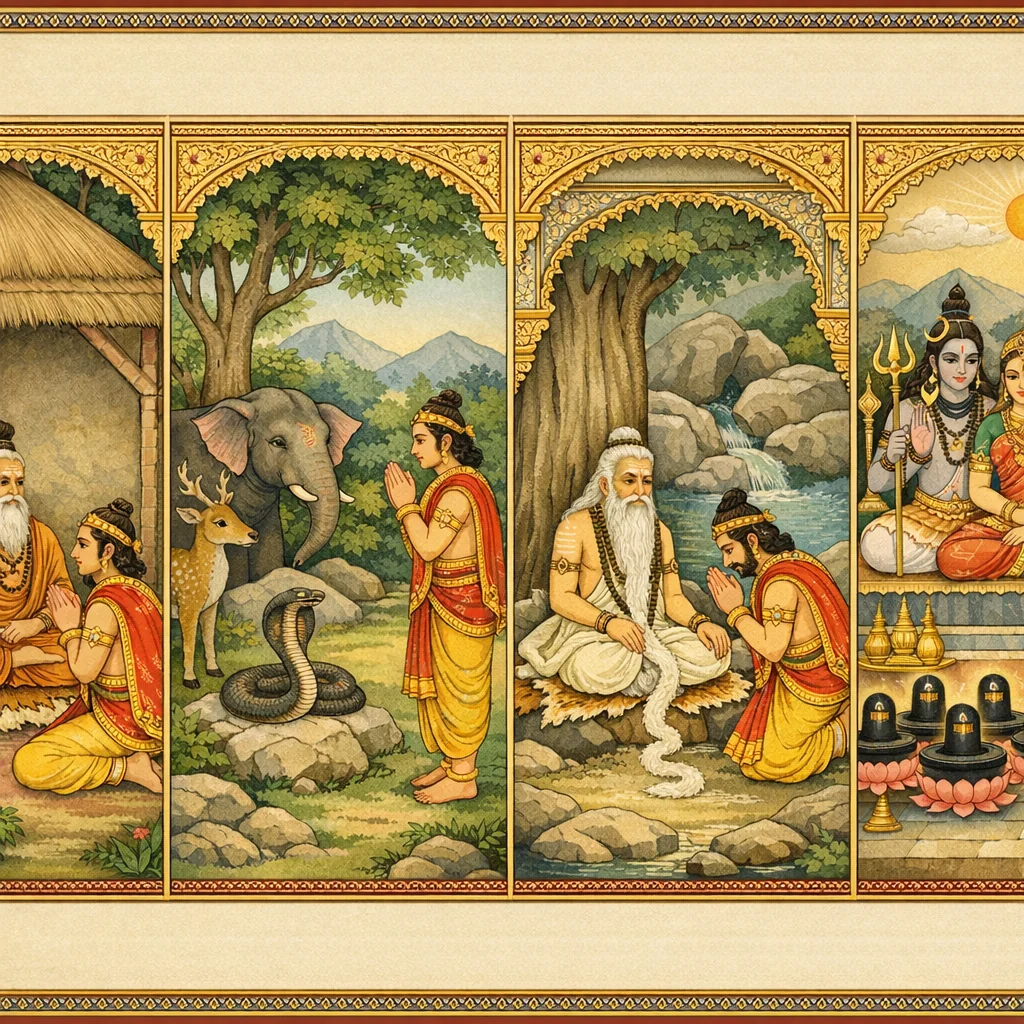
Adhyaya 271
Chapter 271 begins with Sūta extolling the supremely meritorious “liṅgasaptaka,” a cluster of seven liṅgas whose morning darśana and worship bestow longevity, freedom from disease, and the removal of sins. The liṅgas named include Mārkaṇḍeśvara, Indradyumneśvara, Pāleśvara, Ghaṇṭāśiva, Kalaśeśvara (linked with Vānareśvara), and Īśāna/Kṣetreśvara. The ṛṣis ask for the origins of each—who founded them, and what rites and gifts are enjoined. Sūta then relates a long exemplum about King Indradyumna: though he has performed vast sacrifices and donations, his heavenly standing is imperiled when his earthly fame wanes, so he returns to renew his kīrti through sacred works. Seeking confirmation of his identity across immense time, he consults a chain of extraordinarily long-lived beings—Mārkaṇḍeya, a crane-like being (Baka/Nāḍījaṅgha), an owl (Ulūka), a vulture (Gṛdhra), a tortoise (Kūrma/Mantharaka), and finally the sage Lomaśa—each attributing longevity to Śiva-centered devotion (such as bilva-leaf worship and ritual acts) and animal embodiment to ascetic curses. The sequence culminates in instructions connected with Bhartṛyajña and Saṃvarta, yielding a practical resolution: the establishment of seven liṅgas in the kṣetra associated with Hāṭakeśvara, along with seven emblematic dānas fashioned as “mountain-gifts” (Meru, Kailāsa, Himālaya, Gandhamādana, Suvela, Vindhya, Śṛṅgī) from specified materials. The phalaśruti concludes that mere morning darśana of the seven liṅgas frees even unwitting sin, while prescribed worship and gifts grant nearness to Śiva (gaṇatva), long heavenly enjoyment, and exalted worldly sovereignty across rebirths.
Shlokas
Verse 1
सूत उवाच । अथान्यदपि तत्रास्ति सुपुण्यं लिंगसप्तकम् । येनार्चितेन दृष्टेन पूजितेन विशेषतः
Sūta said: Moreover, there is there a supremely meritorious group of seven liṅgas; by worshipping them, by beholding them, and especially by honoring them with pūjā, great merit is obtained.
Verse 2
दीर्घायुर्जायते मर्त्यः सर्वरोगविवर्जितः । मार्कण्डेश्वर इत्युक्तस्तत्र देवो महेश्वरः
A mortal attains long life, free from every disease. There, Maheśvara is spoken of as Mārkaṇḍeśvara.
Verse 3
इन्द्रद्युम्नेश्वरोऽन्यस्तु सर्वपापहरो हरः । पालेश्वरस्तथा चैव सर्वव्याधिविनाशनः
Another is Indradyumneśvara—Hara who removes all sins. Likewise, Pāleśvara is the destroyer of every ailment.
Verse 4
ततो घंटशिवः ख्यातो यो घंटेन प्रतिष्ठितः । कलशेश्वरसंज्ञस्तु वानरेश्वरसंयुतः
Then there is the famed Ghaṇṭaśiva, established by a bell. And another is known as Kalaśeśvara, associated with Vānareśvara.
Verse 5
ईशान शिव इत्युक्तस्तत्र क्षेत्रेश्वरेश्वरः । पूजितो मानवैर्भक्त्या कामान्यच्छत्यमानुषान्
There, the Lord of the sacred region is called Īśāna Śiva, the Kṣetreśvareśvara. Worshipped by people with devotion, he grants desires beyond the ordinary human measure.
Verse 6
वांछितान्मनसा सर्वान्कलिकालेऽपि संस्थिते
All that one desires within the mind—even while the age of Kali yet prevails—
Verse 7
ऋषय ऊचुः । कोऽयं मार्कंडसंज्ञस्तु येन लिंगं प्रतिष्ठितम् । इन्द्रद्युम्नो महीपालः कतमो वद सूतज
The sages said: “Who is this one called Mārkaṇḍa, by whom the liṅga was established? And which Indradyumna is the king, lord of the earth? Tell us, O son of Sūta.”
Verse 8
तथा पालकनामा च येनायं स्थापितो हरः । तथा यो घण्टसंज्ञस्तु कस्मिञ्जातः स चान्वये
“And likewise, who is the one named Pālaka by whom this Hara was installed? And the one called ‘Ghaṇṭa’—in what lineage was he born?”
Verse 9
कलशाख्यस्तु यः ख्यातो वानरेण समन्वितः । ईशानोप्यखिलं ब्रूहि परं नःकौतुकं स्थितम्
“That one renowned as ‘Kalaśa’, associated with a monkey—O Īśāna, tell us everything in full, for great curiosity has arisen in us.”
Verse 10
यतोऽत्र जायते श्रेयः पुनः पुंसां प्रकीर्तय । यैरेतैः स्थापिता देवाः क्षेत्रेऽस्मिन्मानवोत्तमैः
“Proclaim again how, in this place, the highest welfare arises for people—and by which excellent men these deities were established in this sacred field.”
Verse 11
तथा तेषां समाचारं प्रभावं चैव सूतज । दानं वापि यथाकालं मंत्रांश्च विस्तराद्वद
“And also, O son of Sūta, speak in detail of their proper observances and their sacred power—along with the timely charities and the mantras.”
Verse 12
सूत उवाच । अहं वः कीर्तयिष्यामि कथामेतां पुरातनीम् । कथितां भर्तृयज्ञेन आनर्ताधिपतेः स्वयम्
Sūta said: “I shall recount to you this ancient narrative—told by Bhartṛyajña himself, the lord of Ānarta.”
Verse 13
श्रुतयापि यया मर्त्यो दीर्घायुर्जायतेनरः । नापमृत्युमवाप्नोति कथंचित्तत्प्रभावतः
“By merely hearing it, a mortal becomes long-lived; by its power he does not, in any way, meet with untimely death.”
Verse 14
यो मार्कंड इति ख्यातः प्रथमं परिकीर्तितः । संभूतिस्तस्य संप्रोक्ता युष्माकं पापनाशिनी
“He who is famed as Markaṇḍa is first to be spoken of; his origin shall now be explained—an account that destroys your sins.”
Verse 15
इंद्रद्युम्नं प्रवक्ष्यामि सांप्रतं मुनिसत्तमाः । यद्वंशो यत्प्रभावश्च सर्वभूपालमानितः
“Now, O best of sages, I shall speak of Indradyumna—his lineage and his greatness, honored by all kings.”
Verse 16
इंद्रद्युम्नो महीपाल आसीत्पूर्वं द्विजोत्तमाः । ब्राह्मण्यश्च शरण्यश्च साधुलोकप्रपालकः । यज्वा दानपतिर्दक्षः सर्वभूतहिते रतः
“Indradyumna was formerly a king, O best of Brahmins—devoted to Brahmins, a refuge to all, a protector of the virtuous. He performed sacrifices, was foremost in charity, skilled in action, and delighting in the welfare of all beings.”
Verse 17
न दुर्भिक्षं न च व्याधिर्न च चौरकृतं भयम् । तस्मिञ्छासति धर्मज्ञे आसील्लोकस्य कस्यचित्
While that dharma-knowing king ruled, there was no famine, no disease, and no fear wrought by thieves for anyone in the realm.
Verse 18
यथैव वर्षतो धारा यथा वा दिवि तारकाः । गंगायां सिकता यद्वत्संख्यया परिवर्जिताः
As the streams of falling rain, as the stars in the sky, as the sands in the Gaṅgā are beyond counting—so too are they innumerable.
Verse 19
तद्वत्तेन कृता यज्ञाः सर्वे संपूर्णदक्षिणाः । अग्निष्टोमोऽतिरात्रश्च उक्थः षोडशिकास्तथा
Thus he duly performed all sacrifices, each complete with its proper dakṣiṇā (priestly fees): the Agniṣṭoma, the Atirātra, the Ukthya, and likewise the Ṣoḍaśī rites.
Verse 20
सौत्रामण्याऽथ पशवश्चातुर्मास्या द्विजोत्तमाः । वाजपेयाश्वमेधाश्च राजसूया विशेषतः
And also the Sautrāmaṇī rite, the Paśu-sacrifices, and the seasonal Cāturmāsya rites—O best of the twice-born—together with the Vājapeya and Aśvamedha, and especially the Rājasūya, were performed.
Verse 21
पौण्डरीकास्तथैवान्ये श्रद्धापूतेन चेतसा
Likewise, the Pauṇḍarīka rites and many others too were undertaken with a mind purified by śraddhā—faith and reverent devotion.
Verse 22
तेन दानानि दत्तानि तीर्थेषु च विशेषतः । मिष्टान्नानि द्विजेंद्राणां दक्षिणासहितानि च
By him were gifts bestowed—especially at the tīrthas, the sacred bathing-places; and sweet foods were offered to the foremost of Brahmins, together with the due dakṣiṇā.
Verse 23
न तदस्ति धरापृष्ठे नगरं पत्तनं तथा । तीर्थं वा यत्र नो तस्य विद्यते त्रिदशालयः
Upon the earth there was no city or market-town—nor any tīrtha, any sacred ford—where his shrine, a dwelling of the gods, was not found.
Verse 24
तेन कन्यासहस्राणि अच्युतान्यर्बुदानि च । ब्राहमणेभ्यः प्रदत्तानि ब्राह्मणानां धनार्थिनाम्
By him, thousands of maidens were given in charity, and countless riches as well—bestowed upon Brahmins who were in need of wealth.
Verse 25
दशमीदिवसे तस्य रात्रौ च गजपृष्ठिगः । दुन्दुभिस्ताड्यमानस्तु बभ्राम सकलं पुरम्
On his Daśamī day, and again at night, mounted upon an elephant’s back, with the dundubhi kettle-drums being beaten, he toured the entire city.
Verse 26
प्रत्यूषे वैष्णवं भावि पापहारि च वासरम् । उपवासः प्रकर्त्तव्यो मुक्त्वा वृद्धं च बालकम् । अन्यथा निग्रहिष्यामि भोजनं यः करिष्यति
At dawn he proclaimed: “Tomorrow is a Vaiṣṇava day, a day that removes sin. A fast (upavāsa) must be observed—except for the aged and the young. Otherwise, I shall punish anyone who eats.”
Verse 27
इंद्रद्युम्नः स राजर्षिस्तदा विष्णोः प्रसादतः । तेनैव स्वशरीरेण ब्रह्मलोकं तदा गतः
Then the royal sage Indradyumna, by the grace of Viṣṇu, went to Brahmaloka in that very body of his.
Verse 28
तत्र कल्पसहस्रांते स प्रोक्तो ब्रह्मणा स्वयम् । इंद्रद्युम्न धरां गच्छ न स्थातव्यं त्वयाऽधुना
There, at the end of a thousand kalpas, Brahmā himself addressed him: “Indradyumna, go to the earth; it is not time for you to remain here now.”
Verse 29
इंद्रद्युम्न उवाच । कस्माच्च्यावयसे ब्रह्मन्निजलोकाद्द्रुतं हि माम् । अपापमपि देवेश तथा मे वद कारणम्
Indradyumna said: “O Brahman, why do you cast me down so swiftly from your own world? O Lord of the gods, though I am free from sin, tell me truly the reason for this.”
Verse 30
श्रीब्रह्मोवाच । तव कीर्तिसमुच्छेदः संजातोऽद्य धरातले । यावत्कीर्तिर्धरापृष्ठे तावत्स्वर्गे वसेन्नरः
Śrī Brahmā said: “Today, on the earth, the continuance of your renown has been cut off. As long as one’s fame (earned merit) endures upon the face of the earth, so long does that person dwell in heaven.”
Verse 31
एतस्मात्कारणाल्लोकाः स्वनामांकानि चक्रिरे । वापीकूपतडागानि देवतायतनानि च
For this very reason, people created memorial works bearing their own names—stepwells, wells, ponds, and also temples as abodes of the deities.
Verse 32
तस्माद्गच्छ धरापृष्ठं स्वां कीर्तिं नूतनां कुरु । यदि वांछसि लोकेऽस्मिन्मामके वसतिं चिरम्
Therefore, go down to the face of the earth and renew your renown through fresh deeds of merit. If you desire to dwell long in this world of mine (Svarga), this is the way.
Verse 33
अथात्मानं स राजेंद्रो यावत्पश्यति तत्क्षणात् । तावत्प्राप्तं धरापृष्ठे कांपिल्य नगरं प्रति
Then the lord of kings, as soon as he became aware of himself, found that in that very moment he had arrived upon the earth, near the city of Kāṃpilya.
Verse 34
अथ पप्रच्छ लोकान्स किमेतन्नगरं स्मृतम् । कोऽयं देशः कोऽत्र राजा किं पुरं नगरं च किम्
Then he questioned the people: “What is this city called? What is this region? Who is the king here? And what is meant by ‘pura’ and what by ‘nagara’?”
Verse 35
ते तमूचुः परं चैतत्कांपिल्यमिति विश्रुतम् । आनर्तनामा देशोऽयं राजात्र पृथिवीजयः
They said to him: “This renowned city is indeed called Kāṃpilya. This land is known as Ānarta, and the king here is Pṛthivījaya.”
Verse 36
को भवान्किमिहायातः किंचित्कार्यं वदस्व नः
“Who are you, and why have you come here? Tell us what business you have.”
Verse 37
इंद्रद्युम्न उवाच इंद्रद्युम्नो महीपालः पुरासीद्रोचके पुरे । देशे वैजरुके पूर्वं स देशः क्व च तत्पुरम्
Indradyumna said: “I am Indradyumna, a ruler of the earth. Formerly I dwelt in the city called Rocaka, in the land of Vaijaruka. Where is that country now, and where is that city?”
Verse 38
जना ऊचुः । न वयं तत्पुरं विद्मो न देशं न च भूपतिम् । इन्द्रद्युम्नाभिधानं च यं त्वं पृच्छसि भद्रक
The people said: “We do not know that city, nor that country, nor that king. Nor do we know the one named Indradyumna whom you ask about, O good sir.”
Verse 39
इंद्रद्युम्न उवाच । चिरायुरस्ति कोऽप्यत्र यस्तं वेत्ति महीपतिम् । देशं वा तत्पुरं वापि तन्मे वदथ मा चिरम्
Indradyumna said: “Is there anyone here of long life who knows that king—his land or even his city? Tell me at once; do not delay.”
Verse 40
जना ऊचुः । सप्तकल्पस्मरो नाम मार्कंडेयो महामुनिः । श्रूयते नैमिषारण्ये तं गत्वा पृच्छ वेत्स्यसि
The people said: “The great sage Mārkaṇḍeya, known as ‘He who remembers seven kalpas,’ is said to dwell in Naimiṣāraṇya. Go to him and ask—then you will know.”
Verse 41
अथासौ सत्वरं गत्वा व्योममार्गेण तं मुनिम् । पप्रच्छ प्रणिपत्योच्चैर्नैमिषारण्यमाश्रितम्
Then he hastened forth and, traveling by the sky-path, approached that sage who dwelt in Naimiṣāraṇya. Bowing down in reverence, he questioned him aloud.
Verse 42
इंद्रद्युम्नेति वै भूपस्त्वया दृष्टः श्रुतोऽथ वा । चिरायुस्त्वं श्रुतोऽस्माभिः पृच्छामस्तेन सन्मुने
“Have you seen, or even heard of, the king named Indradyumna? We have heard that you are long-lived; therefore, O noble sage, we ask you.”
Verse 43
श्रीमार्कंडेय उवाच सप्तकल्पांतरे भूपो न दृष्टो न मया श्रुतः । इंद्रद्युम्नाभिधानोऽत्र तत्र किं नु वदामि ते
Śrī Mārkaṇḍeya said: “Across seven kalpas, I have neither seen nor heard of any king here named Indradyumna. What, then, can I tell you about him?”
Verse 44
तस्य तद्वचनं श्रुत्वा निराशः स महीपतिः । वैराग्यं परमं गत्वा मरणे कृतनिश्चयः
Hearing those words, the king became without hope. Entering into the highest dispassion, he resolved upon death.
Verse 45
तेन चानीय दारूणि प्रज्वाल्य च हुताशनम् । प्रवेष्टुकामः स प्रोक्त इन्द्रद्युम्नो महीपतिः
Then, bringing firewood and kindling the fire, that king—Indradyumna—was said to be desirous of entering into it.
Verse 46
त्वया चात्र न कर्तव्यमहं ते मित्रतां गतः । नाशयिष्यामि ते मृत्युं यद्यपि स्यान्महत्तरम्
“You must not do this here. I have become your friend. I shall ward off your death, even if it be exceedingly formidable.”
Verse 47
नीरोगोऽसि सुभव्योऽसि कस्मान्मृत्युं प्रवांछसि । वद मे कारणं मृत्योः प्रतीकारं करोमि ते
“You are free from illness; you are blessed and well-favored. Why do you long for death? Tell me the cause of this wish to die; I shall provide the remedy for you.”
Verse 48
इंद्रद्युम्न उवाच । चिरायुर्मे भवान्प्रोक्तः कांपिल्यपुरवासिभिः । तेनाहं तव पार्श्वेऽत्र समायातो महामुने
Indradyumna said: “The people of Kāmpilyapura told me that you are long-lived. Therefore, O great sage, I have come here to your side.”
Verse 49
इंद्रद्युम्नोद्भवां वार्तां त्वं वदिष्यसि सन्मुने । मत्कीर्तिर्न परिज्ञाता ततो मृत्युं व्रजाम्यहम्
“O noble sage, you will recount the tale connected with Indradyumna. Yet my fame is not known; therefore I shall go to death.”
Verse 50
सूत उवाच । तस्य तं निश्चयं ज्ञात्वा दयावान्स मुनीश्वरः । वृथाश्रमं च तं ज्ञात्वा दाक्षिण्यादिदमब्रवीत्
Sūta said: Knowing his firm resolve, that compassionate lord among sages—seeing that his effort would otherwise be in vain—spoke these words out of courtesy and kindness.
Verse 51
यद्येवं मा विशाग्निं त्वमहं ज्ञास्यामि तं नृपम् । नाडीजंघो बको नाम ममास्ति परमः सुहृत्
“If so, do not fall into despair, O Viśāgni. I shall find out about that king. I have a most intimate friend—Baka by name, also called Nāḍījaṅgha.”
Verse 52
चिरंतनश्च सोऽस्माकं नूनं ज्ञास्यति तं नृपम् । तस्मादागच्छ गच्छावस्तस्य पार्श्वे हिमाचले
He is ancient, long associated with us, and he will surely know about that king. Therefore come; let us go to him, to the side of the Himālaya.
Verse 53
साधूनां दर्शनं जातु न वृथा जायते क्वचित्
The sight and audience of holy persons is never, at any time, fruitless.
Verse 54
एवमुक्त्वा ततस्तौ तु प्रस्थितौ मुनिपार्थिवौ । व्योममार्गेण संतुष्टौ बकं प्रति हिमाचले
Having spoken thus, the sage and the king set out. Content, they traveled by the path of the sky toward Baka, in the Himālaya region.
Verse 55
बकोऽपि तं समालोक्य मार्कण्डेयं समागतम् । संमुखः प्रययौ तुष्टः स्वागतेनाभ्यपूजयत्
Baka too, seeing Mārkaṇḍeya arrived, went forward to meet him; delighted, he honored him with words of welcome.
Verse 56
धन्योऽहं कृतपुण्योऽहं यस्य मे त्वत्समागमः । भो भो ब्रह्मविदां श्रेष्ठ आतिथ्यं ते करोमि किम्
Blessed am I, meritorious am I, since I have this meeting with you. O best among the knowers of Brahman, what hospitality may I offer you?
Verse 57
श्रीमार्कंडेय उवाच । मत्तोपि त्वं चिरायुश्च यतो मित्रं व्यवस्थितः । इन्द्रद्युम्नो महीपालस्त्वया दृष्टः श्रुतोऽथवा
Śrī Mārkaṇḍeya said: “You are longer-lived than I, for you stand firmly established as a friend. Have you seen King Indradyumna, or at least heard of him?”
Verse 58
एतस्य मम मित्रस्य तेन दृष्टेन कारणम् । अन्यथा जायते मृत्युस्ततोऽहं त्वां समागतः
For the sake of this friend of mine—so that he may be ‘seen’, that is, known and acknowledged—I have come. Otherwise death would occur; therefore I have approached you.”
Verse 59
बक उवाच सप्तद्विगुणितान्कल्पान्स्मराम्यहमसंशयम् । न स्मरामि कथामेव इंद्रद्युम्नसमुद्भवाम्
Baka said: “Without any doubt I remember fourteen kalpas. Yet I do not recall at all the story connected with King Indradyumna’s origin.”
Verse 60
आस्तां हि दर्शनं तावत्सत्यमेतन्मयोदिम्
“Let the matter of ‘having seen’ rest for now; what I have stated is the truth.”
Verse 61
इंद्रद्युम्न उवाच । तपसः किं प्रभावोऽयं दानस्य नियमस्य च । यदायुरीदृशं जातं बकत्वेऽपि वदस्व नः
Indradyumna said: “What is this power of tapas (austerity), of dāna (charitable giving), and of niyama (disciplined observance), by which such a lifespan has arisen, even in the state of being Baka? Tell us.”
Verse 62
बक उवाच घृतकंबलमाहात्म्याद्देवदेवस्य शूलिनः । ममायुरीदृशं जातं बकत्वं मुनिशापतः
Baka said: “Through the greatness of Ghṛtakambala—belonging to the Trident-bearing Lord, the God of gods—my lifespan became thus; but my becoming ‘Baka’ came about through a sage’s curse.”
Verse 64
अहमासं पुरा बालो ब्राह्मणस्य निवेशने । चमत्कारपुरे रम्ये पाराशर्यस्य धीमतः
“Formerly I was a boy in the home of a brāhmaṇa—the wise descendant of Parāśara—within the delightful city called Camatkārapura.”
Verse 65
कस्यचित्त्वथ कालस्य संक्रांतौ मकरस्य भोः । संप्राप्यातीव चापल्याल्लिंगं जागेश्वरं मया । घृतकुम्भे परिक्षिप्तं पूजितं जनकेन यत्
“Then, at a certain time—on Makara Saṅkrānti—out of sheer childish restlessness, I took the liṅga of Jāgeśvara and placed it into a pot of ghee, though it had been worshipped by my father.”
Verse 66
अथ रात्र्यां व्यतीतायां पृष्टोऽहं जनकेन च । त्वया पुत्र परिक्षिप्तं नूनं जागेश्वरं क्वचित् । तस्माद्वद प्रयच्छामि तेन ते भक्ष्यमुत्तमम्
“When the night had passed, my father questioned me: ‘Son, you have surely put Jāgeśvara somewhere. Tell me; then I will give you excellent food.’”
Verse 67
ततो मयाज्यकुम्भाच्च तस्मादादाय सत्वरम् । भक्ष्यलौल्यात्पितुर्हस्ते विन्यस्तं घृतसंप्लुतम्
“Then, out of greed for food, I quickly took it from that pot of ghee and placed it into my father’s hand—smeared and drenched with ghee.”
Verse 68
कस्यचित्त्वथ कालस्य पंचत्वं च समागतः । जातिस्मरस्ततो जातस्तत्प्रभावान्नृपालये
After some time, death came upon me. Thereafter, by that very power, I was born again with memory of my former birth, in a royal household.
Verse 69
आनर्ताधिपतेर्हर्म्ये नाम्ना ख्यातस्त्वहं बकः । चमत्कारपुरे देवो हरः संस्थापितो मया
In the palace of the lord of Ānarta I became renowned by the name “Baka”. And in Camatkārapura I established the god Hara (Śiva).
Verse 70
तत्प्रभावेण विप्रेंद्र प्राप्तः पैतामहं पदम्
O best of brāhmaṇas, by the power of that meritorious act, he attained the exalted state of the Grandfather—the world and rank of Brahmā.
Verse 71
ततो यानि धरापृष्ठे सुलिंगानि स्थितानि च । घृतेनच्छादयाम्येव मकरस्थे दिवाकरे । मया यत्स्थापितं लिंगं चमत्कारपुरे शुभम्
Then, whatever auspicious liṅgas were established upon the surface of the earth, I would surely cover them with clarified butter (ghṛta) when the Sun was in Makara (Capricorn). And the auspicious liṅga that I myself installed in Camatkārapura—I worshipped in this very way.
Verse 72
आराधितं दिवा नक्तं राज्ये संस्थाप्य पुत्रकम् । नियोज्य सर्वतो भृत्यान्धनवस्त्रसमन्वितान्
I worshipped (Śiva) by day and by night. Having established my son upon the throne, I appointed attendants on all sides, provided with wealth and clothing (to carry out their duties).
Verse 73
ततःकालेन महता तुष्टो मे भगवाञ्छिवः । मत्समीपं समासाद्य वाक्यमेतदुवाच सः
After a long time, the Blessed Lord Śiva was pleased with me. Drawing near to my presence, he spoke these words:
Verse 74
परितुष्टोऽस्मि भद्रं ते तव पार्थिवसत्तम । घृतकंबलदानेन संख्यया रहितेन च
“I am wholly pleased with you—may auspiciousness be yours, O best of kings—because you gifted ghee-blankets, and because you gave without counting, without limit.”
Verse 75
तस्माद्वरय भद्रं ते वरं यन्मनसि स्थितम् । अदेयमपि दास्यामि यद्यपि स्यात्सुदुर्लभम्
“Therefore, choose a boon—may good be yours—whatever is set in your heart. Even what is normally not granted, I will give, even if it is exceedingly rare.”
Verse 76
ततो मया हरः प्रोक्तो यदि तुष्टोऽसि मे प्रभो । कुरुष्व मां गणं देव नान्यत्किंचिद्वृणोम्यहम्
Then I said to Hara: “If you are pleased with me, O Lord, make me one of your gaṇas, O God. I ask for nothing else at all.”
Verse 77
श्रीभगवानुवाच । बकैहि त्वं महाभाग कैलासं पर्वतोत्तमम् । मया सार्धमनेनैव शरीरेण गणो भव
The Blessed Lord said: “Speak your farewell and come, O greatly fortunate one, to Kailāsa, the best of mountains. Along with me, with this very body, become a gaṇa.”
Verse 78
अन्योऽपि मर्त्यलोकेत्र यः करिष्यति मानवः । मकरस्थे रवौ मह्यं संक्रांतौ रजनीमुखे । स नूनं मद्गणो भावी सकृत्कृत्वाऽथ कंबलम्
And any other person in the mortal world who will do this for Me—when the Sun is in Makara (Capricorn), at the time of saṅkrānti, at the onset of night—such a one will surely become My gaṇa, even by doing it but once: the making or offering of the kambala, the ghee-blanket.
Verse 79
त्वं पुनर्मामकं लिंगं समं कुर्वन्भविष्यसि । धर्मसेनेति विख्यातो विकृत्या परिवर्जितः
And you, in turn, shall become one who makes My liṅga even and well-formed; you will be renowned as Dharmasena, free from deformity and corruption.
Verse 80
एवमुक्त्वा स भगवान्मामादाय ततः परम् । कैलासं पर्वतं गत्वा गणकोटीशतामदात्
Having spoken thus, the Blessed Lord took me with Him; then, going to Mount Kailāsa, He bestowed upon me hundreds of koṭis of gaṇas, hosts of attendants.
Verse 81
कस्यचित्त्वथ कालस्य भ्रममाणो यदृच्छया । गतोऽहं पर्वतश्रेष्ठं हिमवंतं महागिरिम्
After some time, while wandering by chance, I came to the lord of mountains—Himavān, the great and lofty peak.
Verse 82
यत्रास्ते गालवो नाम सदैव तपसि स्थितः । तस्य भार्या विशालाक्षी सर्वलक्षणलक्षिता
There dwelt a sage named Gālava, ever established in tapas, holy austerity; his wife, Viśālākṣī, wide-eyed, was endowed with every auspicious mark.
Verse 83
सप्तरक्ता त्रिगंभीरा गूढगुल्फा कृशोदरी । तां दृष्ट्वा मन्मथाविष्टः संजातोऽहं मुनीश्वर
She shone with deep-hued radiance, graceful in her triple curves, with well-formed ankles and a slender waist. Seeing her, O lord of sages, I was overcome by Kāma—desire.
Verse 84
चिंतितं च मया चित्ते कथमेतां हराम्यहम् । तस्माच्छिष्यत्वमासाद्य भक्तिमस्य करोम्यहम्
I pondered in my heart, “How can I take her away?” Therefore, attaining the status of his disciple, I shall show him bhakti—devotional reverence.
Verse 85
शुश्रूषानिरतो भूत्वा येन प्राप्नोमि भामिनीम्
Becoming intent on attendance and service, by that means I may obtain that passionate lady.
Verse 86
ततो बटुकरूपेण संप्राप्तो गालवो मया । संसारस्य विरक्तोऽहं करिष्यामि मह्त्तपः
Then, in the guise of a baṭuka—a young celibate student—I approached Gālava and said, “I am detached from saṃsāra; I shall undertake great tapas, austere discipline.”
Verse 87
दीक्षां यच्छ विभो मह्यं येन शिष्यो भवामि ते
Grant me dīkṣā—sacred initiation—O revered one, by which I may become your disciple.
Verse 88
आहरिष्याम्यहं दर्भांस्तथा सुमनसः सदा । समिधश्च सदैवाहं फलानि जलमेव च
I shall always bring kuśa grass and flowers; and I shall ever bring fuel-sticks, fruits, and water as well.
Verse 89
स मां विनयसंपन्नं ज्ञात्वा ब्राह्मणरूपिणम् । ददौ दीक्षां ततो मह्यं शास्त्रदृष्टेन कर्मणा
Recognizing me as one endowed with discipline, appearing in the form of a brāhmaṇa, he then granted me initiation according to the rite prescribed in the scriptures.
Verse 90
अथ दीक्षां समासाद्य तोषयामि दिनेदिने । तं चैव तस्य पत्नीं तां यथोक्तपरिचर्यया । अशुद्धेनापि चित्तेन छिद्रान्वेषणतत्परः
Then, having received initiation, I kept pleasing him day after day; and I also served his wife exactly as prescribed. Yet, even with an impure mind, I remained intent on seeking a flaw—watching for an opening.
Verse 91
अन्यस्मिन्दिवसे प्राप्ते सा स्त्रीधर्मसमन्विता । उटजं दूरतस्त्यक्त्वा रात्रौ सुप्ता मनस्विनी
On another day, that noble-minded woman, steadfast in the duties of womanly dharma, lay down at night to sleep—having left the hermitage-hut at some distance.
Verse 92
सोऽहं रूपं महत्कृत्वा तामादाय तपस्विनीम् । सुखसुप्तां सुविश्रब्धां प्रस्थितो दक्षिणामुखः
Then I, assuming a great and terrifying form, seized that ascetic woman; while she slept comfortably and unsuspecting, I set out facing south.
Verse 93
अथासौ संपरित्यक्ता संस्पर्शान्मम निद्रया । चौररूपं परिज्ञाय मां शिष्यं प्ररुरोद ह
Then she awoke, disturbed by my touch. Recognizing my thief-like guise, she cried out, “(It is) your disciple!”
Verse 94
साब्रवीच्च स्वभर्तारं गालवं मुनिसत्तमम् । एष शिष्यो दुराचारो हरते मामितः प्रभो
And she said to her husband—Gālava, best of sages—“Lord, this wicked disciple is carrying me off from here!”
Verse 95
तस्माद्रक्ष महाभाग यावद्दूरं न गच्छति
Therefore, O fortunate one, protect (me) before he goes far away.
Verse 96
तच्छ्रुत्वा गालवः प्राह तिष्ठतिष्ठेति चासकृत् । पापाचार सुदुष्टात्मन्गतिस्ते स्तंभिता मया
Hearing that, Gālava said repeatedly, “Stop! Stop!” And he declared, “O sinner, O utterly wicked one—your movement has been frozen by me.”
Verse 97
तस्य वाक्यात्ततो मह्यं गतिस्तंभो व्यजायत । यद्वल्लिखित एवाहं प्रतिष्ठामि सुनिश्चलः
From his words, my motion was arrested at once; I stood utterly still, as if I had been drawn in a picture.
Verse 98
ततस्तेन च शप्तोऽहं गालवेन महात्मना । वंचितोऽहं त्वया यस्माद्बको भव सुदुर्मते
Then I was cursed by the great-souled Gālava: “Since you have deceived me—become a crane (baka), O utterly perverse-minded one!”
Verse 99
ततः पश्यामि चात्मानं सहसा बकरूपिणम् । बकत्वेऽपि न मे नष्टा या स्मृतिः पूर्वसंभवा
Then, suddenly, I saw myself in the form of a crane (baka). Yet even in that crane-state, the memory born of my former existence did not perish.
Verse 100
ततः साऽपि च तत्पत्नी सचैलं स्नानमाश्रिता । मत्स्पर्शादुःखितांगी च शापाय समुपस्थिता
Then his wife too, still wearing her garments, resorted to a purificatory bath. Her body pained by that sinful touch, she stepped forward, intent on pronouncing a curse.
Verse 101
यस्मात्पाप त्वया स्पृष्टा प्रसुप्ताहं रजस्वला । बकधर्मं समाश्रित्य भर्त्ता मे वंचितस्त्वया । अन्यरूपं समास्थाय तस्मात्सत्यं बको भव
“Because, O sinner, you touched me while I slept, when I was in my courses; and by taking refuge in the ‘crane’s way’ you deceived my husband—therefore, assuming another form, become truly a crane (baka)!”
Verse 102
एवं शप्तस्ततो द्वाभ्यां ताभ्यां वै दुःखसंयुतः । चरणाभ्यां प्रलग्नस्तु गालवस्य महात्मनः
Thus cursed by those two, he became filled with misery, and clung to the feet of the great-souled sage Gālava.
Verse 103
गणोऽहं देवदेवस्य त्रिनेत्रस्य महात्मनः । पालकेति च विख्यातो गणकोटिप्रभुः स्थितः
I am a gaṇa of the God of gods, the great-souled Three-eyed Lord. I am famed as Pālaka, established as a commander over crores of gaṇas.
Verse 104
सोऽहमत्र समायातः प्रभोः कार्येण केनचित् । तव भार्यां समालोक्य कामदेववशं गतः
I came here on some errand of my Lord; but on seeing your wife, I fell under the power of Kāma (desire).
Verse 105
क्षमापराधं त्वं मह्यमेवं ज्ञात्वा मुनीश्वर । दुर्विनीतः श्रियं प्राप्य विद्यामैश्वर्यमेव च
O lord of sages, knowing this, forgive my offense. Ill-disciplined as I was, I gained prosperity—and learning and power as well.
Verse 106
न तिष्ठति चिरं स्थाने यथाहं मदगर्वितः । शिष्यरूपं समास्थाय ततः प्राप्तस्तवांतिकम्
One does not remain long in one’s station when, like me, one is proud with intoxication. So I assumed the form of a disciple and then came into your presence.
Verse 107
अस्या हरणहेतोश्च महासत्या मुनीश्वर । तस्मात्कुरु प्रसादं मे दीनस्य प्रणतस्य च
O sage-lord, because of the cause connected with carrying her off—and since she is supremely truthful—therefore show favor to me, who am wretched and bowed down.
Verse 108
अनुग्रहप्रदानेन क्षमा यस्मात्तपस्विनाम् । कोकिलानां स्वरो रूपं नारीरूपं पतिव्रता । विद्या रूपं कुरूपाणां क्षमा रूपं तपस्विनाम्
Because ascetics bestow grace, forgiveness is truly their adornment. A cuckoo’s beauty is its voice; a woman’s beauty is her faithful devotion to her husband; the ugly are beautified by learning; and ascetics are beautified by forgiveness.
Verse 109
सूत उवाच । तस्य तत्कृपणं श्रुत्वा सोपि माहेश्वरो मुनिः । ज्ञात्वा तं बांधवस्थाने दयां कृत्वाऽब्रवीद्वचः
Sūta said: Hearing his pitiable plea, that Māheśvara sage too—recognizing him as one who stood in the place of a kinsman—was moved with compassion and spoke these words.
Verse 110
सत्यवाक्तिष्ठते विप्रश्चमत्कारपुरे शुभे
O brāhmaṇa, the truth-speaking one dwells in the auspicious city called Camatkārapura.
Verse 111
भर्त्तृयज्ञ इति ख्यातस्तदा तस्योपदेशतः । बकत्वं यास्यते नूनं मम वाक्यादसंशयम्
Then, by his instruction, he became renowned as ‘Bhartṛyajña’. And surely—without doubt—by my word he will enter the state of being a heron.
Verse 112
ततः पश्यामि चात्मानं बकत्वेन समाश्रितम्
Then I behold myself—having taken refuge in the condition of being a heron, that is, transformed into a heron.
Verse 113
एवं मे दीर्घमायुष्यं संजातं शिवभक्तितः । घृतकम्बलमाहात्म्याद्बकत्वं मुनिशापतः
Thus, through devotion to Śiva, long life came to me. Yet, by the greatness connected with Ghṛtakambala, through a sage’s curse, I attained the state of being a heron (baka).
Verse 114
इंद्रद्युम्न उवाच एतदर्थं समानीतस्त्वत्सकाशं विहंगम । इंद्रद्युम्नस्य वार्तार्थं मरणे कृतनिश्चयः
Indradyumna said: O bird, for this very purpose you were brought into my presence—to convey news about Indradyumna; for I have resolved upon death.
Verse 115
सा त्वया नैव विज्ञाता ममाभाग्यैर्विहंगम । सेवयिष्याम्यहं तस्मात्प्रदीप्तं हव्यवाहनम्
O bird, because of my misfortune, that matter was not known by you. Therefore I shall resort to the blazing Fire—Agni.
Verse 116
प्रतिज्ञातं मया पूर्वमेतन्निश्चित्य चेतसि । इंद्रद्युम्ने ह्यविज्ञाते संसेव्यः पावको मया
Earlier I had vowed this, having firmly decided it in my heart: if Indradyumna remains unknown, then I must resort to Fire.
Verse 117
तस्माद्देहि ममादेशं मार्कंडेयसमन्वितः । प्रविशामि यथा वह्निं भ्रष्टकीर्तिरहं बक
Therefore grant me your permission, accompanied by Mārkaṇḍeya, so that I may enter the fire—I, the heron (baka), whose reputation has fallen.
Verse 118
मार्कंडेय उवाच । वेत्सि चान्यं नरं कञ्चिद्वयसा चात्मनोऽधिकम् । पृच्छामि येन तं गत्वा कृते ह्यस्य महात्मनः
Mārkaṇḍeya said: “Do you know any other man, older than yourself in years? I ask so that, having gone to him, something may be done for this great-souled one.”
Verse 119
श्रद्धया परया युक्तः संप्राप्तोऽयं मया सह । तत्कथं त्यजति प्राणान्सहाये मयि संस्थिते
Endowed with supreme faith, he has come together with me. How, then, can he abandon his life-breath while I, his companion, stand beside him?
Verse 120
अपरं च क्षमं वाक्यं यत्त्वां वच्मि विहंगम । अयं दुःखेन संयुक्तः साधयिष्यति पावकम् । अहमेनमनुद्धृत्य कस्माद्गच्छामि चाश्रमम्
“O bird, bear with one more word that I shall speak. This one, overwhelmed by sorrow, is preparing to enter the fire. How could I go back to my hermitage without first rescuing him?”
Verse 121
सूत उवाच । तयोस्तं निश्चयं ज्ञात्वा बकः परमदुर्मना । सुचिरं चिंतयामास कथं स्यादेतयोः सुखम्
Sūta said: “Knowing their resolve, the bird Baka became deeply distressed. For a long time he pondered, ‘How can well-being come to these two?’”
Verse 122
ततो राजा मुनिश्चैव दारूण्याहृत्य पावकम् । प्रवेष्टुकामौ तौ दृष्ट्वा बको वचनमब्रवीत्
Then the king and the sage, having gathered firewood, prepared the fire. Seeing that the two were intent on entering it, Baka spoke these words.
Verse 123
मम वाक्यं कुरु प्राज्ञ यदि जीवितुमिच्छसि । ज्ञातः सोऽद्य मया व्यक्तमिन्द्रद्युम्नं नराधिपम्
O wise one, do as I say if you wish to live. Today I have clearly recognized him—the lord of men, King Indradyumna.
Verse 124
यो ज्ञास्यति मम ज्येष्ठः सर्वशास्त्रविचक्षणः । तत्त्वमेनं समादाय मरणे कृतनिश्चयम्
My elder, keenly discerning in all the scriptures, will surely know the truth about him. Take him with us, though he has resolved upon death.
Verse 125
निश्वसन्तं यथा नागं बाष्पव्याकुललोचनम् । समागच्छ मया सार्धं कैलासं पर्वतं प्रति
He sighs like a serpent, his eyes troubled with tears. Come with me to Mount Kailāsa.
Verse 126
यत्रास्ति दयितो मह्यमुलूकश्चिरजीवभाक् । स नूनं ज्ञास्यते तं हि मा वृथा मरणं कृथाः
There lives my beloved companion, Ulūka, long-lived. He will surely know him and the truth about him. Do not embrace death in vain.
Verse 127
ततोऽसौ तेन संयुक्तो बकेन सुमहात्मना । मार्कंडेयेन संप्राप्तः कैलासं पर्वतोत्तमम्
Then he, accompanied by the great-souled Baka and by Mārkaṇḍeya, reached Kailāsa—the foremost of mountains.
Verse 128
सोऽपि दृष्ट्वा बकं प्राप्तं मित्रं परमसंमतम् । समागच्छदसौ हृष्टः स्वागतेनाभ्यनन्दयत्
He too, seeing Baka arrive—his most esteemed friend—came forward in joy and welcomed him with words of greeting.
Verse 129
अथ तं चैव विश्रान्तं समालिङ्ग्य मुहुर्मुहुः । प्राकारवर्णनामासौ वाक्यमेतदुवाच ह
Then, after he had rested, he embraced him again and again; and that one, named Prākāravarṇa, spoke these words.
Verse 130
स्वागतं ते द्विजश्रेष्ठ भूप सुस्वागतं च ते । सख्येऽद्य यच्च ते कार्यं वदागमनकारणम्
Welcome to you, O best of the twice-born; and welcome to you as well, O king. Today, as a friend, tell me what task you have and the reason for your coming.
Verse 131
कावेतौ पुरुषौ प्राप्तौ त्वया सार्धं ममांतिकम् । दिव्यरूपौ महाभागौ तेजसा परिवारितौ
Who are these two men who have come here to me together with you—of divine appearance, greatly fortunate, and surrounded by radiance?
Verse 132
बक उवाच । एष मार्कंडसंज्ञोऽत्र प्रसिद्धो भुवनत्रये । महेश्वरप्रसादेन संसिद्धिं परमां गतः । द्वितीयोऽसौ सुहृच्चास्य कश्चिन्नो वेद्मि तत्त्वतः । मार्कंडेन समायातः सुहृदा व ममांतिकम्
Baka said: “This one here, known as Mārkaṇḍa, is renowned in the three worlds. By the grace of Maheśvara he has attained the highest perfection. The second is his friend—someone; I do not truly know him in essence. He has come here to me along with Mārkaṇḍa, as a companion and friend.”
Verse 135
यदि जानासि तं भूपमिन्द्रद्युम्नं महामते । तत्त्वं कीर्तय येनासौ मरणाद्विनिवर्तते
O great-minded one, if you know that king Indradyumna, then proclaim the true principle by which he may turn back from death.
Verse 136
चिरायुस्त्वं मया ज्ञातो ह्यतः प्राप्तोऽस्मि तेंऽतिकम्
I have known you to be long-lived; therefore I have come into your presence.
Verse 137
उलूक उवाच । अष्टाविंशत्प्रमाणेन कल्पा जातस्य मे स्थिताः । न दृष्टो न श्रुतः कश्चिदिंद्रद्युम्नो महीपतिः
Ulūka said: “By count, twenty-eight kalpas have passed in my existence. Yet I have neither seen nor heard of any king named Indradyumna.”
Verse 138
इंद्रद्युम्न उवाच । तव कस्मादुलूकत्वं शीघ्रं तन्मे प्रकीर्तय । एतन्मे कौतुकं भावि यत्ते ह्यायुरनन्तकम् । उलूकत्वं च संजातं रौद्रं लोकविगर्हितम्
Indradyumna said: “Why did you become an owl? Tell me quickly. This stirs my wonder—that your lifespan is indeed unending, yet owlhood has arisen, dreadful and censured by the world.”
Verse 139
उलूक उवाच । शृणु तेऽहं प्रवक्ष्यामि दीर्घायुर्मे यथा स्थितम् । महेश्वरप्रसादेन बिल्वपत्रार्चनान्मया । उलूकत्वं मया प्राप्तं भृगोः शापान्महात्मनः
Ulūka said: “Listen; I shall explain how my long life came to be. By Maheśvara’s grace—through my worship with bilva leaves—I obtained it. But owlhood I received due to the curse of the great-souled Bhṛgu.”
Verse 140
अहमासं पुरा विप्रः सर्वविद्यासु पारगः । चमत्कारपुरे श्रेष्ठे नाम्ना ख्यातस्तु घंटकः । ब्रह्मचारी दमोपेतो हरपूजार्चने रतः
Formerly I was a brāhmaṇa, accomplished in every branch of learning. In the excellent city called Cāmatkārapura I was famed by the name Ghaṇṭaka—living in brahmacarya, disciplined and self-controlled, devoted to the worship and adoration of Hara (Śiva).
Verse 141
अखंडितैर्बिल्वपत्रैरग्रजातैस्त्रिपत्रकैः । त्रिकालं पूजितः शंभुर्लक्षमात्रैः सदा मया
With unbroken bilva leaves—freshly sprouted and three-leafed—I always worshiped Śambhu three times a day, offering them continually in the measure of a lakh (one hundred thousand).
Verse 142
ततो वर्षसह्स्रांते तुष्टो मे भगवान्हरः । प्रोवाच दर्शनं गत्वा मेघगंभीरया गिरा
Then, when a thousand years had passed, the Blessed Lord Hara—pleased with me—appeared in a vision and spoke in a voice deep as thunderclouds.
Verse 143
अहं तुष्टोऽस्मि ते वत्स वरं वरय सुव्रत । अखंडितैर्बिल्वपत्रैस्त्रिकाले यत्त्वयार्चितः
“Dear child, I am pleased with you. O steadfast in vows, choose a boon—because you have worshiped me three times a day with unbroken bilva leaves.”
Verse 144
बिल्वस्य प्रसवाग्रेण त्रिपत्रेण प्रजायते । एकेनापि यथातुष्टिस्तथान्येषां न कोटिभिः
From the bilva’s tender sprout arises the three-leaf offering; with even a single such leaf Śiva is pleased—whereas with crores of other offerings the same delight is not attained.
Verse 145
पुष्पाणामपि भद्रं ते सुगंधानामपि ध्रुवम् । सखे मया प्रणम्योच्चैः स प्रोक्तः शशिशेखरः
Even among flowers, yours is the most auspicious; even among fragrant offerings, yours is surely supreme. O friend—having bowed in reverence—I thus proclaim Śiva, the Moon-crested Lord.
Verse 146
यदि तुष्टोसि मे देव यदि देयो वरो मम । तन्मां कुरु जगन्नाथ जरामरणवर्जितम्
“If you are pleased with me, O Lord—if a boon is to be granted—then, O Jagannātha, Master of the world, make me free from old age and death.”
Verse 147
स तथेति प्रतिज्ञाय महादेवो महेश्वरः । कैलासं प्रति देवेशः क्षणाच्चादर्शनं गतः
Mahādeva, the Great Lord Maheśvara, pledged, “So be it.” Then the Lord of the gods turned toward Kailāsa; in a moment he vanished from sight.
Verse 148
ततोहं परितुष्टोथ वरं प्राप्य महेश्वरात् । कृतकृत्यमिवात्मानं चिंतयामि प्रहर्षितः
Then I too became wholly content; having obtained the boon from Maheśvara, I considered myself as one whose life’s purpose had been fulfilled, rejoicing.
Verse 149
एतस्मिन्नेव काले तु भार्गवो मुनिसत्तमः । कुशलः सर्वशास्त्रेषु वेदवेदांग पारगः
At that very time there was Bhārgava, the most excellent of sages—skilled in all śāstras and fully versed in the Vedas and their Vedāṅgas (auxiliary limbs).
Verse 150
तस्य भार्याऽभवत्साध्वी नाम्ना ख्याता सुदर्शना । प्राणेभ्योऽपि प्रिया तस्य गालवस्य मुनेः सुता
His wife was a virtuous lady renowned as Sudarśanā—dearer to him even than life—daughter of the sage Gālava.
Verse 151
तस्य कन्या समभवद्रूपेणाप्रतिमा भुवि । सा मया सहसा दृष्टा क्रीडमाना यथेच्छया
He had a daughter, unrivaled in beauty upon the earth. I suddenly saw her, playing freely as she wished.
Verse 152
मध्यक्षामा सुकेशी च बिंबोष्ठी दीर्घलोचना । तामहं वीक्षयित्वा तु कामदेववशं गतः
She was slender-waisted, with lovely hair, lips like the bimba fruit, and long eyes. The moment I beheld her, I fell under the sway of Kāma, the god of desire.
Verse 153
ततः पृष्टा मया कस्य कन्येयं चारुलोचना । विभक्तसर्वावयवा देवकन्येव राजते
Then I asked, “Whose daughter is this fair-eyed maiden?” With every limb well-proportioned, she shone like a celestial girl.
Verse 154
सखीभिः कीर्तिता मह्यं भार्गवस्य मुनेः सुता । एषा चाद्यापि कन्यात्वे वर्तते चारुहासिनी
Her friends told me, “She is the daughter of the Bhārgava sage. Even now she remains unmarried,”—the maiden with a gentle, charming smile.
Verse 155
ततोऽहं भार्गवं गत्वा विनयेन समन्वितः । ययाचे कन्यकां ता च कृतांजलिपुटः स्थितः
Then I went to Bhārgava, endowed with humility, and requested the maiden; I stood there with hands joined in reverence.
Verse 156
सवर्णं मां परिज्ञाय सोऽपि भार्गवनंदनः । दत्तवांस्तां महाभाग विरूपस्यापि कन्यकाम्
Recognizing me as suitable in status, that son of Bhārgava nevertheless gave the maiden—O fortunate one—even to Virūpa.
Verse 158
सुलज्जा साऽतिदुःखार्ता पश्यांब जनकेन च । विरूपाय प्रदत्तास्मि नाहं जीवितुमुत्सहे
Ashamed and overwhelmed with grief, she said, “Look, Mother—by my own father I have been given to Virūpa. I do not wish to go on living.”
Verse 159
विषं वा भक्षयिष्यामि प्रवेक्ष्यामि हुताशनम् । तस्यास्तद्वचनं श्रुत्वा निषिद्धः स द्विजस्तया
“I will swallow poison, or I will enter the fire.” Hearing her words, that brahmin was restrained—checked by her protest.
Verse 160
कस्मान्नाथ प्रदत्तासौ विरूपाय त्वया विभो । कन्यकेयं सुरूपाढ्या सर्वलक्षणसंयुता
“Why, O lord, did you give her to Virūpa? This maiden is endowed with beauty and possessed of every auspicious mark.”
Verse 161
एतच्छ्रुत्वा तु वचनं भार्गवो मुनिसत्तमः । ततस्तां गर्हयित्वासौ धिङ्नारी पुरुषायते
Hearing these words, Bhārgava, the best of sages, then rebuked her: “Fie! A woman who argues thus behaves like a man.”
Verse 162
अनेन प्रार्थिता कन्या मया चास्मै प्रदीयते । तत्किं निषेधयसि मां दीयमानां सुतामिमाम्
“This man requested the maiden, and I am giving my daughter to him. Why, then, do you forbid me from giving this daughter who is being bestowed?”
Verse 163
इत्युक्त्वा स प्रसुष्वाप पत्न्याथ कन्यया समम्
Having spoken thus, he fell asleep—together with his wife and the maiden.
Verse 164
ततोऽर्द्धरात्रे चागत्य मया सुप्ता च भार्गवी । हृत्वा स्वभवने नीता निशि सुप्ते जने तदा
Then, at midnight, I came; and Bhārgavī was asleep. I carried her away and brought her to my own dwelling, while the people slept in the night.
Verse 165
नियुक्ता कामधर्मेण ह्यनिच्छंती बलान्मया । विप्रः प्रातर्जजागार पिता तस्यास्ततः परम्
Though unwilling, she was forced by me into the acts of passion. Then, afterward, her father—the brāhmaṇa—awoke in the morning.
Verse 166
क्वासौ सा दुहिता केन हृता नष्टा मदीयिका । अथासौ वीक्षितुं बाह्ये बभ्राम स्ववनांतिकम्
“Where is my daughter—by whom has she been taken, lost from me?” Then he went outside to search, wandering about near his own forest-grove.
Verse 167
पदसंहतिमार्गेण मुनिभिर्बहुभिर्वृतः । तेन दृष्टाऽथ सा कन्या कृतकौतुकमंगला
Along the well-trodden path, surrounded by many sages, he then saw the maiden—adorned with the auspicious marriage-thread and sacred wedding rites.
Verse 168
रुदंती सस्वनं तत्र लज्जमाना ह्यधोमुखी । ततः कोपपरीतात्मा मां प्रोवाच स भार्गवः
There she was, weeping aloud, ashamed and downcast. Then Bhārgava, his heart overcome with wrath, spoke to me.
Verse 169
निशाचरस्य धर्मेण यस्मादूढा सुता मम । निशाचरो भवानस्तु कर्मणानेन सांप्रतम्
“Because you have taken my daughter in the manner of a night-stalker, therefore by this very deed—now—become a niśācara yourself.”
Verse 170
घंटक उवाच । निर्दोषं मां द्विजश्रेष्ठ कस्मात्त्वं शपसि द्रुतम् । त्वयैषा मे स्वयं दत्ता तेन रात्रौ हृता मया
Ghaṃṭaka said: “O best of brāhmaṇas, why do you hastily curse me though I am without fault? She was given to me by you of your own accord; therefore I took her at night.”
Verse 171
यो दत्वा कन्यकां पूर्वं पश्चाद्यच्छेन्न दुर्मतिः । स याति नरकं घोरं यावदाभूतसंप्लवम्
He who, having first given a maiden, later seeks to take her back—such a man of wicked intent goes to a dreadful hell, until the dissolution of all beings.
Verse 172
अथासौ चिंतयामास सत्यमेतेन जल्पितम् । पश्चात्तापसमोपेतो वाक्यमेतदुवाच ह
Then he reflected, “What he has spoken is true.” Filled with remorse, he spoke these words.
Verse 173
सत्यमेतत्त्वया प्रोक्तं न मे वचनमन्यथा । उलूकरूपसंयुक्तो भविष्यसि न संशयः
“What you have said is indeed true; my word will not be otherwise. Without doubt, you shall become endowed with the form of an owl.”
Verse 174
उत्पत्स्यते यदा चात्र भर्तृयज्ञो महामुनिः । तस्योपदेशमासाद्य भूयः प्राप्स्यसि स्वां तनुम्
“And when, here, the great sage Bhartṛyajña is born, then—having approached and received his instruction—you will regain your own body once again.”
Verse 175
ततः कौशिकरूपं तु पश्याम्यात्मानमेव च । तथापि न स्मृतिर्नष्टा मम या पूर्वसंभवा
“Then I beheld myself indeed in the form of Kauśika. Yet even so, my memory—born from my former existence—was not lost.”
Verse 176
अथ या तत्सुता चोढा मया तस्मिन्गिरौ तदा । सापि मां संनिरीक्ष्याथ तद्रूपं दुःखसंयुता । प्रविष्टा हव्यवाहं सा विधवात्वमनिच्छती
Then the daughter of that man—whom I had married upon that mountain—seeing me thereafter in that altered form, was overcome with sorrow. Unwilling to endure widowhood, she entered the sacred fire.
Verse 177
एवं मे कौशिकत्वं हि संजातं तु महाद्युते । भार्गवस्य तु शापेन कन्यार्थे यत्तवोदितम्
Thus, O greatly radiant one, my condition as Kauśika truly came to be—through the curse of the Bhārgava—just as you had spoken concerning the maiden.
Verse 178
अखंडबिल्वपत्रेण पूजितो यन्महेश्वरः । चिरायुस्तेनसंजातं सत्यमेतन्मयोदितम्
Because Maheśvara was worshipped with an unbroken bilva leaf, long life arose thereby. This is true—so I declare.
Verse 179
सत्यं कथय यत्कृत्यं गृहायातस्य किं तव । प्रकरोमि महाभाग यद्यपि स्यात्सुदुर्लभम्
Speak the truth: what task remains for you now that you have returned home? O fortunate one, I will accomplish it—even if it be exceedingly hard to obtain.
Verse 180
इन्द्रद्युम्न उवाच । इन्द्रद्युम्नस्य ज्ञानाय प्राप्तोऽहं यत्तवांतिकम् । नाडीजंघेन चानीतो मरणे कृतनिश्चयः
Indradyumna said: “I have come to you so that Indradyumna may be known through true knowledge. Nāḍījaṅgha has brought me here, and I am resolved upon death.”
Verse 181
यदि नो ज्ञास्यति भवांस्तं कीर्त्या च कुलेन च । प्रविशामि ततो नूनं प्रदीप्तं हव्यवाहनम्
“If you do not recognize him—by his fame and by his lineage—then indeed I shall enter the blazing fire.”
Verse 182
नो चेत्कीर्तय मे कञ्चिदन्यं तु चिरजीविनम् । पृच्छामि तेन तं गत्वा येन वेत्ति न वा च सः
“Otherwise, tell me of some other long-lived one. I shall go to him and ask—whether he knows him or not.”
Verse 183
बक उवाच । युक्तमुक्तमनेनाद्य तत्कुरुष्व वदास्य भोः । यदि जानासि कंचित्वमात्मनश्चिरजीविनम्
Baka said: “What has been spoken by him today is indeed proper. Therefore do it and tell me, sir—if you know of anyone on this earth who is long-lived (a cirajīvin), for your own sake.”
Verse 184
नो चेदहमपि क्षिप्रं प्रविशामि हुताशनम् । मार्कंडेनापि सहितः सांप्रतं तव पश्यतः
“Otherwise, I too shall quickly enter the fire—together even with Mārkaṇḍa—right now, before your very eyes.”
Verse 185
एवम् ज्ञात्वा महाभाग चिन्तयस्व चिरंतनम् । कंचिद्भूमितलेऽन्यत्र यतस्त्वं चिरजीवधृक्
“Knowing this, O noble one, think carefully and for the long term. Seek out someone elsewhere upon the earth—since you are one who upholds long life.”
Verse 186
आशया परया प्राप्तस्तवाहं किल मंदिरे । पुमानेष विशेषेण मार्कंडेयः प्रियो मम
With the highest hope I have come to your dwelling. This man—Mārkaṇḍeya in particular—is dear to me.
Verse 187
संत्यत्र पर्वतश्रेष्ठाः शतशोऽथ सहस्रशः । येषु सन्ति महाभागास्तापसाश्चिरजीविनः । नान्यथा जीवितं चास्य कथंचित्संभविष्यति
Here there are excellent mountains—by the hundreds and thousands—on which dwell noble ascetics who are long-lived. Otherwise, his life will not be preserved in any way at all.
Verse 188
इंद्रद्युम्नस्य राजर्षेर्हितं परमकं भवेत् । तथावयोर्द्वयोश्चापि तस्माच्चिंतय सत्वरम्
It would be of the highest benefit to the royal sage Indradyumna—and likewise to both of us. Therefore, consider and decide quickly.
Verse 189
तस्य तं निश्चयं ज्ञात्वा मरणार्थं महीपतेः । स उलूकः कृपां गत्वा ततो वचनमब्रवीत्
Knowing that resolve of the king—his intent to die—the owl (Ulūka), moved by compassion, then spoke these words.
Verse 190
यद्येवं तु महाभाग मर्तुकामोऽसि सांप्रतम् । तदागच्छ मया सार्धं गन्धमादनपर्वतम्
If this is so, O noble one, and you truly wish to die now—then come with me to Mount Gandhamādana.
Verse 191
तत्र संतिष्ठते गृध्रः स च मे परमः सुहृत् । चिरंतनस्तथा सम्यक्स ते ज्ञास्यति तं नृपम् । कथयिष्यत्यसंदिग्धं मम वाक्यादसंशयम्
There dwells a vulture, and he is my greatest friend—ancient and discerning. He will rightly recognize that king for you, and he will recount the matter without doubt, in accord with my words—without uncertainty.
Verse 192
तस्य तद्वचनं श्रुत्वा मार्कंडेयादिभिस्त्रिभिः । प्रोक्तः सर्वैर्महाभाग मा त्वं प्रविश पावकम्
Hearing his words, the three—led by Mārkaṇḍeya—together with all the others, addressed the noble one: “Do not enter the fire.”
Verse 193
वयं यास्यामहे सर्वे त्वया सार्धं च तत्र हि । कदाचित्सोऽपि जानाति इंद्रद्युम्नं महीपतिम्
“We shall all go there together with you. Perhaps he may also know King Indradyumna, the lord of the earth.”
Verse 194
तेषां तद्वचनं श्रुत्वा आशया परया युतः । स राजा सह तैः सर्वैः प्रययौ गंधमादनम्
Hearing their words, filled with the highest hope, the king set out with them all toward Gandhamādana.
Verse 195
गृध्रराजोऽपि तान्दृष्ट्वा सर्वानेव कृतांजलिः । उलूकं पुरतो दृष्ट्वा प्रहृष्टः सन्मुखो ययौ
The king of vultures too, seeing them all, greeted them with joined palms. And beholding Ulūka in front, he rejoiced and came forward to meet him.
Verse 196
ततोऽब्रवीत्प्रहृष्टात्मा स्वागतं ते द्विजोत्तम । चिरकालात्प्रदृष्टोऽसि क एतेऽन्येऽत्र ये स्थिताः
Then, delighted at heart, he said: “Welcome, O best of the twice-born! After a long time you are seen again. Who are these others standing here?”
Verse 197
उलूक उवाच । एष मे परमं मित्रं नाडीजंघो बकः स्मृतः । एतस्यापि तु मार्कण्डः संस्थितः परमः सुहृत्
Ulūka said: “This is my dearest friend, known as Nāḍījaṅgha, the crane. And for him as well, Mārkaṇḍa stands as a most intimate well-wisher.”
Verse 198
असौ त्रैलोक्यविख्यातः सप्तकल्पस्मरो भुवि । एतस्यापि सुहृत्कश्चिन्नैनं जानामि सत्वरम्
“He is renowned throughout the three worlds, remembered on earth across seven ages. Yet as for his own friend—someone indeed—I do not quickly know who that is.”
Verse 199
म्रियमाणो मया ह्येष समानी तस्तवांतिकम् । अयं जीवति विज्ञात इंद्रद्युम्ने नरेश्वरे । नो चेत्प्रविशति क्षिप्रं प्रदीप्तं हव्यवाहनम्
“For this one was brought by me to your presence while he was dying. It has been ascertained that he lives only so long as King Indradyumna is known. Otherwise, he will quickly enter the blazing Fire.”
Verse 200
स त्वं जानासि चेद्ब्रूहि इन्द्रद्युम्नं महीपतिम् । चिरंतनो मयापि त्वं तेन प्रष्टुं समागतः
“Therefore, if you know, tell me about King Indradyumna, lord of the earth. You are ancient; and I too have come to question you about him.”
Verse 201
गृध्र उवाच । इन्द्रद्युम्नेति विख्यातं राजानं न स्मराम्यहम् । न दृष्टो न श्रुतश्चापि इन्द्रद्युम्नो महीपतिः
The vulture said: “I do not recall any king renowned as ‘Indradyumna.’ Indradyumna, lord of the earth, has neither been seen by me nor even heard of.”
Verse 202
तस्य तद्वचनं श्रुत्वा सोऽपि राजा सुदुर्मनाः । मनसा चिन्तयामास मरणे कृतनिश्चयः
Hearing his words, that king too became deeply despondent; and in his mind he began to ponder, resolved upon death.
Verse 203
ततस्तु कौतुकाविष्टस्तं पप्रच्छ द्विजोत्तमम् । कर्मणा केन संप्राप्तमायुष्यं चेदृशं वद
Then, filled with curiosity, he questioned that best of the twice-born: “By what deed have you attained such a span of life? Tell me.”
Verse 204
ततः संभावयिष्यामि श्रुत्वा तेऽहं विभावसुम्
“Then, after hearing from you, I shall duly honor and esteem Vibhāvasu.”