Adhyaya 270
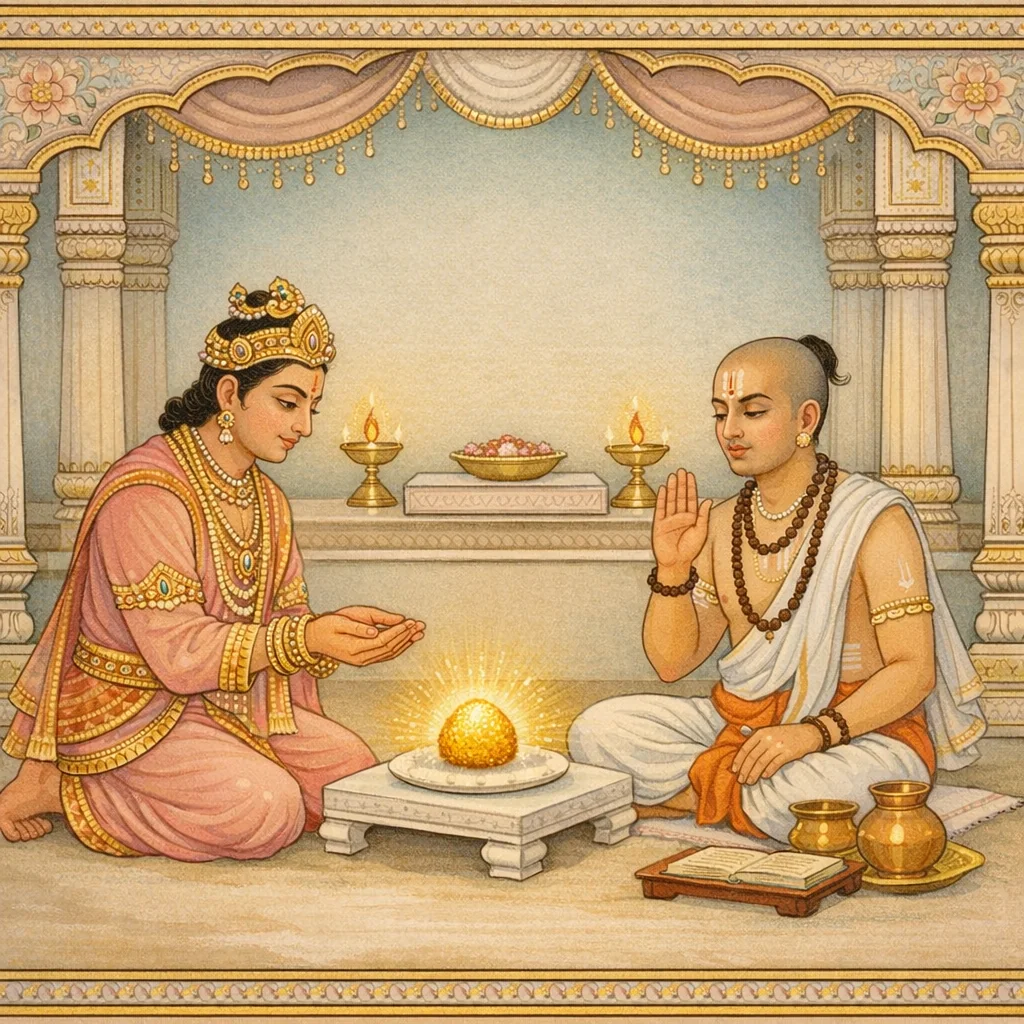
Chapter 270 sets out a ritual theology of expiation (prāyaścitta) for one who has incurred pāpa through ignorance, negligence, desire, or immaturity and has not performed the usual penances. Ānarta asks for a means that destroys demerit and brings immediate relief; Bhartṛyajña teaches the donation of a golden “pāpa-piṇḍa,” specified as a gold mass of twenty-five palas. The rite is to be done in the apara-pakṣa (waning fortnight) with preparatory purity—snāna, clean garments, and the arrangement of a maṇḍapa and vedi. The donor worships according to a cosmological order, venerating a sequence of tattvas beginning with earth and proceeding through the elements and the sensory apparatus, using mantra-like invocations. A learned brāhmaṇa, versed in Veda and Vedāṅga, is then welcomed and honored—feet washed, clothing and ornaments offered—and given a corresponding mūrti/effigy. With a formal transfer-mantra the donor declares that prior pāpa is placed upon the donated form; the brāhmaṇa recites a receipt-mantra (pratigraha) acknowledging the transfer, after which dakṣiṇā is given and he is respectfully dismissed. The chapter notes experiential signs—lightness of body, increased radiance, auspicious dreams—and says that even hearing the procedure is purifying. It adds that the efficacy is heightened in the Kāpāleśvara setting and recommends a homa performed with the Gāyatrī.
Shlokas
Verse 1
आनर्त उवाच । मूर्खत्वाद्वा प्रमादाद्वा कामाद्बालस्यतोऽपि वा । यो नरः कुरुते पापं प्रायश्चित्तं करोति न
Ānarta said: “Whether from folly, from negligence, from desire, or even from childishness—if a man commits sin and does not perform expiation (prāyaścitta)…”
Verse 2
तस्य पापक्षयकरं पुण्यं ब्रूहि द्विजोत्तम । येन मुक्तिर्भवेत्सद्यो यदि तुष्टोऽसि मे प्रभो
“Tell me, O best of brāhmaṇas, the meritorious means that destroys his sins—by which liberation may arise at once—if you are pleased with me, O lord.”
Verse 3
लोभमोहपरो योऽसौ पापपिंडं महामुने । प्रददाति विधिं ब्रूहि येन यच्छाम्यहं द्रुतम्
O great sage, tell me the proper procedure by which that person—overpowered by greed and delusion—may offer the ‘sin-embodying piṇḍa’; by that method I wish to accomplish it quickly.
Verse 4
भर्तृयज्ञ उवाच । दद्यात्स्वपिंडं सौवर्णं पंचविंशत्पलात्मकम्
Bhartṛyajña said: “One should give a piṇḍa made of gold, weighing twenty-five palas.”
Verse 5
विधायापरपक्षे तु स्नापयित्वा विधानतः । मंडपाद्यं च प्राक्कृत्वा स्नात्वा धौतांबरः शुचिः
Then, in the dark fortnight (apakṣa), having arranged everything and performed the bathing rite (snāpana) according to rule—after first preparing the pavilion (maṇḍapa) and other requisites—one should bathe, wear washed garments, and remain pure.
Verse 6
तदा स्वरूपं पृथ्व्यादि पूजयेत्पापकृन्नरः । तथा स मुच्यते पापात्तत्कृताद्धि न संशयः
Then the sinner should worship the true forms beginning with Earth and the rest; by that worship he is freed from the sins he has committed—of this there is no doubt.
Verse 7
चतुर्विंशतितत्त्वानि पृथिव्यादीनि यानि च । तेषां नामभिस्तत्पिंडं पूजयेतन्नराधिपः
The twenty-four principles—beginning with Earth and so on—should be invoked by their names; with those names the king should worship that piṇḍa.
Verse 8
ॐ पृथिव्यै नमः । ॐ अद्भ्यो नमः । ॐ तेजसे नमः । ॐ वायवे नमः । ॐ आकाशाय नमः । ॐ घ्राणाय नमः । ॐ जिह्वायै नमः । ॐ चक्षुषे नमः । ॐ त्वचे नमः । ॐ श्रोत्राय नमः । ॐ गन्धाय नमः । ॐ रसाय नमः । ॐ रूपाय नमः । ॐ स्पर्शाय नमः । ॐ शब्दाय नमः । ॐ वाचे नमः । ॐ पाणिभ्यां नमः । ॐ पादाभ्यां नमः । ॐ पायवे नमः । ॐ उपस्थाय नमः । ॐ मनसे नमः । ॐ बुद्ध्यै नमः । ॐ चित्ताय नमः । ॐ अहंकाराय नमः । ॐ क्षेत्रात्मने नमः । ॐ परमात्मने नमः । धूपं धूरसि मंत्रेण अग्निर्ज्योतीति दीपकम् । युवा सुवासेति च ततो वासांसि परिधापयेत्
One should worship by reciting: “Om, salutations to Earth; to Water; to Fire; to Wind; to Ether; to Smell (the nose); to the Tongue; to the Eye; to the Skin; to the Ear; to Odour; to Taste; to Form; to Touch; to Sound; to Speech; to the Hands; to the Feet; to the Anus; to the Generative organ; to the Mind; to the Intellect; to Citta (mind-stuff); to Ego; to the Kṣetrātman (individual self); and to the Paramātman (Supreme Self).” Then, with the mantra “dhūr asi” one should offer incense; with “agnir jyotiḥ” one should offer a lamp; with “yuvā suvāsaḥ” one should then present garments to be worn.
Verse 9
ततो ब्राह्मणमानीय वेदवेदांगपारगम् । प्रक्षाल्य चरणौ तस्य वासांसि परिधापयेत्
Then, bringing a brāhmaṇa well-versed in the Vedas and Vedāṅgas, one should wash his feet and clothe him with garments.
Verse 10
केयूरैः कंकणैश्चैव अंगुलीयकभूषणैः
With armlets (keyūra), bracelets (kaṅkaṇa), and ring-ornaments for the fingers as well,
Verse 11
भूषयित्वा तनुं तस्य ततो मूर्तिं समानयेत् । मंत्रेणानेन राजेंद्र ब्राह्मणाय निवेदयेत्
After adorning his body, one should then bring forth the golden image; and with this mantra, O best of kings, one should present it to the brāhmaṇa.
Verse 12
एष आत्मा मया दत्तस्तव हेममयो द्विज । यत्किंचिद्विहितं पापं पूर्वं भूयात्तवाखिलम्
“This self, O twice-born, I have given to you in the form of gold. Whatever sin was committed earlier—let it all become yours.”
Verse 13
इति दानमंत्रः । ततस्तु ब्राह्मणो राजन्मंत्रमेतं समुच्चरेत्
“Thus is the mantra for giving the gift.” Then, O King, the brāhmaṇa should duly recite this mantra aloud.
Verse 14
यत्किंचिद्विहितं पापं त्वया पूर्वंमया हि तत् । गृहीतं मूर्तिरूपं तत्ततस्त्वं पापवर्जितः । इति प्रतिग्रहमंत्रः
“Whatever sin was formerly committed by you—indeed, I have taken that, assuming its embodied form. Therefore you are now free from sin.” Thus is the mantra for receiving the gift.
Verse 15
एवं दत्त्वा विधानेन ततो विप्रं विसर्जयेत् । एवं कृते ततो राजंस्तस्मै दत्त्वाथ दक्षिणाम्
Having thus given according to the prescribed rite, one should then respectfully dismiss the brāhmaṇa. When this is done, O King, one should also give him the sacrificial fee (dakṣiṇā).
Verse 16
यथा तुष्टिं समभ्येति ततः पापं नयत्यसौ । तस्मिन्कृते महाराज प्रत्ययस्तत्क्षणाद्भवेत्
When the brāhmaṇa (the recipient) becomes satisfied, he then carries away the sin. Once that is done, O great King, certainty of the rite’s effect arises immediately.
Verse 17
शरीरं लघुतामेति तेजोवृद्धिश्च जायते । स्वप्ने च वीक्षते रात्रौ संतुष्टमनसः स्थितान्
The body becomes light, and an increase of radiance is born. And at night, in dream, one beholds beings standing with minds contented.
Verse 18
नरान्स्त्रियः सितैर्वस्त्रैः श्वेतमाल्यानुलेपनैः । श्वेतान्गोवृषभानश्वांस्तीर्थानि विविधानि च
One sees men and women in white garments, adorned with white garlands and unguents; and also white cows, bulls, and horses—and many kinds of sacred fords (tīrthas).
Verse 19
एतत्ते सर्वमाख्यातं पापपिंडस्य दापनम् । श्रवणादपि राजेंद्र यस्य पापैः प्रमुच्यते
All this has been explained to you—the method of giving the ‘lump of sin’ (pāpapiṇḍa). Even by hearing of it, O lord of kings, one is released from sins.
Verse 20
अन्यत्रापि महादानं पापपिण्डो हरेन्नृप
Even elsewhere, O King, this great gift—the pāpapiṇḍa—removes one’s sin.
Verse 21
एकजन्मकृतं पापं निजकायेन निर्मितम् । कपालेश्वरदेवस्य सहस्रगुणितं हरेत्
Sin committed in a single lifetime, fashioned by one’s own body—Kapāleśvara Deva removes it a thousandfold.
Verse 22
पूर्ववच्चैव कर्तव्यो वेदिमंडपयोर्विधिः । परं होमः प्रकर्तव्यो गायत्र्या केवलं नृप
Just as before, the prescribed procedure for the altar and pavilion should be performed. Then the homa is to be done—only with the Gāyatrī, O King.
Verse 270
इति श्रीस्कान्दे महापुराण एकाशीतिसाहस्र्यां संहितायां षष्ठे नागरखण्डे हाटकेश्वरक्षेत्रमाहात्म्ये कपालेश्वरक्षेत्रमाहात्म्यप्रसंगेन पापपिंडप्रदानविधानवर्णनंनाम सप्तत्युत्तरद्विशततमोऽध्यायः
Thus ends the 270th chapter, entitled “Description of the rite for offering sin-removing piṇḍas,” in the Śrī Skanda Mahāpurāṇa, in the eighty-one-thousand-verse Saṃhitā, within the Sixth—Nāgara Khaṇḍa—under the Tīrtha-glorification of the Hāṭakeśvara sacred region, in the context of the Māhātmya of the Kapāleśvara sacred region.