Adhyaya 268
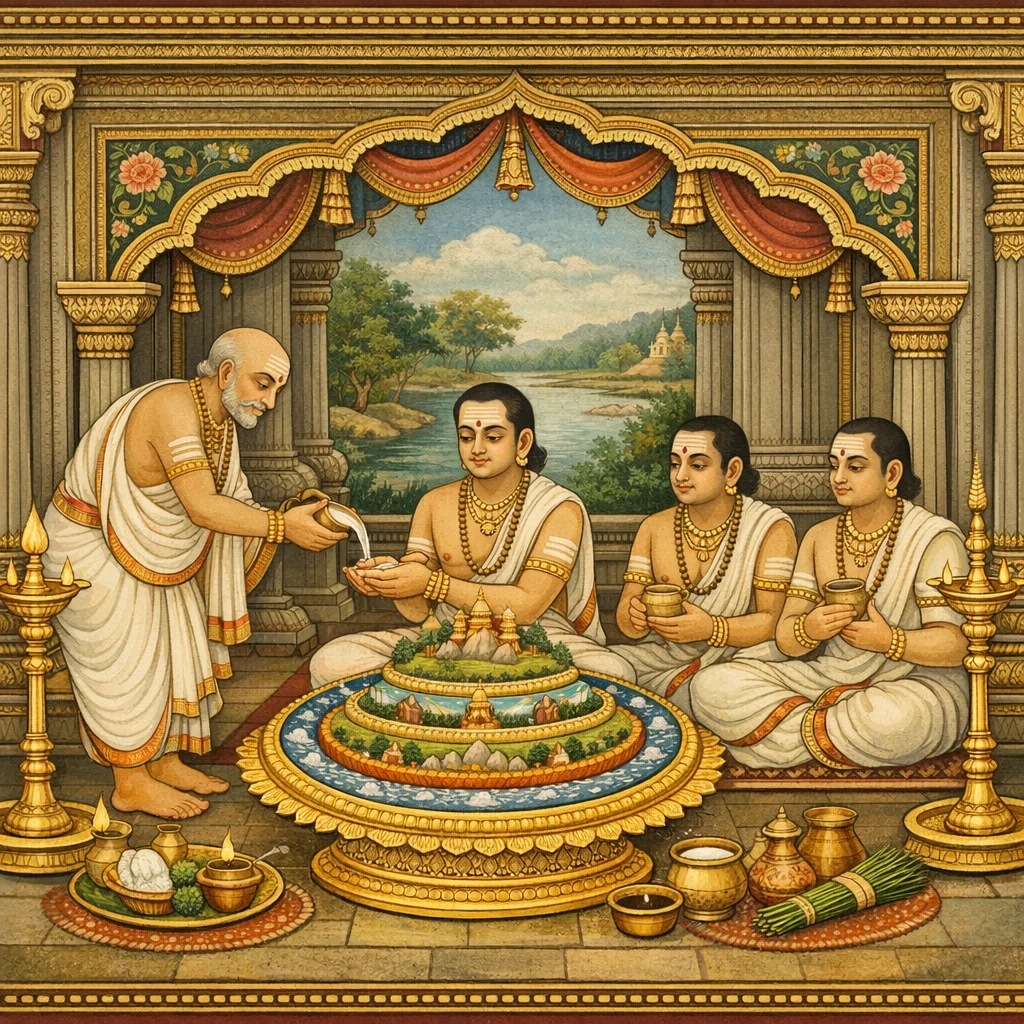
Chapter 268 unfolds as a technical, ritual dialogue: Ānarta asks Bhartṛyajña about the karmic causes of universal sovereignty (cakravartitva) and how it is attained. Bhartṛyajña declares kingship to be rare and merit-born, and teaches that a ruler who, with faith, offers a golden representation of the Earth (hiraṇmayī pṛthvī) before Gautameśvara becomes a cakravartin, citing exemplary monarchs such as Māndhātā, Hariścandra, Bharata, and Kārtavīrya. The chapter then lays out the rite in careful detail. The earth-model is to be fashioned to a measured weight, without deceit in wealth; cosmic geography is depicted through seven oceans (salt, sugarcane-juice, liquor, ghee, curd, milk, and water), seven dvīpas, great mountains (Meru and others), and principal rivers, especially the Gaṅgā. A maṇḍapa with kuṇḍas, toraṇas, and a central vedi is prescribed, along with consecration using pañcagavya and purified water, and mantra-linked acts such as snāna, offering of garments, dhūpa, ārātrika, and grains. The donor recites hymnic acknowledgments of Earth as the world’s support and requests her presence for the gift; the donation is symbolically transferred into water (not placed on the ground or into the recipient’s hand), then respectfully dismissed and distributed to Brahmins. The phalāśruti promises dynastic stability (no loss of kingdom), destruction of sin even by hearing, multi-birth efficacy when performed at Gautameśvara, and nearness to Viṣṇu’s imperishable abode; it also lays down an ethical prohibition against seizing land donated by others.
Shlokas
Verse 1
आनर्त उवाच । कर्मणा केन मर्त्ये च नराणां जायते वद । चक्रवर्तित्वमखिलं सर्वशत्रुविमर्दनम्
Ānarta said: Tell me—by what deed in the human world does a man attain universal sovereignty, becoming a cakravartin who crushes all enemies?
Verse 2
भर्तृयज्ञ उवाच । दुर्लभं भूमिपालत्वं सर्वपापैर्नराधिप । तपोभिर्नियमैर्दानैस्तथान्यैश्च शुभैर्व्रतैः
Bhartṛyajña said: O lord of men, kingship is hard to attain for one burdened with sins; it is won through austerity (tapas), sacred restraints (niyama), charity (dāna), and other auspicious vows.
Verse 3
यः पुनर्भूपतिर्भूत्वा पृथ्वीं दद्याद्धिरण्मयीम् । गौतमेश्वरदेवस्य पुरतः श्रद्धयान्वितः । चक्रवर्ती भवेन्नूनमेवमाह पितामहः
But whoever, having become a king, with faith offers a “golden Earth” (a symbolic gift of the world) before Lord Gautameśvara—he surely becomes a cakravartin; thus spoke Pitāmaha (Brahmā).
Verse 4
मांधाता धुन्धुमारश्च हरिश्चंद्रः पुरूरवाः । भरतः कार्तवीर्यश्च षडेते चक्रवर्तिनः
Māndhātā, Dhundhumāra, Hariścandra, Purūravas, Bharata, and Kārtavīrya—these six are famed as cakravartins.
Verse 5
पृथ्वीदानं पुरा कृत्वा गौतमेश्वरसंनिधौ । दत्त्वा हिरण्मयीं पृथ्वीं सार्वभौमास्ततः स्थिताः
In former times, having performed the gift of “the Earth” in the very presence of Gautameśvara, they donated a golden representation of the world—and thereafter became universal sovereigns.
Verse 6
आनर्त उवाच । भगवन्केन विधिना दातव्या सा वसुन्धरा । अहं दास्यामि तां नूनं श्रद्धा मे महती स्थिता
Ānarta said: “O Blessed One, by what procedure should that ‘Earth’ (the earth-gift) be given? I shall certainly give it—great faith is firmly established in me.”
Verse 7
भर्तृयज्ञ उवाच । कार्या पलशतेनोर्वी वृत्ताकारा नृपोत्तम । तदर्धेनाथवा शक्त्या पंचविंशत्पलात्मिका
Bhartṛyajña said: “O best of kings, one should fashion the ‘Earth’ (for donation) as a circular form, weighing one hundred palas; or else half of that—or, according to one’s capacity, a form of twenty-five palas.”
Verse 9
धरादाने महाराज वित्तशाठ्यं विवर्जयेत् । नैव पंचपलादर्वाक्प्रदातव्या कथञ्चन । लवणेक्षुसुरासर्पिर्दधिदुग्धजलोद्भवाः । समुद्राः सप्त चैतांस्तु कक्षायां तत्र दर्शयेत्
In the gifting of the Earth, O great king, one should renounce all deceit concerning wealth. One must never, in any way, offer an earth-model weighing less than five palas. There one should depict the seven oceans—born of salt, sugarcane-juice, liquor, ghee, curds, milk, and water—arranged as encircling belts.
Verse 10
जंबूप्लक्षकुशक्रौंचशाकशाल्मलिपुष्कराः । समुद्रान्सरितः सप्त द्वैगुण्येन प्रकल्पयेत्
One should also fashion Jambū, Plakṣa, Kuśa, Krauñca, Śāka, Śālmalī, and Puṣkara—the seven continents—and arrange the seven oceans and the rivers in proper proportion, set out in successive expansion by doubled measure.
Verse 11
महेन्द्रो मलयः सह्यो हिमवान्गंधमादनः । विंध्यः शृंगी च सप्तैव कल्पयेत्कुलपर्वतान्
One should likewise represent the seven ‘clan-mountains’: Mahendra, Malaya, Sahya, Himavān, Gandhamādana, Vindhya, and Śṛṅgī.
Verse 12
मध्ये प्रकल्पयेन्मेरुं दिक्षु विष्कम्भपर्वतान् । जंबून्यग्रोधनीपांश्च प्लक्षश्चैव तथा द्रुमान्
At the center one should place Meru, and in the directions the supporting mountains. One should also depict the sacred trees—Jambū, Nyagrodha, Nīpa, and Plakṣa—and other such trees.
Verse 13
गंगाद्याः सरितस्तत्र प्राधान्येन प्रकल्पयेत् । एवं निर्माप्य वसुधां सर्वां हेममयीं नृप
There one should prominently set forth the rivers beginning with the Gaṅgā. Thus, O king, having fashioned the entire Earth as a golden form—
Verse 14
मंडपं कारयेत्पश्चाद्यथापूर्वं प्रकल्पितम्
Thereafter, one should have a maṇḍapa (sacred pavilion) constructed, arranged properly in the manner prescribed earlier.
Verse 15
कुण्डानि तोरणान्येव ब्राह्मणग्रहपूजने । पूर्ववत्सकलं कृत्वा मध्ये वेदिं प्रकल्पयेत्
For the worship of Brāhmaṇas and the Graha-deities, one should also arrange the kuṇḍas (fire-pits) and the toraṇas (gateways). Having done everything as before, one should establish the vedī (altar) in the center.
Verse 16
तत्र संस्थापयेत्पृथ्वीं पंचगव्येन पार्थिव । यथोक्तमंत्रैस्तल्लिंगैस्ततः शुद्धोदकेन तु
There, O king, one should duly install the sacred embodiment of Pṛthvī (Earth), using pañcagavya—the five products of the cow. Then, with the prescribed mantras and proper ritual marks, one should consecrate it with pure water.
Verse 17
इमं मे गंगे यमुने पंचनद्यस्त्रिपुष्करम् । श्रीसूक्तं पावमानं च हैमीं च तदनंतरम्
“This offering of mine—O Gaṅgā, O Yamunā, O Five Rivers; (the hymn) Tripuṣkara; the Śrīsūkta; the Pāvamāna; and thereafter the Haimī”—these are to be recited in this order.
Verse 18
स्नानकर्मणि योग्यांश स्वादिष्ठायनमुत्तमम्
In the bathing rite (snāna), the most excellent and fitting portion is that known as Svādiṣṭhāyana.
Verse 19
एवं संस्नाप्य विधिवद्वासांसि परिधापयेत् । युवा सुवासा मंत्रेण सूक्ष्माणि विविधानि च
Thus, having bathed (the deity/the installed form) according to rule, one should clothe it with garments. With the mantra “Yuvā Suvāsā”, one should also offer fine and varied textiles.
Verse 20
ये भूतानामधीत्येवं ततः प्रोच्य प्रपूजयेत् । धूरसीति च मंत्रेण धूपं दद्यात्समाहितः
Having thus studied/recited the formulas concerning the bhūta (beings/elements) and then proclaiming them, one should worship fully. Composed in mind, one should offer incense with the mantra “Dhūr asi”.
Verse 21
अग्निर्ज्योतीति मंत्रेण कुर्यादारार्तिकं ततः । अहमस्मीति मंत्रेण सप्तधान्यं प्रकल्पयेत्
Then one should perform the ārātrika (waving of lights) with the mantra “Agni is light”. With the mantra “I am”, one should arrange the seven grains as an offering.
Verse 22
एवं कृत्वाऽखिलं तस्या यजमानः सितांबरः । पुरः स्थितोंजलिं बद्ध्वा मंत्रानेतानुदाहरेत्
Having completed all of this for her, the yajamāna (patron of the rite), clad in white, should stand before (the deity/form), join his palms, and recite these mantras.
Verse 23
त्वया संधार्यते विश्वं जगदेतच्चराचरम् । तव दानं करिष्यामि सांनिध्यं कुरु मेदिनि
By you the entire universe—this moving and unmoving world—is sustained. I shall make this gift to you; O Medinī (Earth), grant me your gracious presence.
Verse 24
शरीरेष्वपि भूतानां त्वं देवि प्रथमं स्थिता । ततश्चान्यानि भूतानि जलादीनि वसुन्धरे
Even within the bodies of beings, O Goddess, you are established first. Thereafter the other elements—water and the rest—arise, O Vasundharā.
Verse 25
ये त्वां यच्छंति ते भूयस्त्वां लभंते न संशयः । इह लोके परे चैव पार्थिवं रूपमाश्रिता
Those who offer you in charity attain you again—of this there is no doubt—both in this world and in the next, having taken refuge in your earthly form.
Verse 26
एवं स्तुत्वा समादाय तोयं हेमाकृतिं नृप । वासुदेवं हृदि स्थाप्य मंत्रेणानेन कल्पयेत्
Having thus praised, O king, one should take the water and fashion the golden form; then, placing Vāsudeva within the heart, one should perform the rite with this mantra.
Verse 27
पातालादुद्धृता येन पृथ्वी सा लोककारिणा । अस्या दानेन च सदा प्रीयतां मे जनार्दनः
He by whom the Earth was lifted up from the netherworld—He, the benefactor of the worlds: by gifting this Earth, may Janārdana ever be pleased with me.
Verse 28
एवमुच्चार्य तत्तोयं तोयमध्ये परिक्षिपेत् । न भूमौ नैव हस्ते च ब्राह्मणस्य नृपोत्तम
Having recited thus, one should place that water within water itself; it should not be set upon the ground, nor placed in the hand of a brāhmaṇa, O best of kings.
Verse 29
ततो विसर्जयेद्देवीं मन्त्रेणानेन भागशः । आगता च यथान्यायं पूजिता च यथाविधि
Thereafter, one should ritually dismiss the Goddess, portion by portion, with this mantra—she who was duly invited and worshipped according to the prescribed rule.
Verse 30
अस्माकं त्वं हितार्थाय यत्रेष्टं तत्र गम्यताम् । उस्रा वेदेति मंत्रेण समुच्चार्य ततः परम् । ब्राह्मणेभ्यः प्रदातव्या संविभज्य नराधिप
“For our welfare, go now wherever you wish.” Then, having recited the mantra beginning “usrā vede…”, one should divide the offering and give it to the brāhmaṇas, O lord of men.
Verse 31
एवं ते सर्वमाख्यातं पृथिवीदानमुत्तमम् । शृणुयात्पार्थिवो भावी दाता जन्मनिजन्मनि
Thus the supreme “gift of Earth” has been fully explained to you. A future king who listens to this becomes a giver, birth after birth.
Verse 32
यो राजा पृथिवीं दद्याद्विधिनानेन पार्थिव । राज्यभ्रंशो न वंशेऽपि तस्य संजायते क्वचित्
O king, the ruler who gives the Earth according to this prescribed rite—there is never, at any time, a downfall of sovereignty, even in his lineage.
Verse 33
राज्यभ्रंशसमोपेता ये दृश्यंते महीभुजः । न तैर्वसुन्धरा दत्ता ब्राह्मणानां धृतात्मनाम्
Those kings who are seen suffering the ruin of their kingdoms—by them the Earth was not given to self-controlled brāhmaṇas of steadfast spirit.
Verse 34
तस्मात्सर्वप्रयत्नेन पृथ्वीदानं समाचरेत् । न हरेत्परदत्तां च कथंचिदपि मेदिनीम्
Therefore, with every effort one should practice the sacred gift of land; and in no way should one ever seize the earth that has been given to another.
Verse 35
एतत्पुण्यं प्रशस्यं च पृथिवीदानमुत्तमम् । शृण्वतामपि राजेंद्र तद्देहाद्यघनाशनम्
This supreme gift of land is meritorious and greatly praised; even for those who merely hear of it, O lord of kings, it destroys sins, beginning with those bound to the body.
Verse 36
आस्तां तावत्प्रदानं च पृथिव्याः पृथिवीपतेः । दातुः संप्रेरणं यस्या अज्ञानौघविनाशनम्
O lord of the earth, setting aside the greatness of gifting land itself—even the very impulse that moves one to give in this sacred act becomes a destroyer of the flood of ignorance.
Verse 37
रूपवान्सुभगश्चैव तथा च प्रियदर्शनः । आधिव्याधिविनिर्मुक्तः पुत्रपौत्रसमन्वितः
By its power, one becomes handsome and fortunate, pleasing to behold; freed from mental distress and disease, and endowed with sons and grandsons.
Verse 38
मेधावी जायते मर्त्यो दानस्यास्य प्रभावतः । इत्थंभूता महाराज कृत्वा राज्यमकण्टकम्
Through the efficacy of this gift, a mortal is born endowed with keen intelligence. Thus, O great king, having established a kingdom free from thorns (free from obstacles and enemies)…
Verse 39
प्रीता विष्णोः पदं यांति शाश्वतं यन्निरामयम् । अन्यत्रापि धरादानात्प्रकुर्याच्चक्रवर्तिताम्
Pleased by such charity, they attain Viṣṇu’s abode—eternal and free from suffering. Even elsewhere, by the gift of land one may gain the rank of a universal sovereign (cakravartin).
Verse 40
एकजन्मांतरं यावत्सम्यग्दत्तं नृपोत्तमः । गौतमेश्वरदेवस्य यत्पुरा पुरतः कृतम्
O best of kings, for as long as one lifetime thereafter, the gift once properly made in the very presence of Lord Gautameśvara continues to bear its effect.
Verse 41
सप्तजन्मांतरं यावत्प्रकरोति न संशयः । तस्मात्सर्वप्रयत्नेन तत्र देया मही नृप
It continues to operate for as long as seven lifetimes—there is no doubt. Therefore, O king, with every effort land should be given there.
Verse 268
इति श्रीस्कांदे महापुराण एकाशीतिसाहस्र्यां संहितायां षष्ठे नागरखण्डे हाटकेश्वरक्षेत्रमाहात्म्ये गौतमेश्वरमाहात्म्ये पृथ्वीदानमाहात्म्यवर्णनंनामाष्टषष्ट्युत्तरद्विशततमोऽध्यायः
Thus ends the two-hundred-and-sixty-eighth chapter, titled “The Description of the Glory of Donating Land,” in the Gautameśvara Māhātmya within the Hāṭakeśvara-kṣetra Māhātmya of the sixth (Nāgara) Khaṇḍa of the Śrī Skanda Mahāpurāṇa, in the Ekāśīti-sāhasrī Saṃhitā.