Adhyaya 249
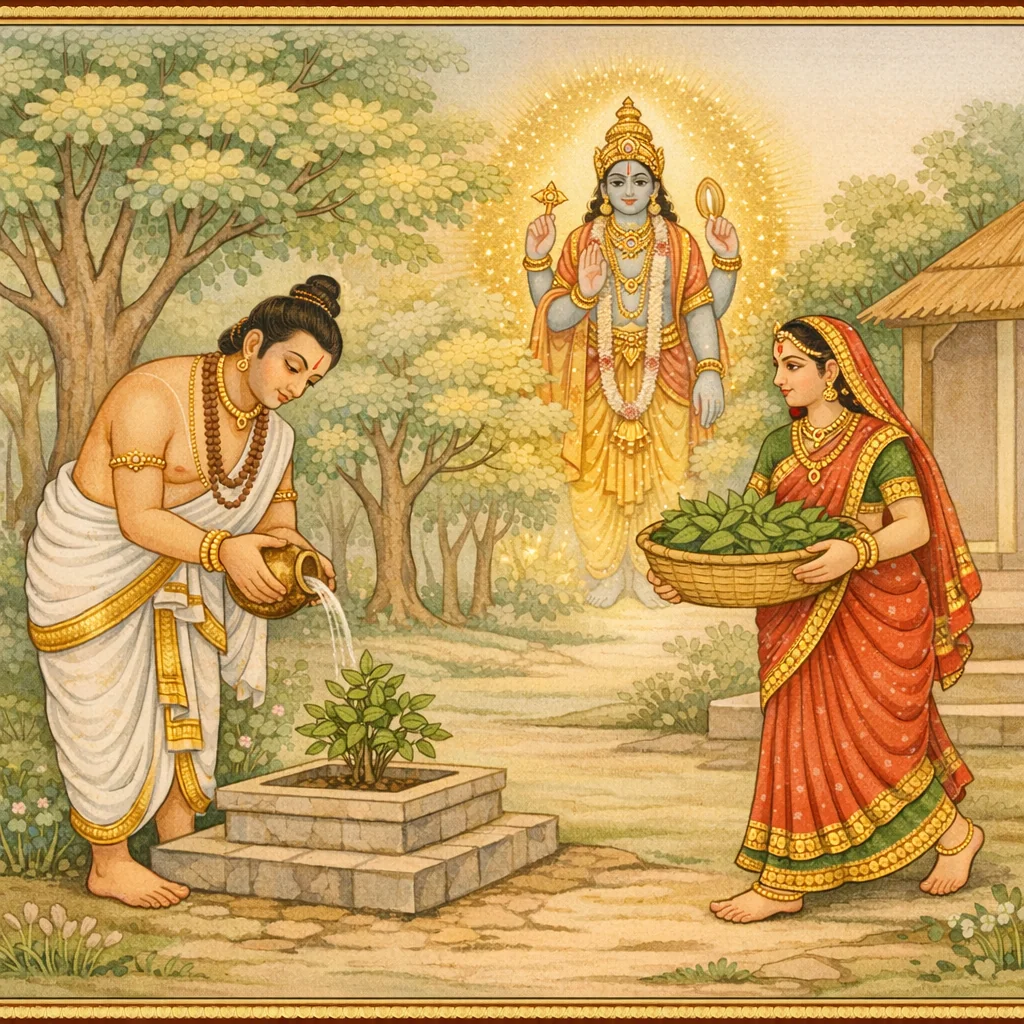
This chapter unfolds as a theological discourse praising Tulasī as a sanctifying presence and a chief instrument of devotion in household life and vow-based practice (vrata). It begins by declaring that planting Tulasī at home yields great spiritual fruit, even warding off poverty and drawing auspiciousness to the family. The text then presents a layered “sacred anatomy” of the plant: Tulasī’s sight, form, leaves, flowers, fruits, wood, marrow, and bark are each linked with Śrī/Lakṣmī and divine good fortune, portraying Tulasī as a pervasive bearer of purity and blessing. A sequence of embodied placements—on the head, in the mouth, in the hands, in the heart, on the shoulders, and at the throat—serves as an ethical-ritual taxonomy promising protection, freedom from affliction, and a liberation-oriented status. Practical devotion is emphasized through daily carrying of Tulasī leaves and regular watering, with special stress on Cāturmāsya: service to Tulasī in this season is said to be rare and highly meritorious, including watering with milk and careful nourishment of the plant’s basin (ālavalāmbu-dāna). The discourse culminates in a unifying image: Hari shines within all trees, and Kamalā (Lakṣmī) is described as dwelling in the tree as a constant remover of suffering, integrating Vaiṣṇava devotion with sacred ecology and seasonal discipline.
Shlokas
Verse 1
वाण्युवाच । तुलसी रोपिता येन गृहस्थेन महाफला । गृहे तस्य न दारिद्र्यं जायते नात्र संशयः
Vāṇī said: For that householder who plants Tulasī—rich in great fruit—poverty does not arise in his home; of this there is no doubt.
Verse 2
तुलस्या दर्शनादेव पापराशिर्निवर्तते । श्रियेऽमृतकणोत्पन्ना तुलसी हरिवल्लभा
By the mere sight of Tulasī, heaps of sin turn back and depart. Born from a drop of nectar for Śrī (Lakṣmī), Tulasī is beloved of Hari.
Verse 3
पिबन्त्या रुचिरं पानं प्राणिनां पापहारिणी । यस्या रूपे वसेल्लक्ष्मीः स्कन्धे सागरसंभवा
When her lovely drink is taken, she washes away the sins of living beings. In her very form Lakṣmī dwells, and upon her shoulder abides the ocean-born goddess.
Verse 4
पत्रेषु सततं श्रीश्च शाखासु कमला स्वयम् । इन्दिरा पुष्पगा नित्यं फले क्षीराब्धिसंभवा
In her leaves Śrī abides always; in her branches is Kamalā herself. Indirā dwells perpetually in her flowers, and in her fruit is she who was born from the Ocean of Milk.
Verse 5
तुलसी शुष्ककाष्ठेषु या रूपा विश्वव्यापिनी । मज्जायां पद्मवासा च त्वचासु च हरिप्रिया
That very Tulasī—whose form pervades the whole universe—abides even in her dried wood. Within the pith she is Padmavāsā (Lakṣmī), and in the outer bark she is Haripriyā, beloved of Hari.
Verse 6
सर्वरूपा च सर्वेशा परमानन्ददायिनी । तुलसी प्राशको मर्त्यो यमलोकं न गच्छति
She is of all forms, the supreme sovereign, the giver of highest bliss. A mortal who partakes of Tulasī does not go to Yama’s realm.
Verse 7
शिरस्था तुलसी यस्य न याम्यैरनुभूयते । मुखस्था तुलसी यस्य निर्वाणपददायिनी
He upon whose head Tulasī rests is not seized by Yama’s servants; and he in whose mouth Tulasī rests is granted the state of nirvāṇa, liberation.
Verse 8
हस्तस्थातुलसीयस्य स तापत्रयवर्जितः । तुलसी हृदयस्था च प्राणिनां सर्वकामदा
He who holds Tulasī in his hand becomes free from the threefold afflictions. And Tulasī, abiding in the heart, grants all rightful desires to living beings.
Verse 9
स्कन्धस्था तुलसी यस्य स पापैर्न च लिप्यते । कण्ठगा तुलसी यस्य जीवन्मुक्तः सदा हि सः
He upon whose shoulder Tulasī rests is not tainted by sins. He who wears Tulasī at the throat is ever a liberated one, even while living.
Verse 10
तुलसीसंभवं पत्रं सदा वहति यो नरः । मनसा चिन्तितां सिद्धिं संप्राप्नोति न संशयः
The man who always carries a leaf born of Tulasī attains, without doubt, the accomplishment he has contemplated in his mind.
Verse 11
तुलसींसर्वकायार्थसाधिनीं दुष्टवारिणीम् । यो नरः प्रत्यहं सिञ्चेन्न स याति यमालयम्
He who waters Tulasī every day—she who accomplishes all beneficial aims and wards off evil—does not go to Yama’s abode.
Verse 12
चातुर्मास्ये विशेषेण वन्दितापि विमुक्तिदा । नारायणं जलगतं ज्ञात्वा वृक्षगतं तथा
Especially during Cāturmāsya, even saluting her bestows liberation—knowing Nārāyaṇa to be present in water, and likewise present in the tree (Tulasī).
Verse 13
प्राणिनां कृपया लक्ष्मीस्तुलसीवृक्षमाश्रिता । चातुर्मास्ये समायाते तुलसी सेविता यदि
Out of compassion for all living beings, Lakṣmī has taken refuge in the Tulasī tree. When the sacred season of Cāturmāsya arrives, if Tulasī is duly served—
Verse 14
तेषां पापसहस्राणि यांति नित्यं सहस्रधा । गोविन्दस्मरणं नित्यं तुलसीवनसेवनम्
For them, thousands of sins depart each day, as though removed a thousandfold. Constant remembrance of Govinda and continual service to the grove of Tulasī—
Verse 15
तुलसीसेचनं दुग्धै श्चातुर्मास्येऽतिदुर्लभम् । तुलसीं वर्द्धयेद्यस्तु मानवो यदि श्रद्धया
In the sacred season of Cāturmāsya, watering Tulasī with milk is exceedingly rare (and thus highly meritorious). Whoever, with faith, nurtures and increases the Tulasī plant—gains a special spiritual fruit.
Verse 16
आलवालांबुदानैश्च पावितं सकलं कुलम् । यथा श्रीस्तुलसीसंस्था नित्यमेव हि वर्द्धते
By offering water to the basin at Tulasī’s root, one’s entire family line becomes purified. And as the sacred establishment of Tulasī is continually nourished, so too does prosperity (Śrī) steadily increase.
Verse 17
तथातथा गृहस्थस्य कामवृद्धिः प्रजायते । ब्रह्मचारीगृहस्थश्च वानप्रस्थो यतिस्तथा
Accordingly, for the householder, rightful desires and aims come to flourish. Whether one is a brahmacārin, a householder, a forest-dweller, or a yati (renunciant), this observance bears fruit for all stages of life.
Verse 18
तथा प्रकृतयः सर्वास्तुलसीसेवने रताः । श्रद्धया यदि जायन्ते न तासां दुःखदो हरिः
Likewise, whatever one’s temperament or disposition, if it arises with faith and takes delight in serving Tulasī, one does not meet Hari as a giver of sorrow; for such devotees He is not the cause of affliction.
Verse 19
एको हरिः सकलवृक्षगतो विभाति नानारसैस्तु परिभावितमूर्तिरेव । वृक्षाधिवासमगमत्कमला च देवी दुःखादिनाशनकरी सततं स्मृताऽपि
Hari is one, yet He shines as though present within all trees, appearing in forms as if shaped by their diverse saps and essences. And Goddess Kamalā (Lakṣmī), too, has taken up residence in the trees; even when merely remembered, she ever destroys sorrow and other afflictions.
Verse 249
इति श्रीस्कांदे महापुराणएकाशीतिसाहस्र्यां संहितायां षष्ठ नाग रखण्डे हाटकेश्वरक्षेत्रमाहात्म्ये शेषशाय्युपाख्याने ब्रह्मनारदसंवादे चातुर्मास्यमाहात्म्ये पैजवनोपाख्याने तुलसीमाहात्म्यवर्णनंनामैकोनपञ्चाशदुत्तर द्विशततमोऽध्यायः
Thus, in the revered Skanda Mahāpurāṇa—within the eighty-one-thousand-verse Saṃhitā—this concludes the two-hundred-and-forty-ninth chapter, titled “Narration of the Glory of Tulasī,” in the Sixth (Nāgara) Khaṇḍa, in the Tīrthamāhātmya of Hāṭakeśvara-kṣetra, within the Śeṣaśāyy narrative, in the dialogue of Brahmā and Nārada, as part of the Cāturmāsya Māhātmya and the Paijavana-upākhyāna.