Adhyaya 24
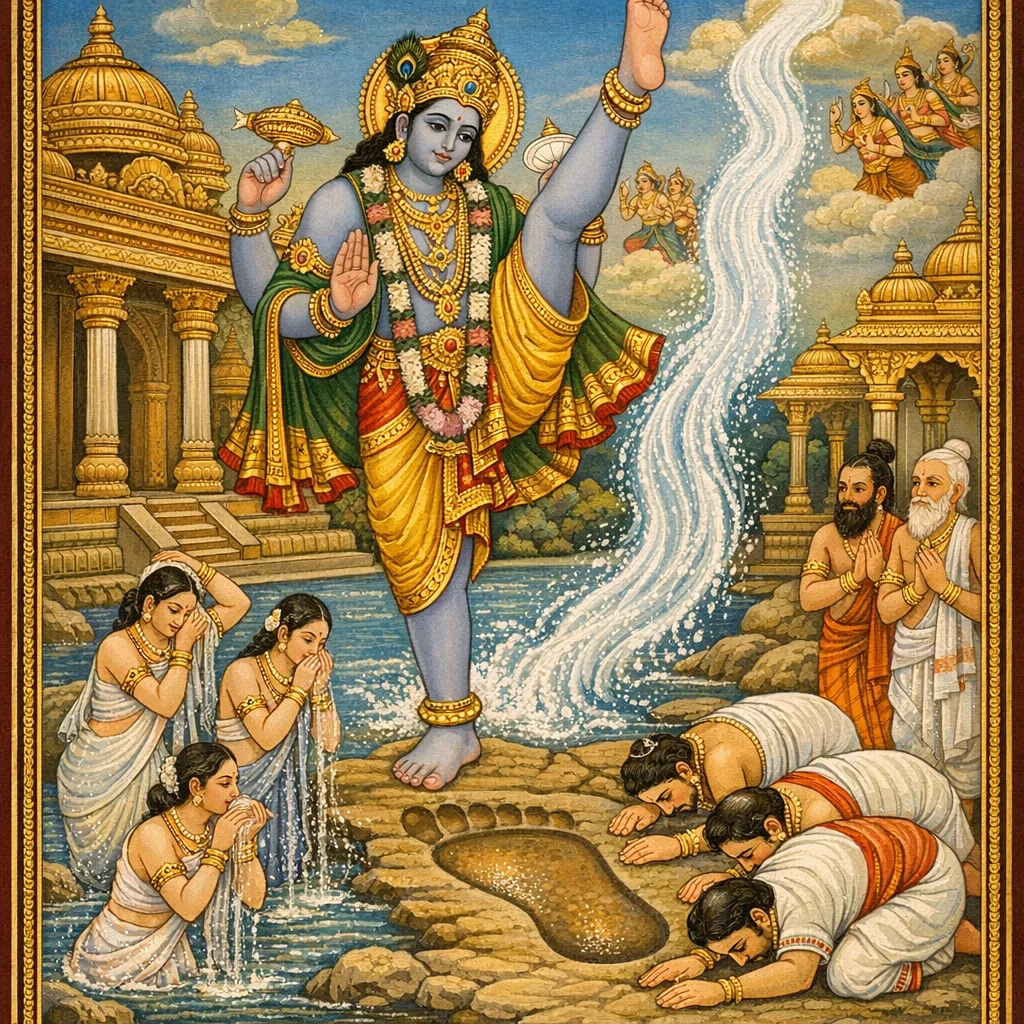
Chapter 24 delivers a tīrtha-māhātmya in which Sūta extols the sacred site called Viṣṇupada as a supremely auspicious pilgrimage-place that removes all demerit. Set within the ritual seasons of the southern and northern ayana transitions, it declares that a devotee who worships Viṣṇu’s footprint and performs ātma-nivedana (self-offering) with focused faith attains Viṣṇu’s parama pada, the supreme state/abode. When the ṛṣis ask for the origin and the exact benefits of seeing, touching, and bathing, Sūta recounts the Trivikrama episode: Viṣṇu binds Bali and, with three strides, pervades the three worlds; a cosmic rupture follows and pristine water descends. That water is identified with the Gaṅgā, remembered as Viṣṇupadī, and it sanctifies the region. The chapter lists graded fruits: after proper bathing, touching the footprint leads to the “supreme state”; śrāddha performed there yields fruit like that of Gayā; Māgha bathing yields fruit like that of Prayāga; sustained practice and even the immersion of bones are said to aid liberation. With striking emphasis, a single bath in Viṣṇupadī water is equated to the combined fruits of many tīrthas, gifts (dāna), and austerities, supported by an earlier gāthā attributed to Nārada. It concludes with a practical mantra for ayana observance—praying that if death comes within six months, Viṣṇu’s footprint be one’s refuge—followed by honoring brāhmaṇas and communal eating as the ethical completion of the rite.
Shlokas
Verse 1
। सूत उवाच । तत्र विष्णुपदं नाम तीर्थं तीर्थे शुभे स्थितम् । अपरं ब्राह्मणश्रेष्ठाः सर्वपातकनाशनम्
Sūta said: There, within that auspicious sacred region, is a holy ford named Viṣṇupada. O best of brāhmaṇas, it is another tīrtha that destroys all sins.
Verse 2
अयने दक्षिणे प्राप्ते यस्तत्पूज्य समाहितः । निवेदयेत्तथात्मानं सम्यक्छ्रद्धासमन्वितः
When the southern solstice has arrived, whoever—collected in mind—worships that (holy presence) and duly offers himself there with steadfast faith,
Verse 3
स मृतोऽप्ययने याम्ये तद्विष्णोः परमं पदम् । प्राप्नोति नात्र संदेहस्तत्प्रभावाद्द्विजोत्तमाः
Even if he should die during the southern course, he attains the supreme abode of that Lord Viṣṇu. Of this there is no doubt, O best of the twice-born—such is the power of that sacred place and worship.
Verse 4
तथा चैवोत्तरे प्राप्ते पूजयित्वा यथाविधि । सम्यङ्निवेदयेद्भक्त्या आत्मानं यः समाहितः । सोऽपि विष्णोः पदं पुण्यं प्राप्य संजायते सुखी
Likewise, when the northern course has arrived, one who—steady in mind—worships according to rule and, with devotion, duly offers his very self, he too attains Viṣṇu’s holy state and becomes blessed with well-being.
Verse 5
ऋषय ऊचुः । कथं तत्र पदं जातं विष्णोरव्यक्तजन्मनः । कथं निवेद्यते तत्र सम्यगात्माऽ यनद्वये
The sages said: How did Viṣṇu’s “Footprint” arise there—of Him whose birth is unmanifest? And how, in the two solstitial courses, is the self properly to be offered there?
Verse 6
तस्मिन्दृष्टेऽथवा स्पृष्टे यत्फलं लभ्यते नरैः । तत्सर्वं सूतज ब्रूहि परं कौतृहलं हि नः
And what fruit is gained by people merely by seeing it or touching it—tell us all of that, O son of Sūta; for great indeed is our curiosity.
Verse 7
सूत उवाच । बलिर्बद्धो यदा तेन विष्णुना प्रभविष्णुना । तदा क्रमैस्त्रिभिर्व्याप्तं त्रैलोक्यं सचराचरम्
Sūta said: When Bali was bound by that all-powerful Viṣṇu, then with three strides the three worlds—moving and unmoving—were pervaded.
Verse 8
हाटकेश्वरजे क्षेत्रे संन्यस्तः प्रथमः क्रमः । महर्लोके द्विती यस्तु तदा तेन महात्मना
In the sacred region of Hāṭakeśvara the first stride was set down; and the second, at that time, by that great being, was placed in Maharloka.
Verse 9
तृतीयस्य समुद्योगं यदा चक्रे स चक्रधृक् । तदा भिन्नं द्विजश्रेष्ठा ब्रह्मांडं लघुतां गतम्
When the discus-bearing Lord prepared to take the third stride, then, O best of the twice-born, the cosmic egg (brahmāṇḍa) was pierced and seemed as though diminished.
Verse 10
पादाग्रेणाथ संभिन्ने ब्रह्मांडे निर्मलं जलम् । अंगुष्ठाग्रेण संप्राप्तं क्रमेण धरणीतले
When the cosmic egg was pierced by the tip of His foot, pure water emerged; and from the tip of His great toe it gradually descended to the surface of the earth.
Verse 11
ब्रह्मलोकं तदा कृत्स्नं प्लावयित्वा जलं हि तत् । शुद्धस्फटिकसंकाशं कुन्देन्दुसदृशद्युति । मत्स्यकच्छपसंकीर्णं ग्राहयूथैः समाकुलम्
That water then flooded all of Brahmaloka. It shone like pure crystal, radiant like jasmine and the moon—filled with fish and tortoises, and crowded with schools of crocodiles.
Verse 12
ततः प्रभृति सा लोके गंगा विष्णुपदी स्मृता । पवित्रमपि तत्क्षेत्रं नयन्ती सा पवित्रताम्
From that time onward, in the world she is remembered as Gaṅgā, “Viṣṇupadī”. Even a place already holy, she leads it to still greater purity.
Verse 13
एवं विष्णोः पदं तत्र संजातं मुनिसत्तमाः । सर्वपापहरं पुंसां तदा विष्णुपदी स्मृता
Thus, O best of sages, Viṣṇu’s Footprint manifested there. Removing all sins of people, it was then remembered as “Viṣṇupadī”.
Verse 14
यस्तस्यां श्रद्धया युक्तः स्नानं कृत्वा यथोदितम् । स्पर्शयेत्तत्पदं विष्णोः स याति परमं पदम्
Whoever, endowed with faith, bathes there as prescribed and touches that Footprint of Viṣṇu—he attains the supreme abode.
Verse 15
यस्तत्रकुरुते श्राद्धं सम्यक्छ्रद्धासमन्वितः । स्नात्वा विष्णुपदीतोये गयाश्राद्धफलं लभेत्
Whoever performs śrāddha there with proper faith—after bathing in the waters of Viṣṇupadī—obtains the merit of the famed Gayā-śrāddha.
Verse 16
माघमासे नरः स्नानं प्रातरुत्थाय तत्र यः । करोति सततं मर्त्यः स प्रयागफलं लभेत्
In the month of Māgha, the mortal who rises early and bathes there continually attains the merit of Prayāga.
Verse 17
अथवा वत्सरं यावत्क्षणं कृत्वात्र भक्तितः । तत्र स्नानं च यः कुर्यात्स मुक्तिं लभते नरः
Or else—whether for a moment or for as long as a year—whoever, with devotion, bathes there attains liberation.
Verse 18
यस्यास्थीनि जले तत्र क्षिप्यंते मनुजस्य च । अपि पाप समाचारः स प्राप्नोति परां गतिम्
Even if a person has lived sinfully, if his bones are cast into the water there, he attains the highest destination.
Verse 19
अपि पक्षिपतंगा ये पशवः कृमयो मृगाः । प्रविष्टाः सलिले तस्मिंस्तृषार्ता भक्तिवर्जिताः
Even birds and insects—beasts, worms, and deer—entering that water, though driven only by thirst and devoid of devotion,
Verse 20
तेऽपि पापविनिर्मुक्ता देहांते चातिदुर्लभम् । चक्रिणस्तत्पदं यांति जरामरणवर्जितम्
Even they are freed from sin, and at the end of life they reach that exceedingly rare abode of the Lord who bears the discus—free from old age and death.
Verse 21
किं पुनः श्रद्धयोपेताः पर्वकाल उपस्थिते । दत्त्वा दानं द्विजेन्द्राणां नरा वेदविदां द्विजाः
How much more, when an auspicious festival time arrives, do people endowed with faith gain merit by giving charitable gifts to the foremost twice-born—Brāhmaṇas who know the Vedas.
Verse 22
तत्र गाथा पुरा गीता नारदेन महर्षिणा । विष्णुपद्याः समालोक्य प्रभावं पापनाशनम्
In this connection, a verse was once sung by the great sage Nārada, after beholding the sin-destroying power and majesty of Viṣṇupadī.
Verse 23
किं व्रतैर्नियमैर्वापि तपोभिर्विविधैर्मखैः । कृतैर्विष्णुपदीतोये संस्थिते धरणीतले
What need is there for vows and restraints, for varied austerities, or for many sacrifices—when Viṣṇupadī’s sacred water is present here upon the earth?
Verse 24
एकः सर्वेषु तीर्थेषु स्नानं मर्त्यः समाचरेत् । एको विष्णुपदीतोये स्नाति द्वाभ्यां समं फलम्
If a mortal were to bathe at all the tīrthas, that would be one measure of merit; but a single bath in the waters of Viṣṇupadī yields a fruit equal to that entire sum.
Verse 25
एको दानानि सर्वाणि ब्राह्मणेभ्यः प्रयच्छति । एको विष्णुपदीतोये स्नाति द्वाभ्यां समं हि तत्
If one were to bestow every kind of charity upon Brāhmaṇas, that is one great total; yet one who bathes in Viṣṇupadī’s waters attains a result equal to that.
Verse 26
पञ्चाग्निसाधको ग्रीष्मे वर्षास्वाकाशमाश्रितः । जलाश्रयश्च हेमंत एकः स्यात्पुरुषः क्षितौ
On earth there may be a man who practices the ‘five-fire’ austerity in summer, remains under the open sky during the rains, and dwells in water in winter—performing severe disciplines through the seasons.
Verse 27
अन्यो विष्णुपदीतोये स्नात्वा विष्णुपदं स्पृशेत् । तावुभावपि निर्दिष्टौ समौ पुरुषसत्तमौ
Another, having bathed in Viṣṇupadī’s waters, touches the Footprint of Viṣṇu; these two are declared equal—both supreme among men.
Verse 28
एकांतरोपवासी य एकः स्याज्जीवितावधि । एकोविष्णुपदीतोये स्नाति द्वाभ्यां समं फलम्
One person may fast on alternate days for the whole span of life; yet a single bath in Viṣṇupadī’s waters yields a fruit equal to that.
Verse 29
त्रिरात्रोपोषितस्त्वेको यावद्वर्षशतं नरः । एको विष्णुपदीतोये स्नाति द्वाभ्यां समं फलम्
A man may observe the three-night fast again and again for a hundred years; yet a single bath in the waters of Viṣṇupadī yields an equal fruit.
Verse 30
सूत उवाच । एवमुक्त्वा मुनिश्रेष्ठो नारदो द्विजसत्तमाः । विरराम मुनीनां स बहूनां पुरतोऽसकृत्
Sūta said: Having spoken thus, Nārada, the best of sages, before many sages and foremost Brāhmaṇas, ceased his discourse.
Verse 31
तस्मात्सर्व प्रयत्नेन स्नानं तत्र समाचरेत । संस्पृशेच्च पदं विष्णोर्य इच्छेच्छ्रेय आत्मनः
Therefore, with every effort one should bathe at that sacred place; and whoever seeks his own highest good should also reverently touch the Footprint of Viṣṇu.
Verse 32
ऋषय ऊचुः । यदेतद्भवता प्रोक्तमात्मानं विनिवेदयेत् । विष्णोः पदस्य संप्राप्ते अयने दक्षिणोत्तरे
The sages said: “What you have declared—about offering oneself in surrender—when one reaches Viṣṇu’s Footprint, at the time of either solstice, southern or northern—”
Verse 33
तत्केन विधिना सूत मन्त्रैश्च वद सत्वरम् । वयं येन च तत्कुर्मः सर्वं भक्तिसमन्विताः
“By what procedure, O Sūta, and with which mantras—tell us quickly—so that we all, endowed with devotion, may perform it in full.”
Verse 34
सूत उवाच । दक्षिणे चोत्तरे चापि संप्राप्ते चायनद्वये । पूजयित्वा पदं विष्णोरिमं मन्त्रमुदीरयेत्
Sūta said: “When either of the two solstices has arrived—southern or northern—having worshipped Viṣṇu’s sacred Footprint, one should recite this mantra.”
Verse 35
षण्मासाभ्यंतरे मृत्युर्यद्यकस्माद्भवेन्मम । तत्ते पदं गतिर्मे स्यादहं ते भृत्यतां गतः
“If, within six months, death should suddenly come to me, then may that Foot—your sacred Footprint—be my refuge and my path; I have entered into your servanthood.”
Verse 36
एवं प्रोच्य हरिं पश्चात्पूजयेद्ब्राह्मणांस्ततः । अथ तैः सममश्नीयात्ततः प्राप्नोति सद्गतिम्
Having thus addressed Hari, one should thereafter honor the brāhmaṇas; then one should eat together with them—thereby one attains a noble destiny.