Adhyaya 239
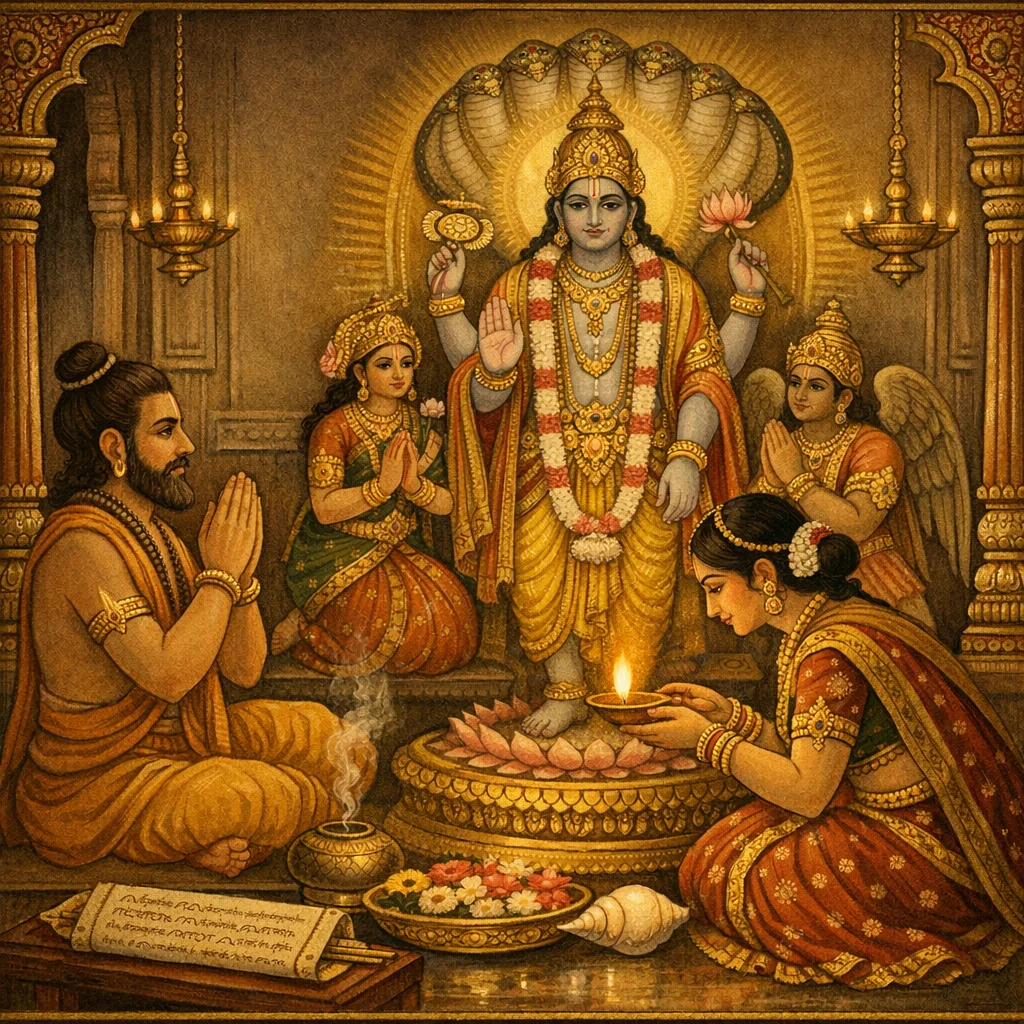
Chapter 239 is cast as a theological dialogue between Brahmā and Nārada. Nārada asks how the sixteen upacāras (ritual services of worship) should be performed, especially for Hari (Viṣṇu) in the state of śayana (reclining rest), and requests a detailed explanation. Brahmā replies by rooting devotion to Viṣṇu in Vedic authority, presenting the Veda as foundational and situating ritual order within a sacred chain of mediation: Veda–brāhmaṇa–agni–yajña. The chapter then extols Cāturmāsya as a distinctive season for contemplating Hari in a water-associated mode, linking water to food and food to a sacral ontology derived from Viṣṇu. Offerings are portrayed as protections against the recurring afflictions of saṃsāra. A clear sequence of worship is outlined: internal and external nyāsa; āvāhana, invoking the Vaikuṇṭha form with its iconographic marks; then āsana, pādya, arghya, ācamana; bathing with scented and tīrtha waters; gifting garments; explaining the significance of the yajñopavīta; applying sandal paste; offering flowers with emphasis on purity and white blossoms; presenting incense with mantras; and dīpadāna (lamp-offering), praised as a powerful remover of darkness and sin. Throughout, efficacy is repeatedly conditioned on śraddhā (intentional faith), and the chapter concludes with strong promises of merit for lamp-offering and related gifts during Cāturmāsya.
Shlokas
Verse 1
नारद उवाच । उपचारैः षोडशभिः पूजनं क्रियते कथम् । ते के षोडश भावाः स्युर्नित्यं ये शयने हरेः
Nārada said: “How is worship performed with the sixteen ritual services? And what, indeed, are those sixteen devotional observances that should be offered daily when Hari is in His sacred ‘reclining’ state?”
Verse 2
एतद्विस्तरतो ब्रूहि पृच्छतो मे प्रजापते । तव प्रसादमासाद्य जगत्पूज्यो भवाम्यहम्
“Explain this to me in detail, O Prajāpati, for I ask you. By attaining your grace, I shall become worthy of reverence in the world.”
Verse 3
ब्रह्मोवाच । विष्णुभक्तिर्दृढा कार्या वेदशास्त्रविधानतः । वेदमूलमिदं सर्वं वेदो विष्णुः सनातनः
Brahmā said: “Steadfast devotion to Viṣṇu should be cultivated in accordance with the ordinances of the Veda and the śāstras. All this is rooted in the Veda; and the Veda itself is the eternal Viṣṇu.”
Verse 4
ते वेदा ब्राह्मणाधारा ब्राह्मणाश्चाग्निदैवताः । अग्नौ प्रास्ताहुतिर्विप्रो यज्ञे देवं यजन्सदा
Those Vedas rest upon the brāhmaṇas, and the brāhmaṇas are devoted to Agni. The learned priest casts the oblation into the fire, ever worshipping the deity through sacrifice (yajña).
Verse 5
जगत्संधारयेत्सर्वं विष्णुपूजारतः सदा । नारायणः स्मृतो ध्यातः क्लेशदुःखादिनाशनः
One who is always devoted to the worship of Viṣṇu upholds the whole world through dharma. Nārāyaṇa—remembered and meditated upon—destroys affliction, sorrow, and the like.
Verse 6
चातुर्मास्ये विशेषेण जलरूपगतो हरिः । जलादन्नानि जायंते जगतां तृप्तिहेतवे
In Cāturmāsya, especially, Hari abides in the form of water. From water, food-grains are born—becoming the cause of the world’s nourishment and satisfaction.
Verse 7
विष्णुदेहांशसंभूतं तदन्नं ब्रह्म इष्यते । तदन्नं विष्णवे दत्त्वा ह्यावाहनपुरःसरम्
That food, born of a portion of Viṣṇu’s own being, is regarded as Brahman. Therefore, having first invoked Him (āvāhana), one should offer that very food to Viṣṇu.
Verse 8
पुनर्जन्मजराक्लेशसंस्कारैर्नाभिभूयते । आकाशसंभवो वेद एक एव पुराऽभवत्
He is not overcome by the latent saṃskāras that lead to repeated birth, old age, and affliction. In ancient times, the Veda—born of space itself—was one alone.
Verse 9
ततो यजुःसामसंज्ञामृग्वेदः प्राप भूतये । ऋग्वेदोऽभिहितः पूर्वं यजुःसहस्रशीर्षेति च
Thereafter, for the flourishing of beings, the Ṛgveda came to be known also by the designations “Yajus” and “Sāman.” The Ṛgveda was spoken of first; and the Yajus beginning with “Sahasraśīrṣa” was also taught.
Verse 10
षोडशर्चं महासूक्तं नारायणमयं परम् । तस्यापि पाठमात्रेण ब्रह्महत्या निव र्तते
That supreme Great Hymn of sixteen verses, wholly pervaded by Nārāyaṇa—by its mere recitation, even the sin of brahma-hatyā (slaying a brāhmaṇa) is turned back and comes to an end.
Verse 11
विप्रः पूर्वं न्यसेद्देहे स्मृत्युक्तेन निजे बुधः । ततस्तु प्रतिमायां च शालग्रामे विशेषतः
First, the wise brāhmaṇa should perform nyāsa upon his own body according to the method taught in Smṛti. Thereafter he should do so upon the sacred image as well—especially upon the Śālagrāma stone.
Verse 12
क्रमेण च ततः कुर्यात्पश्चादावाहनादिकम् । आवाह्य सकलं रूपं वैकुण्ठस्थानसंस्थितम्
Then, in due order, he should perform the subsequent rites beginning with āvāhana (invocation). Having invoked the complete form abiding in the realm of Vaikuṇṭha, he should proceed with worship.
Verse 13
कौस्तुभेन विराजंतं सूर्यकोटिसमप्रभम् । दंडहस्तं शिखासूत्रसहितं पीतवाससम्
He should contemplate Him, radiant with the Kaustubha jewel, shining like ten million suns—holding a staff in His hand, adorned with the tuft (śikhā) and the sacred thread, and clad in yellow garments.
Verse 14
महासंन्यासिनं ध्यायेच्चातुर्मास्ये विशेषतः । एवं रूपमयं विष्णुं सर्वपापौघहारिणम्
One should meditate upon Viṣṇu as the great renunciant—especially during the Cāturmāsya season; thus contemplated in this form, Viṣṇu removes the entire flood of sins.
Verse 15
आवाहयेच्च पुरतो ध्यानसंस्थं द्विजोत्तम । ऋचा प्रथमया चास्योंकारादिसमुदीर्णया
O best of the twice-born, he should invoke Him before him, established in meditation; and he should do so with the first ṛc, uttered beginning with Oṃ.
Verse 16
द्वितीयया चासनं च पार्षदैश्च समन्वितम् । सौवर्णान्यासनान्येषां मनसा परिचिन्तयेत्
With the second ṛc he should offer a seat (āsana), together with the Lord’s attendants; and he should mentally envision golden seats for them.
Verse 17
चिन्तनैर्भक्तियोगेन परिपूर्णं च तद्भवेत् । पाद्यं तृतीयया कार्यं गंगां तत्र स्मरेद्बुधः
By contemplations joined with the yoga of devotion, that worship becomes complete. With the third ṛc he should offer water for washing the feet (pādya), and the wise should remember the Gaṅgā in that offering.
Verse 18
अर्घ्यः कार्यस्ततो विष्णोः सरिद्भिः सप्तसागरैः । पुनराचमनं कार्यममृतेन जगत्पतेः
Then one should offer arghya to Viṣṇu with water envisioned as the rivers and the seven oceans. Again, one should perform ācamana for the Lord of the world with water contemplated as nectar, amṛta.
Verse 19
त्रिभिराचमनैः शुद्धिर्ब्राह्मणस्य निगद्यते । अद्भिस्तु प्रकृतिस्थाभिर्हीनाभिः फेनबुद्बुदैः
Purity for a brāhmaṇa is declared to be attained by three acts of ācamana—using water in its natural state, free from foam and bubbles.
Verse 20
हृत्कण्ठ तालुगाभिश्च यथावर्णं द्विजातयः । शुध्येरन्स्त्री च शूद्रश्च सकृत्स्पृष्टाभिरंततः
By the purifying waters that touch the region of the heart, the throat, and the palate, the twice-born become cleansed according to their respective disciplines; and even women and Śūdras become purified in every way when they are touched by that water even once.
Verse 21
पञ्चम्याऽचमनं कार्यं भक्तियुक्तेन चेतसा । भक्तिग्राह्यो हृषीकेशो भक्त्याऽत्मानं प्रयच्छति
On the fifth day, one should perform ācamana with a mind joined to devotion. Hṛṣīkeśa is attained through devotion alone, and through devotion He grants His very Self.
Verse 22
ततः सुवासितैस्तोयैः सर्वोषधिसमन्वितैः । शेषोदकैः स्वर्णघटैः स्नानं देवस्य कारयेत्
Then, with pleasantly scented water infused with all healing herbs, and with the remaining holy waters kept in golden pitchers, one should have the Deity bathed in ritual ablution (abhiṣeka).
Verse 23
तीर्थोदकैः श्रद्धया च मनसा समुपाहृतैः । अश्रद्धया रत्नराशिः प्रदत्तो निष्फलो भवेत्
Offerings made with tīrtha-water, gathered and presented with śraddhā and wholehearted intent, bear fruit; but even a heap of jewels given without faith becomes fruitless.
Verse 24
वार्यपि श्रद्धया दत्तमनंतत्वाय कल्पते । चातुर्मास्ये विशेषेण श्रद्धया पूयते नरः
Even water, when given with śraddhā, becomes a cause of endless merit. Especially during Cāturmāsya, a person is purified through faith.
Verse 25
षष्ठ्या स्नानं ततः कार्यं पुनराचमनं भवेत् । दद्याच्च वाससी स्वर्णसहिते भक्तिशक्तितः
Then, on the sixth day, one should bathe, and again perform ācamana. And according to one’s devotional capacity, one should give a pair of garments along with gold.
Verse 26
आच्छादितं जगत्सर्वं वस्त्रेणाच्छादितो हरिः । चातुर्मास्ये विशेषेण वस्त्रदानं महाफलम्
The entire world is covered by cloth, and Hari too is covered by cloth. Therefore, especially in Cāturmāsya, the gift of garments yields great fruit.
Verse 27
पुनराचमनं देयं यतये विष्णुरूपिणे । वस्त्रदानं च सप्तम्या कार्यं विष्णोर्मुनीश्वर
Again, ācamana should be offered to the ascetic (yati) who embodies Viṣṇu. And on the seventh day, O lordly sage, one should perform garment-donation for Viṣṇu.
Verse 28
यज्ञोपवीतमष्टम्या तच्चाध्यात्मतया शृणु । सूर्यकोटिसमस्पर्शं तेजसा भास्वरं तथा
On the eighth day, one should offer the sacred thread; and hear its inner meaning. It is like the touch of ten million suns, radiant with spiritual splendor.
Verse 29
क्रोधाभिभूते विप्रे तु तडित्कोटिसभप्रभम् । सूर्येन्दुवह्निसंयोगाद्गुणत्रयसमन्वितम्
But for a brāhmaṇa overcome by anger, it blazes with a splendor like ten million lightning flashes. From the conjunction of sun, moon, and fire, it is endowed with the three guṇas.
Verse 30
त्रयीमयं ब्रह्मविष्णुरुद्ररूपं त्रिविष्टपम् । यस्य प्रभावाद्विप्रेंद्र मानवो द्विज उच्यते
O best of Brahmins, that which is made of the three Vedas—manifesting as Brahmā, Viṣṇu, and Rudra—and which is itself the heavenly realm: by its very power a human being is called ‘twice-born’.
Verse 31
जन्मना जायते शूद्रः संस्काराद्द्विज उच्यते । शापानुग्रहसामर्थ्यं तथा क्रोधः प्रसन्नता
By birth one is born as a śūdra; by the sanctifying rites one is called ‘twice-born’. From that arise the capacities to curse or bless—and likewise (the force of) anger and the power of gracious favor.
Verse 32
त्रैलोक्यप्रवरत्वं च ब्राह्मणादेव जायते । न ब्राह्मणसमो बन्धुर्न ब्राह्मणसमा गतिः
Supremacy among the three worlds arises from the Brāhmaṇa alone. There is no kinsman equal to a Brāhmaṇa; there is no destination equal to the Brāhmaṇa.
Verse 33
न ब्राह्मणसमः कश्चित्त्रैलोक्ये सचराचरे । दत्तोपवीते ब्रह्मण्ये सुप्ते देवे जनार्दने
In the three worlds, with all that moves and does not move, none is equal to a Brāhmaṇa—especially when the sacred thread has been bestowed, when he is devoted to Brahman, and when Lord Janārdana (Viṣṇu) abides in mystic sleep.
Verse 34
सर्वजगद्ब्रह्ममयं संजातं नात्र संशयः । नवम्या च सुलेपश्च कर्तव्यो यज्ञमूर्तये
Truly, the entire universe has become pervaded with Brahman—of this there is no doubt. And on the ninth lunar day (Navamī), a fine ritual anointing (lepa) should be performed for Him who is the very embodiment of sacrifice (yajña).
Verse 35
सुयक्षकर्दमैर्लिप्तो विष्णुर्येन जगद्गुरुः । तेना प्यायितमेतद्धि वासितं यशसा जगत्
By whom Viṣṇu—the Teacher of the world—was anointed with excellent, fragrant paste: by that act this realm is truly nourished, and the world is perfumed with his fame.
Verse 36
तेजसा भास्करो लोके देवत्वं प्राप्य मानवः । ब्रह्मलोकादिके लोके मोदते चंदनप्रदः
Radiant like the sun in the world, a human attains divine status. The giver of sandalwood rejoices in Brahmaloka and other exalted realms.
Verse 37
चंदनालेपसुभगं विष्णुं पश्यंति मानवाः । न ते यमपुरं यांति चातुर्मास्ये विशेषतः
Those who behold Viṣṇu, beautiful with sandalwood anointing, do not go to Yama’s city—especially during the sacred Cāturmāsya season.
Verse 39
लक्ष्म्याः सर्वत्र गामिन्या दोषो नैव प्रजायते । यथा सर्वमयो विष्णुर्न दोषैरनुभूयते
For Lakṣmī, who moves everywhere, no fault ever arises—just as Viṣṇu, present in all forms, is neither tainted nor constrained by defects.
Verse 40
तथा सर्वमयी लक्ष्मीः सतीत्वान्नैव हीयते । प्रतिमासु च सर्वासु सर्वभूतेषु नित्यदा
So too Lakṣmī, pervading all, never diminishes because of her perfect fidelity and purity. She abides forever in all sacred images and in all beings, at all times.
Verse 41
मनुष्यदेवपितृषु पुष्पपूजा विधीयते । पुष्पैः संपूजितो येन हरिरेकः श्रिया सह
Flower-offerings are enjoined for humans, the gods, and the ancestors. Whoever worships the one Hari together with Śrī (Lakṣmī) by flowers thereby honors all.
Verse 42
आब्रह्मस्तंबपर्यंतं पूजितं तेन वै जगत् । अतः सुश्वेतकुसुमैर्विष्णुं संपूजयेत्सदा
By him the whole world is truly worshiped—from Brahmā down to a blade of grass. Therefore one should always worship Viṣṇu with pure white flowers.
Verse 43
चातुर्मास्ये विशेषेण भक्तियुक्तः सदा शुचिः । भक्त्या सुविहिता ब्रह्मन्पुष्पपूजा नरैर्यदि
Especially during Cāturmāsya, if people—ever pure and endowed with devotion—perform flower-worship properly with bhakti, O Brahmin, it becomes highly meritorious.
Verse 44
यंयं काममभिध्यायेत्तस्य सिद्धिर्निरंतरा । पुष्पैरुपचितं विष्णुं यद्यन्ये प्रणमंति च
Whatever desire one contemplates, its fulfillment comes unceasingly. And even those who bow to Viṣṇu, adorned with flowers, share in that auspicious grace.
Verse 45
तेषामप्यक्षया लोकाश्चातुर्मास्येऽधिकं फलम् । एकादश्या धूपदानं कर्तव्यं यतये हरौ
For them too, the worlds attained are imperishable; and during Cāturmāsya the merit bears an even greater fruit. On Ekādaśī, O ascetic, incense should be offered to Hari.
Verse 46
वनस्पति रसो दिव्यो गंधाढ्यो गन्ध उत्तमः । आघ्रेयः सर्वदेवानां धूपोऽयं प्रतिगृह्यताम्
This incense is a divine essence of plants, abundant in fragrance—an excellent perfume, fit to be inhaled by all the gods. May this incense be accepted.
Verse 47
इमं मंत्रं समुच्चार्य धूपमागुरुजं शुभम् । दद्याद्भगवते नित्यं चातुर्मास्ये महाफलम्
Reciting this mantra, one should regularly offer auspicious incense made of agaru to the Blessed Lord; during Cāturmāsya it yields great reward.
Verse 48
कर्पूरचन्दनदलैः सितामधुसमन्वितम् । मांसीजटाभिः सहितं सुप्ते देवेऽथ सत्तम
With camphor and flakes of sandalwood, blended with white honey, and together with māṃsī and jaṭā—when the Lord is asleep, O best of the virtuous, (this is to be offered).
Verse 49
देवा घ्राणेन तुष्यंति धूपं घ्राणहरं शुभम् । द्वादश्या दीपदानं तु कर्तव्यं मुक्तिमिच्छुभिः
The gods are gladdened by fragrance; incense is auspicious and dispels foul odor. On Dvādaśī, those who seek liberation should perform the offering of a lamp.
Verse 50
दीपः सर्वेषु कार्येषु प्रथमस्तेजसां पतिः । दीपस्तमौघनाशाय दीपः कांतिं प्रयच्छति
A lamp is foremost in all rites, the lord of lights. The lamp destroys masses of darkness; the lamp bestows radiance.
Verse 51
तस्माद्दीपप्रदानेन प्रीयतां मे जनार्दनः । अयं पौराणजो मंत्रो वेदर्चेन समन्वितः । दीपप्रदाने सकलः प्रयुक्तो नाशयेदघम्
Therefore, by the offering of a lamp, may Janārdana be pleased with me. This is a Purāṇic mantra, accompanied by Vedic praise; when fully employed in the rite of lamp-offering, it destroys sin.
Verse 52
चातुर्मास्ये दीपदानं कुरुते यो हरेः पुरः । तस्य पापमयो राशिर्निमेषादपि दह्यते
Whoever offers a lamp during Cāturmāsya before Hari—his heap of sin is burned away in less than a moment.
Verse 53
तावत्पापानि गर्जंति तावद्बिभेति पातकी । यावन्न विहितो भास्वान्दीपो नारायणालये
So long do sins roar, and so long does the sinner tremble—until the shining lamp is duly set in the temple of Nārāyaṇa.
Verse 54
दर्शनादपि दीपस्य सर्वसिद्धिर्नृणां भवेत्
Even by merely beholding a lamp, all attainments may arise for human beings.
Verse 55
कामनां यां समुद्दिश्य दीपं कारयते हरौ । सासा सिद्ध्यति निर्विघ्ना सुप्तेऽनंते गुणोत्तरम्
Whatever wish one intends, if one has a lamp prepared and offered to Hari, that very wish is fulfilled without obstacles—especially when Ananta (Viṣṇu) is in yogic repose, abounding in supreme qualities.
Verse 56
पंचायतनसंस्थेषु तथा देवेषु पंचसु । विहितं दीपदानं च चातुर्मास्ये महाफलम्
Lamp-offering, properly performed during Cāturmāsya, yields great fruit—whether in the pañcāyatana arrangement or to the five deities.
Verse 57
एको विष्णुस्तुष्यते मुक्तिदाता नित्यं ध्यातः पूजितः संस्तुतश्च । यच्चाभीष्टं यच्च गेहे शुभं वा तत्तद्देयं मुक्तिहेतोर्नृवर्यैः
Viṣṇu alone—the giver of liberation—is pleased when he is constantly meditated upon, worshipped, and praised. Therefore, whatever is cherished, and whatever auspicious thing is found in one’s home, the best of men should give that as a gift, for the sake of liberation.
Verse 239
इति श्रीस्कांदे महापुराण एकाशीतिसाहस्र्यां संहितायां षष्ठे नागरखण्डे हाटकेश्वरक्षेत्रमाहात्म्ये शेषशाय्युपाख्याने ब्रह्मनारदसंवादे चातुर्मास्यमाहात्म्ये तपोऽधिकारषोडशोपचारदीपमहिमवर्णनंनामैकोनचत्वारिंशदुत्तर द्विशततमोऽध्यायः
Thus ends, in the Śrī Skanda Mahāpurāṇa—within the Ekāśītisāhasrī Saṃhitā, in the sixth Nāgara Khaṇḍa—within the Māhātmya of the Hāṭakeśvara sacred region, in the Śeṣaśāyī narrative, in the dialogue of Brahmā and Nārada, in the Cāturmāsya-māhātmya—the chapter entitled “Description of the Glory of the Lamp among the Sixteen Offerings and the Discipline of Austerity,” being Chapter 239.
Verse 381
दशम्या पुष्पपूजा च भक्तिपूजा तथैव च । पुष्पे चैव सदा लक्ष्मीर्वसत्येव निरंतरम्
On the tenth lunar day (Daśamī), one should offer worship with flowers, and likewise worship with devotion. Truly, Lakṣmī ever dwells unceasingly within flowers.