Adhyaya 234
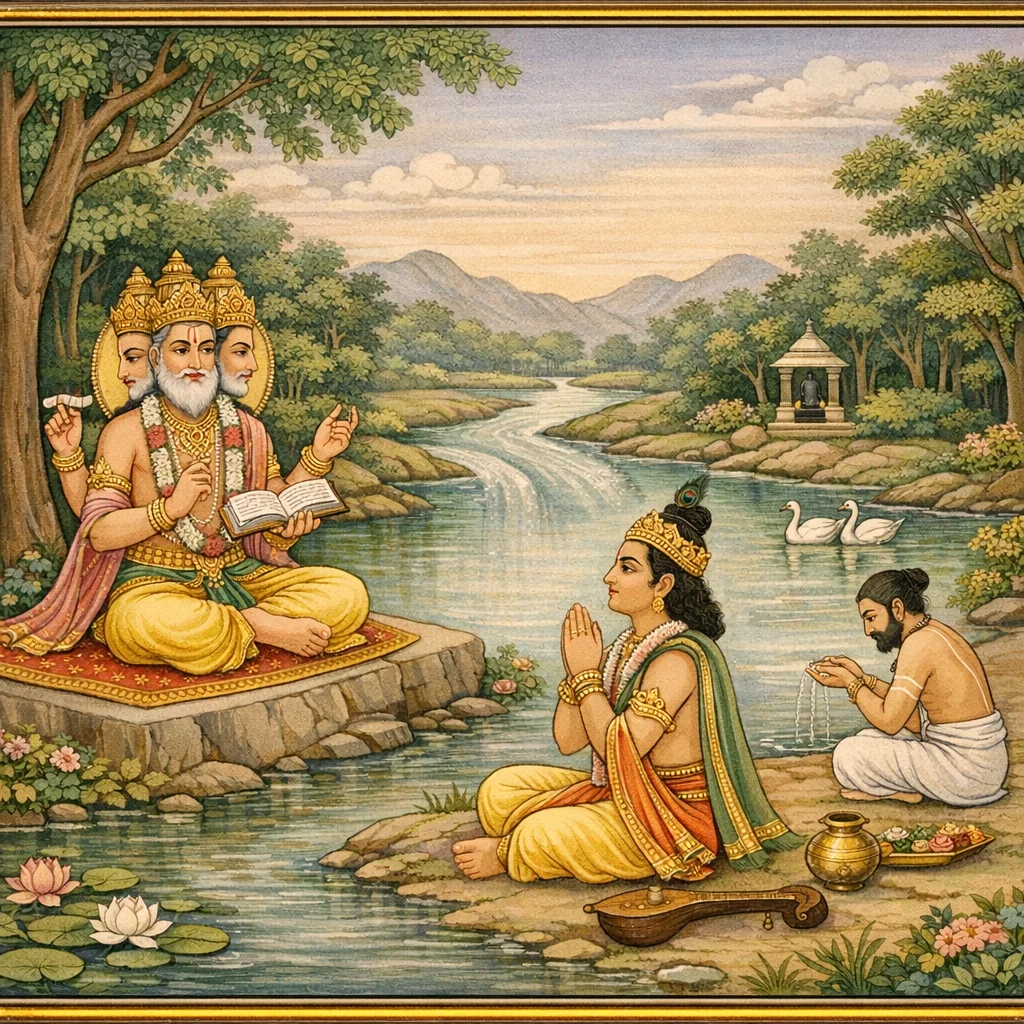
This chapter unfolds as a theological dialogue between Brahmā and Nārada within the Cāturmāsya-māhātmya. It opens with post-bathing ritual practice: daily tarpaṇa to the ancestors performed with śraddhā, especially in a sacred place, and confluence (saṅgama) rites where offerings to the deities, japa, and homa are said to bestow vast merit. The teaching then turns to disciplined living: remembrance of Govinda as the inward preparation for auspicious acts, and a list of dharmic supports—sat-saṅga, devotion to the dvija, tarpaṇa to guru/deva/agni, go-dāna, Veda recitation, truthful speech, and steady dāna-bhakti. When Nārada asks for a precise definition of niyama and its fruit, Brahmā defines it as regulation of the senses and conduct to conquer the inner foes (ṣaḍ-varga) and establish virtues such as kṣamā and satya. The chapter emphasizes manonigraha (mind-restraint) as the causal basis of knowledge and mokṣa, presenting kṣamā as a unifying discipline. It sets forth prohibitions and duties: satya as the highest dharma, ahiṃsā as dharma’s root; avoidance of theft (especially from Brahmins and deities), renunciation of ahaṃkāra, and cultivation of śama, santoṣa, and non-envy. It concludes by declaring bhūta-dayā—compassion toward all beings—as sanātana-dharma, especially to be upheld during Cāturmāsya, since Hari dwells in every heart and harming beings is both a theological and ethical transgression.
Shlokas
Verse 1
ब्रह्मोवाच । पितॄणां तर्पणं कुर्याच्छ्रद्धायुक्तेन चेतसा । स्नानावसाने नित्यं च गुप्ते देवे महाफलम्
Brahmā said: With a mind endowed with śraddhā, one should offer tarpaṇa—libations of water—to the ancestors; and at the close of bathing, one should do so daily—this bears great fruit in the presence of the hidden, inner Deity.
Verse 2
संगमे सरितोस्तत्र पितॄन्संतर्प्य देवताः । जपहोमादिकर्माणि कृत्वा फलमनंतकम्
At that confluence of the river, having satisfied the ancestors and honored the deities, and having performed acts such as japa and homa, one attains endless fruit.
Verse 3
गोविंदस्मरणं कृत्वा पश्चात्कार्याः शुभाः क्रियाः । एष एव पितृदेवमनुष्यादिषु तृप्तिदः
Having first remembered Govinda, one should then perform auspicious rites. This very remembrance becomes the giver of satisfaction to the ancestors, the gods, and human beings (and all such beings).
Verse 4
श्रद्धां धर्मयुतां नाम स्मृतिपूतानि कारयेत् । कर्माणि सकलानीह चातुर्मास्ये गुणोत्तरे
One should cultivate faith joined with dharma, and perform all actions here as purified by sacred recollection. In the excellent four-month holy season (Cāturmāsya), such conduct becomes especially meritorious.
Verse 5
सत्संगो द्विजभक्तिश्च गुरुदेवाग्नि तर्पणम् । गोप्रदानं वेदपाठः सत्क्रियासत्यभाषणम्
Holy company (satsanga), devotion to the twice-born (dvija), and tarpaṇa offered to guru, Deity, and Agni, the sacred fire; the gift of a cow, recitation of the Veda, noble conduct, and truthful speech—these are the praised forms of dharma.
Verse 6
गोभक्तिर्दानभक्तिश्च सदा धर्मस्य साधनम् । कृष्णे सुप्ते विशेषेण नियमोऽपि महा फलः
Devotion to the cow and devotion to giving (dāna) are ever the means of Dharma. And when Kṛṣṇa is “asleep” during Cāturmāsya, even a self-undertaken niyama (religious restraint) bears especially great fruit.
Verse 7
नारद उवाच । नियमः कीदृशो ब्रह्मन्फलं च नियमेन किम् । नियमेन हरिस्तुष्टो यथा भवति तद्वद
Nārada said: “O Brahman, what kind of niyama is this, and what fruit is gained by niyama? Tell how Hari becomes pleased through niyama.”
Verse 8
ब्रह्मोवाच । नियमश्चक्षुरादीनां क्रियासु विविधासु च । कार्यो विद्यावता पुंसा तत्प्रयोगान्महासुखम्
Brahmā said: “Niyama is the disciplined regulation of the senses—such as the eyes—and of one’s conduct in diverse activities. A person of knowledge should practice it; from its proper application arises great happiness.”
Verse 9
एतत्षड्वर्गहरणं रिपुनिग्रहणं परम् । अध्यात्ममूलमेतद्धि परमं सौख्यकारणम्
This niyama removes the “sixfold group” and is the supreme restraint of the inner enemies. Rooted in adhyātma, spiritual inwardness, it is indeed the highest cause of true happiness.
Verse 10
तत्र तिष्ठंति नियतं क्षमासत्यादयो गुणाः । विवेकरूपिणः सर्वे तद्विष्णोः परमं पदम्
There, firmly established, dwell virtues such as forbearance and truth—each taking the form of discernment (viveka). That state is the supreme abode of Viṣṇu.
Verse 11
कृत्वा भवति यज्ञान्यत्कृतकृत्यत्वमत्र तत् । स्यात्तस्य तत्पूर्वजानां येन ज्ञातमिदं पदम्
By accomplishing this, one attains the state of “having done what must be done,” as though other sacrifices too were thereby fulfilled. And for that person’s forebears as well there is benefit, since this supreme state has been realized.
Verse 12
तन्मुहूर्त्तमपि ध्यात्वा पापं जन्मशतोद्भवम् । भस्म साद्याति विहितं निरंजननिषेवणात्
Even by meditating for that single moment, sin born of a hundred lifetimes is ordained to turn to ashes—through devoted resort to the Stainless One, Nirañjana.
Verse 13
प्रत्यहं संकुचत्यस्य क्षुत्पिपासादिकः श्रमः । स योगी नियमी नित्यं हरौ सुप्ते विशिष्यते
Day by day, the fatigue born of hunger, thirst, and the like diminishes for him. Such a disciplined yogin—ever self-restrained—becomes especially eminent during the period when Hari is said to be asleep (Cāturmāsya).
Verse 14
चातुर्मास्ये नरो भक्त्या योगाभ्यासरतो न चेत् । तस्य हस्तात्परिभ्रष्टममृतं नात्र संशयः
If, during Cāturmāsya, a person is not devotedly engaged in the practice of yoga, then nectar itself has slipped from his hand—of this there is no doubt.
Verse 15
मनो नियमितं येन सर्वेच्छासु सदागतम् । तस्य ज्ञाने च मोक्षे च कारणं मन एव हि
For one whose mind—ever moving among all desires—has been restrained, it is the mind itself that becomes the cause of both true knowledge and liberation.
Verse 16
मनोनियमने यत्नः कार्यः प्रज्ञावता सदा । मनसा सुगृहीतेन ज्ञानाप्तिरखिला ध्रुवम्
The wise should ever strive to discipline the mind. When the mind is well mastered, the attainment of complete knowledge is surely assured.
Verse 17
तन्मनः क्षमया ग्राह्यं यथा वह्निश्च वारिणा । एकया क्षमया सर्वो नियमः कथितो बुधैः
That mind should be restrained by forbearance, as fire is subdued by water. Indeed, by a single virtue—forbearance—the wise declare all disciplines to be fulfilled.
Verse 18
सत्यमेकं परो धर्मः सत्यमेकं परं तपः । सत्यमेकं परं ज्ञानं सत्ये धर्मः प्रतिष्ठितः
Truth alone is the highest dharma; truth alone is the highest austerity. Truth alone is the highest knowledge; upon truth, dharma stands firmly established.
Verse 19
धर्ममूलमहिंसा च मनसा तां च चितयन् । कर्मणा च तथा वाचा तत एतां समाचरेत्
Non-violence (ahiṃsā) is the root of dharma. Therefore, one should cherish it in the mind and practice it through action and through speech as well.
Verse 20
परस्वहरणं चौर्यं सर्वदा सर्वमानुषैः । चातुर्मास्ये विशेषेण ब्रह्मदेवस्ववर्जनम्
Stealing—taking what belongs to others—must always be avoided by all people. And during Cāturmāsya in particular, one must refrain from misappropriating property belonging to Brahmins and to the gods (temples).
Verse 21
अकृत्यकरणं चैव वर्जनीयं सदा बुधैः । अहीनः सर्वकार्येषु यः सदा विप्र वर्तते
Doing what ought not to be done must always be shunned by the wise. O Brāhmaṇa, one who in all duties ever moves about vigilant and unnegligent truly lives as he should.
Verse 22
स च योगी महाप्राज्ञः प्रज्ञाचक्षुरहं नधीः । अहंकारो विषमिदं शरीरे वर्त्तते नृणाम्
Such a yogin is greatly wise, seeing with the eye of discernment—knowing, “I am not the intellect.” For egoism (ahaṃkāra) is a subtle poison that dwells in human bodies.
Verse 23
तस्मात्स सर्वदा त्याज्यः सुप्ते देवे विशेषतः । अनीहया जितक्रोधो जितलोभो भवेन्नरः
Therefore it should be abandoned at all times—especially when the Lord is in His divine sleep (during Cāturmāsya). Free from restless striving, a man should become one who has conquered anger and conquered greed.
Verse 24
तस्य पापसहस्राणि देहाद्यांति सहस्रधा । मोहं मानं पराजित्य शमरूपेण शत्रुणा
For him, thousands of sins depart from the body in countless ways, when delusion and pride are overcome by the “enemy” that takes the form of śama—inner calm and restraint.
Verse 25
विचारेण शमो ग्राह्यः सन्तोषेण तथा हि सः । मात्सर्यमृजुभावेन नियच्छेत्स मुनीश्वरः
Śama (self-restraint) should be adopted through discerning reflection, and it is sustained by contentment. The lordly sage should restrain jealousy (mātsarya) through straightforwardness and gentleness of heart.
Verse 26
चातुर्मास्ये दयाधर्मो न धर्मो भूतविद्रुहाम् । सर्वदा सर्व दानेषु भूतद्रोहं विवर्जयेत्
In Cāturmāsya, the dharma of compassion is supreme; for those who are hostile to living beings, there is no true dharma. At all times, and in every act of giving, one should wholly refrain from harming creatures.
Verse 27
एतत्पापसहस्राणां मूलं प्राहुर्मनीषिणः । तस्मात्सर्वप्रयत्नेन कार्या भूतदया नृभिः
The wise declare this to be the root of thousands of sins. Therefore, with every effort, people should practice compassion toward all living beings.
Verse 28
सर्वेषामेव भूतानां हरिर्नित्यं हृदि स्थितः । स एव हि पराभूतो यो भूतद्रोहकारकः
Hari abides eternally in the heart of every being. Indeed, the one who harms living creatures is the one truly defeated—for he insults the indwelling Lord.
Verse 29
यस्मिन्धर्मे दया नैव स धर्मो दूषितो मतः । दयां विना न विज्ञानं न धर्मो ज्ञानमेव च
Any dharma in which compassion is absent is held to be corrupted. Without compassion there is neither true discernment, nor dharma—nor even genuine spiritual knowledge.
Verse 30
तस्मात्सर्वात्मभावेन दयाधर्मः सनातनः । सेव्यः स पुरुषैर्नित्यं चातुर्मास्ये विशेषतः
Therefore, with one’s whole being, the eternal dharma of compassion should be honored and practiced by people always—most especially during Cāturmāsya.
Verse 234
इति श्रीस्कान्दे महापुराण एकाशीतिसाहस्र्यां संहितायां षष्ठे नागरखण्डे हाटकेश्वरक्षेत्रमाहात्म्ये चातुर्मास्यमाहात्म्ये शेपशाय्युपाख्याने ब्रह्म नारदसंवादे चातुर्मास्यनियमविधिमाहात्म्यवर्णनंनाम चतुस्त्रिंशदुत्तरद्विशततमोऽध्यायः
Thus ends Chapter 234, entitled “Glorification of the Greatness of the Rules and Observances of Cāturmāsya,” in the Śrī Skanda Mahāpurāṇa, in the Ekāśīti-sāhasrī Saṃhitā, within the Sixth (Nāgara) Khaṇḍa—under the Māhātmya of the Hāṭakeśvara sacred region, in the Cāturmāsya Māhātmya, in the narrative of Śeṣaśāyī, in the dialogue of Brahmā and Nārada.