Adhyaya 230
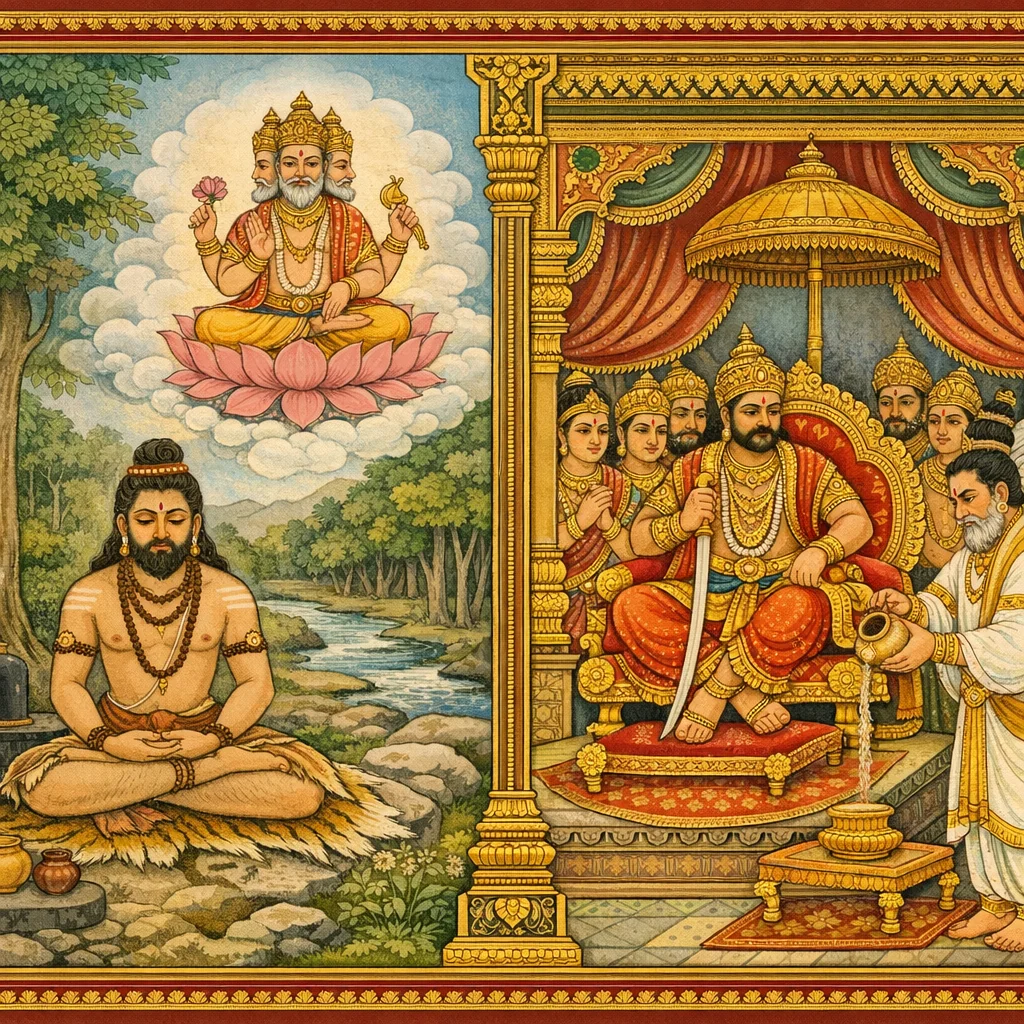
This adhyāya continues the tale after Andhaka’s fall by introducing his son Vṛka as a surviving asura. Vṛka withdraws to a heavily guarded ocean refuge, then comes to Jambūdvīpa and recognizes Hāṭakeśvara-kṣetra as a proven seat of spiritual power, since Andhaka once performed austerities there. In secrecy he undertakes escalating tapas—living first on water, then on air—practising extreme bodily restraint and unwavering concentration on Brahmā (Kamala-sambhava/Pitāmaha). After a long period Brahmā appears, tells him to cease the harsh austerity, and offers a boon. Vṛka asks to be free from aging and death; Brahmā grants it and vanishes. Empowered, Vṛka returns, plans at Mount Raivataka, and advances against Indra. Seeing Vṛka’s boon-born invulnerability, Indra abandons Amarāvatī and, with the gods, seeks refuge in Brahmaloka. Vṛka enters the deva realm, takes Indra’s seat, is consecrated by Śukra, and installs daityas in the offices of the Ādityas, Vasus, Rudras, and Maruts; under Śukra’s direction he also rearranges the sacrificial shares (yajña-bhāga). The chapter presents this transfer of kingship as a theological lesson on the potency and peril of boons, the ethical ambiguity of tapas-driven power, and the vulnerability of cosmic governance to ascetic merit.
Shlokas
Verse 1
सूत उवाच । एवं गणत्वमापन्ने ह्यन्धके दानवोत्तमे । तस्य पुत्रो वृकोनाम निरुत्साहो द्विषज्जये
Sūta said: When Andhaka—the foremost among the Dānavas—had thus attained the status of a gaṇa, his son named Vṛka became dispirited in the matter of conquering his enemies.
Verse 2
भयेन महता युक्तो हतशेषैश्च दानवैः । प्रविवेश समुद्रांतं सुदुर्गं ब्राह्मणोत्तमाः
Overcome by great fear, and accompanied by the surviving Dānavas, he entered a sea-bound region—an exceedingly hard-to-reach stronghold, O best of brāhmaṇas.
Verse 3
ततः शक्रः प्रहृष्टात्मा प्रणम्य वृषभध्वजम् । तस्यादेशं समासाद्य प्रविवेशामरावतीम्
Then Śakra (Indra), his heart rejoicing, bowed to the Bull-bannered Lord (Śiva). Having received His command, he entered Amarāvatī.
Verse 4
चकार च सुखी राज्यं त्रैलोक्येऽपि द्विजोत्तमाः । यज्ञभागान्पुनर्लेभे यथार्थं च धरातले
And he ruled happily—even over the three worlds, O best of twice-born. He again obtained the rightful shares of sacrifice, duly, upon the earth.
Verse 5
एतस्मिन्नेव काले तु ह्यंधकस्य सुतो वृकः । निष्क्रम्य सागरात्तूर्णं जंबुद्वीपं समागतः
At that very time, Andhaka’s son Vṛka, quickly emerging from the ocean, arrived in Jambūdvīpa.
Verse 6
हाटकेश्वरजं क्षेत्रं मत्वा पुण्यं सुसिद्धिदम् । पित्रा यत्र तपस्तप्तमंधकेन दुरात्मना
Considering the sacred region of Hāṭakeśvara to be holy and a giver of excellent attainments, he went there—where his father, the wicked-souled Andhaka, had formerly performed austerity (tapas).
Verse 7
सगुप्तस्तु तपस्तेपेऽयथा वेत्ति न कश्चन । ध्यायमानः सुरश्रेष्ठं भक्त्या कमलसंभवम्
But, hidden from sight, he performed austerities so that none might know. With devotion he meditated upon the Lotus-born Brahmā, foremost among the gods.
Verse 8
यावद्वर्षसहस्रांतं जलाहारो द्वितीयकम् । तपस्तेपे स दैत्येन्द्रो ध्यायमानः पितामहम्
For a full thousand years, with water as his sole sustenance, that lord of the Daityas performed austerities, meditating upon Pitāmaha, Brahmā.
Verse 9
वायुभक्षस्ततो जातस्तावत्कालं द्विजोत्तमाः । अंगुष्ठाग्रेण भूपृष्ठं स्पर्शमानो जितेन्द्रियः
Then, O best of the twice-born, for that long he lived on air alone; having conquered his senses, he touched the earth’s surface only with the tip of his thumb.
Verse 10
एवं च पञ्चमे प्राप्ते सहस्रे द्विजसत्तमाः । ब्रह्मा तस्य गतस्तुष्टिं दृष्ट्वा तस्य तपो महत्
And so, O best of brāhmaṇas, when the fifth thousand years was completed, Brahmā became pleased with him, having beheld the greatness of his austerity.
Verse 11
ततोऽब्रवीत्तमागत्य तां गर्तां ब्राह्मणोत्तमाः । भोभो वृक निवर्तस्व तपसोऽस्मात्सुदारुणात्
Then, approaching that pit, he said, O best of brāhmaṇas: “O Vṛka, desist from this exceedingly dreadful austerity.”
Verse 12
वरं वरय भद्रं ते यो नित्यं मन सि स्थितः
Choose a boon—may auspiciousness be yours—the boon that has ever been fixed within your mind.
Verse 13
वृक उवाच । यदि तुष्टोऽसि मे देव यदि देयो वरो मम । जरामरणहीनं मां तत्कुरुष्व पितामह
Vṛka said: “If you are pleased with me, O Lord—if a boon is to be granted to me—then make me free from old age and death, O Grandfather.”
Verse 14
श्रीब्रह्मोवाच । मम प्रसादतो वत्स जरामरणवर्जितः । भविष्यसि न सन्देहः सत्यमेतन्मयोदितम्
Śrī Brahmā said: “By my favor, dear one, you shall be free from old age and death—there is no doubt. This is truly what I declare.”
Verse 15
एवमुक्त्वा ततो ब्रह्मा तत्रैवांतरधी यत । वृकोऽपि कृतकृत्यस्त्वागतश्च स्वगृहं पितुः
Having spoken thus, Brahmā disappeared right there. And Vṛka too, feeling his purpose fulfilled, returned to his father’s own dwelling.
Verse 16
गिरिं रैवतकं नाम सर्वर्तुकुसुमोज्ज्वलम् । तत्र गत्वा निजामात्यैः समं मन्त्र्य च सत्व रम् । इन्द्रोपरि ततश्चक्रे यानं युद्धपरीप्सया
He went to the mountain named Raivataka, radiant with flowers in every season. There, after swiftly consulting with his own ministers, he set out against Indra, desiring battle.
Verse 17
इंद्रोऽपि च परिज्ञाय दानवं तं महाबलम् । जरामृत्युपरित्यक्तं प्रभावात्परमेष्ठिनः
Indra too perceived that mighty Dānava to be beyond old age and death, by the power of Parameṣṭhin (Brahmā).
Verse 18
परित्यज्य भयाच्चैव पुरीं चैवामरावतीम् । ब्रह्मलोकं गतस्तूर्णं देवैः सर्वैः समन्वितः
Out of fear, he abandoned the city of Amarāvatī and swiftly went to Brahmaloka, accompanied by all the gods.
Verse 19
एतस्मिन्नंतरे प्राप्तो वृकश्च त्रिदशालये । ससैन्यपरिवारेण प्रहृष्टेन समन्वितः
Just then, Vṛka arrived at the abode of the gods, accompanied by his surrounding army and retinue, exultant with delight.
Verse 20
ततश्चैंद्रपदे तस्मिन्स्वयमेव व्यवस्थितः । शुक्रात्प्राप्याभिषेकं च पुष्पस्नानसमुद्भवम्
Then, of his own accord, he seated himself upon that very throne of Indra; and from Śukra he received the abhiṣeka—an inauguration arising from a ceremonial bath of flowers.
Verse 21
सोऽभिषिक्तस्तु शुक्रेण देवराज्यपदे वृकः । स्थापयामास दैतेयान्देवतानां पदेषु च
Consecrated by Śukra, Vṛka took his seat in the sovereignty of the gods; and he installed the Daiteyas in the very offices and stations of the deities.
Verse 22
आदित्यानां वसूनां च रुद्राणां मरुतामपि । यज्ञभागकृते विप्राः शुक्रशासनमाश्रिताः
For the allotment of the sacrificial shares due to the Ādityas, the Vasus, the Rudras, and the Maruts as well, the brāhmaṇas acted in accordance with the ordinance and rule of Śukra.
Verse 230
इति श्रीस्कांदे महापुराण एकाशीतिसाहस्र्यां संहितायां षष्ठे नागरखण्डे हाटकेश्वरक्षेत्रमाहात्म्ये जलशाय्युपाख्याने वृकेन्द्रराज्यलंभनवर्णनंनाम त्रिंशदुत्तरद्विशततमोऽध्यायः
Thus ends the two-hundred-and-thirtieth chapter, entitled “The Description of Vṛka’s Attainment of Indra’s Kingship,” in the Śrī Skanda Mahāpurāṇa, in the Ekāśītisāhasrī Saṃhitā, within the sixth division—the Nāgara Khaṇḍa—under the tīrtha-glorification of Hāṭakeśvara-kṣetra, in the episode called Jalaśāyī.