Adhyaya 23
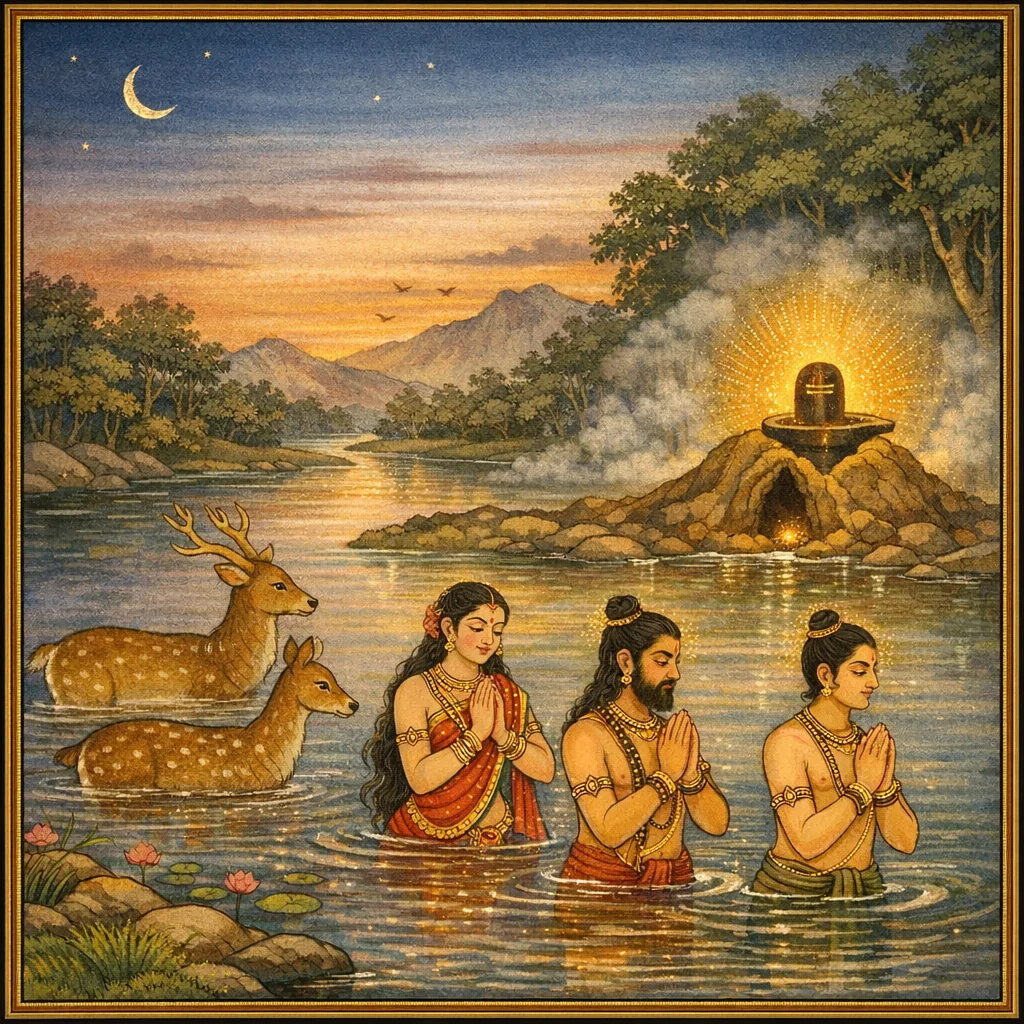
Sūta extols an eminent sacred ford called Mṛgatīrtha, located in the western part of the holy region in question. He declares that one who, with proper faith, bathes there at sunrise on Caitra-śukla-caturdaśī (the bright fortnight’s fourteenth day of Caitra) does not fall into animal wombs again, even when burdened with grave moral faults—thus proclaiming tīrtha-born purification and uplift. When the ṛṣis ask for its origin and specific power, Sūta recounts that in a vast forest hunters pursued a herd of deer; terrified and wounded by arrows, the deer entered a deep reservoir. By the potency of that water they attained human status, and even outward marks of refinement are said to arise from bathing alone. He then gives the etiological cause: the water is linked to a previously mentioned manifestation (liṅga-bheda-udbhava), once hidden under dust, later reappearing through an opening in an anthill by divine ordinance and gradually becoming manifest there. As a further example, Triśaṅku—though in a socially degraded condition—bathed at Mṛgatīrtha and regained a divine form. Therefore, Sūta concludes, hunters and deer alike, by bathing in this tīrtha at the appointed time, are freed from moral impurities and reach an elevated state, binding ritual act, calendrical timing, and narrative authority into a coherent tīrtha theology.
Shlokas
Verse 2
। सूत उवाच । तस्यैव पश्चिमे भागे मृगतीर्थमनुत्तमम् । अस्ति पुण्यतमं ख्यातं समस्ते धरणीतले । तत्र ये मानवास्तीर्थे सम्यक्छ्रद्धासमन्विताः । चैत्रशुक्लचतुर्दश्यां स्नानं कुर्वंतिभास्करे
Sūta said: In the western part of that very region there is an unsurpassed sacred ford called Mṛgatīrtha, renowned as supremely meritorious across the whole earth. Those who, with steady faith, bathe at that tīrtha on the fourteenth day of the bright fortnight of Caitra, at sunrise, obtain great religious merit.
Verse 3
मध्ये स्थिते न ते यांति तिर्यग्योनौ कथंचन । अपि पापसमोपेता दोषैः सर्वैः समन्विताः
Abiding within its sacred sphere, they never go to an animal womb (tiryag-yoni) in any way—even if burdened with sins and accompanied by every fault.
Verse 4
कृतघ्ना नास्तिकाश्चौरा मर्यादाभेदकास्तथा । स्नाता ये तत्र सत्तीर्थे ते यांति परमां गतिम् । विमानवरमारूढाः स्तूयमानाश्च किंनरैः
Even the ungrateful, the unbelievers, thieves, and those who transgress the bounds of dharma—if they bathe there in that true tīrtha—attain the supreme state, ascending excellent celestial vimānas and being praised by the Kiṃnaras.
Verse 5
ऋषय ऊचुः । मृगतीर्थं कथं तत्र संजातं सूतनंदन । किं प्रभावं समाचक्ष्व परं कौतूहलं हि नः
The sages said: “O son of Sūta, how did Mṛgatīrtha arise there? Tell us of its power, for truly our curiosity is great.”
Verse 6
सूत उवाच । पूर्वं तत्र महारण्ये नानामृगगणावृते । नानाविहंगसंघुष्टे नानावृक्षसमाकुले
Sūta said: “Formerly, there was a great forest there, filled with herds of many kinds of deer, resounding with diverse birds, and crowded with many varieties of trees.”
Verse 7
समायाता महारौद्रा लुब्ध काश्चापपाणयः । कृष्णांगा भ्रममाणास्ते यमदूता इवाऽपरे
Then there arrived exceedingly fierce hunters, bows in hand. Dark-limbed and roaming about, they seemed like other messengers of Yama.
Verse 8
एतस्मिन्नंतरे दृष्टं मृगयूथं तरोरधः । उपविष्टं सुविश्रब्धं तैस्तदा द्विज सत्तमाः
In the meantime, O best of the twice-born, those hunters saw a herd of deer beneath a tree, seated there in calm security.
Verse 9
अथ तांल्लुब्धकान्दृष्ट्वा दूरतोऽपि भयातुराः । पलायनपराः सर्वे मृगा जग्मुर्द्रुतं ततः
Then, seeing those hunters even from afar, the deer—stricken with fear, all intent on flight—swiftly ran away from that place.
Verse 10
अथ ते सन्निधौ दृष्ट्वा गंभीरं सलिलाशयम् । प्रविष्टा हरिणाः सर्वे भयार्ताः शरपीडिताः
Then, seeing nearby a deep reservoir of water, all the deer entered it—tormented by fear and afflicted by the hunters’ arrows.
Verse 11
ततस्तत्सलिलस्यांतस्ते मृगाः सर्व एव हि । मानुषत्वमनुप्राप्तास्तत्प्रभावा द्द्विजोत्तमाः
Then, within that sacred water, all those deer indeed attained humanhood—O best of the twice-born—solely by the power and glory of that tīrtha.
Verse 12
अथ तान्मानुषीभूतान्पप्रच्छुर्लुब्धका मृगान् । मृगयूथं समायातं मार्गेणानेन सांप्रतम् । केन मार्गेण निर्यातं तस्माद्वदत मा चिरम्
Then the hunters questioned those deer who had become human: “A herd of deer has just come by this route—by which path did it leave? Tell us at once; do not delay.”
Verse 13
मानुषा ऊचुः । वयं ते हरिणाः सर्वे मानुषत्वं सुदुर्लभम् । तीर्थस्याऽस्य प्रभावेन प्राप्ताः सत्यं न संशयः
The (new) humans said: “We were all those deer. By the power of this tīrtha we have attained the exceedingly rare state of being human—this is true, with no doubt.”
Verse 15
स्नानमात्रात्ततः सर्वे दिव्यमाल्यानुलेपनाः । दिव्यगात्रधरा सर्वे संजाताः पार्थिवोत्तमाः
Thereupon, by bathing alone, they all were adorned with divine garlands and unguents; all bore radiant, heavenly bodies and arose upon the earth as the most excellent of men.
Verse 16
ऋषय ऊचुः । अत्याश्चर्यमिदं सूत यत्त्वया परिकीर्तितम् । स्नानमात्रेण ते प्राप्ता लुब्धकास्तादृशं वपुः
The sages said: “Most wondrous indeed, O Sūta, is what you have recounted—that by bathing alone those hunters obtained such a form.”
Verse 17
तथा मानुष्यमापन्ना मृगास्तोयावगाहनात् । तत्कथं मेदिनीपृष्ठे तत्तीर्थं संबभूव ह
“And likewise, the deer attained humanity by immersion in the water. How, then, did that tīrtha come to be upon the surface of the earth?”
Verse 18
सूत उवाच । लिंगभेदोद्भवं तोयं यत्पुरा वः प्रकीर्तितम् । आच्छन्नं पांसुभिः कृत्स्नं वायुना शक्रशासनात्
Sūta said: “That water, born from the splitting of the liṅga—of which I formerly spoke to you—was wholly covered with dust by the wind, under Indra’s command.”
Verse 19
वल्मीकरंध्रमासाद्य तन्निष्क्रांतं पुनर्द्विजाः । कालेन महता तत्र प्रदेशे स्वल्पमेव हि
“Reaching an opening in an anthill, that water emerged again, O twice-born; and after a long time, in that region it appeared only in a small measure.”
Verse 20
यत्र स्नातः पुरा सद्यस्त्रिशंकुः पृथिवीपतिः । दिव्यं वपुः पुनः प्राप्त श्चंडालत्वेन संस्थितः
In that place, long ago, King Triśaṅku bathed and at once regained a divine body, though he remained established in the condition of a caṇḍāla.
Verse 21
एतस्मात्कारणात्तत्र स्नाताः सारंगलुब्धकाः । सर्वे पापविनिर्मुक्ताः संप्राप्ताः परमं वपुः
For this reason, the hunters who pursued the deer bathed there; all were freed from sin and attained the highest, excellent form.