Adhyaya 226
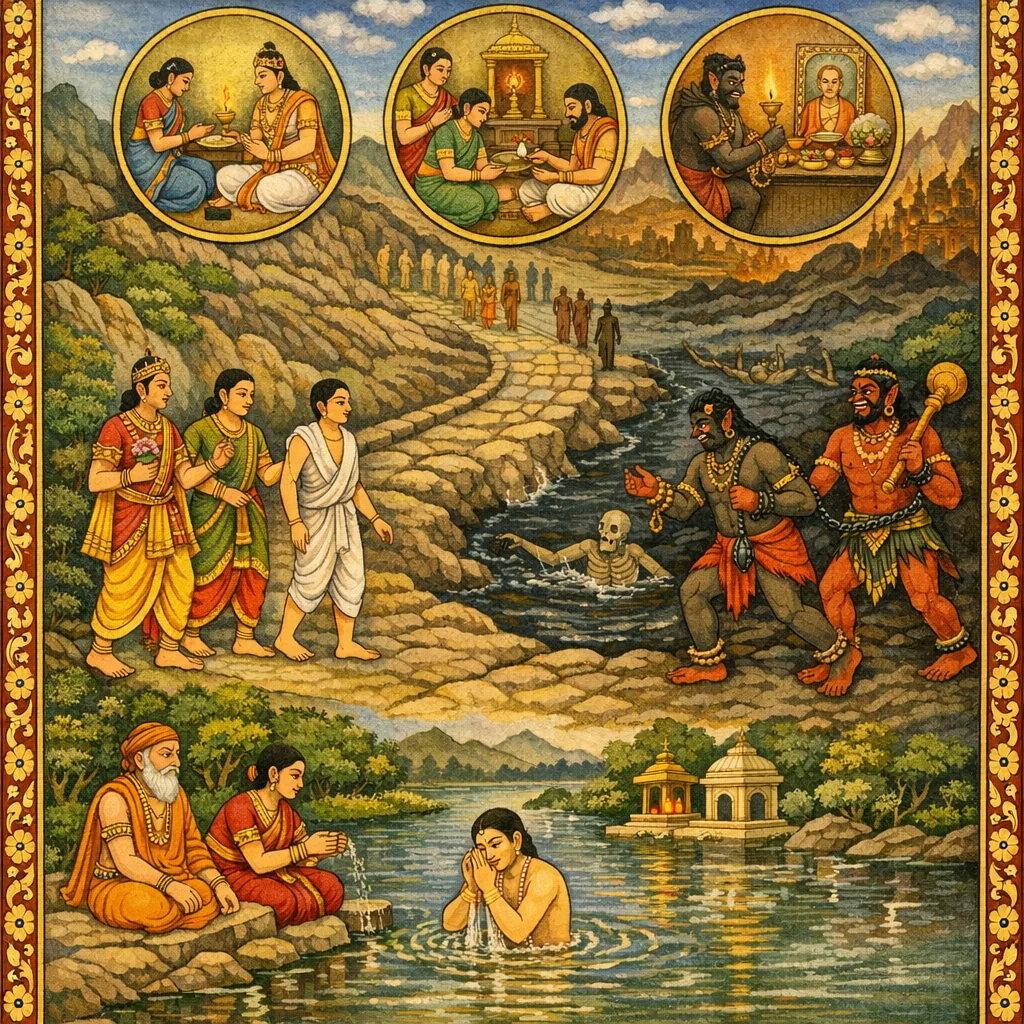
This adhyāya offers a combined teaching on funerary rites and karmic judgment. Bhartṛyajña explains sapīṇḍīkaraṇa as the rite that ends preta-status by establishing one’s place among the ancestors (sapīṇḍatā). Asked about ancestors seen in dreams and about those whose post-mortem gati is unsettled, he replies that such appearances pertain to one’s own lineage. It then addresses the plight of one who dies sonless: substitutes or representatives may perform the rites, and when proper observances lapse, Nārāyaṇa-bali is prescribed as a remedial rite that destroys preta-condition, especially for untimely or abnormal deaths. The discourse broadens into a karmic scheme of three destinies—svarga, naraka, and mokṣa—aligned with dharma, pāpa, and jñāna. In an epic-style inquiry, Yudhiṣṭhira questions Bhīṣma about Yama’s administration: the scribes (Citra/Vicitra), eight kinds of Yama’s messengers with raudra and saumya functions, the Yamamārga, and the crossing of the Vaitaraṇī. A series of hells and punishments is described together with specific remedies—staged śrāddhas and time-marked dānas (monthly and at multi-month intervals) to relieve or avert particular torments—concluding that these accounts make karmic outcomes intelligible and that tīrtha-yātrā is linked with purification.
Shlokas
Verse 1
भर्तृयज्ञ उवाच । यतः सपिंडता प्रोक्ता पितृपिण्डैः समंततः । यावत्सपिण्डता नैव तावत्प्रेतः स तिष्ठति
Bhartṛyajña said: Since sapiṇḍatā is declared to be the joining, on every side, with the ancestral piṇḍas, so long as sapiṇḍatā has not taken place, that being remains stationed in the state of a preta.
Verse 2
अपि धर्मसमोपेतस्तपसाऽपि समन्वितः । एतस्मात्कारणात्प्रोक्ता मुनिभिस्तु सपिंडता
Even if the departed was endowed with righteousness and also possessed of tapas (austerity), for this very reason the sages have prescribed sapiṇḍatā.
Verse 3
यस्ययस्य च योऽन्यत्र योनिं प्राप्नोति मानवः । तत्रस्थस्तृप्तिमाप्नोति यद्दत्तं तस्य वंशजैः
Whatever womb (yoni) or realm a person attains elsewhere, dwelling there he receives satisfaction from what is offered by his descendants.
Verse 4
आनर्त उवाच । ये दृश्यंते निजाः स्वप्ने चिरात्पितृपितामहाः । प्रार्थयंति निजान्कामांस्ततः किं स्यान्महामुने
Ānarta said: Those fathers and grandfathers, long departed, who appear to their own kin in dreams and request the things they desire—what does that signify, O great sage?
Verse 5
भर्तृयज्ञ उवाच । येषां गतिर्न संजाता प्रेतत्वे च व्यवस्थिताः । दर्शयंति च ते सर्वे स्वयमात्मानमेव हि
Bhartṛyajña said: Those whose onward course has not been secured and who remain established in the state of preta—such beings indeed reveal themselves (in dreams), all of them, in their very own form.
Verse 6
स्ववंश्यानां न चान्ये तु सत्यमेतन्मयोदितम् । यथा लोकेऽत्र संजाता ये च कृत्यैः शुभाशुभैः
They appear only to their own descendants, and not to others—this is the truth I have spoken. Just as beings are born in this world according to their deeds, auspicious and inauspicious…
Verse 7
आनर्त उवाच । यस्य नो विद्यते पुत्रः सपिण्डीकरणं कथम् । तस्य कार्यं भवेदत्र तन्मे त्वं वक्तुमर्हसि
Ānarta said: “For one who has no son, how is the rite of sapiṇḍīkaraṇa to be performed? What should be done in that case here? Please tell me.”
Verse 8
भर्तृयज्ञ उवाच । यस्य नो विद्यते पुत्र औरसश्च महीपते । चतुर्णां स्वपितॄणां तु कथं स स्याच्चतुर्थकः
Bhartṛyajña said: “O king, if a man has no son—no legitimate son of his own—then how can he become the ‘fourth’ among his own four ancestors?”
Verse 9
प्रकर्षेण व्रजेद्यस्मात्तस्मात्प्रेतः प्रकीर्तितः । पुत्रेण भ्रात्रा पत्न्या वा तस्य कार्या सपिंडता
Because he ‘goes onward’ decisively, he is therefore called a preta (departed spirit). For him, the rite of making him a sapinda should be performed—by a son, or by a brother, or by a wife.
Verse 10
चतुर्थो यदि राजेंद्र जायते न कथंचन । क्षेत्रजादीन्सुतानेतानेकादश यथोदितान्
O king, if the ‘fourth’ (qualified successor) is not produced in any way, then (one may resort to) the eleven kinds of sons beginning with the kṣetraja, as traditionally taught.
Verse 11
पुत्रप्रतिनिधीनाहुः क्रियालोपान्मनीषिणः । काले यदि न राजेंद्र जायतेऽस्योत्तरक्रिया
The wise speak of ‘sons-by-substitution’ to prevent the lapse of rites. O king, if at the proper time his subsequent funerary rites do not come to be performed (through a son),
Verse 12
नारायणबलिः कार्यः प्रेतत्वस्य विनाशकः । यथान्येषां मनुष्याणामपमृत्युमुपेयुषाम् । कार्यश्चैवात्महंतॄणां ब्राह्मणान्मृत्युमीयुषाम्
The Nārāyaṇa-bali should be performed; it destroys the condition of being a preta. It is prescribed for other people as well who have met an untimely death—and it is also to be performed for self-killers and for brāhmaṇas who have met death.
Verse 13
आनर्त उवाच । कथं मृत्युमवाप्नोति पुरुषोऽत्र महामते
Ānarta said: “O great-minded one, how does a person here come to meet death?”
Verse 14
स्वर्गं वा नरकं वापि कर्मणा केन गच्छति । मोक्षं वाऽथ महाभाग सर्वं मे विस्त राद्वद
“By what kind of karma does one go to heaven or to hell? And how does one attain liberation, O fortunate one? Tell me everything in detail.”
Verse 15
भर्तृयज्ञ उवाच । धर्मी पापी तथा ज्ञानी तिस्रोऽत्र गतयः स्मृताः । धर्मात्संप्राप्यते स्वर्गः पापान्नरक एव च
Bhartṛyajña said: “Here three destinies are declared—the righteous, the sinful, and the knower. By dharma one attains heaven; by sin, hell indeed.”
Verse 16
ज्ञानात्संप्राप्यते मोक्षः सत्यमेतन्मयोदितम् । एनमर्थं भविष्यं तु भीष्मं शांतनवं नृप
“Through knowledge, liberation (mokṣa) is attained—this is the truth I have spoken. This very teaching, O king, you will hear from Bhīṣma, the son of Śāntanu.”
Verse 17
युधिष्ठिरो महाराज धर्मपुत्रो नृपोत्तमः । कृष्णेन सह राजेंद्र पितामहमपृच्छत
King Yudhiṣṭhira—the great monarch, son of Dharma and best of rulers—together with Kṛṣṇa, O lord of kings, questioned the grandsire Bhīṣma.
Verse 18
युधिष्ठिर उवाच । कियंतो नरकाः ख्याता यमलोके पितामह । केन पापेन गच्छंति तेषु सर्वेषु जंतवः
Yudhiṣṭhira said: “O Grandsire, how many hells are spoken of in Yama’s world? And by what sins do living beings go to each of them?”
Verse 19
श्रीभीष्म उवाच । एकविंशत्प्रमाणाः स्युर्नरका यममंदिरे । प्राणिनस्तेषु गच्छंति निजकर्मानुसारतः
Śrī Bhīṣma said: “In Yama’s abode, the hells are said to be twenty-one in number. Beings go to them according to the course of their own deeds (karma).”
Verse 20
ख्यातौ चित्रविचित्रौ च कायस्थौ यममंदिरे
In Yama’s abode are two renowned record-keepers—Citra and Vicitra, the kāyastha scribes.
Verse 21
चित्रोऽथ लिखते धर्मं सर्वं प्राणिसमुद्भवम् । विचित्रः पातकं सर्वं परमं यत्नमास्थितः
Then Citra writes down every righteous deed arising from living beings; and Vicitra, with utmost diligence, records every sin.
Verse 22
यमदूताः सदैवाष्टौ धर्मराजसमुद्भवाः । ये नयंति नरान्मृत्युलोकात्स्ववशगान्सदा
The messengers of Yama are ever eight in number, born of Dharmarāja; they continually lead men from the world of death, bringing them under their control.
Verse 23
करालो विकरालश्च वक्रनासो महोदरः । सौम्यः शांतस्तथा नंदः सुवाक्यश्चाष्टमः स्मृतः
They are remembered as: Karāla, Vikarāla, Vakranāsa, Mahodara, Saumya, Śānta, Nanda, and as the eighth, Suvākya.
Verse 24
एतेषां ये पुरा प्रोक्ताश्चत्वारो रौद्ररूपिणः । पापं जनं च ते सर्वे नयन्ति यमसादनम्
Of these, the four earlier described as fierce in form—all of them—lead sinful people to Yama’s abode.
Verse 25
चत्वारो ये परे प्रोक्ताः सौम्यरूपवपुर्द्धराः । धर्मिणं ते जनं सर्वं नयंति यमसादनम्
The other four, said to bear gentle and pleasing forms, lead all righteous people to Yama’s abode.
Verse 26
विमानेन समारूढमप्सरोगणसेवितम्
(They lead the righteous) mounted upon a celestial chariot, attended and honored by companies of Apsarās.
Verse 27
लिखितस्यानुरूपेण पापधर्मोद्भवस्य च । एतेषां किंकरा ये च तेषां संख्या न जायते
In accordance with what has been written (as one’s record of deeds), and with the sinful conduct that arises from adharma, their attendants—agents of retribution—come forth in such numbers that they cannot be reckoned.
Verse 28
अष्टोत्तरशतं तेषां व्याधीनां परिकल्पितम् । सहायार्थं यमेनात्र ज्वरयक्ष्मांतरस्थितम्
For them, one hundred and eight diseases are ordained; and here, set among fevers and consumptions, they stand as Yama’s helpers in bringing about the destined end.
Verse 29
ते गत्वा व्याधयः पूर्वं वशे कुर्वंति मानवम्
Those diseases go first, and they bring the human being under their power.
Verse 30
यमदूतास्ततो गत्वा नाभिमूलव्यवस्थितम् । वायुरूपं समादाय जनैः सर्वैरलक्षिताः
Then Yama’s messengers go forth and take their station at the root of the navel; assuming the form of wind, they remain unseen by all people.
Verse 31
गच्छंति यममार्गेण देहं संस्थाप्य भूतले । षडशीतिसहस्राणि यममार्गः प्रकीर्तितः
They proceed along Yama’s road, leaving the body set upon the earth. The way of Yama is proclaimed to extend for eighty-six thousand (units of distance).
Verse 32
तत्र वैतरणीनाम नदी पूर्वं परिश्रुता । स्रोतोभ्यां सा महाभाग तत्र संस्था सदैव हि
There, the river named Vaitaraṇī is well-known from ancient report. O fortunate one, it stands there indeed forever, flowing in two channels.
Verse 33
तत्र शोणितमेकस्मिन्स्रोतस्यस्या वह त्यलम् । शस्त्राणि च सुतीक्ष्णानि तन्मध्ये भरतर्षभ
There, in one of her streams, blood flows abundantly; and within it are exceedingly sharp weapons, O bull among the Bharatas.
Verse 34
मृत्युकाले प्रयच्छंति ये धेनुं ब्राह्मणाय वै । तस्याः पुच्छं समाश्रित्य ते तरंति च तां नृप
Those who, at the time of death, give a cow to a Brāhmaṇa—clinging to that cow’s tail, they cross that (Vaitaraṇī), O king.
Verse 35
स्वबाहुभिस्तथैवान्ये शतयोजनविस्तृतम् । द्वितीयं चैव तत्स्रोतो वैतरण्या व्यवस्थितम् । तस्यास्तत्सलिलस्रावि गम्यं धर्मवतां सदा
Others, likewise, cross by the strength of their own arms. The second channel of the Vaitaraṇī is established as stretching a hundred yojanas; its flowing waters are ever traversable for those who abide in dharma.
Verse 36
ये नरा गोप्रदातारो मृत्युकाले व्यवस्थिते । ते गोपुच्छं समाश्रित्य तां तरंति पृथूदकाम् । अन्ये स्वबाहुभिः कृत्वा गोप्रदानविवर्जिताः
Those men who are givers of cows, when the time of death has come—taking hold of the cow’s tail, they cross that broad-watered Vaitaraṇī. Others, deprived of cow-giving, must make the crossing by their own arms.
Verse 37
गोप्रदानं प्रकर्तव्यं तस्माच्चैव विशेषतः । मृत्युकालेऽत्र संप्राप्ते य इच्छेद्गतिमात्मनः
Therefore, the gift of a cow should certainly be performed—most especially so—by one who, when the time of death arrives, desires a blessed passage for the self.
Verse 38
तस्या अनन्तरं यांति पापमार्गेण पापिनः । धर्मिष्ठा धर्ममार्गेण विमानवरमाश्रिताः
Immediately thereafter, sinners go by the path of sin; but the righteous proceed by the path of dharma, borne upon excellent celestial cars.
Verse 39
वैतरण्याः परं पारे पंचयोजनमायतम् । असिपत्रवनंनाम पापलोकस्य दुःखदम्
On the far shore beyond the Vaitaraṇī lies a region five yojanas in extent, called Asipatravana, the ‘Forest of Sword-leaves’, a place of suffering for the world of sinners.
Verse 40
तत्र लोहमयान्येवासिपत्राणां शतानि च । यानि कृन्तंति मर्त्यानां शरीराणि समंततः
There, indeed, are hundreds of iron ‘sword-leaves’, which cut the bodies of mortals on every side.
Verse 41
यैर्हृतं परवित्तं च कलत्रं च दुरात्मभिः । नव श्राद्धानि तेषां चेत्तस्मान्मुक्तिः प्रजायते
For those wicked ones by whom another’s wealth—and even another’s wife—has been taken: if nine śrāddhas are performed for them, then release from that (torment) arises.
Verse 42
तस्मात्परतरो ज्ञेयो विख्यातः कूटशाल्मलिः । अधोमुखाः प्रलंबंते तस्मिन्कंटकसंकुले
Beyond that is known an even worse place—the famed Kūṭaśālmali—where, head-down, they hang suspended amid a thicket of thorns.
Verse 43
अधस्ताद्वह्निना चैव दह्यमाना दिवानिशम् । विश्वासघातका ये च सर्वदैव सुनिर्दयाः । तस्मान्मुक्तिं प्रयांति स्म श्राद्धे ह्येकादशे कृते
Burned day and night by fire from below are those who betray trust—ever harsh and merciless. Yet they are said to attain release when an eleventh śrāddha is performed.
Verse 44
यंत्रात्मकस्ततः प्रोक्तो नरको दारुणाकृतिः । ब्रह्मघ्नास्तत्र पीड्यंते ये चाऽन्ये पापकर्मिणः
Then is described a hell of dreadful form, ‘Yantrātmaka’ (the Mechanized Torture). There brahma-slayers are afflicted, and other doers of sinful deeds as well.
Verse 45
श्राद्धेन द्वादशोत्थेन तेभ्यो दत्तेन पार्थिव । तस्मान्मुक्तिं प्रगच्छन्ति यन्त्राख्यनरकात्स्फुटम्
O king, by the offering given to them through the twelfth śrāddha, they clearly attain liberation from the hell called Yantra.
Verse 46
ततो लोहसमाः स्तंभा ज्वलमाना व्यवस्थिताः । आलिंगंति च तान्सर्वान्परदाररताश्च ये
Then there stand blazing pillars like iron; and they clasp all those who delight in another’s wife.
Verse 47
मासिकोत्थे कृते श्राद्धे तेभ्यो मुक्तिमवाप्नुयुः
If the monthly śrāddha is duly performed, those beings attain release from that condition.
Verse 48
लोहदंष्ट्रास्ततो रौद्राः सारमेया व्यवस्थिताः । भक्षयंति च ते पापान्पृष्ठमांसा शिनो नरान् । त्रैपक्षिके कृते श्राद्धे तेभ्यो मुक्तिमवाप्नुयुः
Then fierce dogs with iron fangs stand ready; they devour sinners, eating the flesh of their backs. When the tri-pakṣa śrāddha is performed, those beings obtain release from that torment.
Verse 49
लोहचंचुमयाः काकाः संस्थितास्तदनंतरम् । सरागैर्लोचेनैर्यैश्च ईक्षिताः पर योषितः
Immediately after that stand crows with beaks as if of iron; those whose eyes were filled with lust and who gazed upon the wives of others behold them (as their tormentors).
Verse 50
तेषां नेत्राणि ते घ्नंति भूयो जातानि भूरिशः । द्विमासिकं च यच्छ्राद्धं तेन मुक्तिः प्रजायते
Their eyes are struck and destroyed again and again, though they repeatedly form anew. By performing the bi-monthly śrāddha, liberation is brought forth for them.
Verse 51
ततः शाल्मलिकूटस्तु तथान्ये लोहकण्टकाः । तेषां मध्येन नीयंते पैशुन्यनिरता नराः । त्रिमासिकं तु यच्छ्राद्धं तेन मुक्तिः प्रजायते
Then comes the Śālmali ridge, and other growths bristling with iron thorns. Through their midst are driven those men devoted to slander and tale-bearing. By performing the tri-monthly śrāddha, liberation is produced for them.
Verse 52
रौरवोऽथ सुविख्यातो दारुणो नरको महान् । ब्रह्मघ्नानां समादिष्टः स महाक्लेशकारकः
Next is the well-known Raurava—a great and dreadful hell—assigned for the slayers of brāhmaṇas; it is a cause of immense anguish.
Verse 53
छिद्यंते विविधैः शस्त्रैस्तत्रस्था ये मुहुर्मुहुः । चतुर्मासिकश्राद्धेन मुक्तिस्तेषां प्रजायते
There, those who dwell are cut again and again by weapons of many kinds. By the four-monthly śrāddha, liberation arises for them.
Verse 54
अपरस्तु समाख्यातः क्षारोदस्तु सुदारुणः । कृतघ्नानां समादिष्टः सदैव बहुवेदनः
Another is declared—Kṣāroda, exceedingly dreadful—assigned for the ungrateful; it brings constant and manifold pain.
Verse 55
अधोमुखा ऊर्ध्व पादाः पीड्यंते यत्र लंबिताः । पञ्चमासिकदानेन मुक्तिस्तेषां प्रजायते
There they are tormented while hanging upside down—faces downward, feet upward. By making the five-monthly offering (dāna), release arises for them.
Verse 56
कुम्भीपाकस्ततो ज्ञेयो नरको दारुणाकृतिः । तैलेन क्षिप्यमाणास्तु यत्र दण्डाभिसंधिताः । दृश्यंते जनहंतारो बालहंतार एव च
Then is to be known Kumbhīpāka, a hell of dreadful form, where they are hurled into oil and subjected to punishment. There are seen killers of people, and killers of children as well.
Verse 57
पतंति नरके रौद्रे नरा विश्वासघातकाः । षण्मासिकप्रदानेन मुच्यंते तत्र संकटात्
Those men who betray trust fall into the dreadful hell called Raudra. By performing the prescribed six-monthly gift (ṣaṇmāsika-pradāna), they are released from that peril there.
Verse 58
सर्पवृश्चिकसंयुक्तस्तथाऽन्यो नरकः श्रुतः । तत्र ये दांभिका लोके ते गच्छन्ति नराधमाः । सप्तमासिकदानेन तेषां मुक्तिः प्रजायते
Another hell is spoken of, filled with serpents and scorpions. Those base men in the world who are hypocrites go there. By the seven-monthly gift (saptamāsika-dāna), their liberation from it comes about.
Verse 59
तथा संवर्तकोनाम नरकोऽन्यः प्रकीर्तितः । वेदविप्लावकाः साधुनिंदकाश्च दुरात्मकाः
Likewise, another hell called Saṃvartaka is proclaimed—for those evil-souled ones who subvert the Veda and who revile the righteous.
Verse 60
उत्पाट्यते ततो जिह्वा सन्दंशैर्व ह्निसम्भवैः । स्वकार्ये येऽनृतं ब्रूयुस्तद्गात्रं खाद्यते श्वभिः
Thereupon their tongue is torn out with fire-born tongs. Those who speak falsehood for their own ends—those bodies are eaten by dogs.
Verse 61
परार्थेऽपि च ये ब्रूयुस्तेषां गात्राणि कृत्स्नशः । अष्टमासिकदानेन तेषां मुक्तिः प्रजायते
And even those who speak falsehood for another’s sake—of them, the limbs are afflicted entirely. By the eight-monthly gift, their release is brought about.
Verse 62
अग्निकूटो महाप्लावो दारुणो नरको महान् । तत्र ते यांति वै मूढाः कूटसाक्ष्यिप्रदा नराः
Agni-kūṭa and Mahā-plāva—this is a vast and terrifying great hell. Into it go those deluded men who give false testimony.
Verse 63
तत्रस्था यातनां रौद्रां सहं तेऽतीव दुःखिताः । नवमासिकदानं च तेषामाह्लादनं परम्
Dwelling there, they endure fierce torments and are exceedingly afflicted. For them, the nine-monthly gift becomes the supreme solace.
Verse 64
ततो लोहमयैः कीलैः संचितोऽन्यः समंततः । तत्र चाग्निप्रदातारः स्त्रीणां हन्तार एव च
Then there is another hell, heaped all around with iron spikes. There go those who set fire to others' property and those who kill women as well.
Verse 66
ततोंऽगारमयैः पुंजैरावृताभूः समंततः । स्वामिद्रोहरतास्तत्र भ्राम्यंते सर्वतो दिशः
Then the ground is covered on every side with heaps of burning coals. There, those devoted to betraying their master wander in all directions.
Verse 67
एकादशोद्भवं दानं तत्र मुक्त्यै प्रजायते । संतप्तसिकतापूर्णो नरको दारुणाकृतिः
There, an ‘ekādaśa’-related gift is said to arise for the sake of release. There is also a hell of dreadful form, filled with scorching sand.
Verse 68
स्वामिनं चागतं दृष्ट्वा पलायनपरायणाः । ये भवन्ति नरास्तत्र पच्यंते तेऽपि दुःखिताः । तेषां द्वादशमासीयं श्राद्धं चैवोपतिष्ठति
Those men who, on seeing their master arrive, become intent on fleeing—such people there are ‘cooked’ in suffering, afflicted and miserable. For them, the annual (twelve-month) śrāddha rite also becomes required.
Verse 69
यत्किंचिद्दीयते तोयमन्नं वा वत्सरांतरे । प्रभुंजते च तन्मार्गे प्रदत्तं निजबान्धवैः
Whatever water or food is offered during the course of the year, they partake of that on the way—what is given by their own relatives.
Verse 70
ततः संवत्सरादूर्ध्वं निजकर्मसमुद्भवम् । शुभाशुभं प्रपद्यंते धर्मराजसमीपगाः
Then, after the passing of a year, those who draw near to Dharmarāja attain the auspicious or inauspicious results that arise from their own actions.
Verse 71
एवं पंचदशैतानि संसेव्य नरकाणि ते । प्राप्नुवंति ततो जन्म मर्त्यलोके पुनर्नराः
Thus, after undergoing those fifteen hells, they obtain birth once more as human beings in this mortal world.
Verse 72
प्राप्नुवंति विदेशे च जन्म ये हेतुवादकाः । नित्यं तर्पणदानेन तेषां तृप्तिः प्रजायते
Those who are hetuvādins (argumentative rationalists) are born in foreign lands; yet through daily tarpaṇa-dāna offerings, satisfaction arises for them (as departed ancestors).
Verse 73
स्वामिद्रोहरता ये च कुराज्ये जन्म चाप्नुयुः । हंतकारप्रदानेन तेषां तृप्तिः प्रजायते
Those who delight in betraying their master and are born under bad governance—by the offering called haṃtakāra, satisfaction is produced for them.
Verse 74
अदत्त्वा ये नरोऽश्नंति पितृदेवद्विजातिषु । दुर्भिक्षे जन्म तेषां तु तेन पापेन जायते
Those who eat without first giving a share to the ancestors (pitṛs), the gods, and the twice-born (dvijas)—by that sin they are born into famine and scarcity.
Verse 76
ये प्रकुर्वंति दम्पत्योर्भेदं वै सानुरागयोः । परस्परमसत्यानि तेषां भार्याऽसती भवेत्
Those who cause a rupture between a loving husband and wife by making them speak falsehoods against each other—such men will have an unchaste wife.
Verse 77
एकस्मिन्वचने प्रोक्ते दश ब्रूते क्रुधान्विता । विरूपा भ्रममाणा च सर्वलोकविगर्हिता । कन्यादानफलैस्तेषां तत्रासां च सुखं भवेत्
When but a single word is spoken, she replies with ten, inflamed with anger—misshapen, wandering about, and reproached by all the world. Yet by the merit of kanyā-dāna, the sacred gifting of a maiden in marriage, happiness arises for them—and for those women there.
Verse 78
कन्यकादानविघ्नं हि विक्रयं वा करोति यः । स कन्याः केवलाः सूते न पुत्रं केवलं क्वचित्
Whoever obstructs kanyā-dāna, or treats the maiden as something to be ‘sold’, begets only daughters and never a son at all.
Verse 79
जायंते ताश्च बंधक्यो विधवा दुर्भगास्तथा । कन्यादानफल प्राप्त्या तासां सौख्यं प्रजायते
They are born as women in bondage, as widows, and as the unfortunate. Yet by attaining the merit of kanyā-dāna, happiness is born for them.
Verse 80
यैर्हृतानि च रत्नानि तथा शास्त्रांतराणि च । ते दरिद्राः प्रजायंते मूकाः खंजा विचक्षुषः । तेषां शास्त्र प्रदानेन इह सौख्यं प्रजायते
Those who have stolen jewels—and also books of sacred learning—are born poor, mute, lame, and impaired in sight. By gifting the scriptures, happiness arises for them here in this very world.
Verse 81
एते तु नरकाः प्रोक्ता मर्त्यलोकसमुद्भवाः । एतैर्विज्ञायते सर्वं कृतं कर्म शुभाशुभम्
These hells are declared to arise from the human world itself. Through them, every deed that has been done—auspicious or inauspicious—becomes known in its true result.
Verse 82
तीर्थयात्राफलैस्तस्य ततः शुद्धिः प्रजायते
Then, by the fruits of pilgrimage to the sacred tīrthas, purification arises for him.
Verse 83
भीष्म उवाच । एतत्ते सर्वमाख्यातं यत्पृष्टोस्मि नराधिप । एकविंशत्प्रमाणं च नरकाणां यथा स्थितम्
Bhīṣma said: O ruler of men, I have told you all that I was asked—the measure and arrangement of the twenty-one hells, as they stand.
Verse 84
भूयश्च पृच्छ राजेंद्र संदेहो यो हृदि स्थितः
Ask again, O best of kings, whatever doubt remains established in your heart.
Verse 226
इति श्रीस्कांदे महापुराण एकाशीतिसाहस्र्यां संहितायां षष्ठे नागर खण्डे हाटकेश्वरक्षेत्रमाहात्म्ये श्राद्धकल्पे भीष्मयुधिष्ठिरसंवादे तत्तद्दुरितप्राप्यैकविंशतिनरकयातनातन्निवारणोपायवर्णनंनाम षड्विंशत्युत्तरद्विशत तमोऽध्यायः
Thus, in the holy Skanda Mahāpurāṇa, in the eighty-one-thousand-verse compilation, in the sixth book, the Nāgara-khaṇḍa, within the Māhātmya of Hāṭakeśvara-kṣetra, in the Śrāddha-kalpa, in the dialogue of Bhīṣma and Yudhiṣṭhira, Chapter 226 concludes, entitled “Description of the torments of the twenty-one hells attained through various misdeeds, and the means for their prevention.”
Verse 685
तत्र धावंति दुःखार्तास्ताड्यमानाश्च किंकरैः । दशमासिकजं दानं तत्र तेषां प्रमुक्तये
There they run about, afflicted by anguish, and are struck by the servants of punishment. For their release there, a charity associated with the tenth-month observance is prescribed as the means of liberation.
Verse 758
क्षयाहे श्राद्धसंप्राप्तौ तत स्तृप्तिः प्रजायते
When Śrāddha is performed on the day of kṣaya (waning and ending), satisfaction and fullness arise for the recipients.