Adhyaya 224
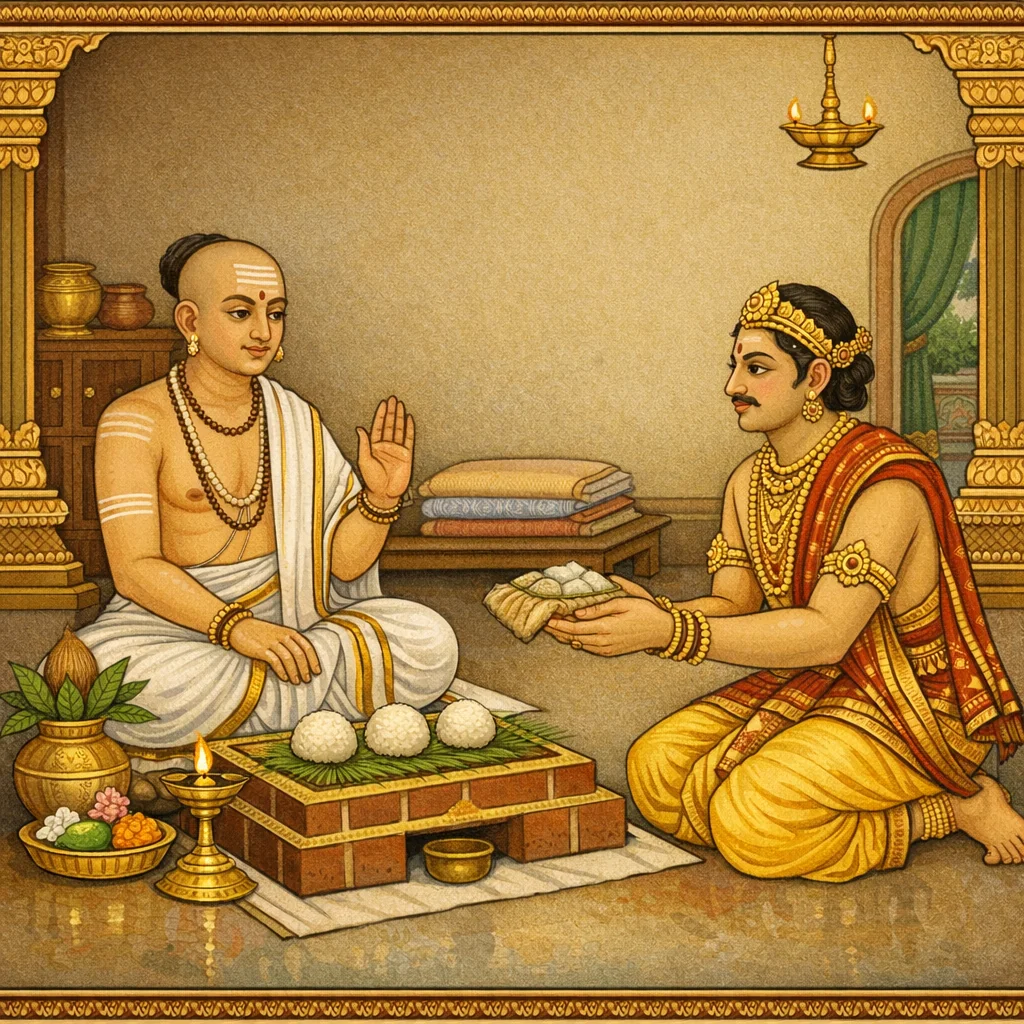
Chapter 224 gives a technical, step-by-step account of the household śrāddha, aimed at the satisfaction of the ancestors (pitṛ-parituṣṭi). Asked how a householder should perform mantra-based rites, the teacher explains inviting qualified brāhmaṇas and invoking the Viśvedevās; offering arghya with flowers, akṣata, and sandal; and the proper placing and use of darbha and tilas. It also distinguishes sāvya acts for deities from apasavya acts for ancestors, noting exceptions such as the nāndīmukha-pitṛs. The chapter sets out seating and directional rules (including maternal-line ancestors) and treats grammatical/ritual exactness in the invocation—correct vibhakti usage—as a mark of correctness. It prescribes homa offerings to Agni and Soma with fitting formulae, warns about handling salt and about direct hand-giving that voids efficacy, and details feeding protocol with a prayer seeking permission. After the meal it describes piṇḍa offerings, veḍi preparation, and distribution rules, concluding with blessings, dakṣiṇā, and restrictions on who may handle ritual vessels. It ends with a timing rule—daytime performance—stating that wrong timing makes the rite fruitless.
Shlokas
Verse 1
आनर्तौवाच । श्रुता मया महाभाग श्राद्धार्हा ब्राह्मणाश्च ये । ये च त्याज्यास्तथा पुत्रा बहवश्चैव सुव्रत
Ānartā said: “O noble one, I have heard of the Brāhmaṇas who are fit to receive Śrāddha, and also of those who should be avoided; likewise, I have heard of many kinds of sons (in relation to rites)—O you of excellent vows.”
Verse 2
सांप्रतं कथयाऽस्माकं मन्त्रपूर्वश्च यो विधिः । गृहस्थेन सदा कार्यः पितॄणां परितुष्टये
“Now please tell us the procedure to be performed with mantras—one that a householder should always carry out—for the complete satisfaction of the Pitṛs (ancestors).”
Verse 3
भर्तृयज्ञ उवाच । प्रणम्यामंत्रिता ये च श्राद्रार्थं ब्राह्मणोत्तमाः । आनीय कुतपे काले तान्सर्वान्प्रार्थयेदि दम्
Bhartṛyajña said: “Having bowed and invited the most excellent Brāhmaṇas for the sake of Śrāddha, one should bring them at the proper time (kutapa-kāla) and respectfully entreat them all in this manner.”
Verse 4
आगच्छंतु महाभागा विश्वेदेवा महाबलाः । ये यत्र विहिताः श्राद्धे सावधाना भवंतु ते
“May the greatly powerful Viśvedevās—O venerable ones—come forth. And may each of them be attentive in the Śrāddha, according to the place and role assigned.”
Verse 5
एवमभ्यर्च्य तान्सर्वांस्ततः कृत्वा प्रदक्षिणाम् । जानुनी भूतले न्यस्य ततश्चार्घं प्रदापयेत्
“Having thus worshipped them all, and then having circumambulated, one should place the knees upon the ground in humility and thereafter offer the arghya, the honor-water.”
Verse 6
मंत्रेणानेन राजेंद्र सपुष्पाक्षतचंदनैः । अर्घमेनं प्रगृह्णंतु मया दत्तं द्विजोत्तमाः । पादप्रक्षालनार्थाय प्रकुर्वंतु मम प्रियम्
“O king, with this mantra—together with flowers, unbroken grains (akṣata), and sandal—let the best of the twice-born accept this arghya offered by me; and, for the washing of their feet, let them do what is pleasing to me.”
Verse 7
एवमुक्त्वा महीपृष्ठे अनुलिप्ते ततः परम् । साक्षतान्प्रक्षिपेद्दर्भान्विश्वेदेवान्प्रकीर्तयन्
“Having said so, then upon the ground that has been properly prepared and smeared, one should place darbha-grass along with unbroken grains (akṣata), while reciting the names of the Viśvedevās.”
Verse 8
अपसव्यं ततः कृत्वा दर्भांस्तिलसमन्वितान् । द्विगुणान्प्रक्षिपेद्भूमौ पितॄनुद्दिश्य चात्मनः
Then, having assumed the apasavya posture (the sacred thread to the right), one should place upon the ground darbha-grass mixed with sesame—twice the amount—dedicating it to one’s own Pitṛs.
Verse 9
एवं सर्वाः क्रियाः कार्या दैविका सव्यपूर्विकाः । पैतृकाश्चापसव्येन मुक्त्वा नांदीमुखान्पितॄन्
Thus all divine rites should be performed beginning with the savya orientation; and ancestral rites should be performed in the apasavya manner—except for the Nāndīmukha Pitṛs.
Verse 10
सर्वे पूर्वामुखाः स्थाप्या युग्माश्च शक्तितो नृप । पितरो मातृपक्षीयाः स्थाप्याश्चोदङ्मुखास्तथा
O King, all (seats or places of invocation) should be arranged facing east, and in pairs as far as one is able. The Fathers of the mother’s lineage, however, should likewise be placed facing north.
Verse 11
एकैकं वा त्रयो वाऽपि स्युरेकैकं वा पृथक्पृथक । पैतृकान्स्थाप्प चक्रेण पितॄणां परितुष्टये
Whether one sets them one by one, or three together, or separately one by one, one should arrange the paternal ancestors in a circular order, for the complete satisfaction of the Pitṛs.
Verse 12
षष्ठ्या विभक्त्या तु तेषामासनं च प्रदापयेत् । ऋजुभिः साक्षतैर्दर्भैः सोदकैर्दक्षिणांगतः
Using the sixth-case (genitive) formula, one should offer them their seats. With straight darbha-grass, together with akṣata (unbroken rice grains) and water, one should proceed in the southern direction.
Verse 13
विषमौ द्विगुणैर्दर्भैः सतिलैर्वामपार्श्वतः । पाणौ तोयं परिक्षिप्य न दर्भांस्तु कथं चन
On the left side one should arrange it, as prescribed, unevenly, with darbha-grass doubled and with sesame. Having sprinkled water upon the hand, one must never, under any circumstance, handle or place the darbhas improperly.
Verse 14
यो हस्ते चासनं दद्याच्चेद्दार्भं बुद्धिवर्जितः । पितरो नासने तत्र प्रकुर्वंति निवेशनम्
If a person, lacking proper understanding, places the darbha-seat into the hand in an improper way, then the Pitṛs do not take their seat upon that seat there.
Verse 15
आवाहनं प्रकर्तव्यं विभक्त्या च द्वितीयया । येनागच्छंति ते सर्वे समाहूताः पृथक्पृथक्
The invocation (āvāhana) should be performed using the second case (accusative); by this, all of them—each invited distinctly—truly do arrive.
Verse 16
अन्यया च विभक्त्या चेत्पितॄनावाहयेत्क्वचित् । नागच्छंति महाभागा यद्यपि स्युर्बुभुक्षिताः
But if, using some other case-form, one were to invoke the Pitṛs, then those great ones do not come—even though they may indeed be hungry for the offered oblations.
Verse 17
विश्वेदेवास आगत मंत्रेणानेन पार्थिव । तेषामावाहनं कार्यमक्षतैश्च शिरोंऽतिकात्
O King, with this mantra—“Viśvedevāsa āgata”—the Viśvedevas are to be invoked. Their invocation should be performed with akṣata, unbroken rice, offered from above the head.
Verse 18
उशंतस्त्वेति च तिलैः पितॄनावाहयेत्ततः । आयंतु न इति जपेत्ततः पार्थिवसत्तम
Then, with sesame and the formula beginning “uśantas tv…,” one should invoke the Pitṛs. After that, O best of kings, one should recite: “āyaṃtu na”—“let them come to us.”
Verse 19
शन्नो देवीति मंत्रेण स्वाहाकारसमन्वितम् । पितॄणामर्घपात्रेषु तथैव च जलं क्षिपेत्
With the mantra “śanno devī…,” accompanied by the utterance “svāhā,” one should likewise pour water into the argha-vessels meant for the Pitṛs.
Verse 20
यवोऽसि यवयास्मद्द्वेत्यक्षतांस्तत्र निक्षिपेत् । चंदनं गंधपुष्पाणि धूपं दद्याद्यथाक्रमम् । सपवित्रेषु हस्तेषु दद्यादर्घ्यं समाहितः
Reciting the mantra, “You are barley; with barley drive away (evil) from us,” one should place the unbroken grains there. Then, in due order, one should offer sandal paste, fragrant flowers, and incense. With hands sanctified by the pavitra-ring, and with a collected mind, one should present the arghya-offering.
Verse 21
या दिव्या इति मन्त्रेण स्वाहाकारसमन्वितम् । पितॄणामर्घपात्रेषु तथैव च जलं क्षिपेत्
With the mantra beginning “yā divyā…,” accompanied by the utterance of svāhā, one should likewise pour water into the argha-vessels for the Pitṛs.
Verse 22
तिलोऽसि सोमदैवत्यो गोसवे देवनिर्मितः । प्रत्नवद्भिः पृक्तः स्वधया पितॄनिमांल्लोकान्प्रीणाहि नः स्वधेति प्रक्षिपेत्तिलान्
Reciting, “You are sesame, whose deity is Soma; created by the gods for the cow-sacrifice (gosava); mixed with the ancient ones through svadhā—O Svadhā, satisfy our Pitṛs in these worlds,” one should then cast sesame seeds into the offering.
Verse 23
यादिव्येति च मन्त्रेण ततो ह्यर्घ्यं प्रदापयेत् । पितृपात्रे समादाय अर्घ्यपात्राणि कृत्स्नशः
Then, with the mantra “yā divyā…,” one should have the arghya offered—taking up the Pitṛ-vessel and arranging all the arghya-vessels completely in their proper order.
Verse 24
अधोमुखं च तत्पात्रं मन्त्रवत्स्थापयेत्ततः । आयुष्कामस्तु तत्तोयं लोचनाभ्यां न वीक्षयेत्
After that, one should place that vessel mouth-down, accompanied by mantra. But one who desires long life should not look upon that water with the eyes.
Verse 25
ततस्तु चन्दनादीनि दीपांतानि समाददेत् । ततः पाकं समादाय पृच्छेद्विप्रान्द्विजो त्तमान्
Then one should take up the offerings beginning with sandal and ending with the lamp. After that, taking the cooked food prepared for śrāddha, the twice-born should respectfully ask the excellent brāhmaṇas for approval and proper procedure.
Verse 26
अहमग्नौ करिष्यामि होमं पितृसमुद्भवम् । अनुज्ञा दीयतां मह्यमपसव्याश्रितस्य भोः
“I shall perform in the fire a homa arising for the Pitṛs. Grant me permission, O revered ones—for I am stationed in the apasavya manner proper to ancestral rites.”
Verse 27
कुरुष्वेति च तैः प्रोक्ते गत्वाग्नि शरणं ततः । अग्नये कव्यवाहनाय स्वाहेति प्रथमाहुतिः
When they say, “Do it,” he then approaches the refuge of Fire. The first oblation is offered with: “To Agni, the carrier of the kavyas, svāhā.”
Verse 28
सोमाय पितृमते स्वधेति च ततः परम् । हुतमन्नं च शेषं च श्राद्धार्हेभ्यः प्रदीयते
Next, one should offer with the words: “To Soma, who is favorable to the Pitṛs—svadhā.” And the food offered into the fire, as well as what remains, should be given to those qualified for śrāddha.
Verse 29
इष्टमन्नं ततो दत्त्वा पात्रमालभ्य संजपेत् । विप्रांगुष्ठं समादाय पाकमध्ये निधाय च
Then, having given the desired food, one should touch the vessel and softly recite the appropriate formulae. Taking the brāhmaṇa’s thumb, one should place it in the midst of the cooked food as well.
Verse 30
पृथिवी ते पात्रमादाय वैष्ण व्या च ऋचा तथा । स्वहस्तेन न वै दद्यात्प्रत्यक्षं लवणं तथा
Taking the earth itself as the offering-vessel and reciting the sacred Vaiṣṇavī ṛc, in the śrāddha rite one should not hand over salt directly with one’s own hand.
Verse 31
स्वहस्तेन च यद्दत्तं प्रत्यक्षलवणं नृप । तच्छ्राद्धं व्यर्थतां याति धृते दत्तेर्द्धभुक्तके । तृप्ताञ्ज्ञात्वा ततो विप्रानग्रे त्वन्नं परिक्षिपेत्
O king, if salt is given directly with one’s own hand, that śrāddha becomes fruitless. When the food has been served and half eaten, then—knowing the brāhmaṇas to be satisfied—one should thereafter place the remaining food in front, as prescribed.
Verse 32
अग्निदग्धाश्च ये जीवा येप्यदग्धाः कुले मम । भूमौ दत्तेन तृप्यंतु तृप्ता यांतु परां गतिम्
May the beings of my lineage—whether those cremated by fire or those not so cremated—be satisfied by what is offered upon the ground; and, being satisfied, may they attain the highest state.
Verse 33
सकृत्सकृज्जलं दत्त्वा गायत्रीत्रितयं जपेत् । मधुवातेति संकीर्त्य ततः पृच्छेद्द्विजोत्तमान्
Having offered water once and again, one should recite the three Gāyatrīs; uttering the Vedic phrase “madhuvātā,” one should then inquire of the foremost Brāhmaṇas as to their satisfaction.
Verse 34
तृप्ताः स्थ इति राजेन्द्र अनुज्ञां प्रार्थयेत्ततः । बन्धूनां भोजनार्थाय शेषस्यान्नस्य भक्तिमान्
“Are you satisfied?”—having thus asked, O king, one should then request permission; and with devotion, one may use the remaining food to feed one’s relatives.
Verse 35
उच्छिष्टसन्निधौ पश्चात्पितृवेदिं समाचरेत् । पितृविप्रासनस्थानां नोच्छिष्टं द्विजसन्निधौ
Afterwards, in the vicinity where the remnants (of the meal) are present, one should perform the pitṛ-altar rite. But in the presence of Brāhmaṇas, no remnants should be kept near the seats or places of the pitṛs and the Brāhmaṇas.
Verse 36
ततो वेदिं समाधाय पैतृकीं दक्षिणाप्लवाम् । तस्यां दर्भान्समाधाय कुर्याच्चैवावनेजनम्
Then, having properly prepared the ancestral (pitṛ) altar—inclined to the south—one should arrange darbha-grass upon it and perform the ritual cleansing by washing.
Verse 37
विभक्त्या पूर्वया पश्चात्पिंडान्दद्याद्यथाक्रमम् । भूयोऽप्यत्र जलं दद्यात्पितृतीर्थेन पार्थिव । सूत्रं च प्रतिपिण्डे वै दयात्तेषु पृथक्पृथक्
With the prescribed divisions, one should offer the piṇḍas in due order. Again, O king, one should offer water there by the pitṛ-tīrtha (the ancestral mode of libation); and one should place a separate thread upon each piṇḍa, individually.
Verse 38
यः सूत्रं पूर्वपिण्डेषु सततं विनियोजयेत् । स विरोधं चरेत्तेषां त्रोटनाच्च परस्परम्
Whoever keeps applying the ritual thread continuously to the earlier piṇḍas causes mutual conflict among them, resulting in rupture and separation from one another.
Verse 39
ततः संपूजयेत्सर्वान्पिंडान्यद्वद्द्विजोत्तमान् । आचम्य प्रक्षाल्य तथा हस्तौ पादौ च पार्थिव
Then one should duly honor all the piṇḍas, and also the foremost Brāhmaṇas. Having performed ācaman (sipping water for purification) and washed, one should wash the hands and feet as well, O king.
Verse 40
नमस्कृत्य पितॄन्पश्चात्सुप्रोक्षितं ततः परम् । कृत्वा सव्येन राजेन्द्र याचयित्वा वराशिषः
After bowing to the Pitṛs (ancestral beings), and then duly sprinkling the offering with sanctified water, O best of kings, one should proceed as prescribed with the left side (savyena) and request auspicious blessings.
Verse 41
अक्षय्यसलिलं देयं षष्ठ्या चैव ततः परम् । पवित्राणि समादाय ऊर्ध्वं स्वधेति कीर्तयेत् । अस्तु स्वधेति तैरुक्ते पिंडोपरि परिक्षिपेत्
One should offer the ‘inexhaustible water’ (akṣayya-salila), and thereafter at the sixth portion/step as well. Taking the pavitras (ritual rings/strands), one should utter aloud ‘svadhā’. When they respond ‘astu svadhā’—‘So be it, svadhā’—one should then sprinkle it over the piṇḍa.
Verse 42
ततो मधु समादाय पायसं च तिलोदकम् । ऊर्जस्वेति च मन्त्रेण पितॄणामुपरिक्षिपेत् ओ
Then, taking honey, sweet rice (pāyasa), and sesame-water, one should sprinkle it for the Pitṛs while reciting the mantra ‘ūrjasva’ (“Be strengthened, full of vigor”).
Verse 43
उत्तानमर्घपात्रं तु कृत्वा दद्याच्च दक्षिणाम् । हिरण्यं देवतानां च पितॄणां रजतं तथा
Having set the arghya-vessel facing upward, one should also offer the dakṣiṇā (honorarium): gold for the deities, and likewise silver for the Pitṛs (Fathers).
Verse 44
ततः स्वस्त्युदकं दद्यात्पितृपूर्वं च सव्यतः । न स्त्रीभिर्न च बालेन नान्ये नैव च केनचित्
Thereafter one should offer the ‘svasti-water’ (svasti-udaka) for well-being, beginning with the Pitṛs and from the left side (savyataḥ). It is not to be performed by women, nor by a child, nor by anyone else in place of the qualified performer.
Verse 45
श्राद्धीयविप्रपात्रं च स्वयमेव प्रचालयेत्
And the vessel or arrangement meant for the brāhmaṇa recipient in the śrāddha should be handled and managed by oneself alone.
Verse 46
ततः कृतांजलिर्भूत्वा प्रार्थयेत्पार्थिवोत्तम । अघोराः पितरः सन्तु अस्मद्गोत्रं विवर्द्धताम्
Then, with hands joined in reverence, O excellent king, one should pray: “May our Fathers, the Pitṛs, be peaceful and not terrible (aghora); may our lineage (gotra) flourish.”
Verse 47
दातारो नोऽभिवर्धंतां वेदाः सन्ततिरेव नः । श्रद्धा च नो मा व्यगमद्बहुधेयं च नोऽस्त्विति
“May benefactors among us increase; may the Vedas and Vedic learning remain with us, and may our progeny continue. May faith (śraddhā) never depart from us, and may we possess abundance for sharing.”
Verse 48
अन्नं च नो बहु भवेदतिथींश्च लभेमद्दि । याचितारश्च नः सन्तु मा च याचिष्म कश्चन
May we have abundant food, and may we obtain guests worthy of honor. May there be those who ask of us (so that we may give), and may none of us ever be brought to begging.
Verse 49
एता एवाशिषः सन्तु विश्वेदेवाः प्रीयंतां ततः । स्वस्त्यर्थमुदकं दद्यात्पितृपूर्वं च सव्यतः
May these very blessings be fulfilled; may the Viśvedevas be pleased. Then, for auspiciousness, one should offer water—beginning with the Pitṛs and from the left side (savyataḥ).
Verse 51
पादावमर्दनं कृत्वा आसीमांतमनुव्रजेत् । बलिं च निक्षिपेत्तस्माद्भोजनं च समाचरेत्
Having performed the rubbing (service) of the feet, one should respectfully accompany up to the proper boundary. Then one should place the offering (bali); after that, one should duly partake of the meal.
Verse 52
मौनेन दृश्यते सूर्यो यावत्तावन्नराधिप
O lord of men, for as long as the Sun remains in sight, one should remain in silence.
Verse 53
यश्चैवास्तमिते सूर्ये भुंक्ते च श्राद्धकृन्नरः । व्यर्थतां याति तच्छ्राद्धं तस्माद्भुंजीत नो निशि
If a man performing Śrāddha eats after the Sun has set, that Śrāddha becomes fruitless. Therefore, one should not eat at night.
Verse 224
इति श्रीस्कांदे महापुराण एकाशीतिसाहस्र्यां संहितायां षष्ठे नागरखण्डे हाटकेश्वरक्षेत्रमाहात्म्ये श्राद्धकल्पे श्राद्धविधिवर्णनंनाम चतुर्विंशत्युत्तरद्विशततमोऽध्यायः
Thus ends, in the Śrī Skanda Mahāpurāṇa—within the compendium of eighty-one thousand ślokas—within the sixth book, the Nāgara Khaṇḍa, in the Māhātmya of Hāṭakeśvara-kṣetra, in the section on Śrāddha rites, the chapter entitled “Description of the Procedure of Śrāddha,” being Chapter 224.