Adhyaya 223
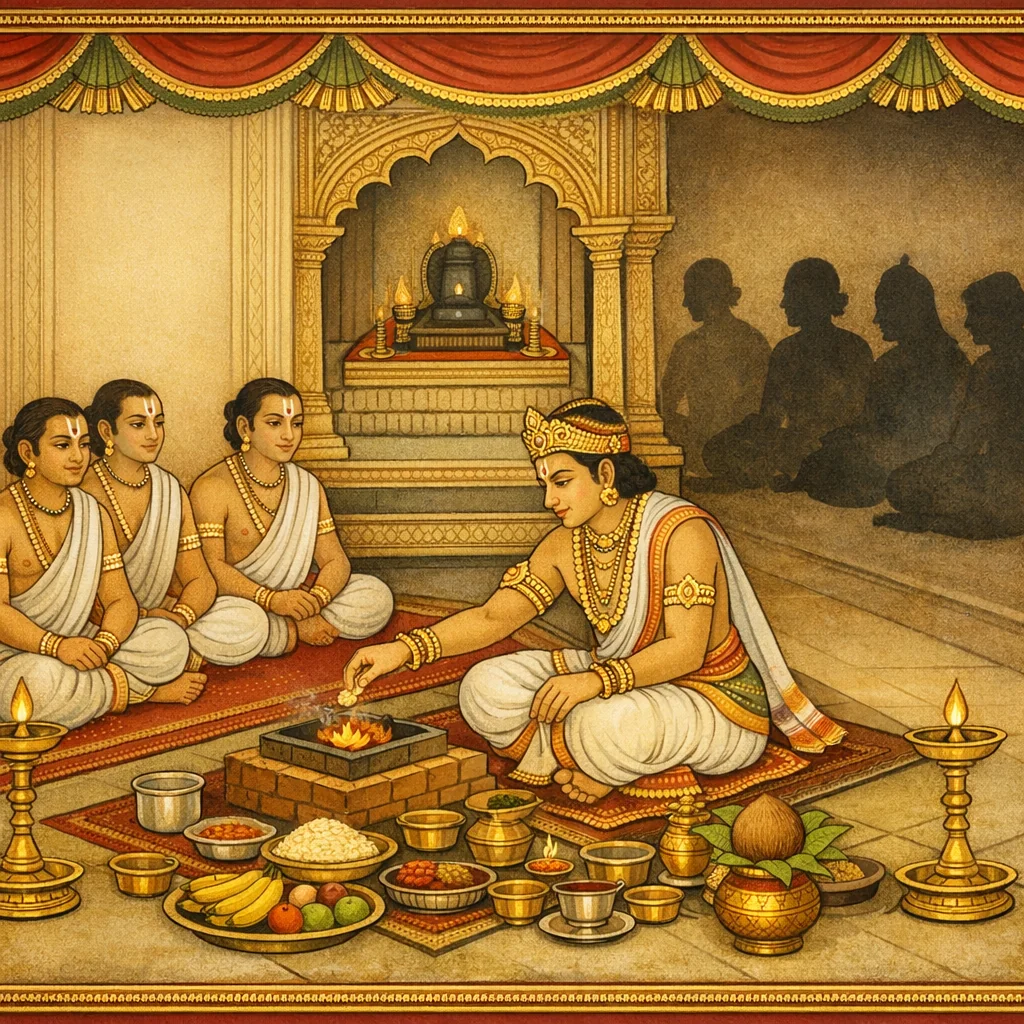
This adhyāya sets forth a technical ethical and ritual teaching on the performance of Śrāddha, emphasizing who may rightly conduct or receive the rite and what circumstances render it ineffective. Bhartṛyajña declares that Śrāddha should be performed with brāhmaṇas eligible for Śrāddha, and he specifies proper timing and form (such as the pārvana at darśa), warning against wrongly reversing the prescribed order. He then states that if Śrāddha is performed by persons marked by illicit birth categories (for example, jāra-jāta), the rite becomes fruitless. Ānarta raises a concern, citing Manu’s listing of twelve kinds of “sons” who can serve as sons for one who is sonless. Bhartṛyajña clarifies a yuga-sensitive rule: some categories were acknowledged in earlier yugas, but in Kali-yuga they are not affirmed as purifying due to social and moral decline, and thus stricter standards apply. The chapter further describes the consequences of varṇa-mixture and prohibited unions, naming their outcomes and disallowed progeny. It concludes by distinguishing “good sons” who protect from the Puṃnāma hell from those categories said to bring downfall, thereby confirming the final claim that Śrāddha associated with jāra-jāta is ineffective.
Shlokas
Verse 1
भर्तृयज्ञ उवाच । श्राद्धार्हैर्ब्राह्मणैः कार्यं श्राद्धं दर्शे तु पार्वणम् । विपरीतं न कर्तव्यं श्राद्धमेकं कथंचन
Bhartṛyajña said: The śrāddha should be performed with brāhmaṇas who are fit recipients; and on the new-moon day, the pārvaṇa śrāddha is to be done. One should not perform even a single śrāddha in a contrary (improper) manner, under any circumstance.
Verse 2
जारजातापविद्धाद्यैर्यो नरः श्राद्धमाचरेत् । ब्राह्मणैस्तु न संदेहस्तच्छ्राद्धं व्यर्थतां व्रजेत्
If a man performs śrāddha through those born of adultery and the like, then—without doubt, even if brāhmaṇas are involved—that śrāddha becomes fruitless.
Verse 3
आनर्त उवाच । भयं मे सुमहज्जातमत्र यत्परिकीर्तितम् । जारजातापविद्धैस्तु यच्छ्राद्धं व्यर्थतां व्रजेत्
Ānarta said: Great fear has arisen in me because of what has been declared here—that a śrāddha performed through those born of adultery, the rejected, and the like becomes fruitless.
Verse 4
मनुना द्वादश प्रोक्ताः किल पुत्रा महामते । अपुत्राणां च पुत्रत्वं ये कुर्वंति सदैव हि
O wise one, Manu is said to have described twelve kinds of sons—those who indeed continually provide the status and function of ‘son’ even for those who have no son.
Verse 5
औरसः क्षेत्रजश्चैव क्रयक्रीतश्च पालितः । प्रतिपन्नः सहोढश्च कानीनश्चापि सत्तम
The legitimate son (aurasa), the son begotten for a wife (kṣetraja), the purchased son, the fostered son, the accepted son, the son brought by a bride (sahoḍha), and the maiden-born son (kānīna)—O best of men—(these are among those enumerated).
Verse 6
तथान्यौ कुण्डगोलौ च पुत्रावपि प्रकीर्तितौ
Likewise, two others—the kuṇḍa and the gola—are also proclaimed as (types of) sons.
Verse 7
शिष्यश्च रक्षितो मृत्योस्तथाश्वत्थो वनांतिगः । किमेते नैव कथिता यत्त्वमेवं प्रजल्पसि
And what of the disciple saved from death, the aśvattha taken as a son-like substitute, and the one dwelling at the forest’s edge—why were these not mentioned, if you speak in this manner?
Verse 8
भर्तृयज्ञ उवाच । सत्यमेतन्महाभाग सर्वे ते धर्मतः सुताः । परं युगत्रये प्रोक्ता न कलौ कलुषापहाः
Bhartṛyajña said: This is true, O fortunate one—by dharma they are all regarded as sons. Yet this is taught for the three earlier ages; in Kali Yuga they do not remove impurity.
Verse 9
तदर्थं तेषु सन्तानं तावन्मात्रं युगेयुगे । सत्त्वाढ्यानां च लोकानां न कलौ चाल्पमेधसाम्
For that purpose, in the former ages the allowance regarding offspring extended only to that limited measure, for the worlds were rich in virtue. But in the Kali age, among people of small discernment, such restraint does not hold in practice.
Verse 10
कलावेव समाख्यातो व्यवहारः प्रपा तदः । अल्पसत्त्वा यतो लोकास्तेन चैष विधिः स्मृतः
Therefore, a particular convention of conduct is declared especially for the Kali age—because people are of diminished inner strength; hence this rule is remembered as necessary.
Verse 11
अत्र यः संकरं कुर्याद्योनेस्तस्य फलं शृणु । ब्राह्मण्यां ब्राह्मणात्पुत्रो ब्रह्मघ्नः संप्रजायते
Hear the consequence of one who here brings about a forbidden mixing of lineage through the womb: even if a son is born to a brāhmaṇa from a brāhmaṇa woman, he becomes a slayer of Brahmins (brahma-ghna).
Verse 12
सर्वाधमानामधमो यो वारड इति स्मृतः
Among all the degraded, tradition declares the most degraded to be the one called Vāraḍa.
Verse 13
क्षत्रियाच्च तथा सूतो वैश्यान्मागध एव च । शूद्रात्तथांत्यजः प्रोक्तस्तेनैते वर्जिताः सुताः
From a kṣatriya is born the Sūta; from a vaiśya, the Māgadha; and from a śūdra likewise is declared the Antyaja—therefore such sons are regarded as to be avoided.
Verse 14
एतेषामपि निर्दिष्टाः सप्त राजन्सुपुत्रकाः । पंच वंशविनाशाय पूर्वेषां पातनाय च
Even among these, O King, seven kinds of ‘good sons’ are specified; but five other kinds are for the destruction of the lineage and for the downfall of the ancestors.
Verse 15
औरसः प्रतिपन्नश्च क्रीतः पालित एव च । शिष्यश्च दत्तजीवश्च तथाश्वत्थश्च सप्तमः
The seven approved sons are: the natural-born (aurasa), the acknowledged (pratipanna), the purchased (krīta), the fostered (pālita), the disciple-son (śiṣya), the one given for livelihood (dattajīva), and the ‘āśvattha’—the seventh.
Verse 16
पुंनाम्नो नरकाद्घोराद्रक्षंति च सदा हि ते । पतन्तं पुरुषं तत्र तेन ते शोभनाः स्मृताः
They ever protect their forefathers from the dreadful hell called Puṃnām, saving the man who is falling there; therefore they are remembered as noble sons.
Verse 17
क्षेत्रजश्च सहोढश्च कानीनः कुण्डगोलकौ । पंचैते पातयंतिस्म पितॄन्स्वर्गगतानपि
Kṣetraja, Sahoḍha, Kānīna, and the two—Kuṇḍa and Golaka: these five are said to cast down even the Pitṛs, the ancestors who have attained heaven.
Verse 18
एतस्मात्कारणाच्छ्राद्धं जारजातस्य तद्वृथा
For this reason, the śrāddha performed by one born of adultery (jāra-jāta) is therefore fruitless.
Verse 223
इति श्रीस्कांदे महापुराण एकाशीतिसाहस्र्यां संहितायां षष्ठे नागरखण्डे हाटकेश्वरक्षेत्रमाहात्म्ये श्राद्धकल्पे श्राद्धार्हानर्हब्राह्मणादिवर्णनंनाम त्रयोविंशत्युत्तरशततमोऽध्यायः
Thus ends, in the Śrī Skanda Mahāpurāṇa—within the compendium of eighty-one thousand verses—within the Sixth Book, the Nāgara-khaṇḍa, in the Tīrtha-māhātmya of the sacred Hāṭakeśvara region, in the section on the Śrāddha-kalpa, the two-hundred-and-twenty-third chapter entitled “The description of Brāhmaṇas and others who are fit or unfit to receive Śrāddha.”