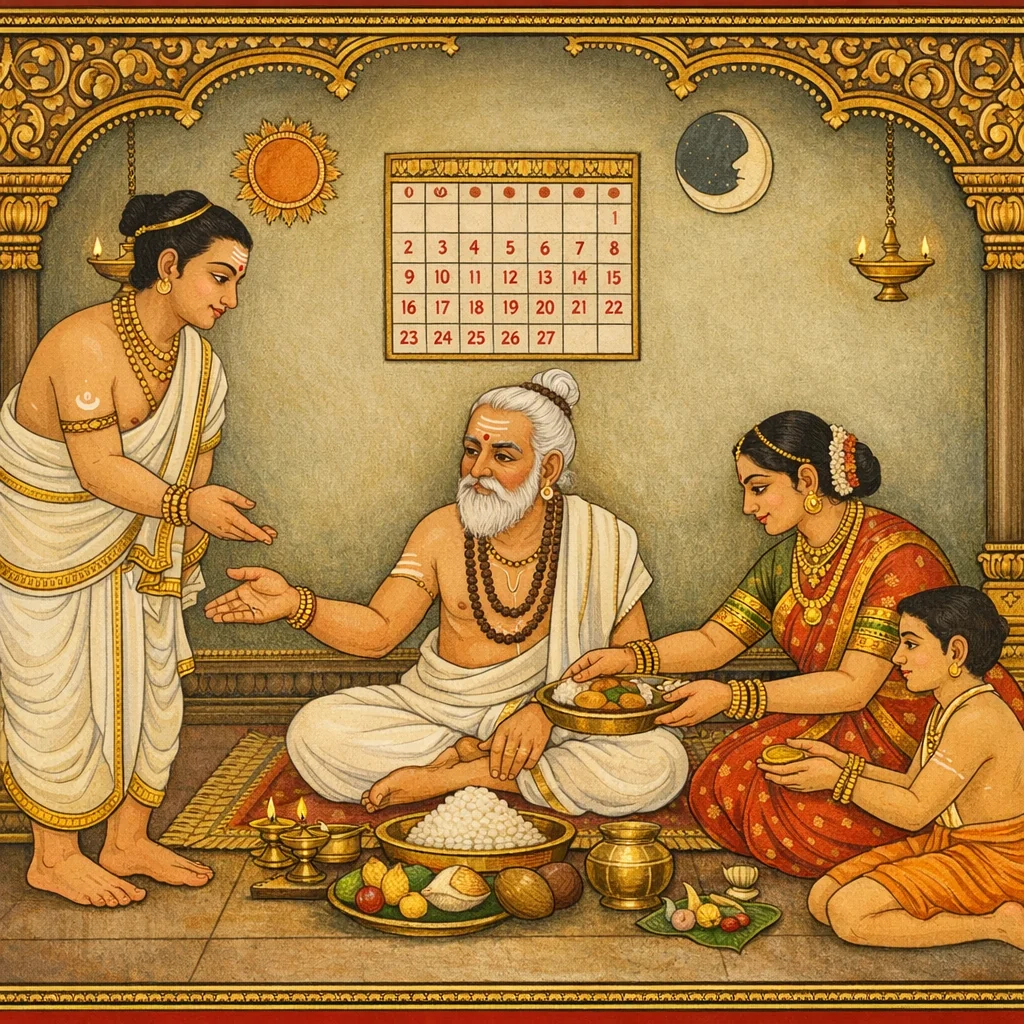
Adhyaya 217
Adhyāya 217 is a technical, instructional dialogue in which Ānarta asks for the complete procedure (vidhi) of śrāddha. Bhartṛyajña answers by organizing the rite around three governing factors: the ethical source of the wealth used (favoring honestly earned and properly accepted means), the principles for selecting invited brāhmaṇas by distinguishing śrāddhārha (qualified) from anārha (disqualified) with many exclusions, and the ritual calendar of tithi and markers such as saṃkrānti, viṣuva, and ayana that yields akṣaya (enduring) results. The chapter also lays down invitation etiquette (including separate invocations for the Viśvedevās and the pitṛs), restraints for the yajamāna, spatial requirements, and numerous conditions that render śrāddha vyartha (ineffective)—improper witnessing, impure food states, absence of dakṣiṇā, noise and quarrel, or incorrect timing. It concludes with lists of Manvādi and Yugādi observances, stressing that offerings made at the proper time—even water with sesame—bestow lasting merit.
Shlokas
Verse 1
आनर्त उवाच । विधिना येन कर्तव्यं श्राद्धं सर्वं मुनीश्वर । तमाचक्ष्वाऽद्य कार्त्स्न्येन श्रद्धा मे महती स्थिता
Ānarta said: O lord among sages, tell me today in full the proper method by which the entire Śrāddha should be performed. Great faith has arisen and stands firm in me.
Verse 2
भर्तृयज्ञ उवाच । शृणु राजन्प्रवक्ष्यामि श्राद्धस्य विधिमुत्तमम् । पितॄणां तुष्टिदं नित्यं सर्वकामप्रदं नृणाम्
Bhartṛyajña said: “Listen, O King. I shall declare the supreme procedure of Śrāddha—ever a source of satisfaction to the Pitṛs (ancestors) and a bestower of all rightful desires for human beings.”
Verse 4
स्वकर्मोपार्जितैर्वित्तैः श्राद्धकार्याणि चाहरेत् । मायादिभिर्न चौर्येण न च्छलाप्तैर्न वंचनैः । स्ववृत्त्योपार्जितैर्वित्तैः श्राद्धद्रव्यं समाहरेत् । सुप्रतिग्रहजैर्द्रव्यैर्ब्राह्मणानां विशिष्यते
One should procure the requisites of Śrāddha with wealth earned by one’s own rightful work—not by deceit, not by theft, not by ill-gotten gain through trickery, and not by cheating. With earnings obtained through one’s proper livelihood, one should gather the materials for Śrāddha. For brāhmaṇas, that which is acquired through proper and blameless acceptance (supratigraha) is especially commended.
Verse 5
रक्षणाप्तैर्नरेन्द्रस्य वैश्यस्य क्षेत्र संभवैः । शूद्रस्य पण्यलब्धैश्च श्राद्धं कर्तुं प्रयुज्यते
For a king, wealth obtained through protection—the rightful duties of governance—is to be employed for Śrāddha; for a vaiśya, that which arises from the field (agriculture); and for a śūdra, that which is earned through trade and sale—these are the proper means for performing Śrāddha.
Verse 6
एवं शुद्धिसमोपेते द्रव्ये प्राप्ते गृहांतिकम् । पूर्वेद्युः सायमासाद्य श्राद्धार्हाणां द्विजन्मनाम्
Thus, when the pure and duly qualified materials have been brought into the home, on the evening of the previous day one should approach and make arrangements with the twice-born who are fit to receive Śrāddha.
Verse 7
गृहं गत्वा शुचिर्भूत्वा कामक्रोधविवर्जितः । आमंत्रयेद्यतीन्पश्चात्स्नातकान्ब्रह्मकर्मिणः
Having gone home, becoming pure, and free from desire and anger, one should first invite the yatis (ascetics); thereafter one should invite the snātakas, established in brahminical duties and sacred conduct.
Verse 8
तदभावे गृहस्थांश्च । ब्रह्मज्ञानपरायणान् अग्निहोत्रपरान्विप्रान्वेदविद्याविचक्षणान्
If such (ascetics and snātakas) are unavailable, one should invite householders devoted to Brahman-knowledge—brāhmaṇas dedicated to the Agnihotra and skilled in Vedic learning.
Verse 9
श्रोत्रियांश्च तथा वृद्धान्षट्कर्मनिरतान्सदा । बहुभृत्यकुटुम्बांश्च दरिद्रा्न्संयुतान्गुणैः
One should also invite śrotriyas, as well as the elderly and those always engaged in the six prescribed duties; likewise those supporting large households and many dependents, even if poor, provided they are endowed with good qualities.
Verse 10
अव्यंगान्रोगनिर्मुक्ताञ्जिताहारांस्तथा शुचीन् । एते स्युर्ब्राह्मणा राजञ्छ्राद्धार्हाः परिकीर्तिताः
Brāhmaṇas who are free from bodily defects, free from disease, restrained in diet, and pure—these, O King, are declared to be worthy recipients for Śrāddha.
Verse 11
अनर्हा ये च निर्दिष्टाः शृणु तानपि वच्मि ते । हीनांगानधिकांगांश्च सर्वभाक्षन्निराकृतीन्
Now hear also those who are specified as unfit—I shall tell you. Those with deficient limbs, those with superfluous limbs, those who eat everything indiscriminately, and those of repulsive disposition are to be rejected.
Verse 12
श्यावदन्तान्वृथादन्तान्वेदविक्रयकारकान् । वेदविप्लवकान्वापि वेदशास्त्रविवर्जितान्
(Reject) those with blackened teeth, those with diseased or useless teeth, those who sell the Veda, those who undermine the Veda, and those devoid of Vedic and śāstric discipline.
Verse 13
कुनखान्रोगसंयुक्तान्द्विर्नग्नान्परहिंसकान् । जनापवादसंयुक्तान्नास्तिकानृतकानपि
One who seeks to uphold the honor of the Pitṛs should exclude those with nail diseases, those who go naked twice, those who harm others, those entangled in slander, atheists, and liars.
Verse 14
वार्धुषिकान्विकर्मस्थाञ्छौचाचारविवर्जि तान् । अतिदीर्घान्कृशान्वापि स्थूलानपि च लोमशान्
Exclude from śrāddha those who live by usury, those in forbidden occupations, the unclean; likewise those excessively tall, emaciated, corpulent, or hairy.
Verse 15
निर्लोमान्वर्जयेच्छ्राद्धे य इच्छेत्पितृगौरवम् । परदाररता ये च तथा यो वृषली पतिः
If one desires the true honor of the Pitṛs, exclude from śrāddha those who are hairless, those addicted to another’s wife, and the husband of a low-caste woman.
Verse 16
वंध्या वै वृषली प्रोक्ता वृषली च मृतप्रजा । अपरा वृषली प्रोक्ता कुमारी या रजस्वला
A barren woman is called vṛṣalī; likewise a woman whose children have died is called vṛṣalī. Another too is called vṛṣalī: an unmarried maiden in whom menstruation has begun.
Verse 17
षण्ढो मलिम्लुचो दम्भी राजपै शुन्यवृत्तयः । सगोत्रायाश्च संभूतस्तथैकप्रवरासुतः
One should exclude: an impotent man; a malimluca (debased, outcaste); a hypocrite; and those who live by royal espionage. Likewise, exclude one born of a woman of the same gotra, and one born from a union within a single pravara.
Verse 18
कनिष्ठः प्राक्कृताधानः कृतोद्वाहश्च प्राक्तु यः । तथा प्राग्दीक्षितो यश्च स त्याज्यो गृहसंयुतः
Also to be excluded is the younger brother who performed ādhāna (the establishing of the sacred fire) before the elder, and the one who married before the elder; likewise, one who received dīkṣā before the elder—such a householder is to be avoided in śrāddha.
Verse 19
पितृमातृपरित्यागी तथाच गुरुतल्पगः । निर्द्दोषां यस्त्यजेत्पत्नीं कृतघ्नो यश्च कर्षुकः
One should exclude the person who abandons father and mother; also the violator of the teacher’s bed (gurutaḷpaga); one who casts off a blameless wife; the ungrateful; and the kṛṣuka, censured here as unfit for the rite.
Verse 20
शिल्पजीवी प्रमादी च पण्य जीवी कृतायुधः । एतान्विवर्जयेच्छ्राद्धे येषां नो ज्ञायते कुलम्
In śrāddha one should avoid the artisan-by-trade, the negligent person, the one who lives by commerce, and the maker of weapons; and also those whose family lineage is not known.
Verse 21
अत ऊर्ध्वं प्रवक्ष्यामि ये शस्ताः श्राद्धकर्मणि । ये ब्राह्मणाः पुरा ख्याताः पापानां पंक्तिपावनाः
Now I shall further declare those who are worthy of praise in the performance of śrāddha: those Brāhmaṇas famed from ancient times as “purifiers of the dining row,” who dispel sin by their very presence.
Verse 22
त्रिणाचिकेतस्त्रिमधुस्त्रिसुपर्णः षडंगवित् । यश्च विद्याव्रतस्नातो धर्मद्रोणस्य पाठकः
Commended for śrāddha are those versed in the triṇāciketa, trimadhu, and trisuparṇa disciplines; the knower of the six Vedāṅgas; one who has completed the concluding bath after the vow of sacred learning; and likewise the reciter and teacher of the Dharmadroṇa.
Verse 23
पुराणज्ञस्तथा ज्ञानी विज्ञेयो ज्येष्ठसामवित् । अथर्वशिरसो वेत्ता क्रतुगामी सुकर्मकृत्
He should be recognized as a true Brāhmaṇa fit for sacred rites: one who knows the Purāṇas and is learned, who understands the Jyeṣṭha-sāman chants, who knows the Atharvaśiras, who is skilled in sacrificial procedure, and who performs righteous deeds.
Verse 25
मृष्टान्नादो मृष्टवाक्यः सदा जपपरायणः । एते ब्राह्मणा ज्ञेया निःशेषाः पंक्तिपावनाः
Those whose food is pure, whose speech is refined, and who are ever devoted to japa—such Brāhmaṇas should be known as complete “purifiers of the dining line,” sanctifying the whole company at ritual meals.
Verse 26
एतैर्विमिश्रिताः सर्वे गर्हिता अपि ये द्विजाः । पितॄणां तेऽपि कुर्वंति तृप्तिं भुक्त्वा कुलोद्भवाः
Even those twice-born who might otherwise be censured—when seated and mingled among such worthy men—still bring satisfaction to the ancestors after they have eaten, for they too are born within the family line.
Verse 27
तस्मात्सर्वप्रयत्नेन कुलं ज्ञेयं द्बिजन्मनाम् । शीलं पश्चाद्वयो नाम कन्यादानं ततः परम्
Therefore, with every effort one should first ascertain the lineage of the twice-born (dvija); then their conduct; then their age and name; and only after that, matters such as forming a marital alliance by giving one’s daughter in marriage.
Verse 28
श्रुतशीलविहीनाय धर्मज्ञायापि मानवः । श्राद्धं ददाति कन्यां च यस्तेनाग्निं विना हुतम्
If a man offers Śrāddha—or even gives his daughter in marriage—to one who lacks learning and good conduct, though he may speak of dharma, that act is like an oblation poured without sacred fire.
Verse 29
ऊषरे वापि तं सस्यं तुषाणां कण्डनं कृतम् । कुलाचारसमोपेतांस्तस्माच्छ्राद्धे नियोजयेत्
Just as grain grown on barren ground is only husk pounded in vain, so rites become hollow when proper standards are lacking. Therefore, for Śrāddha one should appoint those endowed with the good customs and discipline of their lineage.
Verse 30
ब्राह्मणान्नृपशार्दूल मन्दविद्याधरानपि । एवं विज्ञाय तान्विप्रान्गृहीत्वा चरणौ ततः
O tiger among kings, even among Brāhmaṇas there are some of meagre learning. Having thus examined those vipra priests and accepted them, one should then take hold of their feet in reverence.
Verse 31
प्रयत्नेन तु सव्येन पाणिना दक्षिणेन तु । युग्मानथ यथाशक्त्या नमस्कृत्य पुनःपुनः
With care—using the left hand and then the right—one should respectfully receive and arrange the pairs according to one’s ability, and then bow in reverence again and again.
Verse 32
दक्षिणं जान्वथालभ्य मन्त्रमेनमुदीरयेत् । आगच्छंतु महाभागा विश्वेदेवा महाबलाः
Touching the right knee, one should recite this mantra: “May the greatly fortunate, mighty Viśvedevās come.”
Verse 33
भक्त्याहूता मया चैव त्वं चापि व्रतभाग्भव । एवं युग्मा न्समामंत्र्य विश्वेदेवकृते द्विजान्
“I have invited you with devotion; you too, become a sharer in this vow.” Thus, having duly invited the pairs, one should invite the twice-born on behalf of the Viśvedevās.
Verse 34
अपसव्यं ततः कृत्वा पित्रर्थं चाभिमंत्रयेत् । ब्राह्मणांस्त्रीन्यथाशक्त्या एकैकस्य पृथक्पृथक्
Then, wearing the sacred thread in the reverse manner (apasavya), he should invoke the rite for the sake of the Pitṛs. According to his capacity, he should invite three Brāhmaṇas—addressing each one separately and individually.
Verse 35
एकैकं वा त्रयाणां वा एकमेवं निमंत्रयेत् । ब्राह्मणान्मातृपक्षे च एष एव विधिः स्मृतः
He may invite them one by one, or invite the three together, or even a single Brāhmaṇa in this manner. For the maternal line as well, this very same procedure is remembered as the rule.
Verse 36
ततः पादौ परिस्पृष्ट्वा द्विजस्येदमुदीरयेत् । श्रद्धा पूतेन मनसा पितृभक्तिपरायणः
Then, having respectfully touched the feet of the twice-born (Brāhmaṇa), he should recite the following—his mind purified by faith, devoted wholly to reverence for the ancestors.
Verse 37
पिता मे तव कायेस्मिंस्तथा चैव पितामहः । स्वपित्रा सहितो ह्येतु त्वं च व्रतपरो भव
“May my father, and likewise my grandfather, come here into your very person—together with their own fathers. And you, be steadfast in the observance of this sacred vow (vrata).”
Verse 38
एवं पितॄन्समाहूय तथा मातामहानथ । संमंत्रिताश्च ते विप्राः संयमात्मान एव ते
Thus, having invoked the Pitṛs (ancestral spirits) and also the maternal grandfathers, those Brāhmaṇas are duly summoned by mantras—self-restrained and truly disciplined.
Verse 39
यजमानः शांतमना ब्रह्मचर्यसमन्वितः । तां रात्रिं समतिक्रम्य प्रातरुत्थाय मानवः
The yajamāna, calm of mind and established in brahmacarya (continence), should pass that night in due manner; and in the morning he should rise to continue the rite.
Verse 40
तदह्नि वर्जयेत्कोपं स्वाध्यायं कर्म कुत्सितम् । तैलाभ्यंगं श्रमं यानं वाहनं चाथ दूरतः
On that day he should avoid anger, (ordinary) svādhyāya (study/recitation), and blameworthy deeds; he should also keep at a distance oil-massage, exertion, travel, and riding in vehicles.
Verse 41
ततो मध्यं गते सूर्ये काले कुतपसंज्ञिते । स्नातः शुक्लांबरधरः सन्तर्प्य पितृदेवताः । सन्तुष्टांश्च समाहूतांस्तान्विप्राञ्छ्राद्धमाचरेत्
Then, when the sun has reached midday—at the time known as Kutapa—having bathed and wearing white garments, he should satisfy the Pitṛ-deities with offerings; and, with the invited Brāhmaṇas pleased and assembled, he should perform the Śrāddha.
Verse 42
विविक्ते गृहमध्यस्थे मनोज्ञे दक्षिणाप्लवे । न यत्र जायते दृष्टिः पापानां क्रूरकर्मिणाम्
In a secluded and pleasing spot within the house—on ground sloping to the south—where the gaze of sinful, cruel-doing people does not fall, there the rite should be performed.
Verse 43
यच्छ्राद्धं वीक्षते श्वा वा नारी वाऽथ रजस्वला । पतितो वा वराहो वा तच्छ्राद्धं व्यर्थतां व्रजेत्
If a dog, or a menstruating woman, or one fallen from dharma, or a boar looks upon the Śrāddha, that Śrāddha becomes fruitless.
Verse 44
अन्नं पर्युषितं यच्च तैलाक्तं वा प्रदीयते । सकेशं वा सनिंद्यं च तच्छ्राद्धं व्यर्थतां व्रजेत्
If, in a Śrāddha, the food offered is stale, or smeared with oil, or presented with hair in it, or in a blameworthy, defiled condition, then that Śrāddha goes in vain.
Verse 45
विभक्तिरहितं श्राद्धं तथा मौनविवर्जितम् । दक्षिणारहितं यच्च तच्छ्राद्धं व्यर्थतां व्रजेत्
A Śrāddha performed without proper distribution of portions, or without the prescribed silence and restraint, or without offering dakṣiṇā—such a Śrāddha becomes fruitless.
Verse 46
घरट्टोलूखलोत्थौ च यत्र शब्दौ व्यवस्थितौ । शूर्पस्य वा विशेषेण तच्छ्राद्धं व्यर्थतां व्रजेत्
Where the noises of the mill and the mortar are present—and especially where the sound of winnowing with a basket is heard—there the Śrāddha becomes fruitless.
Verse 47
यत्र संस्क्रियमाणे च कलहः संप्रजायते । पंक्तिभेदो विशेषेण तच्छ्राद्धं व्यर्थतां व्रजेत्
Where, during the preparations, quarrelling arises—and especially where the dining row is broken or disturbed—there that śrāddha becomes fruitless.
Verse 48
पूर्वाह्णे क्रियते यच्च रात्रौ वा संध्ययोरपि । पर्याकाशे तथा देशे तच्छ्राद्धं व्यर्थतां व्रजेत
A śrāddha performed in the forenoon, or at night, or at either twilight—and likewise in an open, unsheltered place—becomes fruitless.
Verse 49
ब्राह्मणो यजमानो वा ब्रह्मचर्यं विना यदि । भुंक्ते दद्याच्च यच्छ्राद्धं तद्राजन्व्यर्थतां व्रजेत्
O King, if either the Brāhmaṇa (officiant/recipient) or the sacrificer, lacking brahmacarya (continence and discipline), eats or gives during a śrāddha, then that śrāddha becomes fruitless.
Verse 50
तुषधान्यं सनिष्पावं यच्चोच्छिष्टं च दीयते । अर्धभुक्तं घृतं क्षीरं तच्छ्राद्धं व्यर्थतां व्रजेत्
If grain with husk/chaff, food mixed with impurities, or leftovers are offered; or if ghee and milk that have been partly consumed are given—then that śrāddha becomes fruitless.
Verse 51
येषु कालेषु यद्दत्तं श्राद्धमक्षयतां व्रजेत् । तानहं संप्रवक्ष्यामि शृणुष्वैकमना नृप
O King, I shall now declare those times in which a śrāddha, when offered, attains imperishable merit. Listen with a single-pointed mind.
Verse 52
मन्वादीरपि ते वच्मि ताः शृणुष्व नराधिप । पितॄणां वल्लभा नित्यं सर्वपापक्षयावहाः
I shall also tell you of the sacred occasions called Manv-ādi and others—listen, O ruler of men. They are ever dear to the Pitṛs (the Fathers) and bring about the destruction of all sins.
Verse 53
यासु तोयमपि क्ष्मायां प्रदत्तं तिलमिश्रितम् । पितृभ्योऽक्षयतां याति श्रद्धापूतेन चेतसा
On those occasions, even water offered upon the earth, mixed with sesame seeds, reaches the Pitṛs with imperishable effect—when given with a mind purified by faith.
Verse 54
अश्वयुक्छुक्लनवमी द्वादशी कार्तिकस्य च । तृतीयापि च माघस्य तथा भाद्रपदस्य च
The bright ninth day in Āśvayuja, the twelfth day in Kārtika, the third day in Māgha, and likewise the proper day in Bhādrapada—these are declared auspicious occasions for rites honoring the Fathers.
Verse 55
अमावास्या तपस्यस्य पौषस्यैकादशी तथा । तथाऽषाढस्य दशमी माघमासस्य सप्तमी
New-moon day in Tapasya (Phālguna), the eleventh day in Pauṣa, the tenth day in Āṣāḍha, and the seventh day in the month of Māgha—these too are commended for the rites of the ancestors.
Verse 56
श्रावणस्याष्टमी कृष्णा तथाऽषाढी व पूर्णिमा । तथा कार्तिकमासस्य या चान्या फाल्गुनस्य च
The dark-fortnight eighth in Śrāvaṇa, the full-moon of Āṣāḍha, and likewise the full-moon of Kārtika—and also that of Phālguna—are praised for ancestral observances.
Verse 57
चैत्रस्य ज्येष्ठमासस्य पंचैताः पूर्णिमा नृप । मनूनामादयः प्रोक्तास्तिथयस्ते मया नृप
O King, these five full-moon days—including the full moons of Caitra and Jyeṣṭha—have been declared by me as the foremost among the tithis, beginning with those beloved of the Manus.
Verse 58
आसु तोयमपि स्नात्वा तिल दर्भविमिश्रितम् । पितॄनुद्दिश्य यो दद्यात्स याति परमां गतिम्
Having bathed in those waters, whoever offers a libation (tarpana) mixed with sesame and darbha-grass, dedicating it to the Pitṛs, attains the supreme state.
Verse 59
इह लोके परे चैव पितॄणां च प्रसादतः । किं पुनर्विविधैरन्नै रसैर्वस्त्रैः सदक्षिणैः
By the grace of the Pitṛs, one gains welfare in this world and the next. How much more so when it is performed with varied foods, delicacies, garments, and proper gifts of dakṣiṇā.
Verse 60
अधुना शृणु राजेन्द्र युगाद्याः पितृवल्लभाः । यासां संकीर्तनेनापि क्षीयते पापसंचयः
Now listen, O best of kings, to the yugādis—the ‘beginnings of the ages’—that are dear to the Pitṛs; by merely reciting their names, the accumulation of sins is diminished.
Verse 61
नवमी कार्तिके शुक्ला तृतीया माधवे सिता । अमावास्या च तपसो नभस्यस्य त्रयोदशी
They are: the bright ninth (śukla navamī) in Kārtika; the bright third (śukla tṛtīyā) in Mādhava (Vaiśākha); the new-moon day (amāvāsyā) in Tapasya (Phālguna); and the thirteenth day (trayodaśī) in Nabhasya (Bhādrapada)—these are the yugādi days dear to the Pitṛs.
Verse 62
त्रेताकृतकलीनां तु द्वापरस्यादयः क्रमात् । स्नाने दाने जपे होमे विशेषात्पितृतर्पणे
For the Tretā, Kṛta, and Kali yugas—and in due order for Dvāpara as well—these opening times are especially potent for sacred bathing, charity, mantra-recitation (japa), fire-offerings (homa), and above all for Pitṛ-tarpaṇa, the water-offering to the Ancestors.
Verse 63
कृतस्याक्षयकारिण्यः सुकृतस्य महाफलाः । यदा स्यान्मेषगो भानुस्तुलां वाथ यदा व्रजेत्
These times make one’s meritorious acts inexhaustible and bestow great fruit upon good deeds—especially when the Sun enters Meṣa (Aries), and again when it enters Tulā (Libra).
Verse 64
तदा स्याद्विषुवाख्यस्तु कालश्चाक्षयकारकः । मकरे कर्कटे चैव यदा भानुर्व्रजेन्नृप
O king, that time is called Viṣuva, the equinoctial turning, and it becomes a maker of imperishable merit (akṣaya). It is especially so when the Sun enters Makara (Capricorn) and Karkaṭa (Cancer).
Verse 65
तदायनाभिधानस्तु विषुवोऽथ विशिष्यते । रवेः संक्रमणं राशौ संक्रांतिरिति कथ्यते
That Viṣuva is further distinguished as Āyana, the solstitial turning. The Sun’s passage into a zodiacal sign is called Saṃkrānti.
Verse 66
स्नानदानजपश्राद्धहोमादिषु महाफलाः । त्रेताद्याः क्रमशः प्रोक्ताः कालाः संक्रांतिपूर्वकाः । नैतेषु विद्यते विघ्नं दत्तस्याक्षयसंज्ञिताः
For sacred bathing, charity, japa, śrāddha, fire-offerings (homa), and the like, these times—beginning with “Tretā” and so on, taught in due order and preceded by Saṃkrānti—yield great fruit. In them there is no obstruction; whatever is given then is called “akṣaya”, imperishable.
Verse 67
अश्रद्धयाऽपि यद्दत्तं कुपात्रेभ्योऽपि मानवैः । अकालेऽपि हि तत्सर्वं सद्यो ह्यक्षयतां व्रजेत्
Even what people give without faith—even to unworthy recipients, and even at an improper time—still, all of that at once attains imperishability (akṣaya).
Verse 217
इति श्रीस्कांदे महापुराण एकाशीतिसाहस्र्यां संहितायां षष्ठे नागरखण्डे हाटकेश्वरक्षेत्रमाहात्म्ये श्राद्धकल्पे श्राद्धार्हपदार्थब्राह्मणकालनिर्णय वर्णनंनाम सप्तदशोत्तरद्विशततमोऽध्यायः
Thus ends the two-hundred-and-seventeenth chapter, entitled “Description of the determination of śrāddha-worthy offerings, the (proper) brāhmaṇas, and the (proper) times,” in the Hāṭakeśvara-kṣetra Māhātmya, within the Śrāddha-kalpa of the sixth Nāgara Khaṇḍa of the revered Skanda Mahāpurāṇa, in the Ekāśītisāhasrī Saṃhitā.