Adhyaya 214
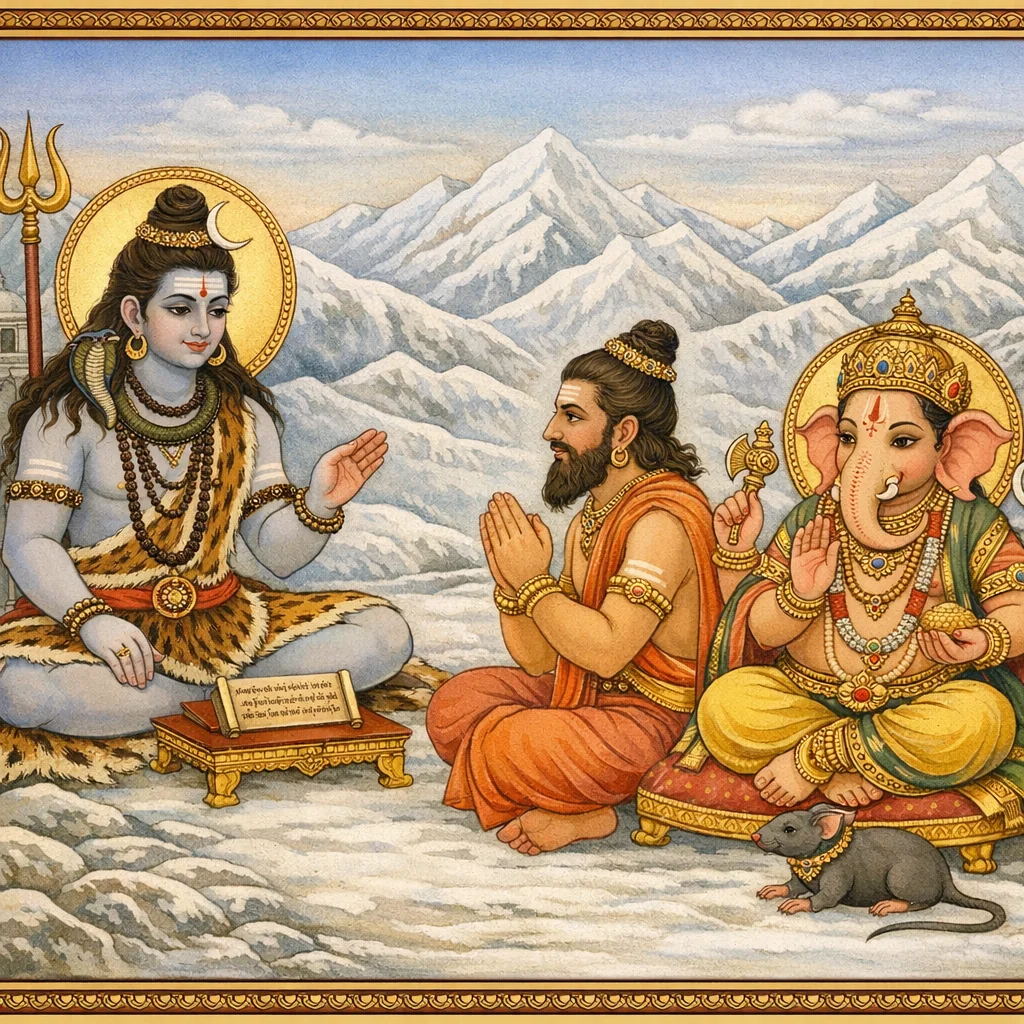
Chapter 214 offers a layered teaching narrative on worship of Vināyaka/Gaṇanātha (Gaṇeśa) as vighna-śānti, the removal of obstacles. Sūta points to a Gaṇanātha established by Viśvāmitra and gives the calendrical key: worship on Caturthī of the bright fortnight in Māgha grants freedom from impediments for a full year. Asked about the deity’s origin and glory, Sūta recounts Gaṇeśa’s emergence from Devī Gaurī’s bodily impurity, his iconographic marks—elephant face, four arms, mouse vehicle, axe and modaka—and his role in a divine conflict, after which Indra declares him to be worshipped first at the start of all undertakings. The narration then turns to an embedded upākhyāna: Rohitāśva asks Mārkaṇḍeya for a single observance that prevents obstacles throughout life. Mārkaṇḍeya recalls Viśvāmitra’s earlier clash with Vasiṣṭha over Nandinī, the wish-fulfilling cow, which drives Viśvāmitra to severe tapas and a need for protection from impediments. On Kailāsa he petitions Maheśvara; Śiva prescribes Vināyaka worship for purification and siddhi, explaining Gaṇeśa’s divine animation through sūkta-formulas (with a “jīva-sūkta” motif) and outlining a concise rite: mantra-salutations to Lambodara, Gaṇavibhu, Kuṭhāradhārin, Modakabhakṣa, Ekadanta; offering modaka as naivedya and arghya; and feeding brāhmaṇas without miserliness. Devī confirms the fruit—remembrance or worship on Caturthī stabilizes works and brings prosperity—and the closing phalaśruti promises sons to the childless, wealth to the poor, victory, improved fortune to the distressed, and the non-arising of obstacles for daily reciters and listeners.
Shlokas
Verse 1
सूत उवाच । तथान्योपि च तत्रास्ति विश्वामित्रप्रतिष्ठितः । गणनाथो द्विजश्रेष्ठाः सर्वसिद्धिप्रदो नृणाम्
Sūta said: “Moreover, there is also another deity established there by Viśvāmitra—Gaṇanātha. O best of brāhmaṇas, he bestows every attainment upon people.”
Verse 2
माघमासे चतुर्थ्यां च शुक्लायां पूजयेत्तु यः । स च संवत्सरं यावत्सर्वै विघ्नैर्विमुच्यते ओ
Whoever worships Him on the Caturthī of the bright fortnight in the month of Māgha is freed from all obstacles for the span of a year.
Verse 3
ऋषय ऊचुः । गणनाथस्य चोत्पत्तिं सांप्रतं सूत नो वद । कथमेष समुत्पन्नः किं माहात्म्यः प्रकीर्तितः
The sages said: “Now, O Sūta, tell us of the origin of Gaṇanātha. How did he come into being, and what greatness (māhātmya) is proclaimed of him?”
Verse 4
सूत उवाच । एष चोत्पादितो गौर्या निजांगमलतः स्वयम् । क्रीडार्थं मानुषैरंगैर्मातंगाननशोभितः
Sūta said: He was brought forth by Gaurī herself, from the impurity of her own limbs. For divine play she fashioned him with human-like limbs, and adorned him with the splendor of an elephant face.
Verse 5
चतुर्हस्तसमोपेत आखुवाहनगस्तथा । कुठारहस्तश्च तथा मोदकाशनतोषकृत्
Endowed with four hands, with the mouse as his mount; holding an axe in his hand, he delights in eating modakas.
Verse 6
सर्वसिद्धिप्रदो लोके भक्तानां च विशेषतः । एष पूर्वं प्रभोः कार्ये संग्रामे तारकामये
He is the bestower of every attainment (siddhi) in the world—especially for devotees. Formerly, in the Lord’s undertaking, in the battle connected with Tāraka—
Verse 7
संग्राममकरोद्रौद्रं न कृतं यच्च केनचित् । निहता दानवाः सर्वे संख्यया परिवर्जिताः
He waged a terrifying battle such as none had ever fought. All the Dānavas were slain—beyond any count.
Verse 8
ततः शक्रेण तुष्टेन प्रोक्तः संग्रामभूमिपः । क्षत विक्षतसर्वांगो रुधिरेण परिप्लुतः
Then Śakra (Indra), being pleased, addressed him upon the field of battle—his whole body cut and wounded, drenched in blood.
Verse 9
अस्मदर्थे त्वया युद्धं यत्कृतं सुगजानन । निहता दानवाः सर्वे संख्यया परिवर्जिताः
“For our sake, O noble Elephant-faced one, you fought this battle. All the Dānavas have been slain—beyond counting.”
Verse 10
तस्मात्त्वं सर्वदेवानामपि पूज्यो भविष्यसि । किंपुनर्मानुषाणां च ये नित्यं विघ्नसंप्लुताः
“Therefore you shall be worthy of worship even by all the gods—how much more so by human beings, who are ever beset by obstacles.”
Verse 11
ये त्वां संपूजयिष्यंति कार्यारंभेषु सर्वतः । कार्यसिद्धिर्न संदेहस्तेषां भूयाद्गिरा मम
“Those who will worship you at the commencement of all undertakings—there is no doubt—their works will succeed. Such is my word.”
Verse 12
एवमुक्त्वा सहस्राक्षो विससर्जाथ तं तदा । संमान्य बहुमानेन गौरीशंकरपार्श्वतः
Thus having spoken, the thousand-eyed one (Indra) then dismissed him, honoring him with great reverence beside Gaurī and Śaṅkara.
Verse 13
अयमर्थः पुरा पृष्टो रोहिताश्वेन धीमता । सर्वविप्रविनाशार्थं मार्कंडेयं महामुनिम्
This very matter was once asked by the wise Rohitāśva of the great sage Mārkaṇḍeya, with the aim of averting the ruin of all brāhmaṇas.
Verse 14
तमेवार्थं महाभागाः कथयिष्ये यथार्थतः । तच्छृणुध्वं पुरावृत्तं सर्वं सर्वे समाहिताः
On that very matter, O fortunate ones, I shall speak truthfully as it is. Therefore listen—fully attentive, all of you—to the entire ancient account.
Verse 15
रोहिताश्व उवाच । भगवन्नत्र ये मर्त्याः सर्वे विघ्नसमन्विताः । शुभकृत्येषु सर्वेषु जायंते शुचयोऽपि च
Rohitāśva said: O Blessed One, the mortals who are here are all beset by obstacles; in every auspicious undertaking, hindrances arise—even for those who are pure.
Verse 16
प्रारब्धेषु च कार्येषु धर्मजेषु विशेषतः । तानि विघ्नानि जायन्ते यैस्तत्कार्यं न सिध्यति
Especially in undertakings born of dharma, once work has begun, those very obstacles arise by which the intended task fails to be accomplished.
Verse 17
तस्माद्विघ्नविनाशाय किंचिन्मे व्रतमा दिश । व्रतं वा नियमो वाऽथ तपो वा दानमेव च
Therefore, for the destruction of obstacles, instruct me in some observance—be it a sacred vow (vrata), a discipline (niyama), an austerity (tapas), or indeed an act of charity (dāna).
Verse 18
सकृच्चीर्णेन येनात्र यावज्जीवति मानवः । तावन्न जायते विघ्नमाजन्ममरणांतिकम्
By performing it even once here, a person—so long as he lives—will not encounter obstacles, from birth until the very end of death.
Verse 19
मार्कण्डेय उवाच । अत्र ते कीर्तयिष्यामि सर्वविघ्नविनाशनम् । व्रतं सर्वगुणोपेतं सर्वपापप्रणाशनम् । विश्वामित्रेण सञ्चीर्णं यत्पुरा भावितात्मना
Mārkaṇḍeya said: Here I shall proclaim to you a vow that destroys all obstacles—endowed with every virtue and annihilating all sins—which in former times was practiced by Viśvāmitra, whose self was disciplined and purified.
Verse 20
विश्वामित्र इति ख्यातो गाधिपुत्रः प्रतापवान् । वसिष्ठेन समं तस्य वैरमासीन्महात्मनः
He was famed as Viśvāmitra, the mighty son of Gādhi; and with Vasiṣṭha there arose enmity for that great-souled one.
Verse 21
ब्राह्मण्यार्थे न सम्प्रोक्तः कथंचित्स महातपाः । ब्राह्मणस्त्वं वसिष्ठेन ततो वैरमजायत
Though he was a great ascetic, Vasiṣṭha did not acknowledge him in the matter of brāhmaṇa-status as “You are a brāhmaṇa”; from that, enmity arose.
Verse 22
रोहिताश्व उवाच । कस्मान्न प्रोक्तवान्विप्रो वसिष्ठस्तु कथंचन । ब्राह्मणः स परं प्रोक्तोब्रह्मादिभिरपि स्वयम्
Rohitāśva said: Why did the sage Vasiṣṭha not in any way declare him a brāhmaṇa? For he is proclaimed the supreme brāhmaṇa—even by Brahmā and the other gods themselves.
Verse 23
मार्कण्डेय उवाच । क्षत्रियश्च स्थितः पूर्वं विश्वामित्रो महीपतिः । मृगयासु परिभ्रांतो वसिष्ठस्य तदाऽश्रमम् । प्रविष्टः क्षुत्पिपासार्त्तः स तेनाथ प्रपूजितः
Mārkaṇḍeya said: Formerly Viśvāmitra, a king established as a kṣatriya, while roaming in the hunt, entered Vasiṣṭha’s hermitage. Afflicted by hunger and thirst, he was then duly honored by Vasiṣṭha with proper hospitality.
Verse 24
तस्यासीन्नन्दिनीनाम धेनुः कामदुघा सदा । सा सूते वाञ्छितं सद्यो यद्वसिष्ठोऽभिवाञ्छति
He had a cow named Nandinī, ever a wish-fulfilling kāmadhenu. She would instantly produce whatever Vasiṣṭha desired.
Verse 25
तत्प्रभावात्स भूपालः सभृत्यबलवाहनः । तेन तृप्तिपरा नीतो मिष्टान्नैर्विविधैस्ततः
By her power, the king—together with his attendants, troops, and mounts—was brought to complete satisfaction, being fed with many kinds of sweet and excellent foods.
Verse 26
पार्थिवोऽयमिति ज्ञात्वा ह्यर्घ्याद्यैर्भोजनैः स च । सोऽपि दृष्ट्वा प्रभावं तं सर्वं धेनोश्च संभवम् । प्रार्थयामास तां मूल्यैर्गजवाजिसमु द्भवैः
Recognizing, “This is a king,” he honored him with offerings such as arghya and with food. The king too, seeing that extraordinary power—and that everything arose from the cow—began to request her, offering a price in elephants and horses.
Verse 27
न ददौ स तदा विप्रः साम्ना दानेन वा पुनः । भेदेन च ततो दण्डं योजयामास वै नृपः
Then the brāhmaṇa did not give her—neither by conciliation nor by gifts. Therefore the king, resorting to coercion, proceeded to impose punishment.
Verse 28
कालयामास तां धेनुं ततः कोपात्स पार्थिवः
Then, in anger, the king drove away that cow.
Verse 29
साऽब्रवीन्नीयमानाऽथ वसिष्ठं किं त्वया विभो । दत्ताहमस्य नृपतेर्यन्मां नयति यत्नतः
As she was being led away, she said to Vasiṣṭha: “O Lord, what have you done? Have you given me to this king, that he takes me away with such effort?”
Verse 30
वसिष्ठ उवाच । न मया त्वं महाभागे दत्ता चास्य महीपतेः । बलान्नयति यद्येष तस्माद्युक्तं समाचर
Vasiṣṭha said: “O fortunate one, I have not given you to this king. If he is taking you by force, then do what is proper.”
Verse 31
तच्छ्रुत्वा कोपसंयुक्ता नन्दिनी धेनुरुत्तमा । जृंभां चकार तत्सैन्यं समुद्दिश्य नृपोद्भवम्
Hearing this, Nandinī, the excellent cow, filled with wrath, made a mighty manifestation directed against the king’s army.
Verse 32
धूमावर्तिस्ततो जाता तस्या वक्त्रात्ततः परम् । ततो ज्वाला महारौद्रास्ततो योधाः सहस्रशः
Then a whirl of smoke arose from her mouth; after that, fiercely dreadful flames appeared; and then, by the thousands, warriors came forth.
Verse 33
नानाशस्त्रधरा रौद्रा यमदूता यथा च ते । पुलिन्दा बर्बराभीराः किराता यवनाः शकाः
Fierce, bearing many kinds of weapons—like the messengers of Yama—there appeared Pulindas, Barbaras, Ābhīras, Kirātas, Yavanas, and Śakas.
Verse 34
ते प्रोचुस्तां वदास्माकं कस्मात्सृष्टा वयं शुभे
They said to her: “O auspicious lady, tell us—from what cause were we created?”
Verse 35
नन्दिन्युवाच । एते मां ये बलात्पापा नयंति नृपसेवकाः । तान्निघ्नन्तु समादेशान्नान्यद्वांछामि किंचन
Nandinī said: “These sinful servants of the king who are dragging me away by force—let them be struck down by command. I desire nothing else.”
Verse 36
ततस्तैस्तस्य तत्सैन्यं विश्वामित्रस्य सूदितम् । युध्यमानं महाराज दशरात्रेण संयुगे
Then, by them, that army of Viśvāmitra was crushed in battle, O great king, as the conflict raged for ten nights.
Verse 37
विश्वामित्रोऽपि तद्दृष्ट्वा ब्राह्म्यं बलमनुत्तमम् । प्रतिज्ञामकरोत्तत्र तारेण सुस्वरेण च
Viśvāmitra too, seeing that unsurpassed power of brahminhood, made a vow there in a clear and resonant voice.
Verse 38
अथाहं संभविष्यामि ब्राह्मणो नात्र संशयः । ममापि जायते येन प्रभावश्चेदृशोऽद्भुतः
“Now I shall become a brāhmaṇa—of this there is no doubt—so that even for me such wondrous spiritual potency may arise.”
Verse 39
तस्मात्तपः करिष्यामि यदसाध्यं सुरैरपि । स्वपुत्रं स्वे पदे धृत्वा ततश्चक्रे तपो महत्
“Therefore I shall perform austerity—such as is unattainable even for the gods.” Having established his own son in his place, he then undertook a great tapas.
Verse 40
ब्राह्मण्यार्थं महारौद्रं सुमहद्दुष्करं तपः । ब्राह्मण्यं तेन नैवाप्तं वैलक्ष्यं परमं गतः
For the sake of brāhmaṇya he performed an exceedingly fierce, very great, difficult austerity. Yet by that he did not attain brāhmaṇya, and he fell into extreme dejection.
Verse 41
ततः कैलासमासाद्य देवदेवं महेश्वरम् । सम्यगाराधयामास गौरीयुक्तं महेश्वरम्
Then, reaching Kailāsa, he properly worshipped Maheśvara, the God of gods—Maheśvara united with Gaurī.
Verse 42
अहं तपः करिष्यामि ब्राह्मण्यस्य कृते प्रभो । त्वदीये पर्वतश्रेष्ठे कैलासे शरणं गतः
“O Lord, I shall undertake austerity for the sake of brāhmaṇya. On your own supreme mountain, Kailāsa, I have come seeking refuge.”
Verse 43
तस्माद्विघ्नस्य मे रक्षां देवदेवः प्रयच्छतु । यथा नो नाशमायाति तपः सर्वं कृतं महत्
“Therefore, may the God of gods grant me protection from obstacles, so that none of this great austerity I have undertaken comes to ruin.”
Verse 44
श्रीभगवानुवाच । शुद्ध्यर्थं चैव यत्कार्यं कार्येस्मिन्नृपसत्तम । विनायकसमुद्भूतां तत्त्वं पूजां समाचर
The Blessed Lord said: “O best of kings, for the sake of purification in this undertaking, perform the worship that arises from the principle of Vināyaka (Gaṇeśa).”
Verse 45
येन ते जायते सिद्धिः सम्यग्ब्राह्मण्यसंभवा
“By this you attain success—success that truly arises from proper brāhmaṇya, from right sacred order and purity.”
Verse 46
विश्वामित्र उवाच । तद्वदस्व सुरश्रेष्ठ तथा तस्य करोम्यहम् । पूर्वं पूजां गणेशस्य सर्वविघ्नप्रशान्तये
Viśvāmitra said: “Tell me that, O best among the gods; I shall do exactly so. First, I will perform the worship of Gaṇeśa, for the complete pacification of all obstacles.”
Verse 47
श्रीभगवानुवाच । एष गौर्या पुरा कृत्वा निजांगोद्वर्तनं कृतः । निर्मलेन कृतः पश्चान्नराकारश्चतुर्भुजः
The Blessed Lord said: “Long ago, Goddess Gaurī, having made a paste from the rubbing of her own limbs, fashioned him. Thereafter, from that pure substance he was formed—human in appearance, and four-armed.”
Verse 49
ततोऽहमनया प्रोक्तः सजीवः क्रियतामयम् । पुत्रको मे यथा भावी लोके पूज्य तमो विभो
“Then she addressed me: ‘Let this one be made living. Let him become my son, and let him be worshipped in the world, O Lord.’”
Verse 50
ततो मयापि संस्पृष्टः सृष्टिसूक्तेन पार्थिव । जीवसूक्तेन सम्यक्स प्राणवान्समजायत
“Then I too touched him, O king, with the Sṛṣṭi-sūkta, and properly with the Jīva-sūkta. Thus he became endowed with vital breath.”
Verse 51
ततो मया प्रहृष्टेन प्रोक्ता देवी हिमाद्रिजा । चतुर्थीदिवसे प्राप्ते मयाऽद्यायं विनिर्मितः
“Then, rejoicing, I spoke to the Goddess, the daughter of Himālaya: ‘When the day of Caturthī arrives, this one has today been duly brought forth by me.’”
Verse 52
पुत्रस्तव महाभागे जीवसूक्तप्रभावतः । एष सर्वागणानां च मदीयानां सुरेश्वरि । भविष्यति सदाऽध्यक्ष स्तस्माच्च गणनायकः
“O greatly fortunate Goddess, by the power of the Jīva-sūkta this shall be your son. And, O Queen of the gods, he will ever be the overseer of all my gaṇas; therefore he will be known as Gaṇa-nāyaka, leader of the hosts.”
Verse 53
पठ्यमानेन यश्चैनं जीवसूक्तेन सुन्दरि । पूजयिष्यति सद्भक्त्या चतुर्थीदिवसे शुभे
O fair one, whoever worships Him with true devotion on the auspicious day of Caturthī, while the Jīva-sūkta is being recited…
Verse 54
तस्य सर्वेषु कृत्येषु सर्वविघ्रानि कृत्स्नशः । प्रयास्यंति क्षयं देवि तमः सूर्योदये यथा
For him, in all his undertakings, all obstacles are utterly destroyed, O Goddess—just as darkness vanishes at sunrise.
Verse 55
नमो लंबोदरायेति नमो गणविभो तथा । कुठारधारिणे नित्यं तथा वाक्संगताय च
Salutation to Lambodara, the Pot-bellied One; salutation to the Lord of the Gaṇas. Ever salutations to the wielder of the axe, and also to Him who grants harmony and right ordering to speech.
Verse 56
नमो मोदकभक्षाय नमो दन्तैकधारिणे
Salutation to the eater of modakas; salutation to the One who bears a single tusk.
Verse 57
एभिर्मन्त्रैः समभ्यर्च्य पश्चान्मोद कजंशुभम् । नैवेद्यं च प्रदातव्यं ततश्चार्घ्यं निवेदयेत्
Having duly worshipped with these mantras, one should then present the auspicious offering of modakas as naivedya; thereafter one should offer arghya, the reverential water-offering.
Verse 58
अहं कर्म करिष्यामि यत्किचिच्छंभुसंभवम् । अविघ्नं तत्र कर्तव्यं सर्वदैव त्वया विभो
“I shall perform the rite—whatever task arises in connection with Śambhu (Śiva). O Mighty Lord, by you it must always be made free of obstacles.”
Verse 59
ततस्तु ब्राह्मणानां च भोजनं मोदकोद्भवम् । यथाशक्त्या प्रदातव्यं वित्तशाठ्यं विवर्जयेत्
“Then one should provide a meal for the brāhmaṇas, consisting of modaka-preparations. One should give according to one’s capacity, avoiding miserliness with one’s wealth.”
Verse 60
एवमुक्तं मया पूर्वं स्वयमेव नृपोत्तम । गणनाथं समुद्दिश्य गौर्याः पुरत एव च
“Thus was it stated earlier by me, O best of kings—directing the rite to Gaṇanātha (Gaṇeśa), and indeed in the very presence of Gaurī (Pārvatī).”
Verse 61
ततः प्रहृष्टा सा देवी वाक्यमेतदुवाच ह । अद्यप्रभृति यः पुत्रं मदीयं गणनाय कम्
“Then that Goddess, delighted, spoke these words: ‘From this day onward, whoever (worships) my son Gaṇanāyaka (the Leader of the Gaṇas)…’”
Verse 62
अनेन विधिना सम्यक्चतुर्थ्यां पूजयिष्यति । तस्य विघ्नानि सर्वाणि नाशं यास्यंत्यसंशयम्
“Whoever will worship (him) properly on the Caturthī according to this method—of him all obstacles will go to destruction, without doubt.”
Verse 63
स्मृत्वा वा पूजयित्वा वा यः कार्याणि करिष्यति । भविष्यंति न संदेहस्ततोस्याविचलानि च
Whether by merely remembering Him or by worshipping Him, whoever undertakes his tasks—those undertakings will surely succeed; of this there is no doubt, and they will remain steady and unshaken.
Verse 64
न सन्देहस्ततोऽस्य श्रीरचलैव भविष्यति
There is no doubt: thereafter his prosperity and auspicious fortune will indeed be unwavering.
Verse 65
श्रीभगवानुवाच । तस्मात्त्वं हि महाभाग चतुर्थ्यां सम्यगाचर । विनायकोद्भवां पूजां येनाभीष्टेन युज्यसे
The Blessed Lord said: Therefore, O fortunate one, duly observe the sacred Caturthī, performing the worship that arises from Vināyaka; by this you shall be united with the desired fruit of your intention.
Verse 66
मार्कण्डेय उवाच । तस्य तद्वचनं श्रुत्वा विश्वामित्रो महीपतिः । गणनाथसमुद्भूतां पूजां कृत्वा यथोचिताम्
Mārkaṇḍeya said: Having heard those words, King Viśvāmitra performed, as was proper, the worship that is born of Gaṇanātha (Gaṇeśa).
Verse 67
तपश्चचार विपुलं सर्वविघ्नविवर्जितम् । ब्राह्मण्यं च ततः प्राप्तं सर्वेषामपि दुर्लभम् ओ
He then undertook abundant austerity (tapas), free from all obstacles; and thereafter he attained brahminhood (brāhmaṇya), a spiritual stature difficult for all to obtain.
Verse 68
तस्मात्त्वं हि महाभाग विनायकसमुद्भवाम् । पूजां कुरु चतुर्थ्यां च संप्राप्तायां विशेषतः । संप्राप्नोषि महाभोगान्हृदिस्थान्नात्र संशयः
Therefore, O fortunate one, perform the worship of Vināyaka—especially when Caturthī has arrived. You shall obtain great enjoyments and the heart’s cherished fulfillments; of this there is no doubt.
Verse 69
यो यं काममभिध्याय गणनाथं प्रपूजयेत् । स तं सर्वमवाप्नोति महेश्वरवचो यथा
Whoever, contemplating any desired aim, worships Gaṇanātha attains all of that—just as declared by the word of Maheśvara.
Verse 70
अपुत्रो लभते पुत्रं धनहीनो महद्धनम् । शत्रूञ्जयति संग्रामे स्मृत्वा तं गणनायकम्
The childless obtains a son; the poor obtains great wealth. Remembering Gaṇanāyaka, one conquers enemies in battle.
Verse 71
या नारी पतिना त्यक्ता दुर्भगा च विरूपिता । सा सौभाग्यमवाप्नोति गणनाथस्य पूजया
A woman abandoned by her husband—unfortunate and disfigured—attains good fortune through the worship of Gaṇanātha.
Verse 72
य इदं पठते नित्यं शृणुयाद्वा समाहितः । न विघ्नं जायते तस्य सर्वकृत्येषु सर्वदा
Whoever recites this daily, or listens to it with collected attention—no obstacle ever arises for him in any undertaking, at any time.
Verse 214
इति श्रीस्कान्दे महापुराण एकाशीतिसाहस्र्यां संहितायां षष्ठे नागरखण्डे हाटकेश्वरक्षेत्रमाहात्म्ये विश्वामित्रोपाख्यानप्रसंगेन गणपतिपूजाविधिमाहात्म्यवर्णनंनाम चतुर्दशोत्तरद्विशततमोऽध्यायः
Thus, in the Śrī Skanda Mahāpurāṇa—within the saṃhitā of eighty-one thousand ślokas—this is the 214th chapter, in the sixth Nāgarakhaṇḍa, in the Māhātmya of the sacred region of Hāṭakeśvara, describing the greatness of the rite of Gaṇapati worship in connection with the episode of Viśvāmitra.