Adhyaya 213
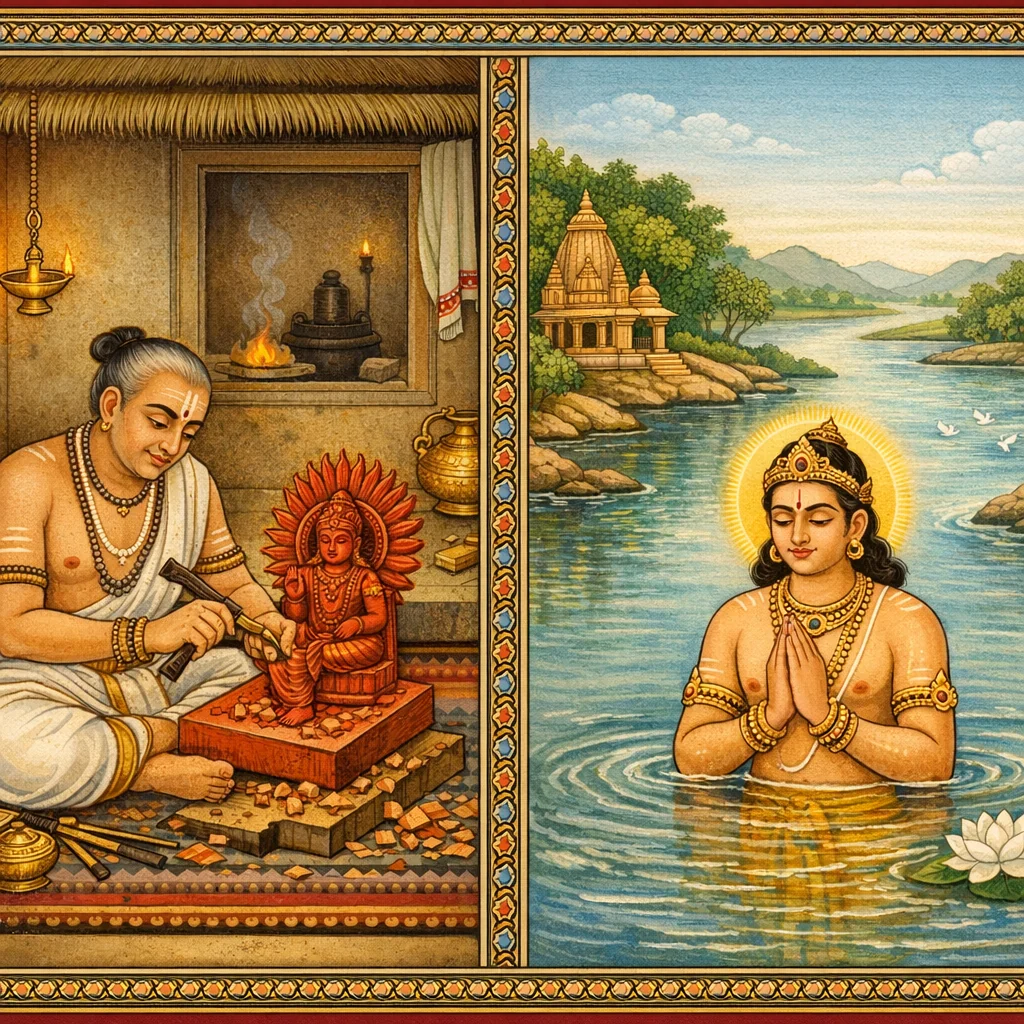
The chapter begins with Sūta continuing the praise of Sūrya’s sanctity, introducing an earlier example: a brāhmaṇa fashions a red-sandalwood image of Sūrya and worships with long devotion until granted a boon. Seeking relief from kuṣṭha (skin disease), he is instructed by Sūrya to observe a timed rite—on a Sunday that coincides with Saptamī, bathe in a meritorious lake and perform 108 circumambulations while carrying fruits as offerings—declared effective for healing and salvation for others as well. Sūrya then establishes a local abode named “Kuharavāsa,” turning the miracle into a lasting sacred place. The narrative shifts to Sāmba, son of Viṣṇu (Kṛṣṇa), whose beauty causes social turmoil and leads to a morally fraught incident of mistaken identity and sexual transgression. Seeking dharmic judgment, Sāmba hears from a brāhmaṇa of the severe expiation called “Tiṅginī,” detailed as a mahāpātaka-destroying rite involving a pit, cow-dung powder, controlled burning, immobility, and meditation on Janārdana. After Sāmba confesses, Hari mitigates the blame by noting the lack of intent/knowledge and directs him instead to a restorative pilgrimage: worship Mārtaṇḍa at Hāṭakeśvara kṣetra with the same 108-circumambulation observance, especially in the month of Mādhava under auspicious calendrical signs. Departing amid family lament and blessing, Sāmba bathes, worships, and gives abundant gifts at a sacred confluence where Viṣṇu is said to remain for removing beings’ sins; the chapter ends with Sāmba’s inner certainty of release from kuṣṭha and the tīrtha’s praise as an eminent, auspicious site, including for women, within the Hāṭakeśvara/Viśvāmitrīya complex.
Shlokas
Verse 1
सूत उवाच । रत्नादित्यस्य माहात्म्यमेतद्वः परिकीर्तितम् । सर्वकुष्ठहरं यच्च सर्वपातकनाशनम् । भूयस्तथैव माहात्म्यं महद्वै श्रूयतां रवेः
Sūta said: “The greatness of Ratnāditya has been recounted to you—how it removes every kind of leprosy and destroys all grave sins. Now again, hear the mighty greatness of Ravi, the Sun.”
Verse 2
तेन चाराधितः सूर्यस्तत्रस्थेन द्विजोत्तमाः
O best of the twice-born, by the one dwelling there, Sūrya, the Sun, was duly worshipped.
Verse 3
पूर्वदक्षिणदिग्भागे समासाद्य ततः परम् । रक्त चन्दनजां कृत्वा प्रतिमां भावितात्मना
Then, having reached the southeastern quarter, he went further and, with a mind intent in devotion, fashioned a sacred image made of red sandalwood.
Verse 4
ततो वर्षसहस्रांते तुष्टस्तस्य दिवाकरः । वरदोऽस्मीति तं प्राह दृष्टिगोचरमागतः
Then, at the end of a thousand years, the Sun—pleased with him—came within his sight and said, “I grant boons.”
Verse 5
ब्राह्मण उवाच । यदि तुष्टोऽसि मे देव कुष्ठव्याधिं हर प्रभो । नान्येन कारणं मेऽस्ति राज्येनापि त्रिविष्टपे
The brāhmaṇa said: “If you are pleased with me, O God, O Lord, remove my leprosy. I desire nothing else—not even kingship in heaven.”
Verse 6
श्रीभगवानुवाच । सप्तम्यां सूर्यवारेण कुरु विप्र प्रदक्षिणाम् । शतमष्टोत्तरं यावत्स्नात्वा पुण्यह्रदे शुभे । फलहस्तः पृथक्त्वेन ततः कुष्ठेन मुच्यसे
The Blessed Lord said: “O brāhmaṇa, on Saptamī, when it is Sunday, perform pradakṣiṇā (circumambulation). Then, after bathing in the auspicious Puṇyahrada, complete one hundred and eight acts, holding fruits in your hands as a distinct offering. Thereafter you shall be freed from leprosy.”
Verse 7
अन्योऽत्र गां गतो योऽपि व्रतमेतत्करिष्यति । सर्वरोगविनिर्मुक्तो मम लोकं स गच्छति
“Even anyone else who comes here to this place and performs this vow will be freed from all diseases and will go to my world.”
Verse 8
श्रीसूर्य उवाच । तच्छ्रुत्वा स तथा चक्रे ब्राह्मणः श्रद्धयाऽन्वितः । विमुक्तश्च तदा कुष्ठाद्दिव्यदेहमवाप्तवान्
Śrī Sūrya said: “Having heard that, the brāhmaṇa did exactly so, endowed with faith. Then he was released from leprosy and attained a divine body.”
Verse 9
अथ भूयोऽपि तं प्राह नीरोगं भगवान्रविः । किं ते प्रियं करोम्यन्यद्वद ब्राह्मणसत्तम
Then again Bhagavān Ravi spoke to him, now free from illness: “O best of brāhmaṇas, tell me—what other dear boon shall I grant for you?”
Verse 10
सोऽब्रवीत्सर्वदैवात्र स्थातव्यं भगवन्विभो
He said: “O Lord, O all-powerful One—may You abide here forever.”
Verse 11
श्रीभगवानुवाच । अतः परं ममावासः स्थानेऽत्र च भविष्यति । नाम्ना कुहरवासाख्या संज्ञा मम भविष्यति
The Blessed Lord said: “From this time onward, My dwelling shall indeed be in this place. And here My name shall be ‘Kuharavāsa’.”
Verse 12
कस्यचित्त्वथ कालस्य विष्णुपुत्रो बभूव ह । सांबोनाम सुरूपाढ्यो जांबवत्यां द्विजोत्तमाः
After some time, a son of Viṣṇu was born, named Sāmba, endowed with great beauty—born of Jāmbavatī, O best of brāhmaṇas.
Verse 13
अथ तं राजमार्गेण गच्छंतं यदुसत्तमम्
Then (people saw) that foremost of the Yadus as he proceeded along the royal road.
Verse 14
पुरनार्योऽपि संतुष्टा वीक्षांचक्रुः सुकौतुकात् । गृहकार्याणि संत्यज्य समारूढा गवाक्षकान्
Even the women of the city, delighted and stirred by curiosity, looked on—leaving their household duties and climbing up to the windows.
Verse 15
तस्य कामात्मदेहस्य दर्शनार्थं समुत्सुकाः । काश्चिदर्धानुलिप्तांग्यः काश्चिदेकांजितेक्षणाः
Eager to behold his desire-enchanting form, some women came with their limbs only half anointed in haste, and some with only one eye lined with collyrium.
Verse 16
अर्धसंयमितैः केशैस्तथान्यास्त्यक्तबालकाः । एकस्मिंश्चरणे काश्चिन्नियोज्योपानहं द्रुताः
Some women, their hair only half tied in haste, and others leaving their children behind, quickly slipped a sandal onto one foot and rushed out.
Verse 17
पादुकां च द्वितीये तु पर्यधावन्नितंबिनीः । व्रजंतीषु तथान्यासु वनितासु गवाक्षकान्
And on the other foot too they put on a sandal, running about; while other women hurried along, they rushed toward the windows.
Verse 18
व्याक्रोशंति क्रुधाविष्टाः शिशवो गुरवस्तथा । नीवीबन्धनविश्लेषसमाकुलितचेतसः
Children cried out, seized by anger, and elders too—their minds thrown into confusion by loosened waist-bands and disarray.
Verse 19
ययुरेवापराः स्वेषु गवाक्षेषु वरांगनाः । स चकर्ष तदा तासां पतितैर्नेत्ररश्मिभिः
Other noble women went to their own windows; and he, at that time, seemed to draw them toward himself by the fallen rays of their eyes.
Verse 20
हृदयानि धरापृष्ठे कामदेवसमो युवा । काचिद्दृष्ट्वैव तद्रूपं तस्य सांबस्य कामिनी
On the earth’s surface stood a youth like Kāma-deva himself; and one love-stricken woman, merely upon seeing that beauty—of Sāmba—
Verse 21
निश्चला कामतप्तांगी लिखितेव विभाब्यते । काचिदग्निसमान्मुक्त्वा निश्वासान्कामपीडिता
One, her body scorched by desire, stood motionless as if painted; another, tormented by passion, released breaths like fire.
Verse 22
एकास्तं च समालोक्य रूपयौवनसंयुतम् । गवाक्षात्प्रपतंति स्म निश्चेष्टा धरणीतले
Some, upon seeing him—endowed with beauty and youth—fell from the windows, helpless and motionless upon the ground.
Verse 23
अन्याः परस्परालाप प्रकुर्वंति वरस्त्रियः । एका सा कामिनी धन्या यास्य चक्रेवगूहनम्
Other noble women began conversing among themselves; but one fortunate, love-stricken woman made as though to embrace him.
Verse 24
निःशेषां रजनीं प्राप्य माघमाससमुद्भवाम् । आस्तां तावत्स्त्रियो याश्च नरा अपि निरर्गलम्
When the whole night had passed—of the month of Māgha—women and men alike remained so, utterly without restraint.
Verse 25
जल्पंति चेदृशं सर्वं तस्य रूपेण विस्मिताः । अत्रये वदन्ति सेवाम एनमर्थेन वर्जिताः
Amazed at his beauty, they spoke in every such way; and to Atrī they said, “Let us serve this one,” though without any worldly motive or proper purpose.
Verse 26
वीक्ष्यामो वदनं येन नित्यमेवेंदुसंनिभम् । कर्णाभ्यां वारिता वृद्धिर्नेत्रयोरप्यसंशयम् । नो चेज्जानीमहे नैव कियती सं भविष्यति
“We shall behold that face, ever like the moon. By the ears the swelling of desire is checked, and by the eyes as well—without doubt. Otherwise we do not know how great it will become.”
Verse 27
एवं संवीक्ष्यमाणस्तु कामिनीभिर्नरैस्तथा । निर्ययौ राजमार्गेण पितृदर्शनलालसः
Thus, watched by amorous women and by men as well, he went forth along the royal road, eager to behold his father.
Verse 28
भगिन्यो मातरो याश्च भ्रातृपत्न्यश्च याः स्थिताः । अवस्थामीदृशीं प्राप्ता ब्राह्मणानामपि स्त्रियः । मातरोऽपि च यास्तस्य भगिन्यश्च विशेषतः
The sisters and mothers who were there, and the wives of his brothers—womenfolk all, even the women of the brāhmaṇas—had come into such a state; and his own mothers and sisters especially were affected.
Verse 29
अन्यस्मिन्नहनि प्राप्ते प्रावृट्काले निशागमे । कृष्णपक्षे तमोभूते अलक्ष्येऽपि गते पुरः
On another day that came—during the rainy season, as night drew near—on the dark fortnight, when gloom prevailed, even the city ahead was scarcely visible…
Verse 30
तन्माता नन्दिनीनाम कामदेवशरार्दिता । तत्पत्न्या वेषमाधाय तच्छय्यायामुपस्थिता
His mother—named Nandinī—pierced by the arrows of Kāma, assumed the guise of his wife and came to his bed.
Verse 31
सोऽपि तां दयितां ज्ञात्वा सेवयामास कामिनीम् । रतोपचारैर्विविधैरश्रद्धेयविनिर्मितैः
He too, thinking her to be his beloved, engaged with that woman in love—by many kinds of erotic attentions, astonishingly contrived.
Verse 32
तया तत्र यदुश्रेष्ठो विकल्पमकरोत्तदा । अंगराजसुता या मे प्राणेभ्योऽपि गरीयसी
There, because of her, the best of the Yadus then fell into doubt: “That daughter of the king of Aṅga—who is dearer to me even than life…”
Verse 33
नैवंविधं रतं वेद अनया यद्विनिर्मितम् । वेश्या अपि न जानंति रतमीदृक्कथञ्चन
No one knows lovemaking of this sort—such as was contrived by her. Even courtesans do not know pleasure like this in any way.
Verse 34
ततो गाढं करे धृत्वा दीपमानीय तत्क्षणात् । यावत्पश्यति सा माता नन्दिनीति च या स्मृता
Then, holding him firmly by the hand, she at once brought a lamp, until that mother—remembered as Nandinī—could see clearly.
Verse 35
ततश्च गर्हयामास रपे किमिदं कृतम् । गर्हितं सर्वलोकानां नर कार्तिप्रदं तथा
Then she reproached him: “O wretch—what is this you have done? It is condemned by all people, O man, and it will bring ill fame as well.”
Verse 36
सापि लज्जासमोपेता महाभयसमाकुला । प्रणष्टा तत्क्षणादेव भयेन महताऽन्विना
She too, overcome with shame and shaken by great fear, vanished that very instant, driven away by overwhelming terror.
Verse 37
सांबोऽपि प्रलपन्नार्तो निद्रां लेभे न वै द्विजाः । रात्रिशेषमभूत्तस्य तदा वर्षशतोपमम्
Even Sāṃba, lamenting in anguish, found no sleep, O twice-born ones; and the remaining part of that night felt to him like a hundred years.
Verse 38
अथ रात्र्यां व्यतीतायां प्रोद्गते रविमण्डले । दुःखेन महता युक्तः प्रोत्थितः स हरेः सुतः
Then, when the night had passed and the orb of the sun had risen, that son of Hari arose, still weighed down by intense sorrow.
Verse 39
आवश्यकमपि त्यक्त्वा कंचिद्ब्राह्मणसत्तमम् । धर्मशास्त्रविधानज्ञं समानीयाथ चाब्रवीत्
Setting aside even his routine duties, he summoned an excellent brāhmaṇa, skilled in the ordinances of the Dharmaśāstras, and then spoke.
Verse 40
रहस्ये विनयोपेतः कृतांजलिपुटः स्थितः । सांब उवाच । मात्रा स्वस्रा दुहित्रा वा स्वयं स्याद्यदि मोहनम्
In private, with humility, standing with folded hands, Sāṃba said: “If delusion should arise—whether toward one’s mother, sister, or daughter—what then?”
Verse 41
कथं शुद्धिर्भवेत्तस्य परमार्थेन मे वद । धर्मशास्त्राणि संवीक्ष्य सर्वाणि च यथाक्रमम्
“Tell me truly how purification can be attained in such a case—after examining all the Dharmaśāstras in their proper order.”
Verse 42
ब्राह्मण उवाच । परनार्याः कृते वत्स प्रायश्चित्तं विनिर्मितम् । धर्म द्रोणेषु सर्वेषु वर्णानां च पृथग्विधम्
The brāhmaṇa said: “For transgression involving another man’s woman, dear child, atonements (prāyaścitta) have been laid down in all the dharma-compendia, with distinct forms according to the varṇas.”
Verse 43
आसां च तिसृणां चैव त्रयाणां परिकीर्तितम् । एवमेवं विनिर्दिष्टं प्रायश्चित्तं विशुदये
“And for these three as well, the atonement has been stated. Thus, in this manner, the prāyaścitta for purification has been laid down.”
Verse 44
मात्रा मोहनमासाद्य भगिन्या वाथ यादव । दुहित्रा वा प्रमादाच्च कार्यं संशोधनं बुधैः । शुद्ध्यर्थं तिंगिनीमेकां नान्यज्जानाम्यहं यतः
O Yādava, if through delusion—whether with one’s mother, or with one’s sister, or through heedlessness with one’s daughter—wise persons prescribe an act of rectification. For purification, I know only one means: Tiṃginī; I know of no other.
Verse 45
धर्मद्रोणेषु सर्वेषु निर्णयोऽयमुदाहृतः । यो मया तव संदिष्टो नान्योस्ति यदुपुंगव
This decision is declared in all the dharma-compendia: the remedy I have instructed you in—O best of the Yadus—there is no other.
Verse 46
अन्यथा यो वदेत्पृष्टः प्रायाश्चित्तं स्वच्छन्द तः । तस्य पापस्य भागी स्याद्यथा कर्ता तथैव सः
If, when asked, someone prescribes an expiation (prāyaścitta) wrongly—merely according to his own whim—then he becomes a sharer in that sin, just like the very doer of the fault.
Verse 47
सांब उवाच । तिंगिन्याः किं स्वरूपं च किं प्रमाणं द्विजोत्तम । सर्वं विस्तरतो ब्रूहि ममास्त्यत्र प्रयोजनम्
Sāmba said: “O best of the twice-born, what is the true nature of Tiṃginī, and what is its measure (proper rule/extent)? Tell me everything in detail, for I have a purpose here.”
Verse 48
ब्राह्मण उवाच । गोवाटचूर्णमादाय गर्तां भृत्वा स्वमानजाम् । शयनं तत्र कर्तव्यं यावद्वक्त्रेण यादव
The Brāhmaṇa said: “Taking the powder of cow-dung (or cow-pen earth), and filling a pit made to one’s own measure, one should lie down there—up to the measure of the face, O Yādava.”
Verse 49
उपरिष्टात्तच्च चूर्णं धार्यं गोवाटसंभवम् । यावद्वक्त्रप्रमाणं च वर्जयित्वा स्वमाननम्
And above (the body) that powder born of the cow-pen should be placed, up to the measure of the face—excluding one’s own full measure.
Verse 50
ततः पादप्रदेशे तु ज्वालयेद्धव्यवाहनम् । यथा शनैः शनैर्दाहः शरीरस्य प्रजायते
Then, at the region of the feet, one should kindle the sacrificial fire, so that the burning sensation gradually, little by little, arises in the body.
Verse 51
न चैव चालयेदंगं कथंचित्तत्र संस्थितः । नैवाक्रंदं तथा कुर्याद्ध्यायेदेकं जनार्दनम्
And while remaining there, he should not move his limbs in any way; nor should he cry out. Thus he should meditate upon the One—Janārdana.
Verse 52
ततो जीवितनाशेन गात्रशुद्धिः प्रजायते
Then, by the loss of life, purification of the body is attained.
Verse 53
तिंगिन्या यत्स्वरूपं च तन्मया परिकीर्तितम् । प्रायश्चित्तमिदं सम्यङ्महापातकनाशनम्
Thus the nature of Tiṃginī has been declared by me. This expiation, when performed properly, destroys even great sins (mahāpātakas).
Verse 54
तच्छ्रुत्वा वचनं तस्य सांबो जांबवतीसुतः । हृदये निश्चयं कृत्वा तिंगिनीसाधकोद्भवम्
Hearing his words, Sāmba—the son of Jāmbavatī—made a firm resolve in his heart to undertake the Tiṃginī sādhana and attain its accomplishment (siddhi).
Verse 55
ततः प्रोवाच विजने वासुदेवं घृणान्वितः । ताताहं विप्रलब्धस्तु नंदिन्या तव भार्यया
Then, in a secluded place, moved with compassion, he spoke to Vāsudeva: “Father, I have indeed been deceived by Nandinī—your wife.”
Verse 56
भार्याया रूपमाधाय पापया तमसि स्थिते । सा मया निजभार्येयमिति मत्वा निषेविता
When darkness prevailed, a sinful woman assumed the form of my wife. Thinking, ‘She is my own wife,’ I consorted with her.
Verse 57
ततस्तु चेष्टितैर्ज्ञात्वा गर्हयित्वा विसर्जिता । ततःप्रभृति गात्रे मे कुष्ठव्याधिरयं स्थितः
But then, recognizing her by her behavior, I reproached her and dismissed her. From that time onward, this disease of leprosy has taken hold of my body.
Verse 58
मयाथ धर्मशास्त्रज्ञः कश्चित्पृष्टो द्विजोत्तमः । प्रायश्चित्तं यथोक्तं मे वद मातृनिषेवणात्
Therefore I approached an excellent Brāhmaṇa, learned in the Dharma-śāstras, and asked: “Tell me the proper expiation (prāyaścitta), as prescribed, for having (unknowingly) committed the act of approaching one’s mother.”
Verse 59
तेनोक्तं साधनं सम्यक्तिंगिन्या मम शुद्धये । सोऽहं तां साधयिष्यामि तस्य पापस्य शुद्धये
He prescribed the proper means for my purification—through the Tiṃginī rite/observance. Therefore I shall undertake it, to cleanse that sin.
Verse 60
अनुज्ञां देहि मे शीघ्रं कार्यं येन करोम्यहम् । क्षंतव्यं च मया बाल्ये यत्किंचित्कुकृतं कृतम्
Grant me permission quickly, so that I may do what must be done. And forgive me for whatever misdeed I committed in my childhood.
Verse 61
मम माता यथा दुःखं न कुर्यात्त्वं तथा कुरु
Act in such a way that my mother may not be made to suffer pain.
Verse 62
तच्छ्रुत्वा वचनं तस्य वज्रपातोपमं हरिः । बाष्पपूर्णेक्षणो दीनस्ततः प्रोवाच गद्गदम्
Hearing his words—like a thunderbolt’s strike—Hari, wretched and with eyes filled with tears, then spoke in a choked voice.
Verse 63
न त्वया कामतः पुत्र कृत्यमेतदनुष्ठितम् । न ज्ञानेन कृतं यस्मात्तत्स्मात्स्वल्पं हि पातकम्
Son, you did not perform this act out of desire; and since it was not done knowingly, therefore the sin is indeed slight.
Verse 64
जानता यत्कृतं पापं तच्चैवाक्षयतां व्रजेत् । न करोति महीपालो यदि तस्य विनिग्रहम्
Sin committed knowingly proceeds toward an inexhaustible consequence, if the king of the land does not restrain and punish that person.
Verse 65
तस्मात्ते कीर्तयिष्यामि प्रायश्चित्तं विशुद्धये । दानं चैव महाभाग येन कुष्ठं प्रणश्यति
Therefore I shall declare to you the prāyaścitta, the expiation for complete purification—and also the sacred gift of charity, O fortunate one, by which leprosy is destroyed.
Verse 66
उक्तानि प्रतिषिद्धानि पुनः संभावितानि च । सापेक्षनिरपेक्षाणि मुनिवाक्यान्यशेषतः
All the sages’ utterances—what is enjoined, what is forbidden, what is again affirmed, and what is spoken as conditional or unconditional—have been stated here in full.
Verse 67
तदत्र विषये पुत्र मम वाक्यं समाचर । भविष्यति महच्छ्रेय इह लोके परत्र च
Therefore, in this matter, my son, follow my instruction; it will bring great welfare—both in this world and in the world beyond.
Verse 68
हाटकेश्वरजे क्षेत्रे विश्वामित्रप्रतिष्ठितः । मार्तण्डोऽस्ति सुविख्यातः सर्वकुष्ठविनाशकः
In the sacred field of Hāṭakeśvara there is the renowned Mārtaṇḍa (Sun-deity), installed by Viśvāmitra—celebrated as the destroyer of every kind of leprosy.
Verse 69
सूर्यवारेण सप्तम्यां संप्राप्ते मासि माधवे । नक्षत्रे पितृदैवत्ये शुक्लपक्षे समागते
When Sunday coincides with the seventh lunar day in the month of Mādhava (Vaiśākha), under a nakṣatra presided over by the Pitṛs, and in the bright fortnight—
Verse 70
भास्करस्योदये प्राप्ते श्रद्धापूतेन चेतसा । शतमष्टोत्तरं यावत्कुरुते च प्रदक्षिणाम्
At Bhāskara’s sunrise, with a mind purified by faith, one should perform circumambulation—up to one hundred and eight rounds.
Verse 71
फलैः श्रेष्ठतमैश्चैव तत्प्रमाणैः पृथक्पृथक् । तस्य कुष्ठं विनिर्याति सद्य एव न संशयः
And with excellent fruits, each offered in the proper measure, that person’s leprosy departs at once—of this there is no doubt.
Verse 72
नीरोगः कुरुते यस्तु रवेस्तस्य प्रदक्षिणाः । तावद्युगं पुमानेष सूर्यलोके महीयते
Even one who is healthy—if he performs these circumambulations of Ravi—this man is honored in the world of the Sun for that many yugas.
Verse 73
सूर्यवारेण यो मर्त्यस्तस्य कृत्वा ण्दक्षिणाम् । नमस्करोति सद्भक्त्या सोऽपि रोगैः प्रमुच्यते
Whoever, on a Sunday, performs the circumambulation and bows with true devotion—he too is released from diseases.
Verse 74
तस्मात्त्वं हि महाराज तमाराधय भास्करम् । देवं वै विधिनानेन यो मयोक्तोऽखिलस्तव
Therefore, O great king, worship Bhāskara, the god, by this very procedure which I have taught you in full.
Verse 75
अविकल्पेन मनसा समाराधय सत्वरम् । मुक्तरोगे विपाप्माथ दिब्यदेहमवाप्स्यसि
Worship swiftly with an undivided mind; freed from disease and sin, you will attain a divine body.
Verse 76
मा कुरुष्व विषादं त्वं कुष्ठव्याधिसमुद्रवम् । तस्मिन्क्षेत्रे स्थिते देवे कुहराश्रयसंज्ञिते
Do not give way to despair, even though you are distressed by the disease of leprosy. In that sacred field there abides the Lord, known by the name Kuharāśraya.
Verse 77
अथ तद्वचनं श्रुत्वा प्रस्थितो विष्णुनन्दनः
Then, having heard those words, the son of Viṣṇu set out on his journey.
Verse 78
सूत उवाच । एतच्छ्रुत्वा वचस्तस्य देवदेवस्य चक्रिणः । चकार गमने बुद्धियोगं सांबोऽर्बुदं प्रति
Sūta said: Having heard these words of the Lord of gods, the wielder of the discus, Sāmba resolved to depart, setting his course toward Arbuda.
Verse 79
ततः शुभेऽहनि प्राप्ते हस्त्यश्वरथसंयुतः । प्रतस्थे स सुतो विष्णोः सेनया परिवारितः
Then, when an auspicious day arrived, the son of Viṣṇu set forth, furnished with elephants, horses, and chariots, surrounded by an army.
Verse 80
अनुयातः सुदूरं च कृष्णेनाक्लिष्टकर्मणा । बाष्पपूर्णे क्षणेनैव सर्वमातृजनेन च
He was accompanied for a long distance by Kṛṣṇa of unwearied deeds, and also by all the women of the family, whose eyes in an instant filled with tears.
Verse 81
बलभद्रेण वीरेण चारुदेष्णेन धीमता । युयुधानानिरुद्धाभ्यां प्रद्युम्नेन च धीमता
He was also accompanied by the heroic Balabhadra, the wise Cārudeṣṇa, Yuyudhāna and Aniruddha, and the wise Pradyumna.
Verse 82
ततो जांबवती पुत्रं दृष्ट्वा तीर्थोन्मुखं तदा । गच्छमानं प्रचक्रेऽथ प्रलापान्कुररी यथा
Then Jāmbavatī, seeing her son turned toward pilgrimage to the tīrtha and going away, began to lament like a kurarī-bird.
Verse 83
हा हतास्मि विनष्टास्मि मंदभाग्या ह्यभागिनी । एकोपि तनयो यस्या ममाप्येनां दशां गतः
“Alas, I am as one slain; I am undone—unfortunate, indeed bereft of good fortune! I who have but a single son—he too has brought me to this condition.”
Verse 84
अथ तां रुदतीं दृष्ट्वा प्रोवाच मधुसूदनः । किममंगलमेतस्य प्रस्थितस्य करिष्यसि
Seeing her weeping, Madhusūdana said: “What ill-omen do you intend for him who has already set out?”
Verse 85
बाष्पपूर्णेक्षणा दीना मुक्तकेशी विशेषतः । एष व्याधिविनिर्मुक्तस्तीर्थयात्राफलान्वितः । कुष्ठव्याधिपरित्यक्तः पुनरेष्यति तेंऽतिकम्
With eyes brimming with tears, wretched and with her hair loosened, she lamented: “He will be freed from disease, endowed with the fruit of pilgrimage to the tīrthas; casting off the affliction of leprosy, he will return again to you.”
Verse 86
एतस्मिन्नंतरे यानादवतीर्य त्वरान्वितः । सांबोऽसौ प्रस्थितस्तत्र यत्र जांबवती स्थिता
Just then, Sāmba—alighting from his conveyance in great haste—set out for the place where Jāmbavatī was staying.
Verse 87
स तां प्रणम्य हृष्टात्मा कृतांजलिपुटः स्थितः । प्रणिपत्य विहस्यो च्चैर्वाक्यमेतदुवाच ह
He bowed to her with a joyful heart and stood with folded hands; then, prostrating himself and smiling, he spoke these words aloud.
Verse 88
मा त्वं मातर्वृथा दुःखमस्मदर्थे करिष्यसि । आगमिष्याम्यहं शीघ्रं तीर्थयात्रां विधाय वै
“Mother, do not grieve in vain on my account. I shall return quickly, having duly completed the pilgrimage to the sacred tīrthas.”
Verse 89
जांबवत्युवाच । रक्षतु त्वां वने वत्स सर्वास्ता वनदेवताः । श्वापदेभ्यः पिशाचेभ्यो दुष्टेभ्यः पुत्र सर्वतः
Jāmbavatī said: “Beloved child, may all the deities of the forest protect you in the wilderness—from wild beasts, from piśācas, and from every harmful force on all sides.”
Verse 91
जठरं पुंडरीकाक्षः कटिं पातु गदाधरः । जानुनोर्युगलं कृष्णः पादौ च धरणीधरः
“May Puṇḍarīkākṣa protect your belly; may Gadādhara guard your waist; may Kṛṣṇa protect the pair of your knees; and may Dharaṇīdhara safeguard your feet.”
Verse 92
एवं संस्पृश्य हस्तेन निजेनांगानि तस्य सा । समालिंग्य समाघ्राय मूर्धदेशे मुहुर्मुहुः
Thus, touching his limbs with her own hand, she embraced him and repeatedly kissed him upon the crown of his head.
Verse 93
प्रेषयामास तं पुत्रं कृतरक्षं यशस्विनी । सा सर्वांतःपुरीयुक्ता निवृता तदनन्तरम्
That illustrious lady then sent forth her son—now duly protected by blessings—and afterwards returned, accompanied by all her attendants of the inner palace.
Verse 94
अश्रुपूर्णेक्षणा दीना निःश्वसन्ती यथोरगी । तथा च भगवान्विष्णुर्यादवैः सकलैः सह
Her eyes filled with tears, she grew despondent, sighing like a distressed serpent. And likewise the Blessed Lord Viṣṇu, together with all the Yādavas, was overcome with sorrow.
Verse 95
प्रविष्टो द्वारकापुर्या सांबं प्रोष्य ततः परम् । अश्रुपूर्णेक्षणो दीनो बलभद्रपुरःसरः
After sending Sāmba away, he entered the city of Dvārakā; his eyes brimming with tears and his heart weighed down—Balabhadra going before him.
Verse 96
पुत्रैः पौत्रैस्तथा मित्रैर्बांधवैरपरैरपि । द्वारकाया विनिष्क्रम्य सांबोऽपि द्विजसत्तमाः
O best of the twice-born, Sāmba too departed from Dvārakā, setting forth accompanied by sons, grandsons, friends, and other kinsmen as well.
Verse 97
संप्राप्तश्च क्रमेणाथ सिंधुसागरसंगमे । यत्र योगीश्वरः साक्षादंबरीषप्रतिष्ठितः
Then, in due course, he arrived at the confluence where the river meets the ocean—where Yogīśvara, Lord Viṣṇu as the Master of Yogins, stands manifest, established there by King Ambarīṣa.
Verse 98
अद्यापि तिष्ठते विष्णुर्जंतूनां पापनाशनः । तत्र स्नात्वा समभ्यर्च्य देवं योगीश्वरं ततः
Even today, Viṣṇu remains there as the destroyer of the sins of living beings. Having bathed there, and then duly worshipped the divine Yogīśvara—
Verse 99
ददौ दानानि विप्रेभ्यो नानारूपाणि शक्तितः । दीनांधकृपणेभ्यश्च तथैवान्येभ्य एव च
He gave charitable gifts to the brāhmaṇas in many forms, according to his capacity; and likewise to the poor, the blind, and the destitute—and to others as well.
Verse 100
यानानि वस्त्ररत्नानि यद्यच्च येन वांछितम् । स त्रिरात्रं हरेः पुत्रः स्थित्वा तत्र समाहितः
Vehicles, garments, and jewels—indeed whatever anyone desired—he bestowed. Then the son of Hari remained there for three nights, concentrated and self-collected.
Verse 110
तत्र क्षणेऽभवत्तस्य चित्ते सांबस्य धीमतः । मुक्तोऽहं कुष्ठरोगेण निर्विकल्पं द्विजोत्तमाः
At that very moment, in the mind of the wise Sāmba, this clear resolve arose: “I am freed from the disease of leprosy, O best of the twice-born, beyond all doubt.”
Verse 116
सूत उवाच । एतद्वः सर्वमाख्यातं विश्वामित्रीयमुत्तमम् । चतुर्थं च पुण्यतीर्थं स्त्रीणां चैव शुभावहम्
Sūta said: “All this has been narrated to you—the excellent Viśvāmitrīya (Māhātmya). It is the fourth sacred tīrtha, and it is especially auspicious for women as well.”
Verse 213
इति श्रीस्कांदे महापुराण एकाशीतिसाहस्र्यां संहितायां षष्ठे नागरखण्डे हाटकेश्वरक्षेत्रमाहात्म्ये विश्वामित्रीयमाहात्म्ये कुहरवासिसांबादित्यप्रभाववर्णनंनाम त्रयोदशोत्तरद्विशततमोऽध्यायः
Thus ends, in the Śrī Skanda Mahāpurāṇa—within the Ekāśītisāhasrī Saṃhitā, in the sixth book, the Nāgara Khaṇḍa—within the Māhātmya of the Hāṭakeśvara sacred region, and within the Viśvāmitrīya Māhātmya, the chapter entitled “Description of the Power and Glory of Sāmbāditya who dwells in the cave,” being Chapter 213.